A few days ago, I went to Drobo's offices for a Q&A as well as some time with the new devices that Drobo promises are faster than ever. What I found surprised me...
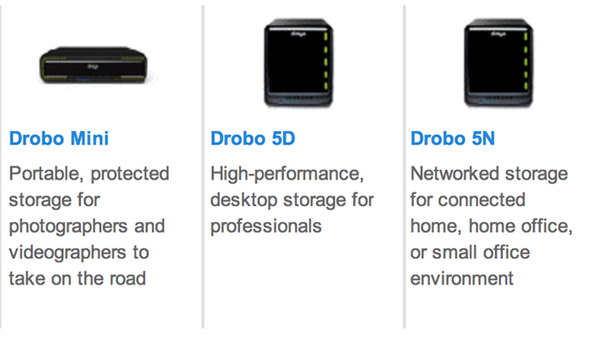
Drobo released the Mini and 5D, both with Thunderbolt and spinning and solid state hard drive support, a while ago, but just yesterday also announced the 5N, an ethernet, networked version of the 5D. I was ecstatic to hear that Drobo was upgrading their drives with Thunderbolt (alongside USB 3.0). But my experience with my own 2nd generation Drobo over Firewire 800 had me skeptical about its true speed.
After visiting with them, however, I have a new optimism for the system. Drobo reworked everything in the Drobo (for the 5D), the Drobo FS (for the 5N), and for the all-new Drobo Mini from the ground up -- software and hardware. The drives are speedy and fast enough to work with 4k video. An optional mSata drive on the bottom (Drobo recommends a 60GB drive) caches library files so things like thumbnails and previews in Lightroom will load essentially as quickly as they do on your internal solid state drives, regardless of whether or not you have standard 7200RPM drives or faster SSDs installed in your drive bays.
The 5D and 5N feature 5 bays for 3.5" drives, but can accept virtually any size or type via an adapter. The Mini holds 4 2.5" drives. In both cases, be sure to get non-Sandforce-based SSDs if you go that route, as Drobo doesn't support them because of issues with deleting data efficiently. This still leaves you with plenty of top-end options, however, such as those from Intel, Crucial, and Samsung.
Both drives feature metal-infused carbon fiber shells, which makes me feel comfortable about portability. A built-in battery lets the drives move cached data normally on memory during data transfers to be moved to the internal drives in the event of a power loss -- so everything is kept safe, (change to Orbitz girl accent) no matter what.
The networked 5N isn't nearly as fast as the other two cousins, but if an ethernet, network-connected drive works best in your workflow (recommended for small businesses/offices), then this is the way to go. Alternatively, you can always connect a 5D to your router that supports external drives through a USB connection, though you'll undoubtedly lose some speed through that connection, too.
My single gripe with the Drobo system was always its speed -- or lack thereof. But I'm excited for a new system that I can use for both backup and live work. And best of all, everything will be backed up with Drobo's BeyondRAID technology.
If you don't know what that is, it's the best kind of RAID there is. You get everything backed up, where you can set one- or two-drive redundancy. And you only lose the data of your largest drive (if you choose one-drive redundancy, which is plenty for me). That means that you don't have to "lose" half of your data storage to backing up. Assuming you the same-sized drives in there, you only lose 20% of your overall storage space (in a 5-drive system). That's brilliant! Dead drive? Slide it out (it's the one with the red light next to it) and slide a new one of the same size or larger back in. Want to increase the size of your system? Change your drives out one by one while waiting for the new data to copy in between switches. Simple! No IT knowledge necessary.
These drives bays will cost you, sure. The 5D is $830, the 5N is $600, and the Drobo Mini comes in at $610, each without any drives. But for that price, you save data storage with BeyondRAID and you get one of the most advanced and easy-to-use storage systems in the world.
Are these the fastest Thunderbolt-enabled RAID solutions? No. But they're plenty fast for anything you'll need. They're beautiful, simple, and most importantly, secure. Have you tried them out yet? Let us know what you think.


28 Comments
Are they still using a propriety design for the data storage? I remember that was a HUGE drawback; you simply cant take the drives and read them on another machine, it had to be one of THEIR machines....
It does have to be a Drobo to read those drives. That's because of the proprietary BeyondRAID system. But it's quite well done. Why would you need to switch between different 'machines?' You can still plug the device into any computer system...
Not if the housing is broken. You will need to get a new drobo to read your data.
But Beyond RAID or not beyond. You always need a 2nd (offsite) backup of your RAID.
No RAID type will save your data with power failures, water, fire, theft.
Trust me: All RAIDs can and will die.
Tom. If I understand you what you mean is that if you have a 4 drive raid o or 5 or 1 going on you can take the 4 drives out and put them in another raid box and just go right away? I am not sure if this is possible or not but what I do know is that my experiences with raid's before drobo were if a drive went down I was in bad shape until a new exact drive was installed and rebuilt (best case scenario) with a drobo you can keep working through that entire process. You can also go find any working drive that is large enough in capacity. doesn't have to be the same size speed model make or anything. I think that in this case, proprietary is somewhat of a plus! A lot like an apple device!
Read lots of negative things about Drobo.
Uh, okay. Want to elaborate on that?
I've heard a lot of negative things about them as well. Most noteably this: http://scottkelby.com/2012/im-done-with-drobo/. I love my Drobo and I have never had a problem with it. It is also fast enough with E-Sata for me to work from. I may be buying this 5N.
Yeah, that's pretty much the only negative thing I've heard about them. Every time someone says something negative about Drobo, they just parrot Kelby's article. It seems like a great solution, nobody I personally know has had an issue with theirs.
I own one and have had many issues with it.
Our friend Nasim Mansurov had a pretty brutal review on his site. I must say, my eSATA gives me connection problems from time to time. Maybe esata is just a poor system to begin with. Can't wait for real thunderbolt speeds soon!
Read below. Yes Scott Kelby wrote a lot of bad things, he has a big mouth anymore... Read any of his posts about Android or Apple anything...
Anyways, I took a look at their Twitter help account, there was an endless stream of people complaining of problems of all kinds. Some so much so that the CEO wanted to speak directly with them.
Seems the general trend is that they have issues. And worst of all is the proprietary filesystem.
Price + speed according to the people I've spoken to.
I'm one of those peeps who believe in doing things myself. If I need to set up a RAID system, I'll go with Synology. You can pop in any drive from any manufacturers and it'll work just fine.
Different beasts.
The Drobo 5D is an Direct Attached RAID enclosure (so can connect on USB etc)
While Synology make NAS boxes.- which will need Gigabit connectivity for decent speeds.
I wonder if they resolved the two issues that I had.
#1 support of foreign characters. If I copied a file to drobo with a file name written with foriegn language characters (ie accents, Japanese, Chinese) It would be [][][][][] etc when I looked at it. Pretty much sucks to have 100s of files all name [][][][][][][][][].txt etc. Can't trust it for non English file names.
#2 rebuild for the beyond RAID was super long. I am not talking about hours, or even days.... more like weeks..... what happens if I lose another disk in the weeks of rebuild.
It still carries USB 3.0, which works with 2.0 as well. If you really wanted, you could probably get an thunderbolt to FW800 adapter later on, when accessories become more common.
Those Thunderbolt to Firewire adapters only work to use Firewire devices with a Thunderbolt port, not the other way.
We use one to back up our schools photo archives (over 40 years of scanned film and .nef).
If you have tha bad luck of having a power outage, the drobo becomes mad, will enter a fast reoot cycle that only hard shutdown (pulling the cable WHILE he's powering up) will stop.
Never got back an answer from drobo about this issue. Defenetly wouldn't spend the money on another one. We'd look at other solution, more costly it may be.....
Qnap.com
Read the Scott Kelby blog before you buy. Mine doesn't work well with Windows. Slows the boot time down substantially (just google "Drobo Windows Boot Problem"). Drobo recommend switching it off and on every time you reboot - not really a solution in my view.
Drive is often not detected by the DroboDashboard software.
All in all it is just not that reliable - I'd never want to put critical data on it.If you use it with Windows embedded backup software it dies and all data can be lost (try googling this for a bunch of war stories)
I have the Drobo Fs and had an amazing amount of problems with it.
This would not bother me so much when the support would be good but this is really the worst of it all ( beside it's slowness).
You will not get feedback for weeks, no answers on your e-mails and posts in the forum, nothing.
When I changed to Snow Leopard, my Drobo was unusable for months and because of the proprietary system, you can't access your data in any way. I tried windows, old OSX, everything...
Never ever will I buy another Drobo and as soon I have the money, I switch.
Best wishes
Frank
Completely agree about the support. I put an FS in service, replacing my internal DAS disks, for the sole purpose of protecting my data. A week after setting it up and xfering all my data, the file system became corrupted. That was back in August.
Fast forward...they are now just sending my drives back to me after I declined them sending them out to a 3rd party for a data recovery attempt. They are offering a free upgrade to the 5N or 5D, but I would trade that for never buying one and having this issue in the first place. VERY poor response from support. I drove the effort 100% and it seemed like they were almost hiding information along the way.
My Drobo FS has been amazing. I have it connected to my 17" MBP via the ExpressCard 34 slot (Caldigit USB 3.0 card), and it is stable and fast. I can edit photos and video smoothly.
While not 100%, it is nothing a simple reboot doesn't fix. I have had no corrupt files and no self-ejecting since I bought it last year.
Their BeyondRAID is a serious piece of mind.
I'm using ChronoSync to manage my back-ups and the like.
Downsides: -stick to spec with the harddrives; -pricey; -proprietary readability
FS is not an USB drive.. It has just one ethernet port..
I have a 2nd Gen Drobo and it's embarrassingly slow. So much so that it's been relegated to being a monthly backup server. After reading your review I was happy to note that they had made an attempt to fix this but then this morning I see that the CNET has voted one of these are the Top5 worst products of the year due to performance. http://cnettv.cnet.com/8301-13489_53-57559330-10389930/worst-products-o…
I'm done. I'll never invest in a Drobo again. I'm a Synology guy from now on.
Funny - PopPhoto did their review just a day before this one ;oP
Would be nice to see a review/comparison of a few NAS and direct attached RAID boxes.
Was looking to get a NetGear 4-bay NAS as it's WAY cheaper than some of the others (~£150 for the enclosure) but then realised I don't have a Gigabit router.....
Hi
I'm thinking of buying the drobo D5 & connect via USB of my router, will I still be able to use it as a network drive because I want the best of both worlds, basically for now I want the 5d to act like the 5n but in the future I want to be able to connect via thunderbolt to my mac mini