Last month we reported Sigma's total revamp of their lens lineup. Their new organization would place lenses in one of three categories: Art, Sports, and Contemporary. Those categories were then immediately filled by three new lenses: The 35mm f/1.4, the 120-300mm f/2.8, and the 17-70mm f/2.8-4.0 macro. The new offerings looked extremely appealing, and this past week we got a hands-on demo with the prototypes.
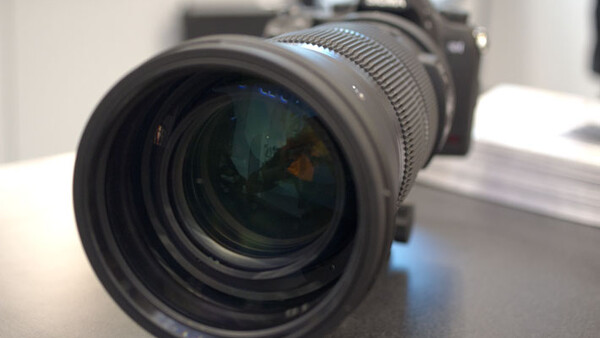
The first lens I wanted to get my hands on was, of course, the beastly 120-300mm f/2.8 Sports lens. As has become the norm with the recent offerings from Sigma, this lens is fast in terms of both aperture and auto focus. I'm continually impressed with the accuracy and speed of Sigma's auto focus motor. To get an idea of how huge this lens is, take a look at the image below.


Though understandably quite heavy, the 120-300mm is a very exciting lens. If their pricing can stay competitive with Canon and Nikon, this is sure to become a popular lens among action/sports photographers.
What struck most of you as a lens you might want to add to your lineup was the second lens I wanted to try out: the 35mm f/1.4. This was the only lens that they had for a Canon mount, so naturally I took it for a spin. It performed exactly as I expected. It's a beautiful lens and from a hardware standpoint, was right on the money. That's really great news, considering this was an unreleased prototype. I took a few shots of course, but unfortunately I can't show those to you (it's a prototype; you understand right?).

For those of you looking for a good 35mm to pick up, you won't have to wait long for this lens. Sigma is releasing it before the others, aiming to have it ready for market in November. As soon as it is available, we will let you know our thoughts in a full review so you can determine if it is a good fit for your needs.
Finally, I took a closer look at the variable aperture 17-70mm f/2.8-4.0 macro lens being categorized under their Contemporary line. Most of us aren't always so jazzed about variable aperture lenses, but they have their place. I personally don't mind them in some cases, but if they don't feel sturdy I am never confident in the product. My eyes lit up when I felt this lens in my hand: it felt good. It felt really good. The zoom was smooth and firm, focus was as snappy as I require, and the weight of the lens wasn't heavy, but had just enough heft to make me feel satisfied I had a quality product. What is of course going to matter is image quality and price, but if this can hit that sweet spot Sigma has a great product on their hands.

I've said it before, and I'll say it again: I'm impressed with what Sigma is doing. Their emphasis on quality and their fulfillment of their promises is something the third party lens market drastically needs. These lenses don't feel like older Sigma lenses, they feel like Zeiss lenses. The time to pay attention to Sigma is now, and if you plan to just brush these aside because they don't have the word "Canon" or "Nikkor" slapped on the side of the lens, you're going to be missing out.


23 Comments
I'm excited that's for sure. I love my Sigma 70-200 2.8 DG It's gives me some amazing images. Always surprised by it.
Cool write up but it has a taint of fanboyism in it.
It would have been nice to see a few shots you did with each... as in a proper review. I know it's a first look but you had them before everyone else and I can't be the only one wanting to see actual performance of these babies!
Simon, Sigma would not let me publish any images taken with these lenses, as it they were all still prototypes. This was not meant to be a review, but we will for sure have a full review written on each of these lenses when they are officially released.
I've considered the 120-300. Reviews show it sharp and fast. But the reviews also state it is prone to electronics failure. Makes it a non-starter for me. Has Sigma addressed this in a new version?
I imagine so, but I won't know until the new one is released next year.
Well, you're paying less for a 2.8 OS zoom than a prime from the big boys... you do the math.
Its AF (in the last two models) hasn't been able to keep up with a Canon or Nikon prime, and it doesn't sound like Jason has ever shot sports with one (either the 300 or 400's used for baseball/football/nearly everything else).
That's the reason you'll rarely see a pro with a 120-300, unless they just couldn't afford $5.8k for the 'big two' branded lenses.
Also, Sigma used to sell these lenses for $2k, before all the prices went up a few years ago, (while the smarter people are selling theirs for what they bought it for) although compare that to about $1600 for nikon 70-200 VRI-II to $2400 over the same period, even though I honestly doubt sigma needed the same 50% markup for overhead.
If you need to nail focus every time, in any situation, and take a tremendous beating while at it- Nikon/Canon 2.8 primes or 200-400mm zoom.
If you need to save 2.7k, (and don't mind lower build quality, and an imperfect focusing system) buy the current gen 2 sigma, or wait for the new one.
They also say it shares the quality of a 300 f/2.8 prime, but I honestly doubt it would look as good as the prime with 1.7x and 2x tcs. The prime is still smokin, even at 2x.
I bought two of those 17-70 for work, I guess the now older version. The autofocus on that thing is the worst thing I've seen in my life. Can't even lock focus in a bright room, aimed at a light source with high contrast. Stutters for like 3-4 seconds, then misses focus.
My first experience with a sigma lens, and it's not a good one. I'll stick to my nikkor glass.
I can attest for a similar experience with their new SWM lenses on a few different Nikon bodies.
Of course, being a discount brand, they have a lot more QC issues from lens to lens, at least comparing it to my Nikon lenses.
The 120-300 2.8 Seems very interesting! Anyone knows if it'll be compatible with Canon's 2x TC III?
I was planning on getting the Canon 300 2.8L IS next year, this seems to bea a cheaper and almost equivalent piece of equipment
As seen on a customer review on BH : " It works extremely well with the Canon 1.4x vII, making it even more versatile. Comparing the overall quality to the Canon 300 2.8 IS it is
only very slightly softer wide open".
So it works with 1.4x and 2x and at almost half the price of the Canon one, seems like a good choice, plus it is more versatile with zoom. I'm a sports photogrpaher, even if I preffer primes for steadyshots, zoom really is my goto with sports events.
Do you know suggested retail pricing yet?
Not yet. As soon as we hear, we'll let you know.
How about release date? (besides "next year")
So what's the difference with the current 120-300 2.8? No OS in this one, am I right?
I would be interested in the answer to this question as well. If you look on the Sigma Website, both seem to have OS, but the now current lens is compatible with converters and is marked "EX". I use this lens, the 120-300mm 2.8 EX DG OS HSM for almost a year now and it is one of the best lenses i have ever used - certainly the one of the sharpest I have.
Be a while before I buy another Sigma lens...the 84 1.4 I bought sprays the focus all over the place...if they can't get a prime right, what chance a zoom?
Really loving this direction Sigma is taking their lens line. The lenses are great looking and increased quality control could really make them a contendor. I wish Sigma would give us a better roadmap on what is next though. I would likely hold off on buying a couple lenses I am looking into replacing if Sigma has those focal lengths planned in the near future.
I have the 85mm 1.4 and its amazing, locks focus instantly, you must have had a faulty one.
I'm looking forward to the 35mm 1.4. I've always wanted to own Canon's 35mm but couldn't justify it's price compared to the other Canon lenses I use more often. Hope it performs well.
I own both a 24-70 and 70-200 II L from canon and when i go out, my main lens is the Sigma 50mm on my 5d III. Gorgeous everything on it. Never got a 35 because Canon is out of their minds with how they price their gear. Definitely looking forward to seeing how the Sigma version checks out.
Is that 35mm 1.4 a full-frame or APS-C lens?
I have had a number of Sigma lenses including the 85 1.4 for over a year and the 150 2.8 (non OS) for about 3 or 4 years. Both have seen a lot of use and have been great performers .. very sharp, nice bokeh and not a single problem with either. Too many people still think about cheap $199 lenses when they think "Sigma" and don't understand some of the great quality products they are putting out there. If someone is having focus accuracy problems, they should consider sending it in for warranty service but it may be that they need to calibrate their camera.
I have and love the Sigma 35 f1.4, the 85 1.4 does have a lot of chromatic ab. but i remove it in LR4, no problem and boy do I wish I could afford the 120-300 f2.8 but not now possibly a used version later. The new line up is amazing and going for joggler of Nikon and Canon. People are always complaining about Nikons and Canons pricing, well Sigma is saving me a bundle.