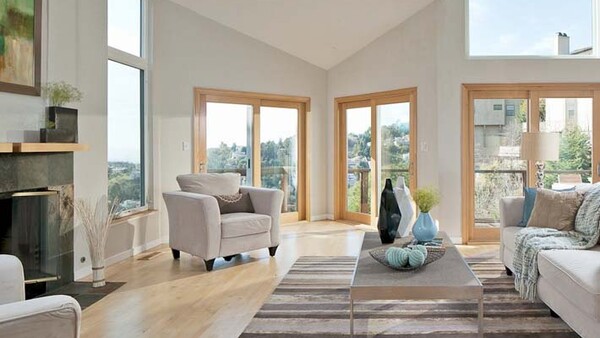
Many of you are familiar with Scott Hargis, who has made his living as both a successful architectural photographer and in recent years, teacher. Scott has cris-crossed the world to teach his methods, including a recent trip to Dubai to teach at Gulf Photo Plus. Scott recently released a multi-part video tutorial that teaches his methods for shooting high-quality photos for real estate photography using off-camera flashes, and Scott was kind enough to send us a copy to review.
Real estate photography is without question one of the most deceptive genres of photography. I mean really, how hard can it be to shoot the inside of a house? It doesn't move, it's a bunch of boxy rooms, and you have an ultra-wide angle lens. Piece of cake, right?
I pity the person who thinks it will be that simple. Just for starters, you'll need to balance interior ambient light with exterior sunlight so that it looks natural, compose in a way that tells the story of the house and not just shoot as wide as your lens goes in an effort to cram ten pounds of crap into a five pound bag, make someone's most valuable asset look like the million bucks it actually is, and shoot the right angles to show off the right features of the house. Let's also not forget that you might only have an hour to work your way through a 4,000 square foot home that you've never stepped in before (oftentimes with an agent breathing down your neck) and you can see how tough these assignments can be.
Many shooters resort to HDR or the use of a single on-camera flash for this type of work. While these methods are fast, they are notorious for the low-quality results that they produce, often due to incorrect colors, poor balance of strobe vs. ambient light, or lack of control with regards to shadows and highlights. In the series, Scott explains the benefit of working with a multiple light setup, and he'll show you how to move through a home quickly and efficiently with that setup. It's entirely possible to shoot a run-of-the-mill home using speedlights in under an hour, and Scott makes sure that by the end of the video series, you'll be able to do just that. Oh yeah - I almost forgot. The best part of using Scott's method to shoot a home? You'll spend an absolute minimal amount of time sitting in front of the computer processing your images, something that certainly can't be said for HDR.
Starting from square one, Scott explains nearly everything you'll need to create beautiful images for real estate using flash photography. From the gear that Scott uses to how he packs it and how it all works together, to the finer nuances of shooting modern kitchens with reflective surfaces trying their best to foil your shot. Says Scott: "The episodes are shot “on location”, in 14 different residences, and are ‘real-life’ shoots done for real-life clients. Every step of the process is covered, including problem-solving and mistakes." Scott was nice enough to provide the first part of his video series for you to check out for free, so you can get a feel of where you'll start, the tone and pace of the video, and where you'll end up.
Over the past couple weeks I worked my way through the video series so that I could give my opinion one way or another to our readers, many of whom have expressed interest in shooting real estate, or already shoot real estate as a source of income. If you have already been shooting real estate for any significant amount of time, some of the series will be a rehashing of what you already know. For example, you may know all about geared tripod heads and walking through a house to create a list of shots that you'll need to get as well as making a plan before you start shooting. But it certainly won't hurt to start at square one with Scott, who lays all the information out concisely and, at times, somewhat humorously.
After Scott takes us over his gear choices and some of the basic concepts of shooting real estate photography, he wastes no time getting right down to the nitty gritty. He starts by taking us into a standard bedroom, a simple one or two-light setup that every real estate photographer needs to have nailed on every shoot. No matter how big or small, you'll shoot plenty of these in every house, and Scott makes it as easy as taking a walk in the park.

From there, it's off to shooting dining rooms and living rooms, where Scott presents a couple of common challenges that you'll have to overcome on the job. From reflections in windows to dark rooms and dark woods, which are notoriously hard to shoot, Scott provides a couple of ingenious solutions that will leave you thinking "why didn't I think of that?" I've been shooting the same genre of photography for a couple of years now, and I had multiple moments like that throughout the series. I guarantee it will be the same for most of the interior and real estate shooters who are reading, as well.
After our living room and dining room shots, Scott takes us to some trickier locations: bathrooms and kitchens. Bathrooms, despite their size, can be notoriously tricky, and once again Scott lays out everything you'll need to know. Kitchens, as Scott points out, are one of the most important areas of the home, and you've got to know how to shoot them well if you are to be hired for repeat work. Scott shows us how to shoot a couple of different kitchens, all of which pose different challenges. We even get to see him make a couple of little mistakes, here, but fret not: he points out what he did wrong and how to avoid problems like that on your own shoots.

One of my favorite parts of this video series is when Scott shows us how he replicates sun streaming through the windows with strobe light. This is one of those techniques that will take your real estate photos from 'meh' to 'oh my god!' and your clients will love you for it. There are a number of little tips and tricks like this sprinkled throughout the series (ever thought of using GND filters to shoot real estate?), and you'll be surprised at the number of crafty solutions and tricks that Scott offers up throughout.
The cherry on top is a trip to Spain, where we're treated to a twilight exterior shot of a gorgeous villa. Twilight exteriors are known as the money shots, and with good reason: they're the images that are most likely to be used to grab a potential buyer's attention, and as Scott says, you have to be able to nail these when given the opportunity. I sound like a broken record here, but this video series once again delivers: you'll learn how to take some cracking twilight exposures that will really sell the home, and like I mentioned earlier, you'll spend less time in post because you'll have captured the shot perfectly in the field.
The Verdict
If you want to get into real estate photography, want to improve your real estate photography, or want to start shooting real estate photography like a pro, this is the series for you. Everything you need is contained within, however, compared to a paper book or e-book, the price could be considered a little bit steep. But look at it this way: for less than the price of one shoot, you'll have years worth of knowledge at your fingertips. Do note that the video is tailored specifically to real estate photography: those shooting for interior design or architectural clients may desire something a bit more robust, however, if you do shoot these subjects, I'm still confident that you'll learn a thing or two from Scott. You also can't use this video series to become an accomplished architectural or interior photographer overnight, as those genres will require different skills and approaches than the ones that are contained in this video series.
All that being said, I haven't seen such a comprehensive guide to shooting real estate photography. Ever. And if you're okay with a little bit of dry humor, you'll feel right at home (bad pun not intended) with this video.
For more information and to read a few testimonials, head on over to www.lightingforrealestatephotography.com or visit Scott Hargis' website.


Join the Fstoppers community for free
-
Post comments and join in the discussions
-
Browse the site ad-free
-
Share your work and get featured in the community
-
Compete in the photo contests for fun and prizes
17 Comments
Would love to comment on this as this has been my field for over 5 years....but fear i will get ripped apart again by those that dont believe what i say or my non HDR/Layering techniques (like last time) haha. But this clip pretty much backs up everything i had/have been saying on the industry for years, thanks Scott ;-)
say what you want :)
Screw the trolls that ALWAYS like ripping into people online.
It's their only way of feeling important, so, forgive them for their bullshit and do what you like. :-)
This video series is well worth the price; I've learned a lot from it.
Also check out, https://itunes.apple.com/us/podcast/real-estate-photography-podcast/id3…
What's with using 3 heavy duty tripods to hold up little OCF's? How is this a mobile (and cost effective) solution? His results look good, but whoa!
John MacLean
http://www.johnmaclean.com
They're all $20 Slik tripods that you can find on ebay, the cheapest of the cheap, and with good reason - he explains in the video that they are really the best solution for hiding them behind pillars, folding them to fit in tiny spaces, and being cheap and easy to replace.
Mike, glad you liked the series!
James - yeah, sometimes people forget that this stuff was being done long before the advent of Photoshop...
@ John - where are you seeing this? I don't own any heavy-duty lightstands... In any case, in my experience, it's more the light you're mounting on it that makes the difference. I find it much faster to use speedlights than to use "studio" heads, regardless of the stand it's on. Typically, the light costs MUCH more than the stand, so I wouldn't get too hung up on stand expense. Still, you're going to have to invest in some grip, if you're going to work commercially.
Im like you Scott i spend minimal time on LR, barely touch photoshop and do pretty much everything i can in camera in the property. Id love to see your videos though to see the difference in our techniques... in London we're zooming around on motorbikes so lightstands arent an option-so ive had to adapt. Have always been tempted by investing in stands/maybe a softbox though for the bigger clients however got my technique down with using just speedlights that often i wonder if i really need to.... :)
nice stuff, I think I will buy that for x-mas
Nice one Mike - really look forward to your posts which are always informative. Scott - I've been on the verge of buying this for 6 months as I want to move from shooting architectural exteriors to interiors. Mike says this might not be the DVD for me - what do you think?
I had been shooting RE in the UK almost exclusively using HDR for about two years (up until February) this year when i invested in Scott's Video series. It's the best $175 I've spent in years and I am now fully converted to his techniques and only use HDR in 'very' ambient or 'impossible to light' situations.
I had been shooting RE in the UK almost exclusively using HDR for about two years (up until February) this year when I invested in Scott's Video series. It's the best $175 I've spent in years and I am now fully converted to his techniques and only use HDR in 'very' ambient or 'impossible to light' situations.
Scott is always inspirational.
As a new RE photographer, I found Scott's video series to be tremendously helpful. Worth every penny. The video series is perfectly portioned into chapters that you can refer to anytime online if you need a refresher. I particularly like the "insolitas" at the end of the series, where Scott occasionally adds short videos with new content. In short: really good content that's detailed and well-organized, presented in a personable, easy-to-follow manner. Nice job, Scott (and Malia Campbell, producer/videographer)!
I may have an opportunity to get into some architectural photography. I've been doing weddings and portraits for around 6 yrs, but not homes. Do you have to have a tilt/shift lens? I know converging lines can be somewhat fixed in photoshop, but if you just shoot with a wide angle lens, do you feel that works as well. I plan on doing some practicing before I commit to this. Thanks
Are you shooting Architectural or Interiors?? Theres quite a big difference especially in style. I will shoot one way for architects and a total different way for Real Estates/homes. However for interiors (or Real Estate) i only carry two lenses a 17-40 and a prime 50mm (sometimes a little pancake 40mm-just cause i love it) and thats it, oh and a speedlight.
I correct all my lines on Light Room with a few tweaks (or photoshop if you prefer). For exteriors I have to shoot entire buildings in London so super tight streets-in an ideal world tilt shift would be perfect (but damn expensive and time consuming for RE)-however you can get away without having a tilt shift, just make sure you give your building enough clear sky as possible so that when you correct in post you dont end up cropping the top of the building off, this of course is when in tight streets hopefully you will be shooting in lovely wide open space where you can get far enough back without a brick wall, line of cars, dustbins, tourists getting in the way haha. Another way is if you can try and view the building from a long vantage point and shoot with a long lens...my advice would be unless your getting into serious Architecture work dont bother with the tilt shift just perfect your craft with a "wide" lens.
Its entirely different skill set to shooting people, but its highly enjoyable, always interesting and its gotten me into seeing some of Londons most expensive houses.... have fun and good luck
I guess the intro video isn't available anymore? It seems to be missing from the page.