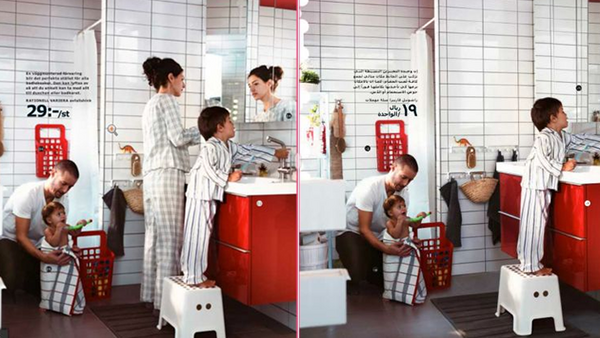
A few weeks ago you may remember Ikea's attack on product photography. Today news has spread that the Saudi Arabia franchise has photoshopped all females out from catalogs distributed throughout the Islamic nation. Women aren't the only ones being censored, however, as even glasses of wine have been transformed into less offensive "festive cups". What does Ikea have to say about the post processing changes found in their catalogs?

Ikea is one of the world's largest producers of home furniture. Each year they print over 200 million catalogs and distribute them to roughly 40 countries around the world. Besides obvious changes in text, layout, and language, all of the catalogs look pretty similar: except those published in Saudi Arabia.


Ikea spokes person Sara Carlsson has issued a response stating:
"We should have reacted and acknowledge that eliminating women in Saudi Arabia version [of the catalog] conflicts with Ikea's values."
As photographers, we often have to compromise our creative visions for the companies that hire us. A company like Ikea has every right to change or alter something in a photograph they paid us to produce. But should those same companies have to change their image and company branding based on cultural and political ideals in different regions of the world?







Join the Fstoppers community for free
-
Post comments and join in the discussions
-
Browse the site ad-free
-
Share your work and get featured in the community
-
Compete in the photo contests for fun and prizes
32 Comments
Anyone noticed that the image of the two women in the kitchen hasn't been shopped? It's a totally differnt image with differnt lighting? They just used an image without the women in. It's the same with the photo of the mum and little girl, it's a differnt image, not shopped! Still stupid that they can't show women but hey ho thats life.
I was thinking the same thing. Ikea is trying to pull something over everyone if they want people to believe that they didn't send it to them this way.
I don't see anything wrong with this. It is okay for a company to follow certain customs and sensibilities of the country in which it wants to do business in. I, on the other hand, was quite impressed with the quality of the photoshop work.. quite seamless..
It does beg the question though - why didn't they just shoot a set of pictures with no women in them.. Surely, that would have been an easier solution than going through all this (and possible negative press).
I am sure that is all they did. One frame with people and one without. Then just paste the empty picture over the one with people in the spot where the woman was standing/sitting.
Being Intolerant is a custom? DAmn ... well i'll go commit a few crimes and say its my custom. Im sure that will fly in court.
That's not what intolerance is. If a company wants to adapt their publication to local conventions, even if it is self-censoring, that's entirely up to them.
Now, you can come along and say that their traditions and values are bullshit and that they should stop being so retarded. And you certainly would have a point. But that doesn't make you more tolerant, it makes you IN-tolerant because you're telling other people what they should and shouldn't be doing.
I do not know your heritage but from your name and the profile picture I am going to hazard India or a nearby nation. Assuming that is correct and you are Indian would you find it acceptable if IKEA or another company started editing out people with an Indian background from advertisements?
Respecting another's culture is virtuous but that should not extend to backward, tyrannical and ancient customs. If the men of the Islamic world do not wish to see women's faces then they should consider wearing a blind fold instead of trying to control how others live their lives.
IKEA is not a Saudi Arabian company, and based on their country of origin, they have values that include gender equality. A company should conduct itself based on its corporate values no matter where they are.
From an international business prospective, IKEA did a wonderful job. To be successful you need to know your market. Non-financials its cultures, values, norms and financial such as GDP per capita so on and so forth. If any corporate values should support cultural diversities.
Other similar approaches made by giants in other industries:
Starbucks in KSA still serves your favorite late or coffee blend in a paper cup that says Starbucks but no mermaid(usual logo) on the cups, walls, napkins, or wrappers. McDonnald's India does not serve Pork or beef burgers. Muslim's are not allowed to have pork, and the Cow is holy in Hinduism. There you have it!I hope this could help you and others take a deeper view of other cultures. you'd never know. you could like whats going on in Korea, or in Jordan :)
I see the point you are making Ahmad, but I have to disagree. I think IKEA damages it's global brand in this case, just look at the negative press it has recieved as of late. Of course you could argue that any press is good press, but I don't believe this was a particularly smart business move. I support respect for other religions and cultures, but not at the expense of 50% of the world's population. A company can't pick and choose where/when they are going to support women, they either do or they don't. I really don't think this is the same as choosing to serve pork or not :)
the reasons IKEA did this was because in Saudi Arabia women are not allowed to work, or seen with hair. also its not the IKEA Group's decision, IKEA is a Franchise so IKEA Saudi Arabia decides these things.
Joel, Saudi women do actually work. as it is everywhere in the world its difficult these days but they do work. Its true that the Saudi government imposes rules in regards what to ware in public, yet that is applicable on men and women alike. Women are to cover almost everything and god forbid they catch men wearing speedos (actually i would be happy if they do catch one wearing such thing!) :)
some Saudi women have done remarkably well in the fashion industry, for example Kim Kardashian is rockin' a blazer designed by Lady Fozaza a Saudi designer based in the Dubai http://3.bp.blogspot.com/-3oLJ2Sh9z0Y/TsHvrW9rTyI/AAAAAAAARkU/IGTkCQJb_…
wrt the franchise remarks, please refer to the above reply i made to Duvyk
I'm from Saudi Arabia and I can tell you this is plain stupid. Not sure why IKEA did that because if you look in some of the popular Saudi magazines like "Sayedati" it is full of ads and different articles like home decor, gossip, lifestyle, etc with women wearing clothes that are considered too revealing by Saudi standards. In the old days, they used to manually use a black marker and color over body parts in a way as to make believe they are wearing black garments underneath. Now they mostly don't give a crap. So whoever thought of this brilliant idea should get fired or roll back into the dark ages.
I think they shot each scene without the people as well, and maybe even with every person separate to make it easier to choose later. Doubt they cloned out the people.
On the other hand, IKEA doesn't pay any taxes to Sweden. Ingvar Kamprad (Owner) uses different fake-ish foundations off shore to skip taxes, and everyone knows this. So the images isn't the only corrupt thing about IKEA.
To the public, IKEA just bragged about being the first US furniture retailer that will sell only LED lamps. They're so environmental friendly.
Skip taxes... like Adobe dose. [Google: "Adobe Systems Incorporated Delaware"]
As far as the "edited" version of the images, I don't see a problem. It's a marketing strategy and they should be idiots not take advantage of this. People have jobs just to research this. Others don't have any jobs and complain on what Photoshop horror they did. This technique is used by most big corporations, even Canon, Nikon, Sony and other. You may notice they have more then one global website, and sometimes products or accessories may differ from one country to another.
Taxing is corruption
Agreed. The second image used for each comparison is not a result of retouching the first one. They are distinct images captured separately. One with people, one without. In some cases, the second image may be a composite of the image having people with an image without the people.
Take for example, the blue dining room scene (ikea-saudi-arabia-photoshop-4.png) Notice the alignment of chairs on one side of the table with objects on the far side of the table. Objects no where near the people change the alignment between images. It is obvious that they are distinct images, not a retouched/clone/healed version of the other.
Anyone that is ok with this is (IMHO) simply a wussy. People get offended all day/every day for loads of crappy, crap, crap... That's life people, no one ever said it was easy nor do you have a right to not be offended. Grow a pair.. It's the 21st century for crying out loud!!!
Gee..uh know your market and advertise to them. IKEA's US catalog has been altered changing all the text to
English!
Have to second the question that has been asked already.... Why not just shoot the images without people in them??
Look carefully, They had.
I'm a Saudi photographer, I really admire what IKEA has done as they respect our religion and manners.
thanks IKEA.
IKEA should stand up for gender equality, they are a global brand.
They don't respect your religion or your manners, Tamim. They just put up with your crap so they can sell you their crap.
Companies this big should be aware of their influence and have not only a business plan, but principles which are not for sale.
Also, as a saudi photography, It would be very interesting to know what are the limitations you face in your job, what are you allowed to do and what not?
It looks too good to be photoshop work, I think the photo shoot was with/without people.. I'm not surprised, women appearing in Saudi Arabian ads & publications in general are required to have a certain dress code, otherwise the publication won't be allowed.
its advertising. Its designed to make sales. What part of that is hard to understand?. Nothing that you buy from Ikea, and I have lots, will ever look like the pictures in the catalog. Nor will me driving an Audi ever look like the ads.
Dear Ikea;
Instead of worrying about cultural sensitivities, why don't you worry about your crap instructions and crappier furniture.
Rich
They seem to be doing well in sales, the idea behind Ikea was affordable furniture that could be packed and shipped anywhere at the most effective and efficient way possible. So light weighht materials, your own assembly, and etc.. as allowed them to make their furniture price point very low. You don't have to buy it, they aren't making you, but I know they have a lot of satisfied customers and an extremely praised business plan.
Dear People of the World,
We manufacture and sell furniture. Our goal is to sell the stuff we make for more than it costs to make it. That's it; that is all we do. Don't over-think it.
Sincerely,
IKEA
Agreed, shareholders interest in priority numbero uno, no matter how you look at it.
A pity that no Saudi Arabian women have been able to comment on this thread but luckily several of their male counterparts have turned up to assure us that this is all OK. Nothing to see here, move along...
How sad is the culture of a people to equate with religion!
Culture is a set of many factors and religion is one factor equal with everyone else (language, music, history etc.) but nothing more. A piece of the puzzle that determines our personality rather total. This is medieval, your whole culture consist only of a religion, whatever it is!