
If you are like me then you might not always get caught up in some of the super technical aspects of photography. One aspect of photography I recently investigated was the loss of sharpness caused by Diffraction. Last night while playing with the new Nikon D800 camera I examined lens diffraction and how diffraction can seriously affect the sharpness of your photography.
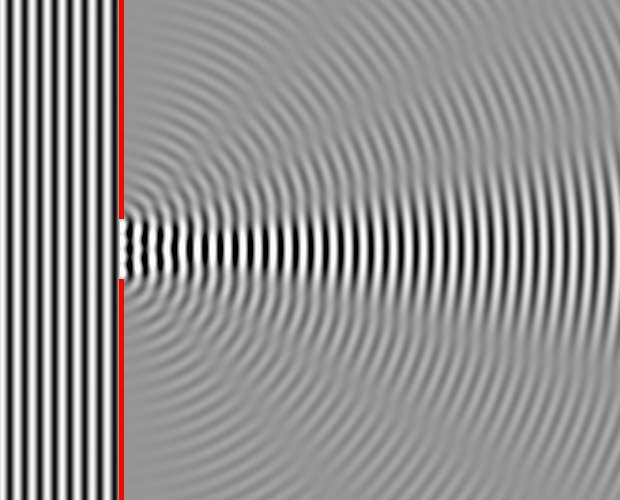
Diffraction in simple terms is a phenomena that occurs with light when it interacts with an obstacle. Most of us are familiar with light diffraction patterns found on the backs of CDs, in water molecules in the air, or on spider webs when looked at the right angle. Diffraction can also occur in your DSLR camera which can become a major problem and cause your images to lose their sharpness. Here is a simple diagram that shows how light particles hit your camera's digital sensor when going through large apertures and smaller apertures.

So what does this all mean for your photography, and how does diffraction make images soft? I recently did a few tests with a Nikon D800 and a Nikkor 60mm lens to see exactly what the real world effects of diffraction were on macro photography. The first test was my own eye. We setup an Alien Bee R800 Ringflash and took a few photographs at different apertures. The resulting 36 megapixel images revealed that stopping down the macro lens past f22 resulted in a lack of sharpness. I would have loved to have taken test shots with an even wider aperture like F8 but the ringflash was too powerful at the lowest setting for anything below f22 at ISO 100. Here are the resulting photos (click each image to view full res).


After reviewing the results and seeing first hand how super small apertures can decrease sharpness, I decided to test something more static and remove as many variables as possible such as camera and subject movement and lens focusing distances. Lee and I decided to see how much detail we could resolve in a $50 bill. We used the same Nikon D800 and Nikkor 60mm lens but instead of a ring flash we backlit the currency with a strip box fitted to a Profoto Air 1000. Now with the camera on a tripod we were able to see exactly how different apertures were affected by diffraction. Here are the results:

As you can see, the images from F8-F16 look the sharpest and then diffraction really starts showing up in the smaller apertures. However, with macro photography, sometimes you are more concerned with overall depth of field more than overall sharpness. You can clearly see how shallow the depth of field is on the first 3 images and how the entire bill becomes in focus as we decrease the aperture. Below are the full Nikon D800 files at the widest aperture and the smallest aperture so you can examine the effects of diffraction more carefully.


Obviously lens diffraction only becomes concerning at super small apertures. If you are shooting portraits then you will probably never stop your lens down far enough to see the effects of lens diffraction. However, when you are shooting with very powerful studio strobes, you might have to shoot at much smaller apertures if you cannot get your lights far enough away from your subject. Diffraction affects each lens differently and as pixel size decreases diffraction usually shows up earlier. So my best advice is to run a few tests with your different cameras and lenses and find the sweet spots where diffraction is tolerable. For you super scientific thinking photographers out there, feel free to leave your thoughts in the comments below as we would love to hear your explanations as well.





Join the Fstoppers community for free
-
Post comments and join in the discussions
-
Browse the site ad-free
-
Share your work and get featured in the community
-
Compete in the photo contests for fun and prizes
36 Comments
One of the bests posts ever!
"Like"
^_^
My macro lens gets hit by diffraction around f13. Then again I'm getting an f26 effect at that aperture.
There seems to be more than diffraction affecting the sharpness in this test. I am no technical expert, but in my own diffraction tests the entire image looses sharpness as the f-stop gets smaller. This test shows a sharp center at f8 and soft towards the edges (bottom of flag pole) and then the edges of the image get sharper with smaller f-stops down to f32 or f42 before overall sharpness begins drops off. I think the lens is negatively affecting the test.
are you sure you aren't looking at the shallow depth of field at f8? At the angle we shot, the DOF at f8 is mm and falls off quickly.
Almost there. The colorful effect that you see on the back of a CD is technically called diffraction grating (http://hyperphysics.phy-astr.gsu.edu/hbase/phyopt/grating.html and http://en.wikipedia.org/wiki/TFT_LCD). And yes, you guys nailed it about light wave (or more like waves) interfering with itself, thus creating different wavelengths. Same deal with oily water.
Oh, by the way, LCDs were invented based on this principle.
I guess majorring in computer engineering does come in handy at times. But when I wanna see how well my lens performance and at what aperture, I just go on slrgear.com or dxomark.com and read :)
Don't mention DXO around here Tam, people might get outraged :)
Okay okay, how about Ken Rockwell???
Hahaha ... your getting colder
You're*
Very informative post, told very simply and effectively. And congrats on your new D800.
Awesome vid. I can't wait for my D800 to arrive.
Great info, thanks
What perfect timing for this! I just did a bunch of macro shots this morning from about F2.8 up to F40. Now I can't wait to compare them and see what the diffraction does to the images.
your link to the nikkor 60mm macro seems to link to a canon 60mm. Also, prob a dumb question but how are you reaching f/40+ with a lens that maxes out at f/32?
Ooops, WP didn't update the fixed link last night. It's good now.
The Nikkor's min aperture is f/32 at infinity but when you focus close enough for 1:1 magnification it goes to f/57
good to know, thanks. i don't normally do macro shooting.
Apparently spelling wasn't your strong SUIT either. "strong suite" sounds like some kind of hotel room for body builders.
just a typo, it's fixed now
Great article, examples and video. Thanks for the hard work. One more minor quibble (it gave me a chuckle though.) Near the end of the article you mentioned finding the sweat spot of your lens. I might perspire like a pig, but my lenses haven't developed any permanent sweat spots yet.
Just checked my 17-40 for 17mm I am getting the best sharpness for f/8 f/9 f/10 f/11 F/13 f/14
and for 40mm the best sharpness I am getting for f/10 f/11 f/13 f/14 so it means I should choose between f/10 - f/14 to get the best sharpness in range 17mm to 40mm. Very good post.
You also here problems at the extreme ends of either aperture or zoom range. Is this also diffraction or a different problem? People often say don't shoot at he max or min aperture or the max and min zoom.
Diffraction has nothing to do with the angle the light is hitting the sensor. When light hits a hard edge, it is diffracted away from the original propagation direction. See right side of attached image. This diffracted wave will interfere with itself, but is not the root cause of the decrease in resolution. Notice how it causes the red laser spot to appear larger than it would without the extra rings?
if the diffracted wave is not the root cause of the decrease in resoution, what do you propose is the direct cause?
I think Hwang misstated it in the last two sentences. Diffraction is the root cause, but the angle the light hitting the sensor has nothing to do with it. If the angle the light hits the sensor had anything to do with it, then you wouldn't see the same strength of diffraction effects in the center of the sensor as on the edges.
... and diffraction would not been an issue in film photography.
Without a digital sensor, diffraction will be reduced, but the light hitting the edges of the aperture blades cause diffraction. I suppose the big difference is that film might not resolve that level of detail.
Sorry -- I guess my last message was convoluted. The diffracted wave is the root cause of the problem. The interference is not the root cause of the problem (although it doesn't help). My point is that diffraction has nothing to do with the angle the light is hitting the sensor.
very good article Pat
Thank you so much. I heard so much about diffraction but I didn't know what it really was until I saw this video on Youtube. I also didn't know that this site existed until now, but I will visit more often from now on.
I have a question though. How does high megapixel count affect diffraction? If I understood correctly from the video, the CAUSE of diffraction has nothing to do with the megapixel count, but will a 12 megapixel sensor SHOW the same amount of diffraction compared to a 36 megapixel camera (when both are viewed in same size)? Or does megapixel count have nothing to do with diffraction?
great post
Great post, once again something else to throw in the mix, but essential to get that pic tac sharp,,
While I think you mean well, the science here is pretty far off. Diffraction is the fundamental limiting phenomenon in imaging - even if you built a perfect lens and had a detector with infinitesimally small pixels, the smallest feature that could be reproduced in an image would be limited by diffraction. Specifically, the smallest resolution "element" that a lens produces is 2.44 times the F/# times the wavelength of the light (say, 0.5 microns for visible light). Larger apertures (F/1.4, F/2.8, etc.) produce smaller resolutions and vice versa. An F/1.4 lens produces a spot about 1.7 microns in diameter while and F/40 lens produces a spot almost 50 microns in diameter. Diffraction really only starts to become noticeable when it is 2-4x the size of a detector pixel. The D800 has pixels that are just under 5 microns, so at F/22, when you started to notice that diffraction was blurring the image, the spot size was about 27 microns. Almost 5x time the pixel size, which seems just about right (this is still assuming we have a "perfect" lens).
The diagram you show at the beginning is actually the opposite of what's really happening. Larger apertures (F/1.4, etc.) allow rays to strike the detector from wider angles. The inclusion of the steeper angles creates greater interference in the light and thus a smaller spot. Meanwhile, smaller apertures (F/22, etc.) restrict the bundle of rays striking the detector to shallower angles. The shallower angles don't interfere as much and you get a larger spot.
The blurring you see at wider apertures actually has less to do with diffraction and more to do with aberrations (imperfections in the shape of the lens elements & alignment). Aberrations tend to be worse near the edges of the aperture. As you stop a lens down, it blocks more of the aberrations from having an effect. That's why a lot of lenses have a "sweet spot" around F/4-F/16: much of the aberration has been blocked and diffraction hasn't taken a big hold yet.
I appreciate the attempt at the explanation, but I think you could have used a review by an optical physicist here.
Great explanation but unfortunately it really makes me burn. Never had this problem with manual focus lenses and also non-DSLR's. For what the damn camera companies (Nikon & Canon) are charging for their lenses and bodies there should be no diffraction.
I was beginning to wonder if I got a lemon for a 10-24mm Nikkor lens yesterday and that I didn't have lemon lenses already. I went out in the backyard and shot at 10mm, 15mm, 20mm and 24mm. From wide open to f/16 @ 10mm I was OK. This is viewing a fine JPEG file at 200% in Photoshop CS5. After that f/22 looked worse than f/8 or f/11. The same for my other Nikkor lenses. What started me on this test was the fact that I dropped my 10-20mm Sigma zoom lens. Not a large drop but it broke the cheapo plastic lens shade in 3 pieces. The tech at my local camera store said it appeared to be OK. Since it is warranty I could send it in for a free focus from Sigma.
Initially I thought that there was still something screwed up when comparing f/22 at 10mm to f/8 or f/11 at 10mm. Then I found out about diffraction last night on another website. So apparently I paid over $800.00 for a 10-24mm Nikkor lens with great reviews only to find out that it is limited in getting sharpness and good depth of field. What a crock.
Welcome to every lens ever. This is not a problem with lenses themselves (besides a little variance, some will have visible diffraction earlier than others, but all will have it) but rather with physics. If you can change physics, then you'll be allowed to be upset.
Since the grain of film emulsion is a sort of analogue to the pixels on a sensor why don't film images exhibit the same effect?
Well done test. One other factor to consider, however, is the performance of a lens across the frame at different apertures. Many lenses -- particularly wide angle lenses -- have less sharpness at the edges at wider apertures even though they may be sharper in the center, and they often have field curvature that can affect DOF in unpredictable ways based on where the camera's focus point is set. The number of glass-to-air surfaces and the quality of glass and coatings can make a difference in sharpness at smaller apertures. Smaller formats like Micro Four Thirds tend to have optimal performance at wider apertures than Full Frame. Experience / practice is the best teacher and controlled testing (as was done here) is very helpful. The piece touched on sharpening in post, which is the final stage where diffraction effects can be compensated to some extent with advanced software, and where the sharpening can be tailored to the output destination and size.
The explanation is very correct. But the graph showing the 3 cameras shows a terrible mistake and misunderstanding of what really happens inside a lens with particles. It is VERY different of what is drown there. I imagine you did it to simplify concepts, but really induces people to think about it in a very wrong way.