The strap that came in the box with your camera is the cheapest part of your kit, and it acts like it. It is a thin nylon band with the manufacturer's logo printed down its length, it parks the entire weight of the camera on the back of your neck, and after four hours at a wedding or six miles on a trail you feel every gram of it. Replacing it is the smallest amount of money that buys the largest change in how you carry a camera. The catch is that "camera strap" now covers half a dozen different products, from a nylon sling that converts three ways to a leather harness that hangs two bodies at your hips.
Three questions decide the purchase. Where does the weight go, meaning your neck, one shoulder, or across both shoulders and hips? How does the strap attach to the camera, because the attachment system determines how fast you can take the strap off, whether you can mount a tripod without unthreading anything, and how much you can trust the connection? And how much gear are you hanging on it, because a strap that is a joy with a small mirrorless camera and a 35mm prime is a bad joke under a 70-200mm f/2.8.
Two ground rules for the guide. Strap makers mostly do not publish load ratings, so where a manufacturer gives a number we quote it, and where it does not, we say so instead of inventing one. And none of these straps has come through Fstoppers for a formal hands-on review, so every entry is written from verified current specs and each strap's documented design and materials.
At a Glance
- Best Overall: Peak Design Slide
- Best Quick-Release: Falcam F38 Quick Release Buckle Kit for Shoulder Strap
- Best Leather: ONA The Presidio
- Best Wrist Strap: Peak Design Cuff
- Best Sling and Cross-Body: BlackRapid Sport-X
- Best Budget: OP/TECH USA Pro Loop Strap
- Best for Heavy Setups: HoldFast Gear MoneyMaker 2-Camera Harness
- Best for Small Mirrorless Cameras: COOPH Rope Camera Strap
Best Overall: Peak Design Slide
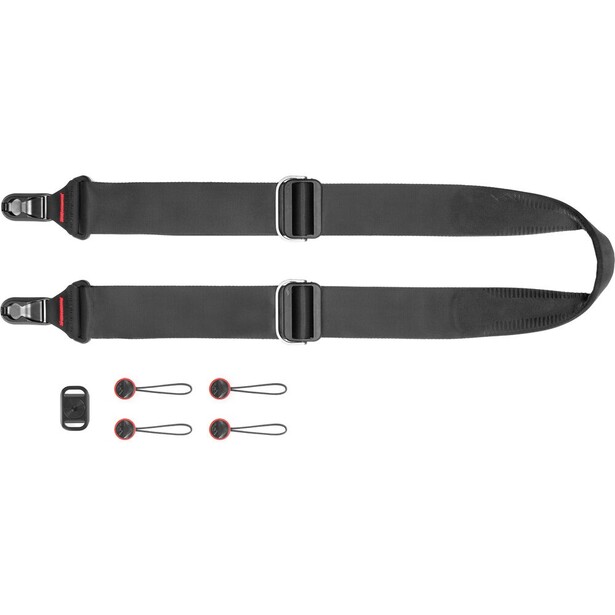
- Carry style: sling, shoulder, or neck
- Attachment: Anchor Link system, four V4 anchors, plus an included anchor mount for the tripod socket
- Materials: 45 mm internally padded nylon webbing, silicone grip strip, aluminum hardware
- Adjustment: 39 to 57 in (99 to 145 cm) via dual one-finger quick-adjusters
- Rated capacity: each anchor rated to hold over 200 lb (90 kg)
- Price: $79.95 (B&H)
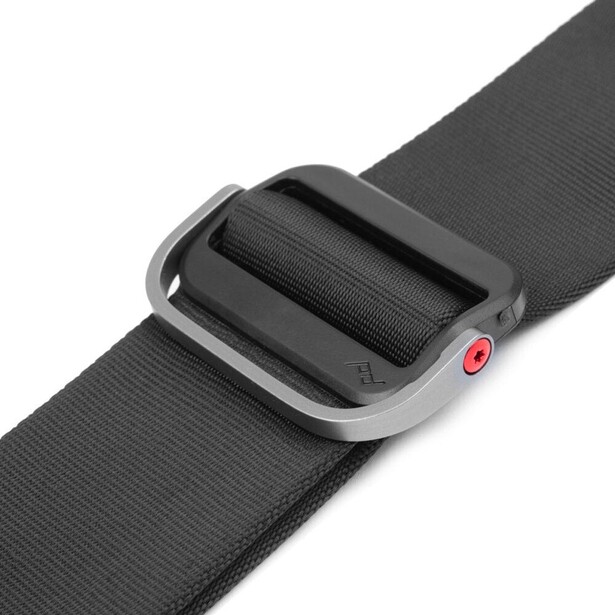
Most straps commit you to one way of carrying a camera. The Peak Design Slide refuses to, and that flexibility is why it wins the top slot. The webbing is 45 mm of seatbelt-style nylon with padding built inside it rather than bolted on, and it is deliberately two-faced: one side is smooth so it glides across a jacket when you lift the camera to your eye, the other carries a silicone grip strip so it stays put on a bare shoulder. Flip it depending on what you are wearing. The two aluminum quick-adjusters shorten or lengthen the strap with one finger while the camera hangs from it, which sounds minor until you are in a crowd trying to raise a camera on a strap four inches too long.
The real argument for the Slide is the Anchor Link system it belongs to. The four small anchors connect and disconnect in about a second, they are rated to hold more than 200 lb each, and they are shared across every strap Peak Design sells, so a camera moves between the Slide, a wrist strap, and a capture clip without ever threading webbing through a lug again. The anchors shipping today are the V4 design, which went back to a thicker Dyneema cord after the thinner V3 cord wore through too fast; if your camera has eyelets too tight for them, Peak Design sells Micro Anchors for exactly that. The included anchor mount screws into the tripod socket so the body hangs lens-down at your hip.
The honest weaknesses are worth naming. This is a lot of money for a nylon strap. The anchor cords are a wear item, sheathed against abrasion and meant to be replaced once the red inner layer shows through, which is not something you think about with a leather strap stitched into the lugs. The aluminum hardware clacks against a camera slung on your back, and on a very small mirrorless body the 45 mm webbing feels like overkill; the narrower Peak Design Slide Lite is the better buy there. Anyone tall, or anyone wearing the strap over a winter coat, should look at the Peak Design Slide XL, which runs from 43.5 to 64 in. For everyone else, check the current price of the Peak Design Slide at B&H.
What We Like
- Converts between sling, shoulder, and neck carry without tools
- Dual quick-adjusters work one-handed with the camera attached
- Reversible smooth and grippy faces for different clothing
- Anchors are shared across Peak Design's whole strap and clip range
What Could Be Better
- Expensive for a nylon strap
- Anchor cords are a wear item that must be inspected and replaced
- Metal hardware knocks against the camera body
- Oversized on small mirrorless bodies
Best Quick-Release: Falcam F38 Quick Release Buckle Kit for Shoulder Strap
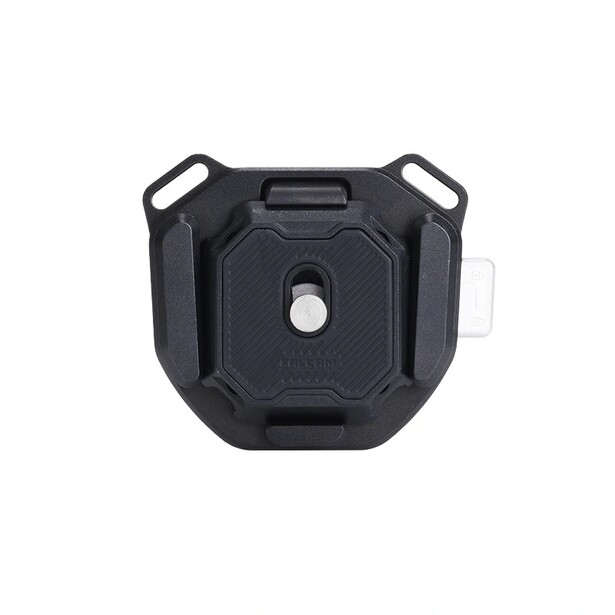
- Carry style: add-on for an existing neck or shoulder strap
- Attachment: F38 base with an Arca-compatible quick release plate, 1/4"-20 screw
- Materials: aluminum base and plate, anti-skid gasket, stainless steel and nylon lock washer
- Adjustment: none; it adds a quick release to whatever strap you already own
- Rated capacity: base mounting lugs rated to 44 lb (20 kg)
- Price: $28.79 (B&H)
Anyone who works between a strap and a tripod all day knows the small, stupid friction of it: unclip the strap, unscrew whatever is in the tripod socket, fit the plate, mount the camera, then reverse the whole thing when you move on. The Falcam F38 Quick Release Buckle Kit for Shoulder Strap deletes that sequence. A slim aluminum base threads onto the webbing of a strap you already own, an F38 plate lives on the bottom of the camera, and the camera slides into the base and self-locks with a click. Because the plate is Arca-compatible, the plate holding your camera on the strap drops straight onto an Arca clamp on the tripod head.
This is the only pick in the guide that is not a strap, and we are picking it on purpose. Peak Design's anchors are a quick release for the strap; the F38 is a quick release for the camera, which is a different problem. The base and plate are aluminum, the kit weighs 60 g, and Falcam rates the mounting lugs for 44 lb, beyond any camera and lens most people will hang off a shoulder. The plate carries a rubber pad so it does not chew the base of the body, and an anti-twist lip stops the camera pivoting on the screw, the failure mode that makes cheap 1/4-inch strap mounts feel unsafe.
The tradeoffs are physical. You are adding a hard metal block between the camera and your body, and you feel it: the camera sits proud, the base makes noise when it swings into a door frame, and the plate raises the body by a few millimeters, which on some cameras crowds the battery door. The system also assumes you will standardize on F38, and while the plate is Arca-compatible in the direction that matters, the base will not accept a plate from another ecosystem. It suits the photographer who already lives in an Arca world and moves between a strap, a tripod, and a clip constantly, and it is unnecessary for anyone who mounts a tripod twice a year. If the first description is you, check the current price of the Falcam F38 Quick Release Buckle Kit for Shoulder Strap at B&H and pair it with a strap you already like. Our tripods guide covers the head and clamp side of the same standard.
What We Like
- Camera detaches from the strap in one motion, no unthreading
- Arca-compatible plate goes straight from strap to tripod head
- Anti-twist design stops the camera pivoting on the screw
- Upgrades a strap you already own instead of replacing it
What Could Be Better
- Adds a rigid metal block between camera and body
- Plate can crowd the battery door on some bodies
- Commits you to the F38 ecosystem
- Not a strap, so it is an extra purchase on top of one
Best Leather: ONA The Presidio
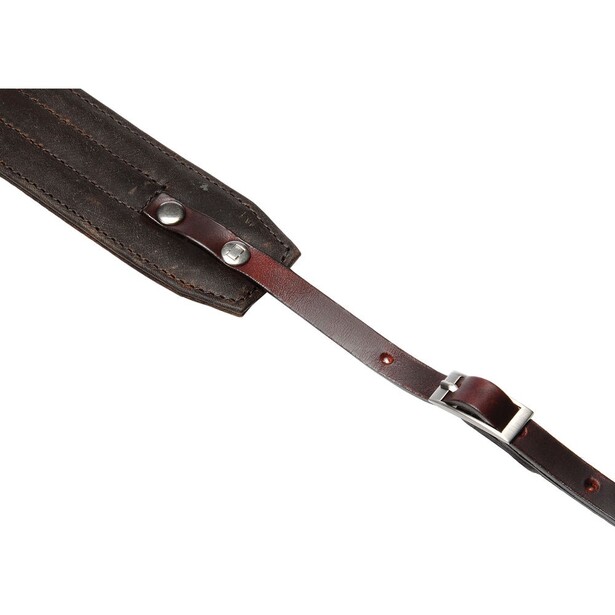
- Carry style: neck or shoulder
- Attachment: leather connector tabs that thread through the camera's strap lugs
- Materials: full grain leather or waxed canvas with leather trim, neoprene padding, chrome buckles
- Adjustment: 63 in total length, drop adjustable from 19.5 to 23.5 in
- Rated capacity: rated by ONA for camera and lens combinations up to 6 lb
- Price: $129 (B&H)
Leather straps get bought for how they look and kept for how they age, and the ones that fail do so because somebody built a fashion accessory instead of load-bearing hardware. ONA's Presidio does the boring engineering properly. The shoulder section is full grain leather backed with neoprene, so the part against your body has some give and does not skate off a coat. Two chrome buckles set the drop anywhere from 19.5 to 23.5 in, real adjustment rather than the single fixed length most leather straps ship with, and the leather connector tabs cinch through the lugs so no metal ring rubs the top plate.
It gets better with mileage. Full grain leather darkens, softens, and takes the marks of where you have carried it, and after a season the shoulder section has molded to you. A waxed canvas version with leather trim exists if you want the same hardware in something more weather-tolerant, and neither looks like camera gear, which is the point on a street where you would rather not advertise what you are carrying.
Read the load rating before you buy, because it is the whole story here. ONA rates the Presidio for kits up to 6 lb, which covers a mirrorless body with a prime or a mid-size zoom and rules out a professional body with a 70-200mm f/2.8 on the front. It has no quick release, so taking it off means unthreading two leather tabs, and the leather wants conditioning if you shoot in rain. This is the strap for the photographer carrying one moderate camera who cares what it looks like on their shoulder, and the wrong strap for anyone hauling heavy glass all day. Hawkesmill's handmade Horween leather straps are the ones we would look at next, though B&H does not stock them and you order direct from England. Otherwise, check the current price of the ONA Presidio at B&H.
What We Like
- Full grain leather with a neoprene-backed shoulder section
- Genuinely adjustable drop, unusual for a leather strap
- Ages into something better looking than it started
- Discreet in situations where camera gear draws attention
What Could Be Better
- Rated only to 6 lb, so heavy zooms are out
- No quick release; removing it means unthreading the tabs
- Leather needs conditioning if it gets wet regularly
- Costs more than the nylon straps that outperform it under load
Best Wrist Strap: Peak Design Cuff
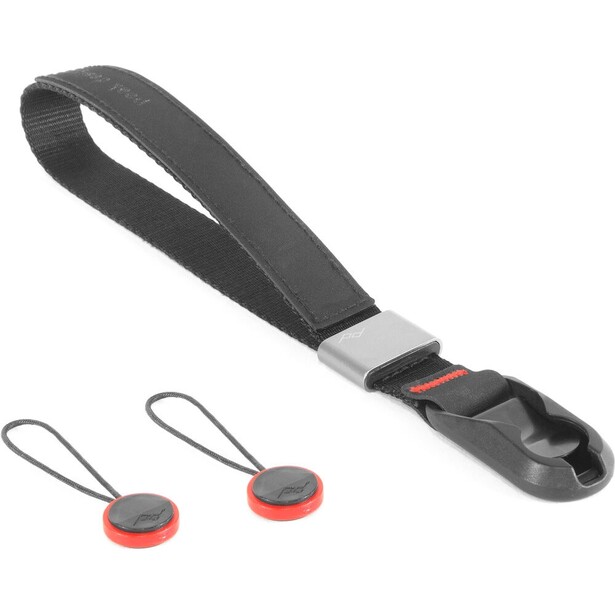
- Carry style: wrist
- Attachment: Anchor Link system, V4 anchors
- Materials: seatbelt-style nylon webbing, aluminum and glass-filled nylon hardware, adjustable magnet
- Adjustment: 8 to 11.4 in (20 to 29 cm) cinch loop with a locking slider
- Rated capacity: each anchor rated to hold over 200 lb (90 kg)
- Price: $39.95 (B&H)
Not every camera needs to hang off your body. Street photographers, anyone shooting a small rangefinder-style camera, and every second shooter who has spent a reception with a strap tangled around their arm eventually arrives at a wrist strap, and the Peak Design Cuff solves the design problem rather than restating it. The loop locks open when you want to slide your hand in and out freely, then a slider cinches it against the wrist when you want the camera secured. A magnet catches the loose tail so it is not flapping in your frame. It weighs 50 g, so the camera in your hand still feels like a camera.
It runs on the same anchors as the Slide, which is the reason to buy it if you already own one Peak Design strap. Two anchors live permanently on the camera and the Cuff and the Slide trade places in about two seconds, so a walk that starts as a shoulder carry becomes a hand carry at the door of a museum without a tool or a fumble. The anchors are rated at over 200 lb each. The connection is not the weak link. The wrist is.
That is the honest limit. A wrist strap only saves the camera if the loop is cinched, and the temptation, especially in cold weather, is to leave it slack and treat it as decoration. The locking slider makes the right behavior easy, but nothing enforces it. There is also a ceiling on what a wrist should carry: a small body with a prime is fine, and a professional body with a fast telephoto on one wrist is a sprained tendon waiting to happen. For the photographer who wants the camera in their hand and nothing across their chest, check the current price of the Peak Design Cuff at B&H.
What We Like
- Locking cinch loop is genuinely secure, not decorative
- Magnetic keeper stops the tail from swinging into frame
- Swaps with a Slide in seconds on the same anchors
- At 50 g it adds nothing to the feel of the camera
What Could Be Better
- Only protects the camera when the loop is actually cinched
- Wrong tool for heavy bodies and long lenses
- Anchor cords need periodic inspection
- No load spreading at all, so long carries get tiring
Best Sling and Cross-Body: BlackRapid Sport-X
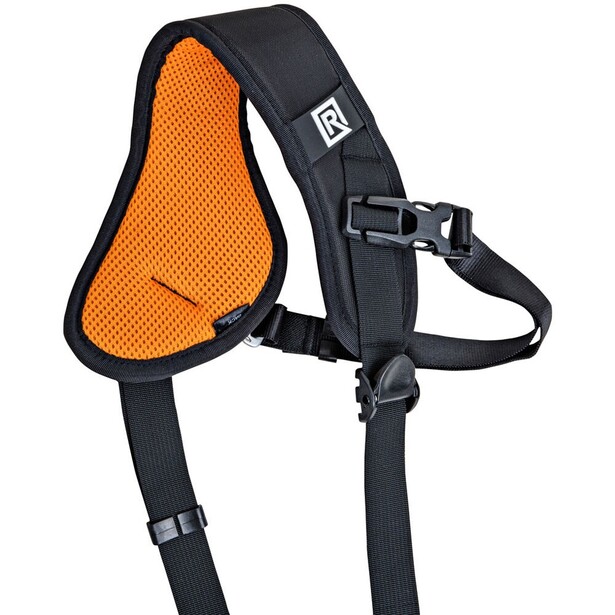
- Carry style: cross-body sling, sold in right-handed and left-handed versions
- Attachment: FastenR FR-5 screws into the tripod socket, connects to a swivel locking carabiner
- Materials: nylon mono mesh and polyester over a curved TPE foam pad, 1 in nylon webbing
- Adjustment: webbing adjustable to a maximum of 66 in, with spring-loaded cam locks and an underarm stabilizer
- Rated capacity: not published by BlackRapid
- Price: $119.95 (B&H)
BlackRapid invented this category, and the Sport-X is the current, most heavily padded version of the idea. The camera hangs upside down at your hip from a locking carabiner, and you lift it, sliding the body up the webbing to your eye. Nothing unclips, nothing gets pulled over your head, and the motion takes about a second. B&H now lists the Sport-X as the replacement for the long-running Sport Breathe, worth knowing if you go looking for the older model and find it gone.
The X in the name is extra padding. The shoulder pad is 16 in long and flares from 2.2 to 3.7 in, curved to the slope of the shoulder rather than cut as a flat strip that rides up your neck, with a TPE foam core and a nylon mono mesh face over it. Two spring-loaded cam locks pin the camera's travel so it cannot slide past where you set it, and a removable underarm stabilizer stops the pad creeping off your shoulder when you crouch or scramble. The kit ships with a safety tether, a second connection that catches the body if the primary one backs out.
Two things to be clear about. The FastenR screws into the tripod socket, so the socket is occupied: mounting a tripod means unscrewing it or adding a plate that gives you both, which is the friction the Falcam kit above exists to remove. And BlackRapid does not publish a load rating, so what you get is the company's assurance that the system carries professional bodies and telephotos, backed by a FastenR that threads into the tripod socket, the strongest of the four attachment types, rather than a number we can point at. Handedness is fixed at purchase. For an event, wildlife, or hiking photographer carrying a single camera all day, check the current price of the BlackRapid Sport-X at B&H.
What We Like
- Camera slides from hip to eye in one motion
- Wide curved pad is shaped to the shoulder rather than cut as a flat strip
- Underarm stabilizer keeps the strap put during active shooting
- Safety tether included as a redundant connection
What Could Be Better
- Occupies the tripod socket
- No published load rating
- Right and left versions are separate purchases
- Hardware and webbing look and sound industrial
Best Budget: OP/TECH USA Pro Loop Strap
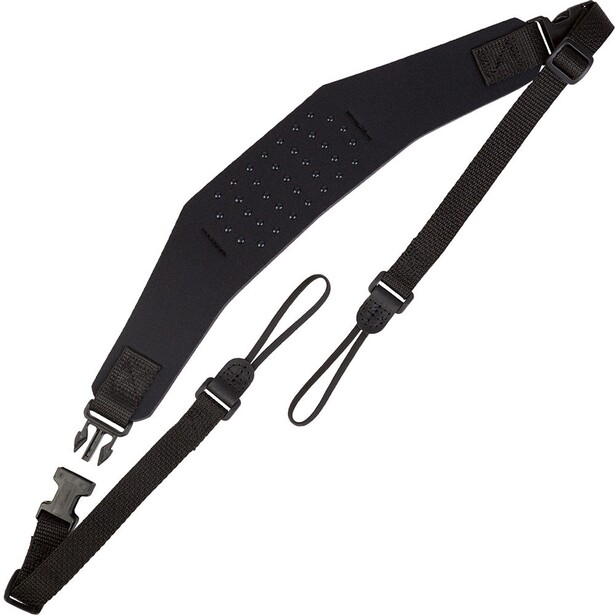
- Carry style: neck or shoulder
- Attachment: 1/4 in webbing loops through the camera's strap lugs, plus quick-disconnect buckles
- Materials: 2.5 by 15 in curved neoprene pad with a non-slip backing, 3/4 in nylon webbing, leather tabs
- Adjustment: 37 to 43 in (94 to 109 cm)
- Rated capacity: OP/TECH recommends a comfortable load up to 15 lb (7 kg); each connector is rated at 146 lb tensile strength
- Price: $25.99 (B&H)
Here is the cheapest genuine upgrade in photography. The OP/TECH USA Pro Loop Strap has been in the catalog for decades, is still made in the United States, carries a lifetime warranty, and costs less than a decent lens filter. The trick is the neoprene. The pad is 2.5 in wide and 15 in long, curved to the shape of a neck rather than cut straight, and the material has enough stretch to absorb the bounce of a camera as you walk, so the load arrives smoothed out instead of as a series of small impacts. OP/TECH's own claim is that the system makes a load feel 50% lighter, which is marketing, but the underlying mechanism is real.
It is also better built than the price suggests. The quick-disconnect buckles are rated at 146 lb of tensile strength each, so the strap comes off the camera in a second, and the same buckles accept OP/TECH's system connectors, which lets one strap serve several cameras or a pair of binoculars. The 1/4 in webbing loops thread the strap lugs, so it fits small mirrorless bodies whose lugs will not take a full-width strap. The 15 lb comfort ceiling is well above the 6 lb rating on our leather pick.
What you give up is finesse. This strap looks exactly like what it is, a black neoprene band, and nobody has ever complimented one. Neoprene stretch cuts both ways: it damps the bounce, and it gives a heavy camera a small amount of spring that some photographers dislike. The pad slides around on a slick shell jacket, and there is no way to convert this into a sling. If you want the cheapest comfortable answer to a neck strap that hurts, check the current price of the OP/TECH USA Pro Loop Strap at B&H.
What We Like
- Neoprene pad genuinely damps the bounce of a walking camera
- Quick-disconnect buckles rated at 146 lb each
- Made in the USA with a lifetime warranty
- Narrow webbing loops fit small mirrorless strap lugs
What Could Be Better
- Utilitarian looks with no attempt at style
- Neoprene stretch adds a slight bounce under heavy gear
- Pad can slip on slick outerwear
- Neck and shoulder only; no sling conversion
Best for Heavy Setups: HoldFast Gear MoneyMaker 2-Camera Harness
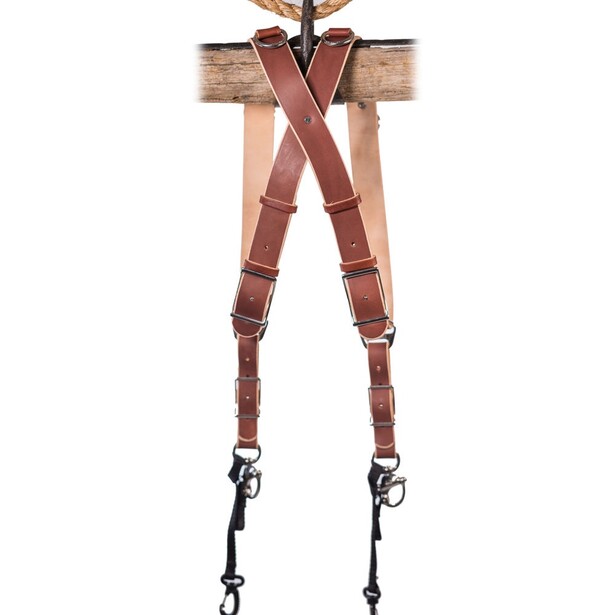
- Carry style: dual-camera harness across both shoulders, bodies at the hips
- Attachment: HoldFast screws into each camera's tripod socket, sailboat clips on adjustable sliders, removable safety straps
- Materials: 1.5 in English bridle leather or water buffalo leather, stainless steel D-rings and split rings
- Adjustment: sliders set the drop; sized small (5'7" and under), medium (5'8" to 6'2"), or large (6'3" and up)
- Rated capacity: not published by HoldFast Gear
- Price: $260 (B&H)
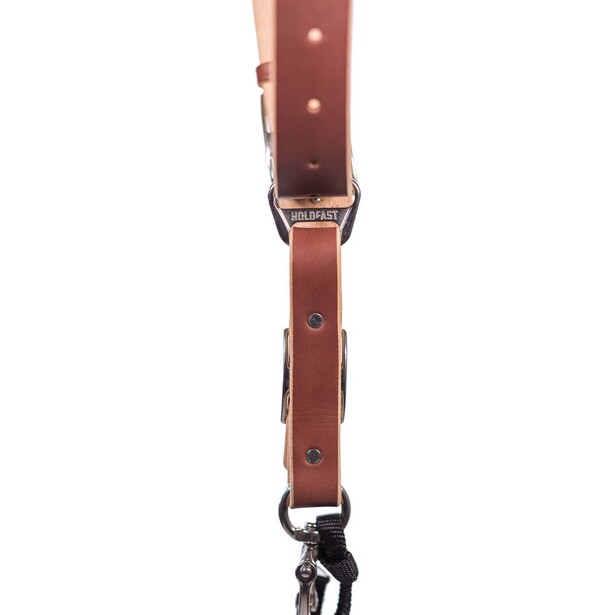
Once you are carrying two professional bodies with fast zooms on them, no single strap is the answer. Ten or twelve pounds of gear on one shoulder for eight hours is how photographers end up in physical therapy. The HoldFast Gear MoneyMaker 2-Camera Harness answers that the only way that works, by crossing two leather straps in an X across your back and hanging a camera at each hip, so the weight splits between both shoulders and rides low against your body.
It has been the default at weddings for over a decade. The leather is English bridle or water buffalo, thick enough that it does not stretch under load, and it breaks in the way a good belt does: stiff at first, then molded to you. Sailboat clips riding on adjustable sliders let each camera glide up to your eye and drop back to the hip without unclipping anything, and a removable safety strap runs from the base of each clip to the camera's side lug as a backup to the main connection. It is made in Oklahoma and carries a lifetime warranty against manufacturing defects, the sort of promise a company makes only when it expects the product to still be in service in fifteen years.
The costs are real and they are not only financial. This is the most expensive pick in the guide by a wide margin. Thick leather is heavy before you have hung a single camera on it, and cold weather makes it stiffer. Both cameras attach through their tripod sockets, so tripod work means unscrewing hardware unless you fit plates that give you both. Sizing matters more than people expect: HoldFast sizes the harness by your height, and the size is chosen at purchase rather than adjusted later. It is conspicuous, which is fine at a wedding and less fine on a quiet street. If you shoot one body, the HoldFast Gear MoneyMaker Solo is the single-camera version of the same hardware, and it is the one sold in right-handed and left-handed layouts. For two-body event work, check the current price of the HoldFast Gear MoneyMaker 2-Camera Harness at B&H. Pair it with a bag that carries lenses on your hips rather than your back; our camera backpacks guide covers what works alongside a harness.
What We Like
- Splits the weight of two bodies across both shoulders
- Cameras slide from hip to eye without unclipping
- Thick bridle or water buffalo leather that molds to you
- Made in the USA with a lifetime warranty against defects
What Could Be Better
- By far the most expensive pick here
- Heavy and stiff before it is broken in
- Uses both cameras' tripod sockets
- Size is locked in at purchase, and it is sized by your height
Best for Small Mirrorless Cameras: COOPH Rope Camera Strap
- Carry style: neck or shoulder
- Attachment: German steel rings with protective leather flaps, or 12 mm webbing bands for cameras with small lugs
- Materials: 10 mm mountaineering rope with vegetable-tanned Italian leather ends, hand-assembled in Hungary
- Adjustment: fixed lengths of 100, 115, or 130 cm; a separate adjustable model spans 90 to 150 cm (35.4 to 59 in)
- Rated capacity: not published by COOPH
- Price: $80 (B&H)
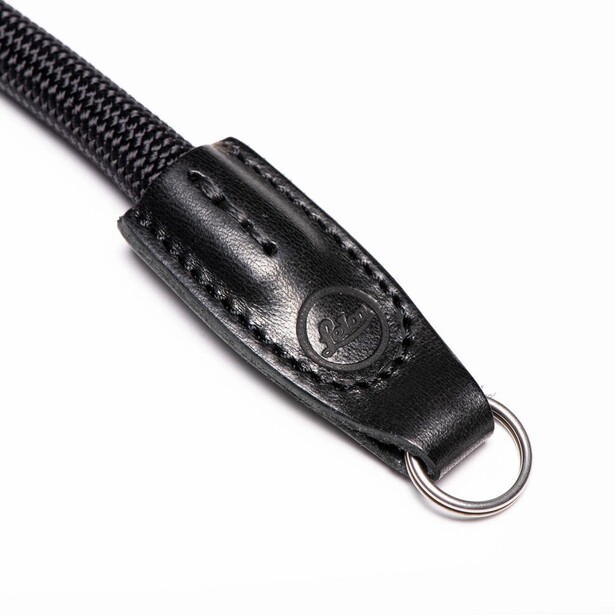
Put a 45 mm padded nylon strap on a compact mirrorless camera and the strap becomes the biggest thing you are carrying. The COOPH Rope Camera Strap solves that. It is climbing rope, 10 mm on the standard strap and 9 mm on the adjustable one, finished with vegetable-tanned Italian leather and German steel rings, hand-assembled in Hungary. On a small camera it looks correct in a way that tactical nylon never does, and the round profile sits differently on the neck than a flat strap: it does not fold, it does not twist, and it does not stick to a bare shoulder in summer. Leica has sold a version of this design under its own name for years.
Practicality is better than the styling suggests. The rope has almost no memory, so it coils into a jacket pocket with the camera and comes out without kinks. Three fixed lengths let you set a neck carry or a proper cross-body sling, and an adjustable model that runs from 90 to 150 cm exists if you would rather set the length yourself. If your camera has the narrow lug slots common on rangefinder-style bodies, COOPH sells the same straps with 12 mm webbing bands instead of steel rings, which is the detail most rope-strap makers get wrong.
Understand what you are giving up. There is no padding of any kind, so comfort depends on the load staying light: with a small body and a prime it is fine all day, and with a heavy zoom the rope turns into a cable digging into your collarbone. COOPH does not publish a load rating, so the ceiling is a judgment call. The steel rings can tap the camera if the supplied leather flaps are not seated over them, and there is no quick release, so this is a strap you leave on the body. For the photographer with a small camera who wants a handsome strap that otherwise gets out of the way, check the current price of the COOPH Rope Camera Strap at B&H. Also consider the Peak Design Form Leather Camera Strap if you want leather in the same minimalist spirit, since it runs on the same anchors as the Slide.
What We Like
- Round rope profile does not fold, twist, or stick to skin
- Coils away into a pocket without kinking
- Steel rings or webbing ends to suit different strap lugs
- Looks right on a small camera in a way nylon does not
What Could Be Better
- No padding, so it bites under a heavy lens
- No published load rating
- Fixed lengths on the standard model
- Steel rings can mark the camera if the leather flaps are not seated
How to Choose a Camera Strap
Start with where the weight goes, because that determines whether you are still comfortable at hour six. A neck strap puts the entire load on the cervical spine, the worst structure in your body for the job, and it is tolerable only when the camera is light. A shoulder or sling strap moves the load onto the trapezius and the diagonal of your torso, which is why almost every professional carrying one camera for a full day ends up in a sling. A dual harness splits the load across both shoulders and is the only real answer above roughly 8 lb of gear. Match the design to your kit weight, not to how the strap looks in a product photo.
Then look hard at the attachment system, because it is the part people ignore and the part that fails. Cord anchors, as on Peak Design's straps, clip in and out in a second, and the cords are consumable, so they must be inspected and replaced. Steel or split rings, as on rope and many leather straps, are secure, slightly fiddly, and capable of scratching a top plate if the maker does not supply bumpers. Leather or webbing tabs threaded through the lugs are the most permanent and the least convenient. Tripod-socket screws, as on BlackRapid and HoldFast, are the strongest of the four and the reason a heavy telephoto rig hangs safely, at the cost of occupying the socket you need for a tripod. Anyone who works on a tripod all day should either accept that friction or fit an Arca-compatible quick release like the Falcam kit.
The spec that matters more than people expect is the load rating, and the awkward truth is that most strap makers do not publish one. Where a number exists, respect it: ONA's 6 lb ceiling on the Presidio is a real limit, not a suggestion, and hanging a professional body and a fast telephoto on a strap rated for a fraction of that is how gear ends up on concrete. Where there is no number, let the design tell you, since a thin unpadded rope announces what it is for as clearly as a 3.7 in curved sports pad does.
The spec that matters less than people expect is width. Wide is not automatically comfortable. A curved pad shaped to a shoulder outperforms a wider flat strap, and what predicts comfort is the shape of the pad, whether the strap adjusts with the camera hanging on it, and whether the camera stays where you put it when you move. Buy the handedness and the size correctly the first time, because slings and harnesses are built left or right and sized to your height, and none of that can be fixed after the fact.
What We're Looking For
We weigh how a strap distributes weight, how its attachment system handles the gear it claims to carry, how fast it comes on and off the camera, and how the materials hold up to sweat, rain, and years of use. Every specification here was verified against the manufacturer's current published figures and a current retailer listing at the time of writing, and where a maker declines to publish a load rating we say so rather than filling the gap. None of these eight straps has come through Fstoppers for a formal hands-on review, so the entries are written from verified specs and each strap's documented design, hardware, and materials. Most picks across our buying guides come from gear our writers have used and reviewed hands-on. Where we have not, as here, we say so.
Frequently Asked Questions
Are Camera Straps Safe Enough to Trust With an Expensive Camera?
Yes, provided you inspect the connection points. The failures that make the rounds online are almost always worn cord anchors that were left in service too long or a tripod-socket screw that backed out over months of use. Check anchor cords for exposed inner layers, retighten socket screws periodically, and use the safety tether if your strap includes one.
Should I Use a Neck Strap or a Sling Strap?
Use a sling if you carry one camera for more than an hour or two. A sling moves the load off your cervical spine and onto your shoulder and torso, and it brings the camera to your eye faster than a neck strap does. Neck straps still make sense for light cameras, for studio work where the camera is rarely on you, and for photographers who dislike a strap crossing their chest.
Do Quick-Release Systems Weaken the Connection?
No, when they are rated properly. Peak Design's anchors are rated at over 200 lb each and the Falcam F38 base at 44 lb, both far beyond any camera and lens you can carry on a shoulder. The weak point is not the mechanism, it is neglect: cord anchors are wear items, and a quick release you never inspect eventually becomes the thing that fails.
What Strap Should I Use With a Heavy Telephoto Lens?
Attach the strap to the lens' tripod collar, not to the camera body, and use a sling or a harness rather than a neck strap. Hanging a long lens from the body's strap lugs puts all the leverage on the lens mount. A sling like the Sport-X, connected at the collar, keeps the load where the lens is designed to take it.
Is an Expensive Camera Strap Worth It?
For most photographers, a mid-priced strap is the sweet spot and the flagship models earn their money only through use. A budget neoprene strap solves the comfort problem for very little outlay. Spend more only for a specific capability, which usually means quick release, sling conversion, or the ability to carry two bodies at once.
Fstoppers may earn a commission from purchases made through links in this article. Our picks are made independently by our editorial team.