Nobody buys their last camera backpack first. Most photographers buy three or four, each one bought to fix the thing that annoyed them about the last one, and the pile in the closet gets expensive. The bag you need is not decided by how much gear you own. It is decided by how you get to the picture: a subway ride, a two-hour trail, an airport, a wedding reception. A pack that is perfect for one of those is quietly miserable for another, and the spec that separates them is almost never capacity in liters.
Three things decide the purchase. How you get into the bag (back panel, side hatch, or clamshell) determines whether you shoot or fumble. How the load is carried (a padded harness with a real hip belt versus two straps and hope) determines whether 20 pounds is fine or ruinous at hour three. And how much of the bag is camera determines whether a jacket, lunch, and laptop also fit. Weather-sealing matters less than the marketing suggests, because almost every pack here needs a rain cover in a real downpour.
Two ground rules. Every pick gets its honest weakness stated in the text, and every pick tells you whether the camera insert and rain cover are included or sold separately, because that catches people out constantly. Every figure below comes from the manufacturer's current published specification, and each entry says which pack it came from.
At a Glance
- Best Overall: WANDRD PRVKE 31L V4
- Best Budget: Lowepro Flipside BP 300 AW III
- Best for Travel: Nomatic McKinnon Camera Pack 35L V2
- Best for Hiking and the Outdoors: Shimoda Explore v2 35
- Best Large-Capacity Pack for Working Pros: Think Tank Photo BackLight 36L
- Best Everyday Carry: Peak Design Everyday Backpack V3 20L
- Best Premium Pack: Gura Gear Kiboko 2.0 30L+
- Best for Hybrid Photo, Video, and Drone Kits: PGYTECH OneGo 2 Backpack 25L
Best Overall: WANDRD PRVKE 31L V4
- Capacity: 31 L, expanding to 35 L via the roll-top
- Weight: 3.3 lb (1.49 kg)
- External dimensions: 18.5 x 12 x 6.5 in (47 x 30.5 x 16.5 cm)
- Laptop and tablet: laptop sleeve up to 16 in, separate tablet sleeve
- Camera capacity: depends on the cube; the Essential Plus cube holds a body with a lens attached plus two or three more lenses
- Materials and weather protection: P900D tarpaulin and N840D ballistic nylon shell, P200D interior, YKK zippers
- Included: camera cube sold separately or bundled; Rainfly rain cover sold separately
- Price: $254 (B&H)
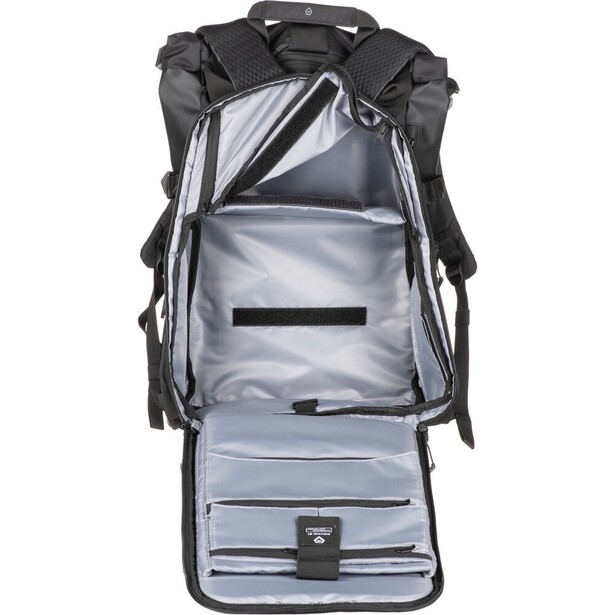
The PRVKE 31L V4 wins this slot because it refuses to pick a side. It is a genuine camera bag with a cube in it, and a genuine 35-liter travel pack with the cube out, and that dual identity is what most photographers need from one purchase. WANDRD rebuilt the pack for V4 with a molded back panel, magnetic tote handles, and a side hatch measuring 10 by 5.5 inches, which is the number that matters: wide enough to pull a full frame body with a 24-70mm f/2.8 attached without taking the bag off your shoulder.
The construction is the other reason it leads. The shell is P900D tarpaulin over N840D ballistic nylon, closer to luggage material than to a typical camera bag, and the roll-top means the pack shrinks when it is half empty instead of holding its shape like a shoebox. Rolled down, at 18.5 by 12 by 6.5 inches, it clears typical US carry-on limits with room to spare. A clamshell opening, a hidden passport pocket, an AirTag sleeve, and a luggage pass-through round it out. The description here is built from WANDRD's current published specifications rather than from time on our own backs.
Now the part the marketing skips. The camera cube is not in the box, and the Essential Plus or Pro Plus cube is a separate purchase that pushes the real cost of a working setup past the headline figure. The rain cover is a separate purchase too: WANDRD sells its Rainfly as an accessory, and the pack ships with a dedicated pocket for a rain cover it does not give you. The harness is the other limit: past roughly 20 pounds you feel the load in your shoulders in a way a Shimoda or a Think Tank will not allow.
This is the bag for the photographer who wants one pack for the flight, the walk from the hotel, and the commute home. If that is you, check the current price of the WANDRD PRVKE 31L V4 at B&H. Also consider the WANDRD PRVKE 21L V4 if you carry one body and two lenses.
What We Like
- Roll-top expands from 31 L to 35 L and compresses when half empty
- Large side hatch reaches a body with a standard zoom attached
- Tarpaulin and ballistic nylon shell that outclasses most camera bags
- Works as a straight travel pack with the cube removed
What Could Be Better
- The camera cube is a separate purchase
- No rain cover in the box
- Harness is not built for heavy, long-distance loads
- Roll-top adds a step every time you get into the main compartment
Best Budget: Lowepro Flipside BP 300 AW III
- Capacity: 17 L total
- Weight: 3.09 lb (1.4 kg)
- External dimensions: 12.2 x 8.66 x 18.11 in (31 x 22 x 46 cm)
- Laptop and tablet: laptop up to 13 in, tablet up to 10 in
- Camera capacity: a body with a 70-200mm lens attached, plus three or four more lenses
- Materials and weather protection: 600D polyester and 600D polyester ripstop exterior, PU-coated front, 10 mm YKK zippers
- Included: dividers and the All Weather AW Cover
- Price: $134.95 (B&H)
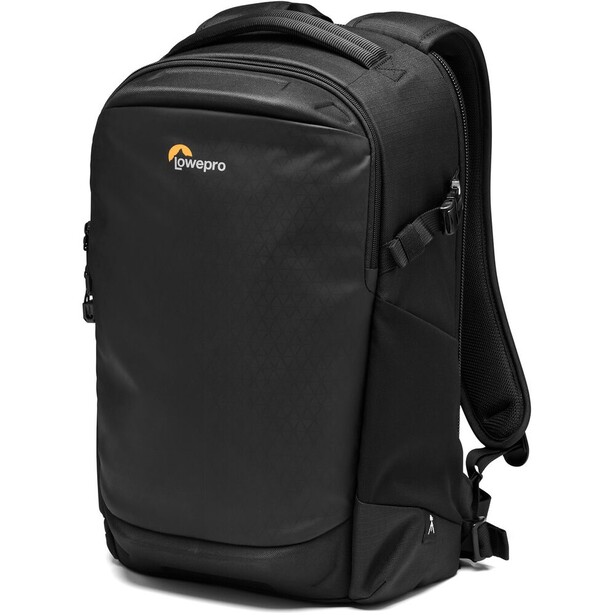
Cheap camera bags usually fail in the harness, and the Flipside BP 300 AW III is the rare budget pack that spends its money in the right places instead. It is a rear-access design, meaning the camera compartment opens against your back, so the panel you unzip is the one that was never touching the dirt, and nobody can open the bag while you are wearing it. Photographers who work crowded markets and transit hubs have been buying Flipsides for that reason for well over a decade.
The 17-liter body is small, and that is the point. Lowepro rates it for a body with a 70-200mm mounted, three or four more lenses, a 13-inch laptop in a suspended CradleFit pocket, and a compact tripod on the side strap, at 3.09 pounds empty. The dividers are included, the All Weather AW Cover lives in the base, and the PU-coated front and molded EVA bumpers survive being set down on wet gravel. The third generation added a single side-access port, so a quick camera grab no longer means unloading the whole pack.
It makes real compromises. The 13-inch laptop limit is the biggest one in 2026, when most working photographers carry a 15-inch or 16-inch machine, and that alone disqualifies it for many buyers. The side port is a small single opening rather than a full hatch, so it takes the camera and little else, and personal-item space in 17 liters is minimal. The description here comes from Lowepro's current specification, not from an Fstoppers reviewer's shoulders.
Buy it if your priority is protecting gear cheaply and you can live with a smaller laptop, and skip it if you want one bag for gear plus life. It remains the sanest entry point into a real camera pack, so check the current price of the Lowepro Flipside BP 300 AW III at B&H.
What We Like
- Rear-panel access keeps zippers off the ground and away from crowds
- Fits a body with a 70-200mm attached in a 17 L pack
- Rain cover and dividers included
- Light at 3.09 pounds empty
What Could Be Better
- 13-inch laptop limit is restrictive in 2026
- Side access is one small port, not a full hatch
- Almost no room for personal items
- Plain, unmistakably-a-camera-bag styling
Best for Travel: Nomatic McKinnon Camera Pack 35L V2
- Capacity: 35 L, expanding to 42 L
- Weight: 5.75 lb (2.61 kg)
- External dimensions: 22 x 13.5 x 9.5 in (56 x 34 x 24 cm)
- Laptop and tablet: external sleeve up to 16 in, internal sleeve up to 14 in
- Camera capacity: configurable camera compartment measuring 21 x 12.5 x 5.25 in inside
- Materials and weather protection: high-tenacity ripstop with a water-resistant coating, urethane-coated zippers
- Included: four medium and five small dividers, removable waist strap, accessory straps; no rain cover
- Price: $319.99 (B&H)
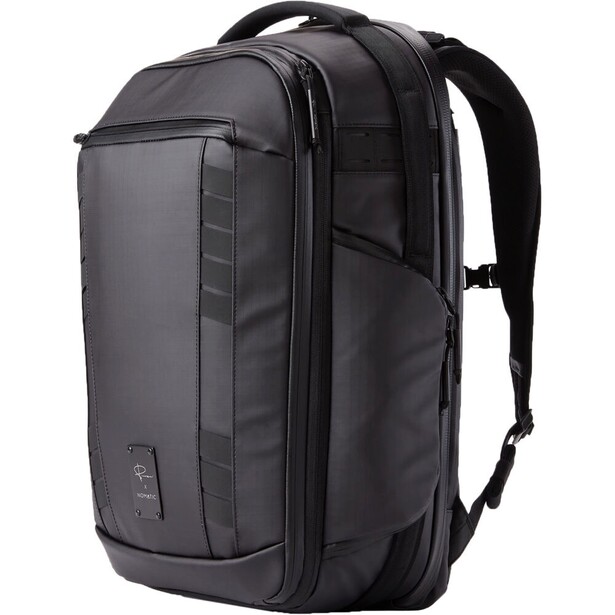
Travel is where camera bags fall apart, because a travel photographer is carrying two bags at once: the kit, and four days of clothes. The McKinnon Camera Pack 35L V2 is designed around exactly that split. The lower two-thirds is a configurable camera compartment, the upper section is a clothing compartment with its own expansion that Nomatic enlarged for the V2, and the whole pack grows from 35 to 42 liters when you need it to. The layout reflects a working travel routine, right down to the accessory straps that take a tripod or a jacket without a bungee cord.
Details matter here more than the headline capacity. There are two laptop sleeves, one external for airport security and one internal for travel, and they take different sizes: 16 inches on the outside, 14 inches on the inside. The waist strap is removable, which sounds trivial until you have flown with a pack whose hip belt would not stop flapping. The dividers are included, which is not true of the WANDRD or the Shimoda. The layout claims here come from Nomatic's current specification for the V2.
The weight is the wall you hit. At 5.75 pounds empty it is the heaviest pack in this guide, before a single lens goes in. Fill both compartments and you have a bag that is legal as a carry-on by dimensions but a burden through a long terminal. The ripstop shell is water-resistant rather than waterproof, with no rain cover included, and it is the second-priciest pack here.
If your photography happens at the end of a flight and you want one bag that carries the kit and the clothes, this is the one to buy, so check the current price of the Nomatic McKinnon Camera Pack 35L V2 at B&H. Also consider the Peak Design Travel Backpack 45L if you want more clothing volume and are happy to buy camera cubes separately.
What We Like
- Genuine clothing compartment above a full camera compartment
- Expands from 35 L to 42 L
- Two laptop sleeves, including an external one for security lines
- Dividers, waist strap, and accessory straps all included
What Could Be Better
- Heaviest pack here at 5.75 pounds empty
- No rain cover, and the shell is only water-resistant
- Internal laptop sleeve maxes out at 14 inches
- Expensive for a pack built for airports rather than trails
Best for Hiking and the Outdoors: Shimoda Explore v2 35
- Capacity: 35 L
- Weight: 4.4 lb (2 kg), shell without a Core Unit
- External dimensions: 11.6 x 21.2 x 7.8 in (29.5 x 54 x 20 cm)
- Laptop and tablet: dual padded sleeves, laptop up to 16 in
- Camera capacity: set by the Core Unit you choose, from a mirrorless kit up to a gripped DSLR body and lenses
- Materials and weather protection: 210D and 420D carbonate-coated nylon ripstop
- Included: rain cover and accessory straps; the Core Unit camera insert is sold separately
- Price: $319.95 (B&H)
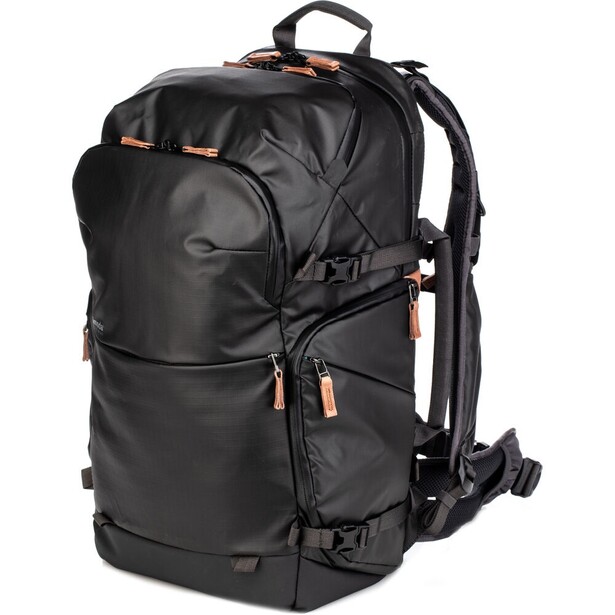
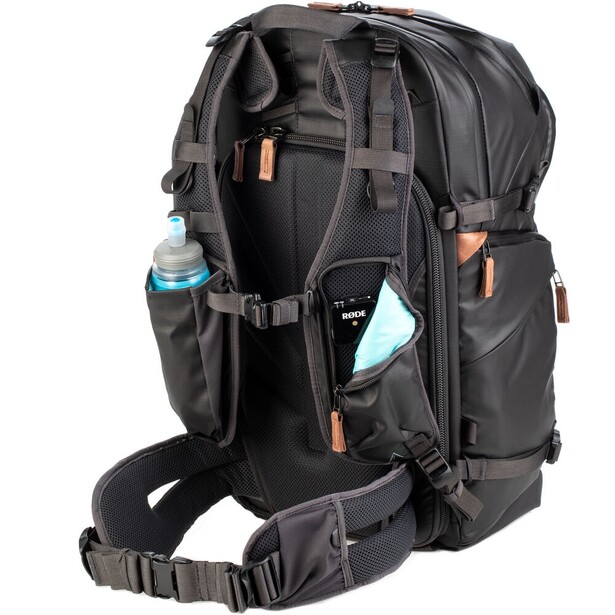
Walk far enough with a camera bag and one thing stops mattering (how fast you can grab the camera) and one thing starts mattering enormously (whether the load sits on your hips or hangs off your shoulders). The Explore v2 35 is built by people who understood that, with an internal frame, a load-bearing hip belt, and an adjustable torso length so the harness tunes to your back rather than the average of everyone's. Shimoda was founded by an outdoor photographer who spent years modifying trekking packs to hold cameras, and it shows.
The Core Unit system is the other half of the design. The camera insert slides in through the anti-theft rear panel and comes in several sizes, so the same shell carries a small mirrorless kit on a day hike or a heavy DSLR setup on an expedition, and you can pull the unit entirely and use the pack for an overnight. A side opening gives you the camera without taking the pack off, which is more than the Think Tank offers. The whole thing is 35 liters at 4.4 pounds empty, light for a pack with a real suspension system, and at 21.2 by 11.6 by 7.8 inches it fits inside most carry-on limits, which a 55-liter trekking pack does not.
Two honest problems. The Core Unit is not included, so the shell alone is not a camera bag out of the box, and the size you pick changes both the total cost and the room left for a jacket, water, and food. The other is supply: at the time of writing, Shimoda's own store lists the Explore v2 35 as out of stock with availability estimated in early September 2026. The enthusiasm here is informed by the current specification rather than earned in the field.
Get it if your photography involves elevation gain, and skip it if you shoot in cities, where that suspension buys you nothing. If you hike to your compositions, check the current price of the Shimoda Explore v2 35 at B&H. Also consider the Lowepro PhotoSport PRO BP 55L AW IV if you need overnight capacity and want the camera insert included.
What We Like
- Real internal frame, load-bearing hip belt, and adjustable torso length
- Modular Core Unit inserts scale the camera space to the trip
- Light for a pack with this much suspension, at 4.4 pounds
- Rain cover included, and it fits most carry-on limits
What Could Be Better
- Core Unit insert is a separate purchase
- Backordered on Shimoda's own store at the time of writing
- Overbuilt and overpriced if you never leave pavement
- Adjustable-torso harness adds bulk you do not need in a city
Best Large-Capacity Pack for Working Pros: Think Tank Photo BackLight 36L
- Capacity: 36 L, including 11 L of non-camera daypack space
- Weight: 4.9 lb (2.2 kg)
- External dimensions: 12.5 x 22.4 x 10.2 in (31.8 x 57 x 26 cm)
- Laptop and tablet: laptop up to 16 in, tablet up to 10 in
- Camera capacity: two gripped bodies with lenses attached plus four to six zooms and a flash; a 600mm f/4 detached
- Materials and weather protection: 420D Velocity and 420D high-density nylon with a water-repellent coating
- Included: dividers and a seam-sealed rain cover
- Price: $329.75 (B&H)
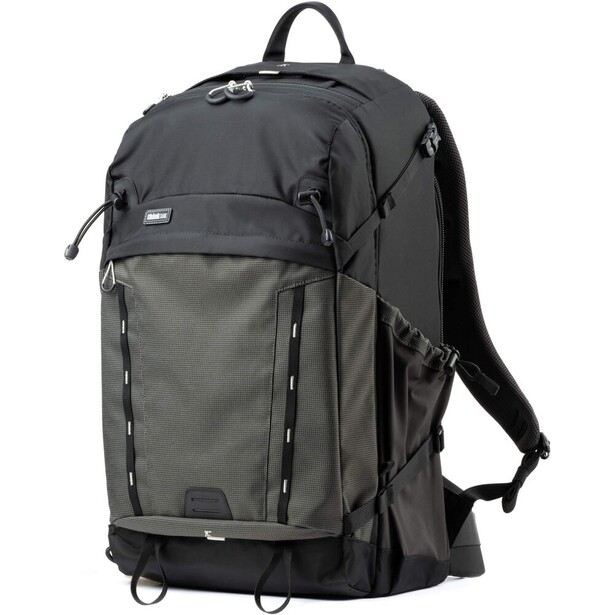
When you are being paid to be somewhere, the bag stops being a lifestyle object and becomes a tool that either holds the whole kit or does not. The BackLight 36L holds the whole kit. Think Tank rates it for two gripped bodies with lenses mounted, four to six zooms, and a flash, and it takes a 600mm f/4 detached from the body, which almost nothing else in this size class can honestly claim. That is a wedding second-shooter's full load, or a wildlife photographer's long-lens day.
The access design is what makes it work in the field. The camera compartment opens through the back panel while the harness stays on your body, so you can swing the pack to your front, unzip, and change lenses standing in a creek without setting anything in the mud. The harness is a proper one, with a padded hip belt that transfers real weight, and Think Tank leaves 11 liters of the 36 for things that are not cameras. Dividers and a seam-sealed rain cover are both included.
The tradeoffs come from the same choices. At 4.9 pounds empty and 22.4 inches tall it is a big pack, and loaded to its rating it is genuinely heavy, which is fine on a job and tedious on a day out. Rear-panel access is secure but slower than a side hatch, and the BackLight does not have one. The claims here come from Think Tank's current published specification rather than from an Fstoppers reviewer's field time.
Buy it if you carry two bodies for money and need the pack to stop being a problem, and buy something smaller if you are packing one camera and two lenses. For anyone hauling a professional kit, check the current price of the Think Tank Photo BackLight 36L at B&H. Also consider the Lowepro ProTactic BP 450 AW III if you want four separate access points and a modular external attachment system.
What We Like
- Carries two gripped bodies plus a long lens, up to a 600mm f/4 detached
- Rear access lets you work with the harness still on
- 11 L of dedicated non-camera space
- Dividers and a seam-sealed rain cover in the box
What Could Be Better
- Big and heavy when loaded to its rating
- No side hatch for a quick grab
- Purely functional looks
- Overkill for a one-body kit
Best Everyday Carry: Peak Design Everyday Backpack V3 20L
- Capacity: 17 L compressed, 20 L at full MagLatch expansion
- Weight: 3.66 lb (1.66 kg) without dividers, 4.43 lb (2.01 kg) with them
- External dimensions: 18.1 x 13 x 8.3 in (46 x 33 x 21 cm)
- Laptop and tablet: laptop sleeve to 15 x 10 x 1 in (holds a 15-inch or 16-inch MacBook Pro), tablet sleeve to a 12.9-inch iPad Pro
- Camera capacity: a body with a lens attached plus two or three lenses, using the FlexFold dividers
- Materials and weather protection: 400D double poly-coated, DWR-impregnated recycled nylon canvas shell, 900D waterproof bottom liner, weatherproof UltraZips
- Included: three FlexFold dividers; no rain cover, and Peak Design does not make one specifically for this pack
- Price: $223.96 (B&H)
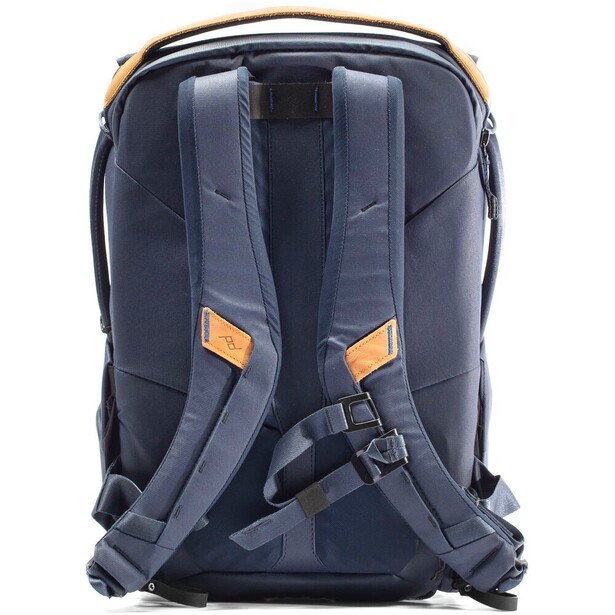
Most camera backpacks announce themselves. The Everyday Backpack V3 20L is the one you can carry into a client meeting, which is not a small thing when your bag lives on your back six days a week. The V3 is the current version, and what Peak Design specifies for it is a 400D recycled nylon canvas shell with a DWR treatment, a 900D waterproof bottom liner, anodized aluminum and glass-reinforced nylon hardware, and three FlexFold dividers in the box.
The access is why people stay loyal to this pack. Two weatherproof UltraZips run down the sides into the main compartment, so the camera is one motion away with the bag slung on a shoulder, and the MagLatch top opens with one hand and adjusts the pack's height as you load it, taking the bag from 17 liters compressed to 20 liters at full extension. The FlexFold dividers fold into shelves rather than flat walls, so a 20-liter bag holds a body, two lenses, a 16-inch MacBook Pro, a charger, and a lunch without any of it rattling. The side straps handle a travel tripod, and our tripods guide covers which ones are light enough to carry that way all day.
What you give up is capacity, weight, and rough-weather confidence. Twenty liters is not much once a camera kit is inside, and the pack has no real hip belt, so this is a bag for a mile of city, not eight miles of trail. It is also not the light option it looks like: 3.66 pounds empty, and 4.43 pounds once the three dividers are installed, which is heavier than the 31-liter WANDRD. The shell is weather-resistant rather than waterproof, and Peak Design does not offer a rain cover cut for this bag. The figures here are Peak Design's own; no Fstoppers reviewer has carried this version for us.
This is the bag for a photographer whose camera is part of a normal working day rather than a separate expedition, so check the current price of the Peak Design Everyday Backpack V3 20L at B&H. Also consider the Peak Design Everyday Backpack V3 30L if you want the same design with room for a second body and a change of clothes.
What We Like
- Dual side hatches make one-shoulder camera grabs effortless
- MagLatch top takes the pack from 17 L to 20 L and back
- Three FlexFold dividers included, and they turn a small bag into a well-organized one
- Looks like a normal backpack, not a camera bag
What Could Be Better
- No rain cover, and Peak Design does not make one for it
- No meaningful hip belt for heavy loads
- Heavy for its size: 4.43 pounds with the dividers in
- Expensive for 20 L of space
Best Premium Pack: Gura Gear Kiboko 2.0 30L+
- Capacity: 30 L
- Weight: 4.05 lb (1.84 kg)
- External dimensions: 12.6 x 20.47 x 6.69 in (32 x 52 x 17 cm)
- Laptop and tablet: laptop sleeve up to 16 in (the plain 30L has no laptop sleeve)
- Camera capacity: two DSLR bodies with seven lenses, a body with a 400mm f/2.8 attached, or unattached lenses up to 800mm
- Materials and weather protection: water-resistant X-Pac VX-21 shell with a VX42 reinforced base, Atilon foam dividers
- Included: dividers, removable waist strap, and a rain cover
- Price: $459.95 (B&H)
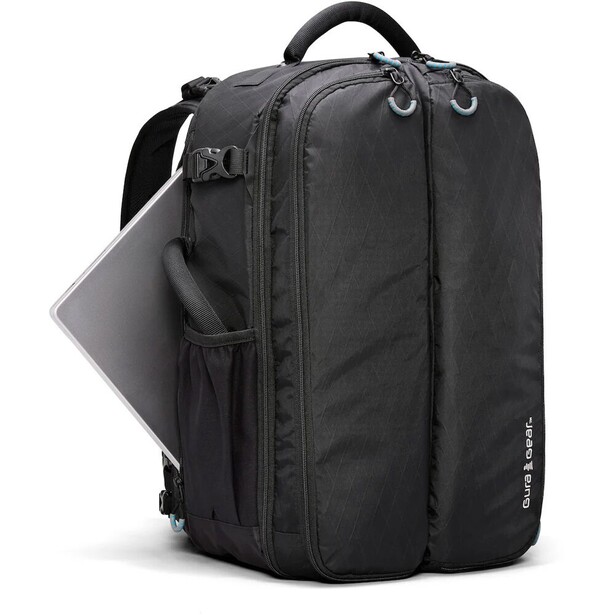
Here is the number that explains why wildlife photographers keep buying Gura Gear: 4.05 pounds for a 30-liter pack rated to carry two bodies and seven lenses, with the dividers, the waist strap, and the rain cover already in the box. The Think Tank that swallows a comparable professional load weighs nearly a pound more before you add anything, and on a bush flight with a 15 kg baggage allowance, a pound of bag is a pound of lens you left home. The Kiboko 2.0 30L+ gets there with an X-Pac VX-21 shell, a sailcloth-derived laminate far lighter than ballistic nylon at similar tear strength.
The butterfly opening is the signature. Rather than one big lid, the front splits into two independently zipped panels, so you open the left half to grab a lens while the right half stays closed against wind, rain, and dust. Anyone who has opened a full camera bag in a dust cloud understands why that exists. The Atilon foam dividers are stiffer and lighter than standard padding, the interior is long enough at 20 inches to take an unattached 800mm super-telephoto, and the 30L+ designation means it includes a 16-inch laptop sleeve, which the plain 30L does not.
The price is the obvious weakness: this is the most expensive pack here, and it is a specialist tool. The suspension is respectable but not a mountaineering harness, so a Shimoda still carries a heavy load more comfortably uphill. There is no side access, so quick grabs mean setting the pack down. The case here rests on Gura Gear's current specification and a design built specifically for long-lens wildlife kits, not on Fstoppers field time.
If you fly to shoot wildlife and every gram counts against a weight limit, nothing else here is close, so check the current price of the Gura Gear Kiboko 2.0 30L+ at B&H. Also consider the Gura Gear Kiboko 2.0 22L+ if your longest lens is a 100-400mm and you want an even lighter pack.
What We Like
- Light for its capacity at 4.05 pounds
- Butterfly panels keep half the bag closed to the weather
- Takes an unattached lens up to 800mm, or a body with a 400mm f/2.8 mounted
- X-Pac shell, 16-inch laptop sleeve, dividers, and rain cover included
What Could Be Better
- The most expensive pack in this guide
- No side access for fast grabs
- Harness is not a trekking suspension
- Specialist design that is wasted on a one-body kit
Best for Hybrid Photo, Video, and Drone Kits: PGYTECH OneGo 2 Backpack 25L
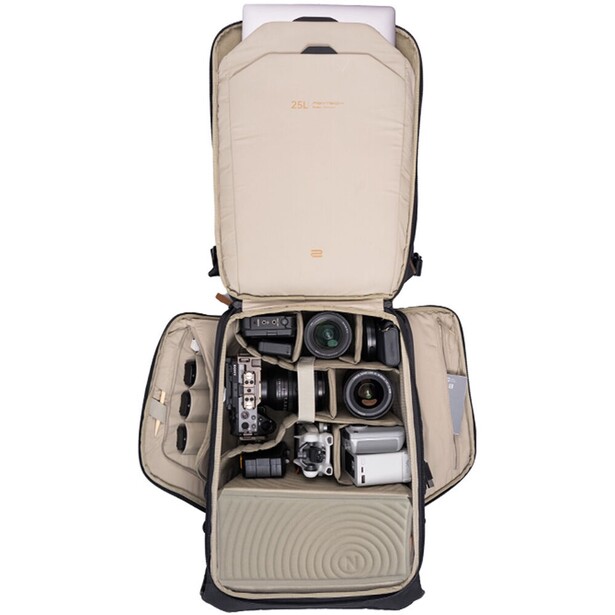
- Capacity: 25 L (a 20 L version is also sold)
- Weight: 3.41 lb (1.55 kg) without dividers
- External dimensions: 19.68 x 14.17 x 7.87 in (50 x 36 x 20 cm)
- Laptop and tablet: laptop up to 16 in, 12.9-inch tablet sleeve
- Camera capacity: two bodies and seven lenses, or two bodies, four lenses, and a Mavic Mini Fly More Combo
- Materials and weather protection: PU-coated, water-repellent 100% polyester
- Included: dividers; no rain cover and no waist belt
- Price: $239.95 (B&H)
Plenty of photographers now leave the house with a camera, a couple of lenses, a small drone, a microphone, and a laptop, and most camera backpacks treat the drone as an afterthought you wedge in sideways. PGYTECH builds drone accessories for a living, and the OneGo 2 25L is rated for two bodies and seven lenses, or two bodies, four lenses, and a full Mavic Mini Fly More Combo with its controller and batteries.
It is also the quiet value pick of this guide. It undercuts the Peak Design and WANDRD packs, includes its dividers, holds a 16-inch MacBook Pro and a 12.9-inch iPad Pro in dedicated sleeves, and weighs 3.41 pounds. A 180-degree rear clamshell gets you into everything at once, the one-piece molded back panel breathes, the shoulder straps are wide and thick, and a side quick-access opening means the camera comes out without taking the pack off. If you fly a drone as part of the job, our camera drones guide covers what should be going into that compartment.
Where it gives ground is the harness and the weather kit. PGYTECH ships the 25L with no waist belt at all, so this is a pack for a day of shooting rather than a long carry under load, and no rain cover comes with a shell that is water-repellent rather than waterproof. The stated weight also excludes the dividers, so the number on your back is higher than 3.41 pounds. The specifications here are PGYTECH's current published figures.
This is the pack for the hybrid shooter with a drone and a mic kit who does not want to pay flagship prices, so check the current price of the PGYTECH OneGo 2 Backpack 25L at B&H. Also consider the PGYTECH OneGo 2 Backpack 20L if you carry one body and want a smaller footprint on your back.
What We Like
- Laid out for a drone kit alongside camera gear
- Side access hatch and a 16-inch laptop sleeve
- Dividers included at a price well under the flagship packs
- Clean styling that does not read as a camera bag
What Could Be Better
- No waist belt in the box, so heavy loads sit on your shoulders
- No rain cover included
- Quoted weight excludes the dividers you will actually use
- Water-repellent, not waterproof
How to Choose a Camera Backpack
Start with access, the decision you live with every time you shoot. Rear-panel access puts the opening against your back, keeping zippers out of the dirt and away from pickpockets, and it forces you to take the bag off to use it. The Think Tank BackLight and the Gura Gear Kiboko are the two packs here with no side port at all, so with either one a lens change is a stop, not a motion. Everything else in this guide gives you a side hatch as well: the WANDRD, the Peak Design, and the PGYTECH are built around it, while the Lowepro, the Shimoda, and the Nomatic add a smaller side port to a rear-access design. Decide which failure you can tolerate, a slower grab or a zipper a stranger can reach.
Then be honest about how far you walk. If your longest carry is from a parking spot to a venue, ignore suspension entirely and buy on access and looks. If you walk miles with a loaded pack, the hip belt is the only spec that matters, because a real belt puts the weight on your hips instead of your trapezius muscles, and an adjustable torso length lets that belt sit on your hip bones. Only the Shimoda and the Think Tank here have suspension built for that job.
Capacity is the spec people over-buy, and it is measured misleadingly. A 30-liter camera backpack does not have 30 liters of camera space, because the laptop sleeve, the pockets, and the padding eat into it. Think Tank quotes 11 liters of daypack space in the BackLight 36L for exactly this reason. Compare camera compartment dimensions, not headline liters.
Two more things. Check the laptop size first, because it silently disqualifies bags: the Flipside stops at 13 inches, the McKinnon's internal sleeve at 14, and most of the rest take a 16-inch machine. Then check what is in the box. WANDRD and Shimoda sell the shell without the camera insert, and Peak Design, WANDRD, Nomatic, and PGYTECH all omit a rain cover, so the true price of a working setup runs above the sticker. Lowepro, Think Tank, and Gura Gear include both.
What We're Looking For
Our picks weigh access design, how the load is carried, the ratio of camera space to life space, build quality and weather protection, and what the pack costs once you have added the parts it does not ship with. We favor bags that solve one job well over bags that claim to solve all of them. On testing, we are being straight with you: the entries above are written from each manufacturer's current published specification rather than from hands-on time with that exact pack, and every entry says so rather than implying a testing history we do not have. Where a figure could not be confirmed against a primary source, it is not in the guide. Prices are the current B&H figures and will move.
Frequently Asked Questions
How Big a Camera Backpack Do I Actually Need?
Most photographers need less than they buy. A 20-liter to 25-liter pack holds one body, two or three lenses, a 16-inch laptop, and a day's personal items, which covers most shooting. Move up to 30 or 36 liters only if you carry two bodies, a long telephoto, or clothing for a trip.
Are Camera Backpacks Waterproof?
Almost none of them are. The packs here are water-resistant or water-repellent, which handles drizzle and light rain, and the zippers are the weak point on all of them. For sustained rain you need a rain cover, and only Lowepro, Think Tank, Gura Gear, and Shimoda include one. WANDRD sells its Rainfly separately, and Peak Design, Nomatic, and PGYTECH ship their packs here without a cover at all.
Is Side Access Worth Paying For?
It is if you shoot while moving. A side hatch lets you swing the bag onto one shoulder and pull the camera out in seconds, which is the difference between catching a street moment and watching it pass. If you shoot from a tripod or in dirty, crowded environments, rear-panel access is more secure and you lose nothing.
Can I Take a Camera Backpack as an Airline Carry-On?
Usually, but check the numbers rather than the marketing. The WANDRD PRVKE 31L V4 (18.5 x 12 x 6.5 in), Shimoda Explore v2 35 (21.2 x 11.6 x 7.8 in), and Gura Gear Kiboko 2.0 30L+ (20.5 x 12.6 x 6.7 in) all sit inside the common 22 x 14 x 9 in US allowance. The PGYTECH OneGo 2 25L is a fraction over on width at 14.17 in, and the Nomatic McKinnon 35L V2 and Think Tank BackLight 36L sit right at the limit, so all three can be challenged on stricter international carriers, especially when expanded.
Do I Need a Camera-Specific Backpack at All?
No. A camera cube dropped into a normal backpack works if you rarely carry more than a body and one lens. What you lose is fast access, structured protection, and a harness designed for a dense, heavy load, all of which matter the moment your kit grows. Our beginner cameras guide covers where that money is better spent early on.
Fstoppers may earn a commission from purchases made through links in this article. Our picks are made independently by our editorial team.