The age of AI has been widely viewed as a direct attack on photographers and artists, and while off-the-cuff advice like "adapt or die" may seem practical, it misses the greater picture. Working photographers need to redefine their value by showing where their humanity and vision shine through in ways technology cannot replicate.
The birth of photography was a major disruption when it arrived in the 1800s. For painters, photography was seen as a direct threat to their livelihoods. In his video, Blake Rudis explains that photography was initially viewed as a soulless contraption that required no skill, no artistic vision, just a mechanical tool that any unskilled person could use. Because the camera could capture a scene with the push of a button, critics disqualified it from being real art.
But pioneers pushed photography's boundaries away from realistic scenes and opened up artistic expression. The Pictorialists, with photographers like Alfred Stieglitz, emphasized darkroom processes to create painterly effects, arguing that their goal was expression and therefore art.
Rudis introduces the next disruption: Kodak's Brownie camera in 1900, the first camera priced for the general public. Skipping ahead more than a century, the 2000s brought digital photography, and once again, the "now it's too easy" argument crept in from film shooters. Then came the iPhone and mirrorless systems, putting capable cameras in everyone's pocket, with professionals watching clients say, "My nephew has an iPhone; he can shoot our event."
But despite all the hand-wringing, photography didn't disappear. Professional photographers didn't vanish when the Brownie arrived, or digital, or the iPhone. What happened wasn't extinction — it was evolution. When the tool became more accessible, photographers had to figure out what they brought to the table beyond just owning equipment. Each disruption was about access, and with access came the need to reevaluate. Professionals had to offer vision, technique, and an eye for composition that the casual snapshooter didn't have. The technology got easier, so photographers had to get better at the parts technology couldn't replicate. In short, it was an identity crisis that had to be resolved to survive and move on in the new landscape.
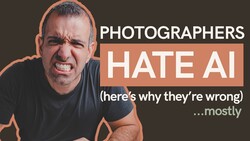
AI fits well within the disruption cycle. And what do working photographers need to do to survive the AI apocalypse? That's exactly what Blake Rudis tackles in his video. He talks about a practical framework for how photographers can adapt in a landscape where AI-generated imagery is becoming the norm. If you're wondering how to navigate this, watch the video above.



Join the Fstoppers community for free
-
Post comments and join in the discussions
-
Browse the site ad-free
-
Share your work and get featured in the community
-
Compete in the photo contests for fun and prizes
2 Comments
Wow alot to unpack. I feel like this video is very important for a lot of frustrated creatives to see.
The problem is that not all disruptions throughout history are the same, and each one gets progressively smarter, more capable of producing superior professional-like images, and, I daresay, more human. At least that's the great fear of AI, which is that it will have the same ability to create as a human. Arguably without the human emotion behind it, but creative nevertheless.
The Kodak Brownie did not eliminate professional grade photography... mostly portraits at that time. The ordinary person could make snapshots, but the people who bought a Brownie probably weren't of the economic class to spend a lot of money on a professional portrait anyway, or it was a toy, so technology merely added to the marketplace for photography rather than take much of a bite out of it. Advertising campaigns were not photographed with a consumer Kodak Instamatic, so there was a distinct job opportunity for professionals throughout the 20th century.
That pretty much ended with digital camera technology, which put a significant dent into professional photographer's income. Stock photography prices plummeted. Far more people could become expert photographers with much less investment in equipment and overall costs of doing business. For those who are trying to make a living from photography nowadays, the competition from untrained individuals with a smartphone is undeniably a catastrophe. Realtors in my area are shooting virtually all low-to-mid priced homes themselves. Headshots are created with an iPhone. Commercial product shots are constructed using AI tools.
Of course, there's the potential for human photography in high-end commercial campaigns, or portraits, but the market is getting far more squeezed than ever before, because... innovation is getting progressively smarter and more competent. I would have to think twice before recommending my 21 year-old self that he launch any kind of a photography business today.