






















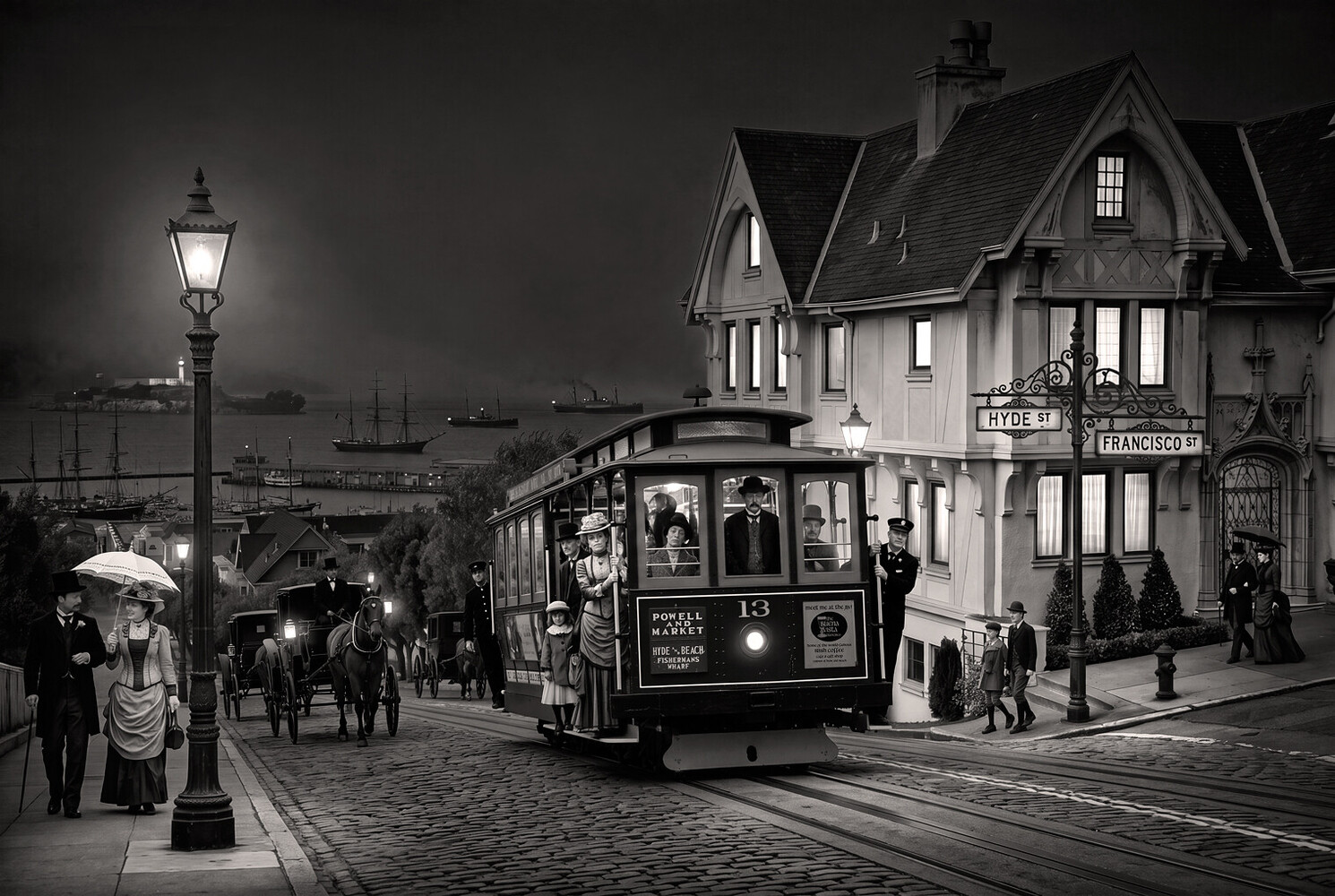
This is the third Victorian era version of my San Francisco street photo. I made the first version entirely in Photoshop, combining my original with Victorian characters sourced from the US Library of Congress. After speculating on whether AI could do a better job, I made the second version in color with Nano Banana 2. As I said in my comments for that contest entry, the AI image looked a bit surreal, sort of like a Thomas Kinkade print. I certainly wasn't convinced that AI was going to be anything I'd take seriously for my own photography.
However, after converting to black and white, everything changed for me. The image looks more real to me, probably because the pictures we have from that era are in black and white, not color. I went ahead and made a print and immediately loved it. It felt like opening Photoshop for the first time way back in 1991. In fact, this was the first sense of excitement from using new software that I'd experienced in more than a decade. It's not perfect, in the sense that every compositional element and positioning in a photograph is controlled precisely by the photographer. I've been debating recently with another Fstoppers member whether it's appropriate to even call AI a photograph. But it's been like walking into a Jules Verne story, and there's a place for that. Call it computer generated imaging if you prefer, but it's still a picture prompted by some imagination.
Which do you like better, color or black and white?
Click on the thumbnails below to comment and rate each image.
Click here to learn about the Fstoppers rating system and what each star value means.
4 Comments
San Francisco, California. The original photo shot with a Nikon D800E.
I found myself researching when various elements in this picture were first used, just to make sure they actually existed in the late 1800s.
Here are a few items that I found:
The first steamship visiting San Francisco was in 1847.
Alcatraz was built in 1853 as a U.S. military fortress and lighthouse.
Fire hydrants were first installed in San Francisco around 1858.
The first cable car in San Francisco was introduced in 1873.
The first electric house lights in San Francisco appeared in 1878.
The first electric street lamps in San Francisco appeared in 1879.
Many of San Francisco’s street cobblestone and paving blocks were replaced with asphalt and concrete beginning in the early 1900s.
Asphalt roofing shingles were invented in Grand Rapids, Michigan in 1903 and saw widespread use in San Francisco following the 1906 earthquake. In the late 1800s, most houses were built with wood roofs, with a few upscale Victorian homes using natural slate tiles.
This is super interesting!
Thanks, Marian. The date I found most surprising was the fire hydrants. In my original AI instructions, I asked it to remove the fire hydrant along with modern cars and people, assuming that if fire hydrants had been present in the 1906 earthquake, the city wouldn't have been destroyed by fire. It was the fires that broke out after the earthquake, rather than the earthquake itself, that destroyed much of San Francisco.
Turns out they did have fire hydrants in 1906 but the earthquake ruptured most of the rigid underground water lines, cutting water pressure to nearly nothing. I knew that roofs were mostly made of wood because that was a major contributing factor in the fire spreading from house to house. The military, in trying to stop the fires by blowing up buildings along a few streets to create a fire break, inadvertently sent more sparks flying everywhere and started more fires. The 1906 disaster led to a great many improvements in the engineering of pipeline materials and design.