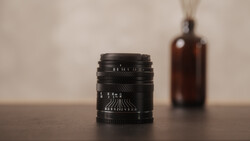
Laowa's ACRIS 35mm f/2.8 1X Macro APO reaches 1:1 magnification at a focal length that keeps the background, the sky, and the setting in the frame while your subject fills the foreground. Wide angle macro is a small niche, and the lenses built for it often ask you to accept unusual compromises in exchange for that perspective.
Autofocus on the Laowa ACRIS 35mm f/2.8 1X Macro APO works only from about 50 cm out, so once you get close enough for real macro work, you're focusing by hand. Christopher Frost tests that arrangement on a Sony a7CR and finds the switching can get tedious, since you have to click the focus ring over to manual as soon as you approach your subject. The ring is mechanically coupled to the focus group, which makes small adjustments feel direct and precise. Turn it fully to the right, and a gentle click engages autofocus on the Canon EF, Nikon Z, and Sony E versions, while the L-mount and Canon RF versions are manual focus only. Frost found autofocus speed average in good light, with misses and some hunting when the light dropped.
Up close, the results shift dramatically. At 1:1 on a banknote, Frost sees excellent sharpness at f/2.8, with better contrast than the lens shows at normal distances. Stopping down to f/4 adds a touch more sharpness, though some color fringing sticks around through f/8, and diffraction softens the image at f/11 and f/16. That puts the usable aperture range for life-size work at the wide end, which is a different habit than many people bring to macro.
At 1:1, the light reaching the sensor drops by about two stops compared with the same lens focused at infinity, so f/8 on the camera behaves closer to f/16 for both exposure and diffraction. Through-the-lens metering hides the exposure loss, but the softness still shows up. A lens that resolves fine detail wide open at macro distances lets you shoot at f/2.8 or f/4 and build depth of field with focus stacking instead of stopping down. Many current bodies, including the a7CR, offer focus bracketing in camera, and a mechanically coupled ring makes manual stacking smooth when you'd rather control each step yourself. Working distance is the other practical factor. With a 35mm lens at life size, the front element sits very close to the subject and often casts a shadow on it, so a small LED panel or a flash on an off-camera cord placed to one side, plus a flexible diffuser, tends to work better than lighting from the camera position. Laowa has served this corner of macro before with its Laowa 15mm f/4 Wide Angle Macro, and the Canon RF 24mm f/1.8 Macro IS STM offers a similar wide perspective at half life-size. Wide macro gives you a bug's-eye view that places a small subject inside its environment, which a 100mm macro lens can't do.
The lens is all metal and finished in Laowa's purple-blue paint, with a weather-sealing gasket at the mount and a USB-C port for firmware updates. At about 530 g, it's heavy for a 35mm f/2.8 lens. An autofocus hold button is supposed to attempt focus at macro distances when held for a couple of seconds, according to Laowa, though it didn't help on Frost's early production copy. There's no aperture ring on the Sony version and no optical stabilization, though it paired fine with in-body stabilization, and the filter thread is 72 mm. At normal distances, the center is sharp at f/2.8 but low in contrast until you stop down to f/4, and the corners show heavy vignetting and color fringing wide open. Frost goes on to test how the lens handles the camera's APS-C crop mode, bright light sources, coma, sunstars, bokeh, and chromatic aberration, which puts the APO name to a direct test.
The video above walks through each of those results in detail, so give it a look before you decide whether this lens fits the way you shoot close-ups.





Join the Fstoppers community for free
-
Post comments and join in the discussions
-
Browse the site ad-free
-
Share your work and get featured in the community
-
Compete in the photo contests for fun and prizes
1 Comment
Cropping the Tamron 24mm would give you 0.75 magnification in APSC mode, though you lose about a stop of light and resolution. On a7cr it should be comletitive if anyhow you close the aperture