

In Miami in May 2023, Marvin Joseph asked Chris Evert and Martina Navratilova to put their heads together and lean on each other, and he made a portrait of two old rivals bound again by cancer. Joseph said it took off in a way he had not expected, pulling traffic and new subscriptions behind it. On February 4, 2026, The Washington Post eliminated the job that produced it, along with every other staff photographer position at the paper.
Eight Photographers and Eight of Fourteen Editors
The National Press Photographers Association posted a statement dated February 4, the day the notices went out, and the trade press and the photography forums took their counts from it. An earlier version of that statement put the loss at nine staff photographers and half of a twelve-person photo desk. The association corrected the figures the next day, and the statement now reads that the Post laid off all eight of its staff photographers and eight of its fourteen photo editors. Hyperallergic, which reached Joseph by phone the day after the cuts, also counted eight staff photojournalists.
Eight of fourteen is 57 percent of the editing bench, and it leaves six people to handle the visuals of a national newspaper. The photographers are the line with no remainder. The Post still runs pictures, from wire services, from freelancers it commissions one assignment at a time, and from a photojournalism fellow, Maxine Wallace, whose Post photo credits have continued through 2026. What ended on February 4 was the staff photographer, the standing job whose whole purpose was to go out and make them.
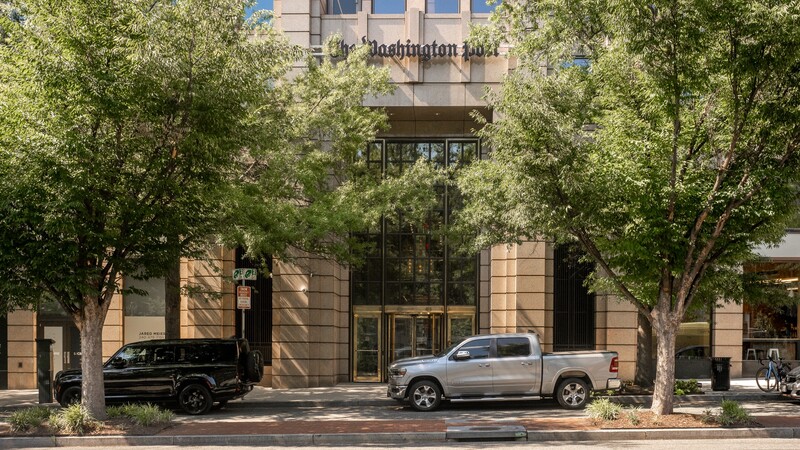
The scale around that number was not exaggerated. Layoff notices began landing on Wednesday, February 4, and the first reports put the cut at about a third of the newsroom. The Washington-Baltimore News Guild's own count, reported by Washingtonian five days later, was larger: 350 to 375 journalists out of a newsroom of about 790, or 44 to 47.5 percent. Sports went. Books went. Staff photography went as a unit rather than as a list of individual names. Three days after the notices, publisher and chief executive Will Lewis stepped down, and chief financial officer Jeff D'Onofrio took over in an acting capacity. The Post did not answer questions about the cuts.
What a Staff Photographer Actually Cost
The Post published what it was willing to pay for the thing it deleted. The last time the paper advertised the job on its own careers site, in May 2025, the listing carried a salary band of $92,600 to $138,800 for a staff photographer in the Washington newsroom, with night and weekend shifts attached. What the eight people who lost those jobs were actually earning has never been made public.
Salary is not what an employer spends. The Bureau of Labor Statistics tracks the gap in its Employer Costs for Employee Compensation series, and for March 2026 it found that wages and salaries made up 69.9 percent of private-sector employer costs per hour worked, with benefits accounting for the other 30.1 percent. That is an average across all of private industry rather than a figure for the Post, whose benefit load nobody outside the company knows, so treat it as a yardstick and not as the paper's books. Divide the band by 0.699 and you get an approximate all-in cost. The bottom of that range runs a company about $132,000 a year. The top runs about $199,000.
On that arithmetic, eight such jobs come to somewhere between roughly $1.06 million and $1.59 million a year. Take the top of it. That is the entire staff photographer corps of a national newspaper in the capital, and it is a rounding error against a payroll that just shed 350 to 375 journalists. The photo staff was never the expensive part of the ledger. It was the legible part, because a department is a single line in a spreadsheet and deleting it costs no bylines on page one.
The Feed That Was Supposed to Replace Them
The replacement logic works on its own terms. A wire subscription is billed as a standing fee rather than per photograph, and what it buys is enormous. The Associated Press reports in its 2025 annual report that it moved 1.34 million photos that year, part of roughly 5,000 pieces of journalism a day, more than 80 percent of it visual, to customers in 126 countries. That averages out near 3,670 frames a day moving on the wire. A metro daily can fill its news pages, its sports section, and its home page out of that feed without anyone leaving the building.
Much of what the feed contains is scheduled events. A wire photographer stands in the same press pen at the same hearing and files the same competent frame, and for most of a daily's needs that is genuinely sufficient. What no wire subscription contains is an assignment. Nobody at a wire service decided that two tennis players in remission should be photographed leaning against each other in Miami, because that idea belongs to a specific newspaper making a specific argument to its own readers. The Post's six remaining photo editors now build pages mostly out of pictures that were commissioned by other institutions, for other reasons, on other people's news judgment.

The assumption underneath it is that the feed is a fixed natural resource. It is not. On April 6, 2026, the AP offered buyouts to more than 120 unionized staffers, most of them on the U.S. news team, in a restructuring the cooperative said would touch under 5 percent of its global news headcount. Executive editor Julie Pace told staff, in a note reported by TheWrap, that the division tied to newspaper groups now makes up less than 10 percent of the AP's business, with the majority of revenue coming from broadcasters, digital outlets, and technology companies. Newspapers are no longer the customer the wire is built around.
Photo and video came next. On August 20, 2026, Poynter reported that the AP would lay off 20 U.S. video production staff that Friday and move the work to a new hub in Noida, India, with 10 U.S. photo editors and 10 London video production staff also marked for elimination on a timeline the union had not been given. Tony Winton, executive director of the News Media Guild, put the risk in terms of institutional knowledge rather than headcount, warning that people who had spent decades building context and skill would be swapped out for staff who did not have it. The feed being asked to stand in for the Post's picture desk is cutting its own photo editors, and the number of American photo editors standing between a frame and a front page is falling on both sides of the transaction.
What a Stringer Has to Charge
That leaves the freelancer. When the Columbia Journalism Review surveyed 30 freelance photojournalists in 2017 about pay and treatment at major outlets, the day rate they reported for the Post was $350. Assume generously that it has moved since. The structure of the problem has not.
To gross the $132,000 that the bottom of the Post's own staff band implies, a stringer billing $350 a day needs 378 billing days. There are 365 in a year. Of the 260 weekdays, minus about eleven holidays and a few weeks for vacation and illness, roughly 234 are available, and an editorial freelancer who bills half of those is busy. At 120 billable days, matching that $132,000 figure requires about $1,104 a day. At $350, those same 120 days gross $42,000.
Out of that $42,000 come the costs the staff job absorbed silently. A self-employed photographer pays both halves of Social Security and Medicare, 15.3 percent assessed on 92.35 percent of net self-employment earnings, an effective 14.13 percent against the 7.65 percent withheld from a paycheck. On $32,000 of net earnings after overhead, that is roughly $4,520 to the IRS before a dollar of income tax. Health coverage moves onto the photographer's own books, and the BLS figures put the employer's share of health insurance alone at $3.41 per hour worked in private industry, about $7,090 a year at full time. Paid leave, which for a freelancer is simply an unbilled day, averages $3.54 an hour, another $7,360. Retirement contributions average $1.57, about $3,270 more. None of that touches bodies, glass, repairs, liability insurance, mileage, or the second camera you carry because the first one will eventually fail in the rain.
Each pricing model protects a different side of the transaction. A wire subscription converts photography into a fixed annual line item that does not move when the news does, which is precisely why a finance department likes it. A day rate converts photography into a variable cost that the paper incurs only when an editor decides a story is worth a picture, which means the decision to make a photograph now competes, story by story, against the free option already sitting in the feed. The staff photographer was the arrangement in which somebody was paid to go looking before anyone had decided the story was worth it.
Pricing all of that honestly is a skill, and it is the skill the industry has spent twenty years telling photographers not to bother developing. If this market is where you are headed, the business side deserves more study than the shooting does, and Fstoppers' Making Real Money course is aimed at the arithmetic rather than the light. The staff job hid every line of it. The freelance version hands you the whole spreadsheet and calls it independence.
Who Owns the Picture Now
The trade does give one thing back, at least on paper. Under 17 U.S.C. § 101, a work made for hire includes anything an employee produces within the scope of employment, and § 201(b) vests that copyright in the employer. Every frame those eight photographers made for the Post belonged to the Post. Commissioned work is different: a freelance photograph becomes a work for hire only if it falls into one of nine specific categories and the parties agree to the arrangement in a signed written instrument. One of those nine categories is a contribution to a collective work, which is exactly what a newspaper issue is. The exit ramp exists, and using it takes a written instrument signed by both sides. Individual publishers do not publish their freelance terms, so read the contract you are handed rather than the statute you hope applies to it.

Joseph started at the Post in 1996 as a news aide. Back then, he said, the picture desk ran around 35 photographers. He told Hyperallergic that the cut was "a shocker." "I really thought maybe we would die another day," Joseph said. He traced the shrinking of newspaper photo staffs to a change in how news gets consumed and to the rise of social media. "I think in some ways, quality gave way to the need for speed," he said. "We have to take pictures much faster now."
In late August 2026, The Washington Post's careers site listed 41 open positions. There is an Op-Ed Editor, a Graphics Assignment Editor, a News Designer on the West Coast, a Print Desk Designer on contract, a CDL circulation driver, a diesel mechanic, and, among the newest listings, a Chief AI Officer. There is no photographer. The other habit Joseph described belongs to the job that used to exist, the one that came before speed: you waited until the bitter end for something to happen. Nobody bills for the waiting, which is why nobody is doing it.
Lead image by Tony Webster, CC BY 2.0. Source.



Join the Fstoppers community for free
-
Post comments and join in the discussions
-
Browse the site ad-free
-
Share your work and get featured in the community
-
Compete in the photo contests for fun and prizes