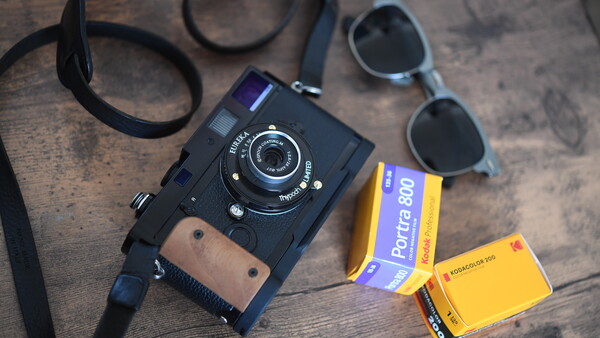
There's an advantage to a small camera that doesn't call attention to itself: you can become the gray man. Not invisible or undercover; not some photographic ninja.
Just… unremarkable. In documentary and news photography, that can be useful. During a protest, around a tense police operation, or simply in a scene where emotions are running high, the last thing you necessarily want to be is the guy with two enormous professional zooms hanging off his body and a camera bag that looks like it contains enough equipment to photograph the Super Bowl. People notice that.
And when people are angry, frightened, exhausted, or simply convinced that photographers are somehow part of the problem, being noticed can become a problem of its own. Sometimes people in times of stress look for something, for someone to blame or throw their energy at.
A small camera with a tiny lens changes the equation.
You're still a photographer. You're still visible. You still have to behave responsibly, respect perimeters, and understand that no photograph is worth putting yourself or somebody else in danger; but you don't necessarily have to look like the photographic equivalent of a SWAT team.
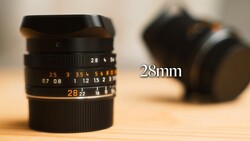
The Thypoch Eureka 28mm lens is particularly good at this. Strapped on my Leica MP, it’s a bit of glass that doesn’t scream “look at me.” One small body. One small lens. No sprawling rig. You can stand there, observe, work quietly and, when the opportunity presents itself, make the photograph.
Sometimes the difference between getting the frame and getting into a physical altercation isn't photographic technique—sometimes it's simply whether somebody decides you're a threat.
A tiny lens doesn't guarantee anything. People still see the press pass, or they’re amped up on adrenaline and are looking for an outlet. Sometimes you just have the bad luck to be in their path and to be that guy, but reducing the amount of hardware you put between yourself and the world can reduce the amount of attention you attract.
For certain kinds of photography, that's a feature.
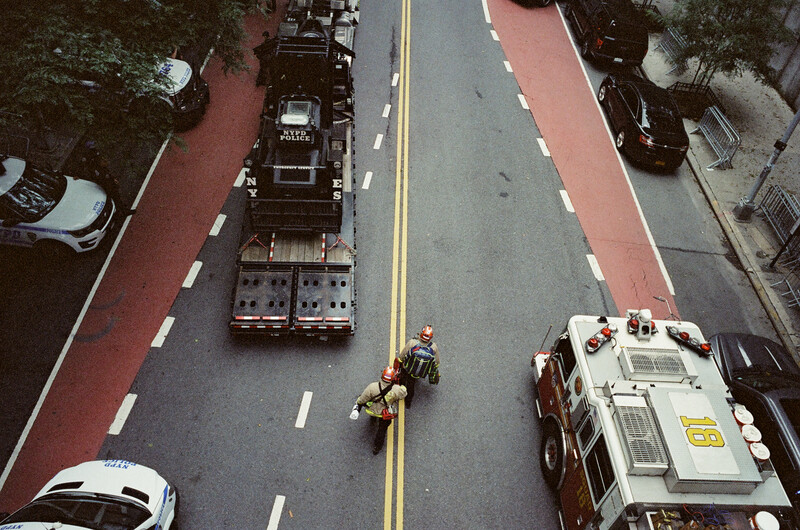
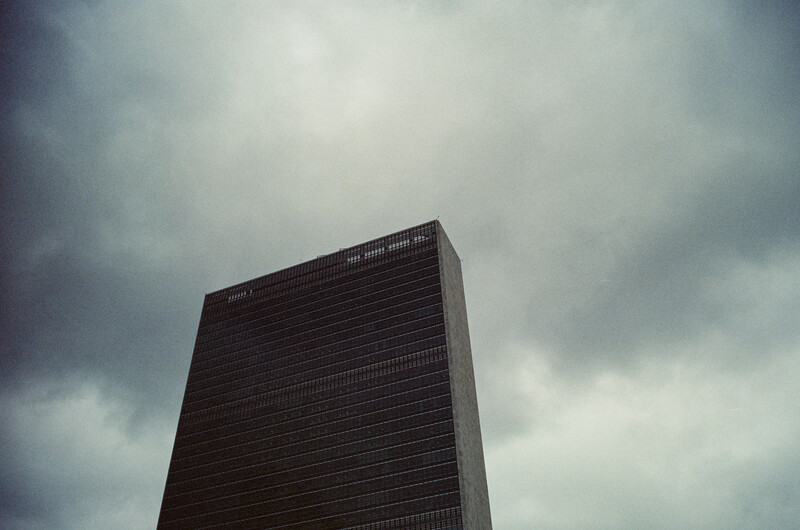
Last month I was on assignment covering a potential building collapse in Midtown when I found myself stuck with the FDNY and NYPD Emergency Response Teams. The streets had been closed off, and the press had been escorted several avenues away.
Somehow, though, I was left alone. I kept my press pass visible, but I didn't push my luck. I tried to tuck myself away and just outside the eyeline of anyone who might give me too long or too hard a look. I wasn’t hiding or trying to pretend I was someone I wasn’t—I just needed to be less interesting than the problem at hand.
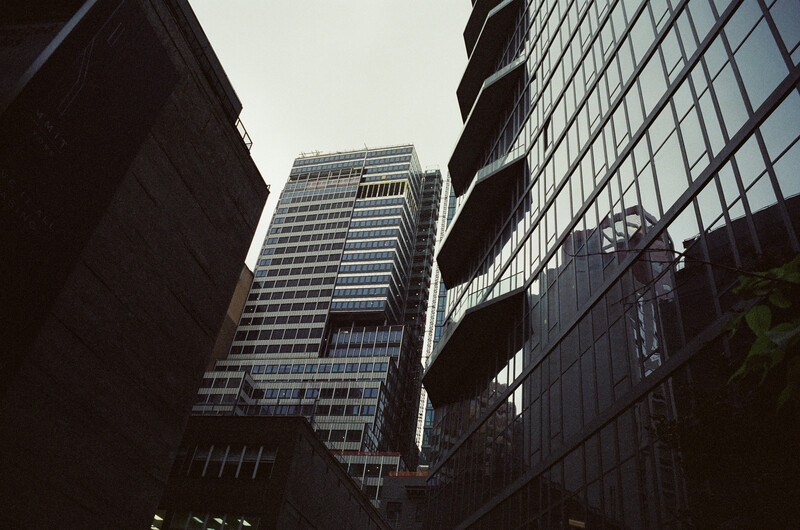
There are moments in New York when you understand very quickly that you are either part of the scene or you're in the way. Firefighters were working; police were watching the perimeter. Everyone had a job. Mine was to catch the scene without becoming another problem somebody had to deal with.
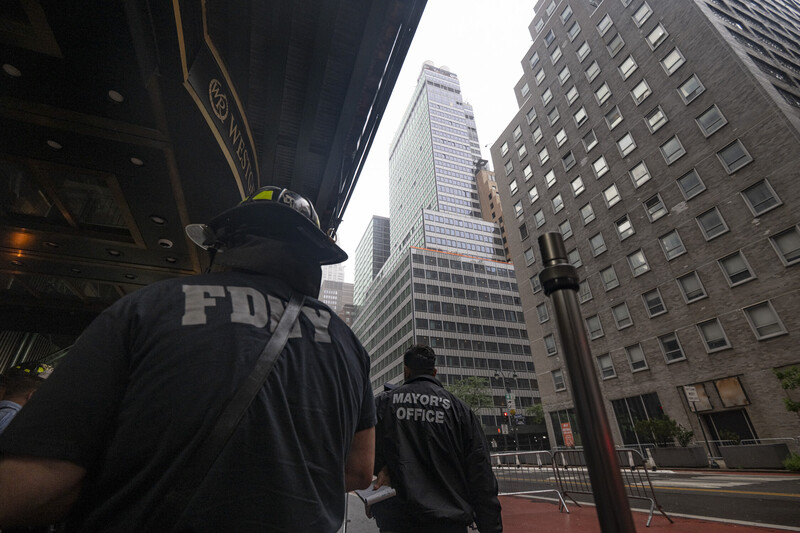
And this is where the Eureka made a difference.
With the little 28mm mounted on my Leica, the whole rig was almost comically unobtrusive. No enormous front element. No long black tube announcing in flashing red lights photographer approaching. Just a small camera hanging against my chest. My Nikon Z 6 and digital setup stayed in my bag—reachable if I needed it, but out of the way for the moment.
I stayed where I was allowed to be and started looking.
The 28mm was exactly right for it. Wide enough to show the machinery of the response: the trucks, the barricades, the uniforms, the building, but not so wide that everything became a postcard of disaster.
I could get close to the action without pretending I was closer than I was. More importantly, nobody seemed particularly interested in the camera.
That matters—a conspicuous camera changes a room. People straighten up; they look at you. They perform, or they decide they don't want you there.
The Eureka largely disappeared against my black jacket. It allowed me to keep shooting. So I kept shooting. Firefighters moving through the frame. Cops talking quietly behind the barricade. The strange stillness that falls over a city block when traffic disappears. The building itself looming above all of it, looking less like architecture and more like a very large problem nobody had quite figured out yet.
This was not a controlled test.
There was no brick wall to test distortion. No tripod. No resolution chart.
There was just Midtown, a potential disaster, a few hundred people trying to keep something from becoming a much larger disaster, and me standing there with a tiny 28mm lens. And I remember thinking: This is exactly why you carry the thing.
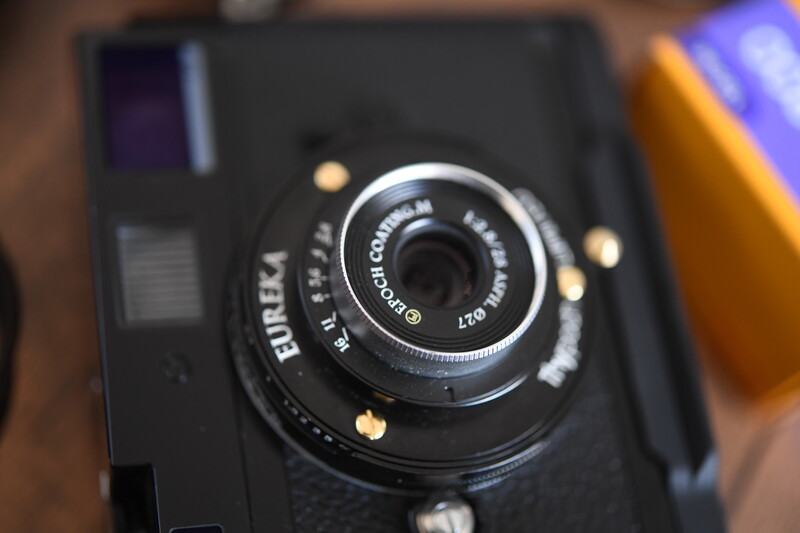
Pancake lenses have always had a difficult job. They're supposed to disappear. That's the entire point.
A big, spectacular lens announces itself. It says: This person is doing photography. A pancake says: Oh, this old thing?
The Voigtländer Color-Skopar 28mm f/2.8 is a terrific example of the traditional approach. It is compact, light, and optically very strong. If your primary concern is extracting the maximum amount of information from corner to corner, it's a formidable little lens.
Before we get too romantic about a little brass pancake, let's acknowledge what is actually inside the thing.
The Eureka uses a 7-element, 4-group optical design, with an aspherical element and high-refractive-index glass. The design is intended to deliver modern sharpness and control of aberrations while remaining extraordinarily compact. So while the lens is, by design, emulating the look of the Dallmeyer Anastigmat 35mm f/3.5 lens found on the Ilford Advocate camera, the internal structure and optical formula are unique and absolutely modern.
The maximum aperture is f/2.8, stopping down to f/16, through an 8-blade diaphragm. Stopped down, those blades can produce defined eight-point sunstars—useful when you're photographing bright point sources, streetlights, the sun catching a building edge, or any of the other little sources of urban light that tend to make photographers behave like moths.
The really unusual specification is the focusing distance.
The Eureka focuses down to 0.4 meters, or roughly 1.3 feet.
For a 28mm pancake, that's remarkably close. It gives the lens another personality entirely when you're working at short distances. You're not limited to the conventional street-photography role of standing back and fitting the world into the frame. You can get physically involved with it.
Thypoch's Epoch Coating M is intended to provide a clean, modern rendering while helping control flare and aberrations. Thypoch also quotes extremely low distortion, at approximately 0.462%.
Those are useful numbers.
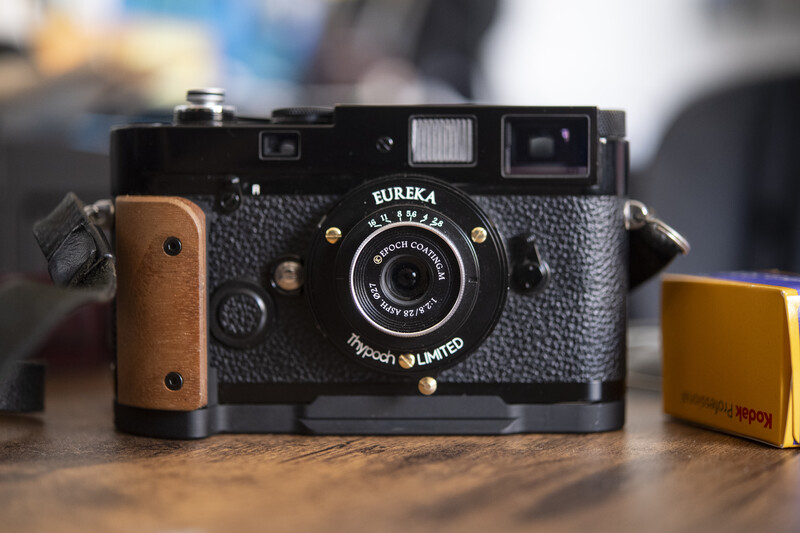
This is where field use matters. A lens this small doesn't merely save space in a camera bag. It removes one of the excuses for leaving the camera at home.
At roughly 21.9 mm thick and 133 g, the Eureka is genuinely an everyday-carry proposition.
You can sling a camera over your shoulder and go to dinner. Walk around a market. Get on a train. Wander through a neighborhood with no particular photographic agenda whatsoever. Or stand on a street corner wondering if a building is going to collapse a hundred feet from you instead of three blocks away.
And because the lens isn't constantly reminding you that you're carrying several thousand dollars' worth of optical engineering on your chest, you can get on with the business of looking.
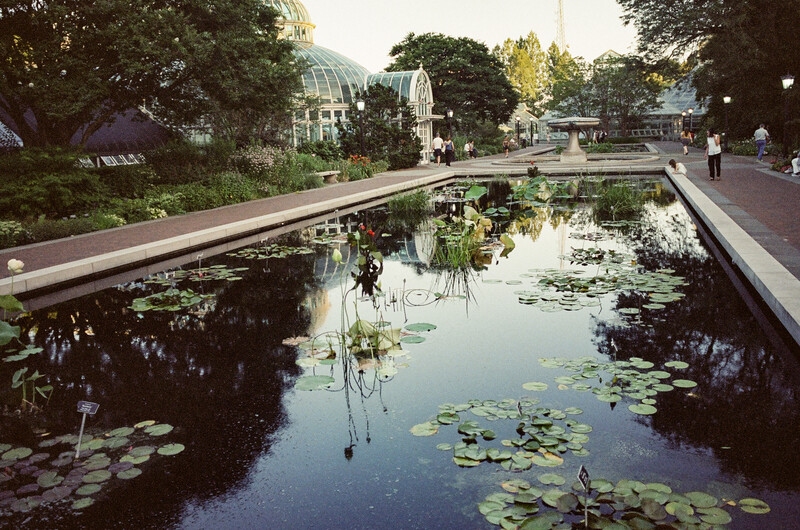
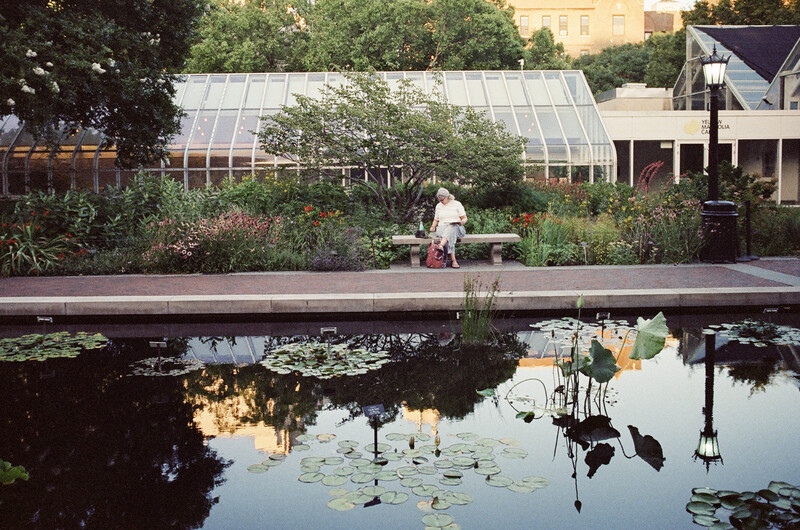
I've always liked 28mm for this sort of photography. Twenty-eight millimeters doesn't merely show you the subject; it shows you what the subject is doing in the room. You're close enough to participate, but wide enough to retain the evidence. A person at a table. The dirty glass beside them. The hand reaching for the salt. The neon sign reflected in the window behind them.
That's the difference between a picture of somebody and a picture of where they were. The Eureka's 28mm field of view is particularly good for this because it encourages proximity.
You don't stand across the street and snipe.
The Eureka focuses down to 0.4 meters: that's close. Very close, considering the size of the lens. And this is where the lens gets genuinely fun. Put the camera on the table; get close to the plate. Shoot a detail and leave enough of the environment in the frame to explain why the detail matters.
The 28mm perspective turns close focusing into environmental storytelling rather than simple magnification. It's not a macro lens, thankfully. It's a lens for getting physically involved with the scene.
Coming back to discuss the optical formula, there's an uncomfortable truth about modern lenses: we're spoiled. We spend enormous amounts of time discussing corner performance at f/4 while standing in places where nobody cares about corner performance at f/4.
The Eureka is sharp. It's particularly convincing in the center, and its performance at close range is better than you might reasonably expect from something this thin. But if you photograph a brick wall and compare it pixel-for-pixel with a stronger modern 28mm (as a single example, the Sigma 28mm f/1.4 DG HSM Art), you may find the stronger modern 28mm wins.
Fine. The brick wall will recover. Meanwhile, you have the photograph you actually wanted. And the Eureka's optical behavior is interesting precisely because it doesn't feel like a giant piece of corrective engineering shrunk down until it became uncomfortable. It has enough modern correction to be dependable, but enough personality to keep things from feeling sterile. That's a good place for a lens to live.
Here's my test for a lens: forget the MTF chart for a moment; forget the crops. Forget whether somebody can find a quarter-pixel difference between it and a lens costing twice as much.
Ask yourself: Would I take this lens out tonight?
The Eureka makes that question very easy. It's small enough that the camera doesn't become an event. The 28mm focal length is wide enough to deal with real life and intimate enough to get close. The f/2.8 aperture is perfectly reasonable for daylight, street work, travel, interiors, and the sort of evening photography where a modern digital camera can comfortably make up the difference.
At $459, the question isn't whether you can find a cheaper 28mm. Of course you can. The question is whether you want this particular combination of optical performance, construction, size, close-focus capability, and tactile character. For me, that's a much more interesting question.
Final Verdict
The Thypoch Eureka 28mm f/2.8 isn't the lens I'd recommend to someone whose primary goal is winning a laboratory comparison. Optically it’s outstanding, but if you’re a pixel-peeper, there are sharper options. There are faster options. Thypoch offers one—the Thypoch Simera 28mm f/1.4 is an outstanding, if significantly larger and heavier, option.
There are probably options that will make your computer's histogram and your internet forum friends considerably happier. But that's missing the point.
The Eureka is a field lens. A walking-around lens. It is small enough to carry, interesting enough to use, close-focusing enough to get involved, and optically good enough that you stop thinking about the lens and start thinking about the photograph.
But more significantly, there's that other quality.
Discretion.
In a world where photographers increasingly arrive looking like mobile production crews, there's something refreshing about carrying one small camera and one small lens.
Become the gray man. Don't draw attention. Don't make yourself part of the story when your job is to document it. Get close when you can. Back off when you should. Be respectful and pay attention to the people around you.
And when the moment comes, make the photograph. That's the real trick. The best lens isn't always the one that produces the best photograph under controlled conditions. Sometimes it's the one that lets you stay in the room. Sometimes it's the one nobody notices until you've already made the picture.
The Eureka gets you there. And once you're out there, 28mm is a pretty good place to be.
Highly recommended for: street photography, documentary work, news, travel, everyday carry, Leica M shooters, and anyone who believes a camera should be something you take with you rather than something you occasionally remember to pack.
Less ideal for: pixel-peeping competitions, people who require f/1.4, and anyone who thinks the corners of every photograph should be as clinically perfect as the center.



Join the Fstoppers community for free
-
Post comments and join in the discussions
-
Browse the site ad-free
-
Share your work and get featured in the community
-
Compete in the photo contests for fun and prizes
2 Comments
Not sure how putting an unknown lens on a $7,000 Leica makes one disappear into the background. I suppose most people don't even know what a Leica is. At least when I venture forth my silver Df with an old MF Nikkor, people assume it's a film camera.
Part of it comes down to just using smaller gear. The MP with a small, pancake lens is going to draw a lot less attention than a pair of Z9 bodies. I still kept those within reach inside my bag, but really sometimes you just need to take whatever small advantage you can get.