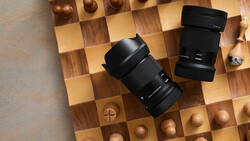
Choosing the right zoom lens for your camera isn't straightforward, especially when the options have different strengths. Sigma's recent APS-C releases, the 17-40mm f/1.8 DC Art and 18-50mm f/2.8 DC DN Contemporary, offer very different benefits, making the decision tougher but more interesting.
Coming to you from Curtis Padley, this detailed video puts the Sigma 17-40mm f/1.8 DC Art and 18-50mm f/2.8 DC DN Contemporary lenses through their paces, awarding points across various categories such as build quality, size, image quality, and features. Both lenses receive praise for their solid construction, but the 17-40mm edges ahead thanks to its superior weather-sealing and thoughtful additions, like custom buttons, an AF-to-MF switch, and a versatile aperture ring. However, these extras come with a trade-off: the 17-40mm is heavier at 535 grams compared to the lighter 18-50mm at 290 grams, a difference you'll notice if you prefer compact gear for travel or casual shoots. Padley notes that, despite being heavier, the 17-40mm could simplify your setup by replacing several prime lenses, potentially saving you weight overall.
In terms of image sharpness, the video highlights surprising insights. The Sigma 17-40mm impresses with consistently sharper corners at wide apertures compared to the 18-50mm, though real-world performance differences are subtle enough that most won't see a noticeable improvement. It's only when pushing both lenses to extremes that you might appreciate that slight edge. Still, Padley emphasizes that both lenses deliver stunning, professional-level results, ensuring your photos will look exceptional regardless of your choice.
Beyond sharpness, Padley evaluates focal length and aperture versatility. While the 18-50mm provides more telephoto reach (equivalent to 75mm vs. 60mm), the 17-40mm compensates with a brighter aperture, creating more appealing background blur and better low-light performance. If your work involves portraits, weddings, or cinematic video projects, the wider aperture might be worth sacrificing the extra reach. On the flip side, the 18-50mm lens has a remarkably close minimum focusing distance, making it ideal if you occasionally shoot close-ups or macro-like images.
Both lenses handle autofocus impressively, offering reliability whether capturing photos or video. Chromatic aberration is well managed by each lens, though again, the 17-40mm Art lens slightly edges out its counterpart when pushed to extremes. Price is another critical factor, with the 18-50mm clearly offering affordability at around half the price of the premium 17-40mm Art lens. Yet, Padley points out that if you're considering multiple primes alongside a zoom, the 17-40mm could actually prove cost-effective in the long run.
Ultimately, choosing between these lenses comes down to your priorities: do you prefer portability and affordability, or do you value professional-level features and versatility in challenging lighting conditions?Check out the video above for the full rundown from Padley.





Join the Fstoppers community for free
-
Post comments and join in the discussions
-
Browse the site ad-free
-
Share your work and get featured in the community
-
Compete in the photo contests for fun and prizes
No comments yet