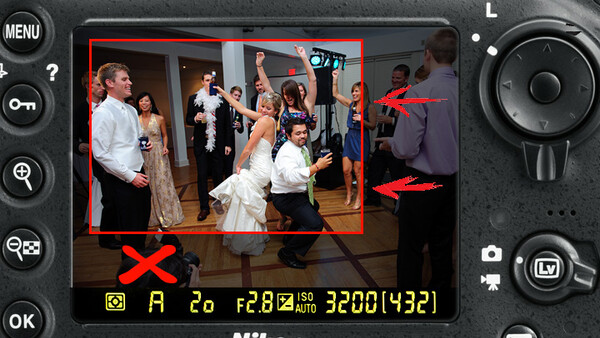
Many photographers start off their careers focusing on wedding photography. I started my career as a wedding photographer in Charleston, and I still enjoy shooting a handful each year. Over the next few months, I hope to share some of my thoughts on wedding photography and how event photographers can improve their photos. Today I was reminded how important "In Camera Cropping" is for emotionally charged photographs. Read the full post to see two examples of how cropping can make or break an image.
First let me start of by saying that shooting events whether it be parties, wedding receptions, athletics, or street photography is no easy task. There are a lot of factors that go into making a great image including maintaining focus, building or finding good light, capturing the key moment, and positioning yourself to hide all non critical or distracting elements in the scene. But if you can quickly and efficiently work through all of these issues (and respond to them as second nature) then your images are going to resonate well with your viewer.
One area I see a lot of my assistants struggle with is being mindful of a tight and interesting In Camera Crop. Just to make clear, I am talking about framing your image and not altering pixels. Even though digital cameras now have 24-36 megapixels and allow for unlimited post cropping options, I still do very little, if any, post production cropping. For one it takes up a lot of extra time, and two it can really open the door for mediocrity and laziness if you get accustom to fixing everything you shoot (I first learned this with level horizons).
 This first example comes from a wedding I shot years ago. I'm a big believer that people react the strongest to pure human emotion. If you can zoom in a bit, you can usually force the reaction you want out of your reader. People like seeing others engaged in interesting and emotional activities. Often times, cropping out non crucial elements like legs, sky, floor, surrounding people, and backgrounds can tell a stronger story than shooting wider and including everything. The first shot to the left was taken by one of my assistants. He actually had the better position since the kicker light was placed behind his subject for a touch of dramatic backlight. However, the light becomes distracting because it wasn't correctly hidden and placed behind his subjects. Also the focal length was so wide that in my opinion, much of the emotion is completely lost. This shot is great for documenting what actually happened but it's very poor in forcing the reader a personal emotion. So even though he nailed the key moment, the photo still fails overall and ultimately gets deleted.

This second example is a bit more subtle. The overall camera angle is pretty much the same and the lighting might be identical. The angle I took was a bit wider around 11mm on a DX camera and my assistant's focal length was around 24mm on a FX camera. By positioning myself just a bit closer and lower the the action, I was able to remove a lot of the background and focus only on the bride and her dance partner. My assistant's image isn't horrible (I really like the Groom's expression), but again it does not force the emotion of the bride as well. Of course the biggest flaw is that the back of my head is in the frame.


Now I don't want anyone to misread this post and think that tighter crops are always better than wider crops because that simply isn't true. If you really want your audience to respond to your work, the most important thing is to capture the human element as well as you can. Sometimes that reaction comes from a naturally beautiful scene with dramatic lighting, but more often than not a well received photograph will come from capturing a true human emotion in an unusually intimate way. Of course you probably want to deliver your client a variety of images that are tight and wide because they will both tell different stories; but for your portfolio or website you really want to scrap those photos that do not give people that "wow" factor.
So next time you go out and shoot an event, take a little time to slow down and really evaluate the environment you are shooting. Actually LOOK through your viewfinder and anticipate a solid crop. When something isn't working, take a second to think about how you can improve the image. So many photographers get into this mental state of bliss when something exciting happens in front of their camera. They do capture the moment but they capture it poorly or fail to take the frame they really wish they had taken. If you work with assistants or around videographers, take time to position yourself out of each other's shots. If you are working as an assistant, let the photographer who hired you take the risks and cover something else interesting he might be missing. And if all else fails, spray and pray....just kidding of course!
Join the Fstoppers community for free
-
Post comments and join in the discussions
-
Browse the site ad-free
-
Share your work and get featured in the community
-
Compete in the photo contests for fun and prizes
24 Comments
I guess that is why shooting with a wide angle lens is more challenging (crop-wise) since you get so much more information that needs to harmonise within one frame. If you are not careful, you will end up with a lot of unnecessary information. I look forward to follow this series of informative articles on wedding photography!
I've had the most success with wide angle in two situations...either really close to your main subject so your eye goes to them yet it's still wide to capture a large environment or a little further back (full body) in an area that has very little extra information like a nice landscape. The worst is WA shot vertically, avoid that 99.5% of the time hah
Hahaha spray and pray.
This does remind me of a saying that photography is a lot of times more about subtraction than addition. Thanks!
Why cropping? Just frame it right in the first place :-)
that's what I'm talking about...cropping and composing the shot correctly before ever hitting the shutter button.
That's for sure, it comes with expreience. I frame so tight that I need to add background in post lol.
Normally (read: almost always 99% of the time always) called framing. Cropping in camera means using the in camera crop tool. Thats... what everyone else calls it.
Just write a post on the importance of intelligently framing a photo. It'll be instantly even more helpful because it will use the right terms to train people that don't know well enough to frame well to know the term for what they are learning.
If you find yourself cropping a lot, no matter how, at a wedding, or editing the wedding more like... then maybe you should re-evaluate how good you are at being at the right time at the right place, that's what it's all about.
This sort of job, especially wedding, but anything really, do indeed require a lot of extra thought, not just what's in front of you. But how to really capture that to best tell the story, or best show it off, the dancing photos are a clear give away to this.
I've just really begun, in the last few months or so, to see a lot better this way, but it takes a lot of time, and practice (experience) but I think a lot of people can achieve this, but it's not quite for everyone perhaps. I can't paint. :) But hopefully I can take a photo or two.
What if they aren't good at being in the right place at the right time, but awesome at spotting the perfect crop for a shot.
Should they still give up their hopes and dreams of being awesome like Sandy Whoever?
Wow. You practically blasted your assistants' photos with your "perfect" shots. Don't they even have names?
I can't remember who took those shots and I wouldn't call them out in public. My shots aren't "perfect" by any means, I just wanted to show 2 examples that happened at the exact same time...one seemed mindful of the framing and the other one didn't.
I use "cropping" a lot in my camera through zooming. When I find the right crop, I keep it in mind and do the real thing i post processing. Works very well for me!
/ www.zayaphotography.com
If you have time to try different cropping via zoom, you have time to actually take the shots and keep them all.
Your paragraph suggest you visualize in camera then shoot wide then crop in post. why would you knowingly crop in a fashion that reduces file size and print size when you can shoot it with maximum res. in the first place? Unless you use a D800 or medium format... I don't see the benefit from it.
I have developed the habit of framing all my shots tight such that no further cropping is required in post. I am now finding that since moving to the D800 from the D300, I need to consciously try to frame wider sometimes, just to give myself more cropping options later on.
This just verifies the age-old adage from Capa: “If your photos aren’t good enough, then you’re not close enough."
Its interesting that everyone here is talking about how they don't have to crop in post production because their framing is great... which is actually what the article is talking about, but people seem to be missing that. They read the title and think its about cropping, its about framing. Then people say: maybe you shouldn't crop, you should just frame better. Which means the two ends aren't meeting each other at all, the writer and the reader. Its just funny, is all.
And yes, intelligent framing does save you work in post. Though more often than not, I'll purposely frame something a little off-center and a little wide in case I want that feeling. If not, then its no harm to bring it in slightly to the side, but it doesn't need to be done to bring the subject tighter in from being too far away, just to give options in post (rule-of-thirds or centered, usually).
Don't forget to leave room for the crop/adjustment to standard print sizes. I learned in school to compose my shots for a full frame print. Now; when I have to print off an 8x10, I end up having to crop out parts that I totally meant to have in the image. You definitely can't shoot shoot wide and count on cropping later; but you have to be careful not to shoot so tightly that you don't have a little wiggle room when printing various sizes.
does the 5:4 standard ratio of an 8x10 make you really mad when it comes to prints haha. I can't stand printing something that has to be cropped differently then how I framed up the original shot. It's a shame 8x12 didn't become the standard size for prints.
I feel for you and Lee man. Some of the community on here act so high and mighty. As if every shot they take is perfect every time! lol I took the post to be kind of an intro to composing shots, particularly at a wedding, to be more interesting. Like a beginners course. It's a very informative post with great examples. Something that anyone who does this type of work can appreciate. Keep up the good work.
p.s. I attached an image that took using the same ideas you explain in this post.
Exactly, maybe many of the photographers who read FS are extremely mindful but I know a lot of the people I bring along as assistants don't stop to think as much as they should. I hire pretty good people and I'm not knocking them but I think many photographers who shoot events under estimate the value of anticipation and looking at more than just the main subject in their viewfinder.
That's a great shot you have! When shooting garter or bouquet tosses, you def want to shoot wider and capture more in the frame. If you are quick enough to shoot a tight telephoto shot and capture both the reaction of the bride and the bridesmaids then you've done extremely well.
keep it coming Patrick... excellent!!!
For the record I hate 8x10 because of this. Can we try to rid the world of that size photo?
I am agree with Carlos. I too use "cropping" a lot in my camera through zooming.