
When it comes to wireless microphones, there are already some very strong options available, so when a new system comes along, it needs to offer something more than simply being another wireless microphone. The Insta360 Mic Pro is entering a market where DJI and Rode are already well established, so the question for me isn't really whether it works, because most modern wireless microphone systems work pretty well. The more important question is whether the Mic Pro actually gives you something that makes it worth choosing over the competition.
I have been using it in a number of different situations, and one of the things that became obvious quite quickly is just how versatile this system is. It isn't simply something you clip onto your shirt when you're recording a piece to camera. It can be used as a traditional clip-on microphone, as a replacement for a shotgun microphone in certain situations, and it can also be connected directly to smartphones and computers. That makes it a much more useful bit of kit if, like me, you're constantly moving between cameras, computers, and different types of content.
Color E-Ink
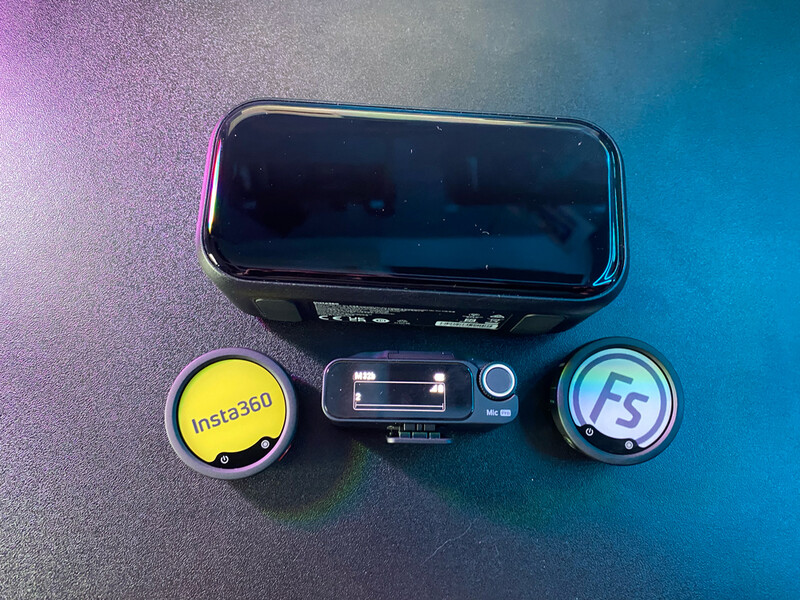
The transmitters themselves are also quite interesting. Insta360 has gone with an E-Ink display rather than a conventional screen, and this is one of those features that initially looks like a gimmick until you actually start using it. The display can be customized through the Insta360 app, and because E-Ink only uses power when the display changes, it doesn't constantly drain the transmitter just to keep the information visible. You can customize what is displayed, which makes it easier to identify transmitters or personalize them for different uses.
It is a small thing, but I do like the idea behind it. Wireless microphone systems can become surprisingly confusing when you're working with two transmitters, particularly if you're working quickly and trying to remember which transmitter is connected to which person. Having a display that you can actually customize gives you information at a glance without having to connect everything to an app.
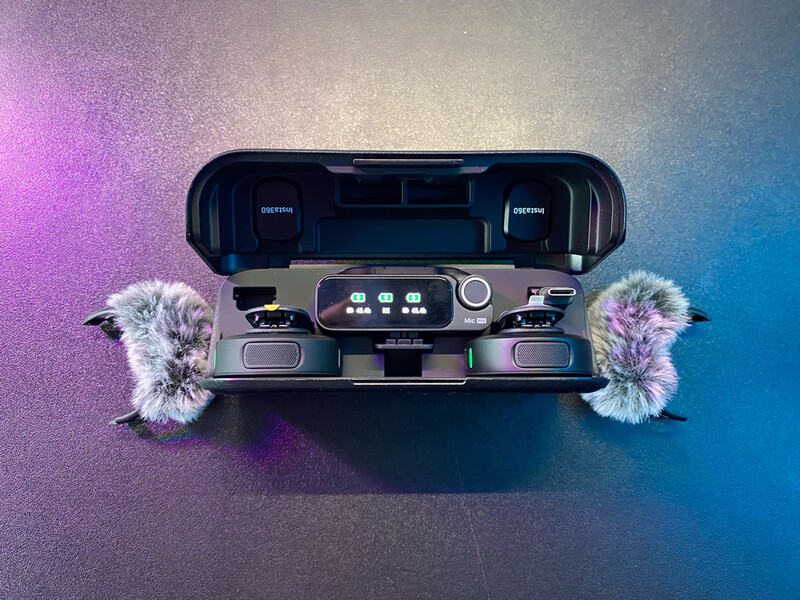
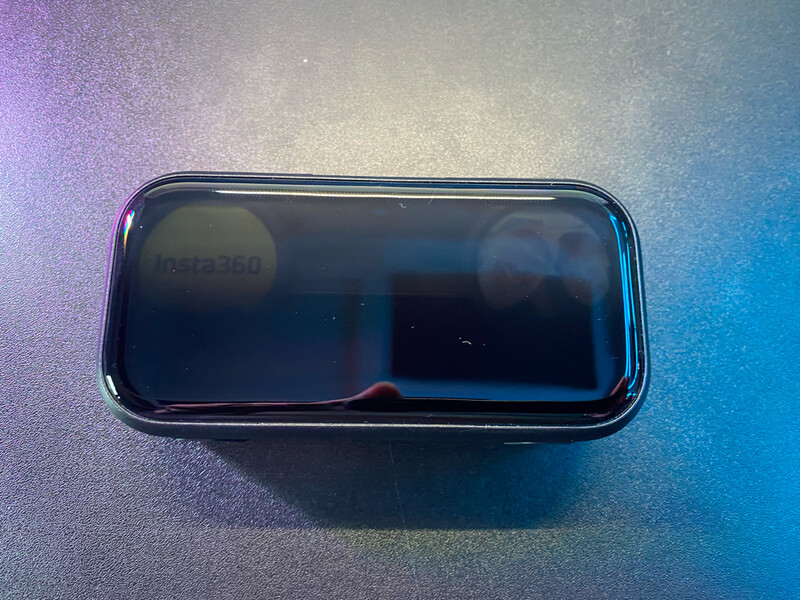
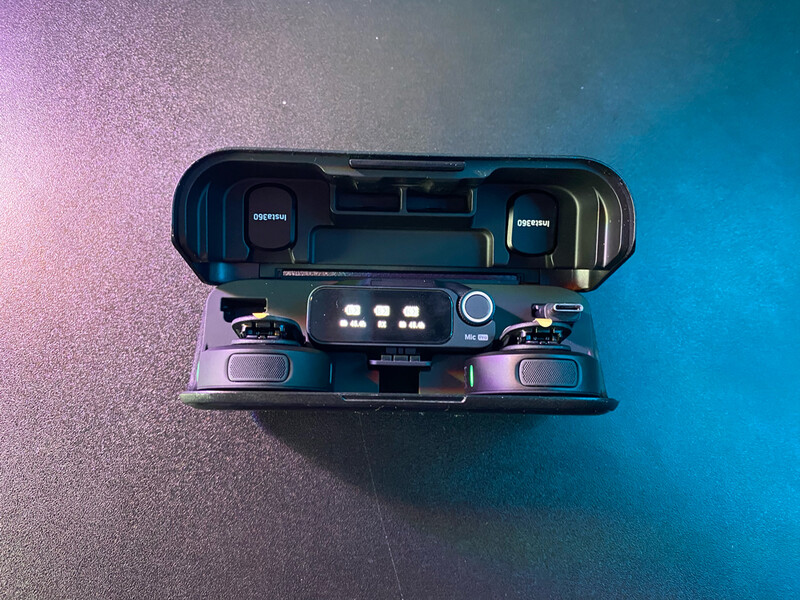
The charging case is also well made and feels like it should survive being thrown into a camera bag without too much trouble. My only real criticism here is that there isn't anywhere to store the cables, so while the transmitters and receiver have a nice dedicated home, you still need somewhere else in your bag for the accessories. It's not a major problem, but considering the case is designed to be the place where you keep the system together, it would have made sense to have a little additional storage. Additionally, there is no place in the case to store the windshields.
Where things become more important, however, is audio quality, because a microphone can have all the clever features in the world, but if it doesn't sound good, then none of them really matter. The Mic Pro supports 32-bit float recording, which is particularly useful if you're recording unpredictable audio levels. It gives you considerably more flexibility when dealing with recordings that have been captured too loudly or too quietly, and for people recording themselves in the field, that extra safety net can be useful.
The actual sound of the microphone is clean, although I found it to be slightly mid-heavy. That isn't necessarily a problem because it can be corrected with EQ, but it does mean that I wouldn't necessarily use the recordings completely untouched. Once the audio has been equalized, however, the results are very good, and the Mic Pro is certainly capable of competing with some of the more established high-end wireless microphone systems.
One of the more interesting aspects of the Mic Pro is the microphone array. Rather than simply giving you one pickup pattern, the three-microphone array allows you to choose between Cardioid, Figure-8, Omnidirectional, and Voice Focus modes. That gives the system considerably more flexibility than a basic wireless lavalier, particularly if you're using it in situations where the microphone needs to do more than simply record the person wearing it.
The noise cancellation is probably one of the biggest strengths of the system, and this is something that could be particularly useful for people creating content outdoors. There are two levels of AI noise cancellation, weak and strong, and both do a good job of reducing background noise.
The important thing with noise cancellation is that it shouldn't sound like noise cancellation. Some systems can remove background noise but leave the voice sounding processed or unnatural, which can be just as distracting as the original noise. The Mic Pro does a very good job of reducing unwanted background sounds while keeping the voice relatively natural, and that makes it much more useful for real-world recording rather than simply being something you switch on for the sake of having the feature.
For anyone recording outdoors, this is probably one of the areas where the Mic Pro makes the most sense. Wind, traffic, people talking in the background, and general environmental noise are all things that can quickly turn a good recording into something that requires a lot of work in post-production. Having a system that can reduce some of that noise before you even get back to the editing suite is useful.
Then we come to range, and this is where things become slightly less straightforward. Insta360 rates the system for up to 400 meters, which sounds impressive, but as with most wireless systems, the headline range figure doesn't necessarily represent what you will experience in normal use.
Testing
During testing, there were instances of signal dropouts when the transmitter was behind the body relative to the receiver. This is not necessarily unique to the Mic Pro, and similar behavior can be experienced with other 2.4 GHz wireless microphone systems. Your body can interfere with the signal, particularly when you're moving around and the transmitter and receiver don't have a clear line of sight.
For landscape photography and video, this is something I would keep in mind. If you're standing in front of the camera and talking directly toward it, you are unlikely to have a problem. If you're walking away from the camera, turning your back to it, or putting significant distance between yourself and the receiver, then the claimed maximum range becomes much less relevant than the actual conditions you're shooting in.
What I do like about the Mic Pro is that Insta360 hasn't treated it as just another microphone for one particular type of creator. The ability to use it with different devices makes it much more flexible, and if you're already using Insta360 cameras, there is another significant advantage because some of those cameras can connect directly to the microphone without requiring the receiver.
That can make a real difference when you're trying to keep your setup small. The fewer individual pieces of equipment you need to connect, mount, and remember, the easier it becomes to concentrate on actually creating the content.
For me, that is probably the biggest strength of the Mic Pro. It isn't necessarily one single feature that makes it stand out, but the combination of audio quality, 32-bit float recording, multiple pickup patterns, very good noise cancellation, the E-Ink displays, and the flexibility of how it can be connected.
It also feels like a product that has been designed for people who are doing more than simply recording talking-head videos in a controlled environment. If you're moving between locations, recording outdoors, using different cameras, or switching between video and computer-based content, having one microphone system that can cover all of those situations is useful.
Would I say it is perfect? No. The mid-heavy sound means I would probably still apply some EQ in post-production, and the charging case would be better if it had somewhere to keep the cables. Plus, opening it isn't exactly intuitive. The range is also something I would treat with a degree of caution rather than assuming that 400 meters means you can walk 400 meters away from your camera and expect a perfect connection.
But none of those issues are deal breakers for me. In fact, when you look at the Mic Pro as a complete system rather than focusing on one specification, it becomes a very convincing option.
If you're already invested in the Insta360 ecosystem, I think the argument becomes even stronger because of the ability to connect directly to compatible cameras. If you're not using Insta360 cameras, there are still plenty of reasons to consider it, particularly if you want a wireless microphone that can be used across cameras, phones, and computers without having to buy several different systems.
Ultimately, the Mic Pro feels like a serious attempt by Insta360 to compete with the established names in wireless audio. It doesn't simply rely on the Insta360 name or a collection of headline specifications. The audio quality is good, the noise cancellation is particularly impressive, and the flexibility of the system makes it useful across a wide range of content.
For someone like me who spends a lot of time creating video outdoors and needs equipment that can adapt to different situations, that versatility is probably more important than having the absolute best microphone in one specific category. The Mic Pro does a very good job of being a microphone system that can do a lot of things well, and that makes it considerably easier to recommend.
I've created a video to let you hear the audio in different settings here.
What I Like
The overall versatility is probably the thing I like most about the Insta360 Mic Pro. Being able to use it as a wireless mic, work with different pickup patterns, connect it to different devices, and record using 32-bit float gives it a lot of flexibility.
The E-Ink displays are also a really useful feature rather than simply something added to make the product look different. Being able to customize the displays and have information visible without constantly using power is a clever solution.
The noise cancellation is another major positive. It does a very good job of reducing background noise while keeping the voice sounding natural, which is particularly useful when recording outdoors.
I also like the fact that Insta360 has thought about how the microphone fits into its wider camera ecosystem. If you already own compatible Insta360 cameras, being able to connect directly without the receiver makes the system even more appealing.
What Could Be Improved
The charging case is good, but I would like to see somewhere inside it to store the cables and smaller accessories. If the case is going to be the main place where the system lives, it makes sense for everything to fit inside it.
The sound profile could also be a little more neutral. The mid-heavy character isn't a major issue because it can be corrected with EQ, but I would prefer a microphone that required less adjustment before it was ready for use.
Finally, I would treat the 400-meter range figure as a best-case scenario rather than something you should expect in every situation. The dropouts when the transmitter was behind the body demonstrate how much real-world conditions can affect 2.4 GHz wireless systems.
Overall, though, these are relatively minor criticisms of what is a very capable wireless microphone system. The Insta360 Mic Pro offers good audio quality, excellent noise cancellation, and a level of versatility that makes it suitable for far more than simply clipping a microphone onto your shirt.





Join the Fstoppers community for free
-
Post comments and join in the discussions
-
Browse the site ad-free
-
Share your work and get featured in the community
-
Compete in the photo contests for fun and prizes
No comments yet