Background blur is usually the first effect you learn to create on purpose, and that early success tends to shape how you shoot for years. The settings you lean on, from aperture to shutter speed to exposure mode, decide whether your images feel flat or deep long before you open an editor.
Most shooting advice treats aperture as a two-position switch: open wide for separation, stop down for sharpness. Max Kent takes apart both halves of that idea, starting with shallow depth of field. He calls a wide aperture the lazy version of depth, a shortcut that imitates the three-dimensional feel that good light creates on its own. His alternative is to build depth from light and layers, with soft light falling from roughly 45 degrees above and to the side so that bright and shadowed areas alternate through the frame. He points to film and television, where scenes with people in them are commonly lit this way whether the background is blurred or not. In his own demonstration at f/2.8, most of the separation comes from those bands of light and shadow stepping back into the scene.
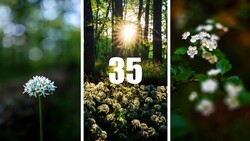
The same principle holds well outside portraits. A stand of trees under flat light reads as one surface, while the same trees under angled sun pick up shadows that pull each trunk away from the next. Kent pairs this with a clear foreground, midground, and background, which sounds like first-week material until you look hard at a cluttered frame. You know where each plane sits because you were standing there. A viewer sees only overlapping shapes, and that overlap flattens an image as thoroughly as flat light does. Get the planes and the light working together, and you can produce convincing depth at f/8. Kent still reaches for f/1.8 when it's dark, or when nothing else in the scene gives him separation and he has run out of options.
Background blur stopped being a sign of serious gear years ago. Apple introduced Portrait mode on the iPhone 7 Plus in 2016, and now almost every phone can simulate shallow depth of field in software. As a result, a blurred background no longer tells anyone that a picture was made with care. Light direction and the arrangement of planes are much harder for software to invent after the fact. You can test your own work quickly. Convert a frame to black and white and shrink it to thumbnail size. If the subject still separates from its surroundings, the depth comes from tone and placement. If everything merges into one gray mass, the blur was carrying the image alone. Run the same check on a few frames shot at f/8, and you'll start to see which scenes can stand without a wide aperture.
At the other end of the dial, f/16 and f/22 put more of the scene in focus, but they also bring in diffraction, which softens fine detail across the whole frame. Kent explains that most lenses are sharpest somewhere between f/5.6 and f/11, often called the critical aperture. Wider than that range, lens aberrations start to cut into sharpness instead. When a landscape needs detail from front to back, many shooters stay around f/8 or f/10 and focus stack. They take separate frames focused on the foreground, midground, and background and blend them into one file. Kent then turns to shutter speed and argues that 1/250 s, the safe default for crisp results, shows a scene the way it looks rather than the way it feels. His preferred range sits between 1/10 s and 1/60 s, where a passing cyclist or car shows clear motion yet keeps its shape. He describes setting up a composition first and waiting for something to move through it.
Kent's case for why most professionals skip full manual exposure is in the video above.




Join the Fstoppers community for free
-
Post comments and join in the discussions
-
Browse the site ad-free
-
Share your work and get featured in the community
-
Compete in the photo contests for fun and prizes
No comments yet