
A 24mm lens at f/8 has an opening 3.00 mm across. A 600mm lens at f/8 has one 75 mm across, 25 times wider, and it draws a diffraction pattern on the sky 25 times finer. Both land a blur spot on your sensor exactly 10.7 microns wide.
Every other limit in photography has a price attached. Aberrations yield to better glass, noise yields to a bigger sensor, flare yields to better coatings. Diffraction yields to nothing, because it is not a property of your lens at all.
Diffraction Is What Happens When You Delete Most of a Wave
Light leaving a distant point arrives at your lens as a flat wavefront, essentially infinite in extent. The Huygens-Fresnel principle says you can treat every point on that wavefront as a tiny source throwing off its own spherical wavelet, and the field farther along is the sum of all of them. In a complete, untouched wavefront, the wavelets heading sideways cancel each other exactly, and what survives is the wave continuing straight ahead. That cancellation is the only reason light appears to travel in straight lines at all.
An aperture destroys the arrangement. It removes every wavelet outside its rim, so the sideways contributions from the wavelets that remain have no partners left to cancel against, and energy shows up at angles no geometric ray ever went. The formal statement of this, the Fresnel-Kirchhoff integral, is a sum taken over the open part of the aperture only, which is why the size and shape of the hole set the entire pattern.
Diffraction is therefore not light bouncing off the metal of the blades, and it is not an aberration. Aberrations are errors in how the glass bends light, and a designer can drive them toward zero with better surfaces, exotic glass, and enough money. Coatings work on reflections at glass-air surfaces, which is a flare and transmission problem, not a pupil problem. Diffraction is a boundary condition set by the size of the opening and the wavelength, and the only way to eliminate it would be to make the aperture infinitely large.
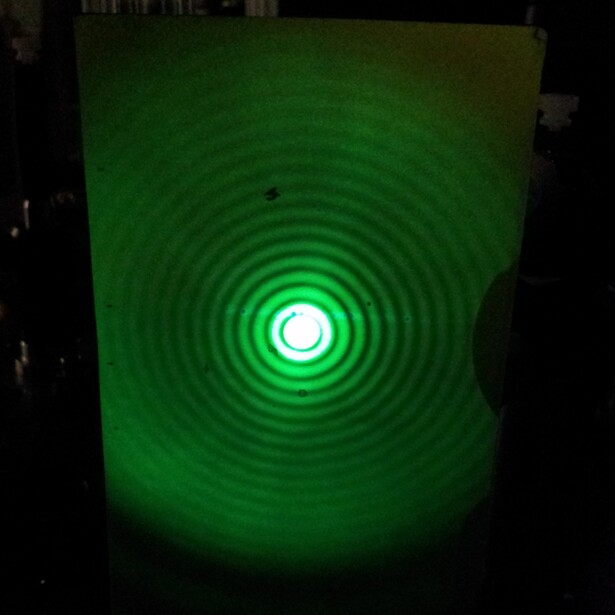
Work out the sum for a circular hole and you get the Airy pattern: a bright central disc surrounded by faint rings, named for George Biddell Airy, who published the solution in 1835. The math produces a Bessel function of the first kind, the cylindrical cousin of a sine wave, a decaying oscillation with an infinite string of zeros. The first of those zeros sits at 3.8317, which is where the familiar constant 1.22 comes from, since 3.8317 divided by pi is 1.2197. Inside that first dark ring sits 83.8% of all the light in the spot. The first bright ring holds 7.2%, the second 2.8%, the third 1.5%.

At 550 nm, the middle of the visible spectrum and where a Bayer sensor is most sensitive, that formula collapses to arithmetic you can do in your head. The Airy disc is 1.34 microns wide for every unit of f-number: 5.4 microns at f/4, 10.7 at f/8, 14.8 at f/11, 21.5 at f/16, and 29.5 at f/22.
Why the f-Number, and Not the Size of the Hole
The angle the light fans out into depends on the physical diameter of the opening and on nothing else. A wider hole diffracts less, which is why an astronomer buying a telescope cares about aperture in millimeters and never mentions focal ratio when discussing resolution.
You do not record an angle. You record a spot on silicon, and converting that angular scale into a distance at the image plane brings in the effective focal length. The diffraction angle goes as lambda over D, so the blur on the sensor goes as lambda f over D, which is lambda N. The exit pupil is a different thing and sits wherever the design puts it; in an image-space telecentric lens it is at infinity while the focal length stays finite. The diameter of the hole sits in the denominator of the diffraction angle and in the numerator of that lever arm. The two cancel exactly, and only the ratio of focal length to diameter survives.

Run four lenses at f/8. The 24mm has a 3.00 mm opening and reaches its first dark ring at 46.1 arcseconds. The 50mm reaches 22.1 arcseconds, the 200mm 5.5, the 600mm 1.8. Across a 25-fold range of physical apertures and diffraction angles, all four put a 10.73-micron disc on the sensor. Not approximately. Identically.
The long lens really is resolving finer detail on the subject, by a factor of 25, and on a double star or a distant ridge line that is the number that matters. It does not translate into a smaller spot on the sensor, because the optics that bought the fine angular resolution magnified the scene by the same factor. The astronomer and the photographer are describing one piece of physics and quoting the term that matters for their own job.
There Is No Cliff, and There Never Was
The Airy disc is a useful mental picture and a poor measuring tool, because a photograph is not a field of isolated points. What you want to know is how much contrast survives at each level of fine detail, which is the modulation transfer function. For an aberration-free system, the MTF is the fractional overlap area between the pupil and a shifted copy of itself, and for a circle that overlap has an elementary closed form.

The curve has a hard right-hand end, the cutoff frequency. At 550 nm, the finest detail a perfect lens can transmit is 227 line pairs per millimeter at f/8, 165 at f/11, 114 at f/16, and 83 at f/22. Past that frequency, the MTF is not small, it is zero, and no information exists to be recovered by any sharpening tool ever written.
Everywhere to the left of that end, nothing kicks in. The curve leaves 1.0 at zero frequency and starts down immediately, with an initial slope of 4 over pi, about 1.27 points of contrast for the first 1% of the way toward cutoff, then bends progressively toward zero. Three quarters of the way to cutoff the exact curve still holds 14%, where that opening slope carried on as a straight line would have run out at 4%. It is below 1 at every non-zero frequency at every aperture you own. Diffraction is not a threshold you cross at f/11. It is a tax you have been paying, in proportion, since f/1.4.
The curve also explains why nobody notices. A perfect lens at f/16 delivers 67% contrast at 30 line pairs per millimeter, roughly what a sharp 16 x 20 inch print demands at normal viewing distance, and 18% at 80 line pairs per millimeter, where pixel-level scrutiny lives. Both figures come from the same curve, which is why an f/16 landscape can look measurably degraded at 100% and print beautifully at exhibition size.
"Diffraction limited" is a compliment that photographers use as an insult. It means a lens has so little residual aberration left that diffraction is now the binding constraint, and the formal version, the Marechal criterion, sets the bar at a root-mean-square wavefront error under about one-fourteenth of a wavelength. A lens that is diffraction limited at f/4 is superb. "The camera's diffraction-limited aperture is f/7.1" is a statement about pixel pitch and means something entirely different.
What More Megapixels Actually Change
The 61 MP sensor in the Sony a7R V spreads 9,504 pixels across 35.7 mm, which is 3.76 microns per pixel and a Nyquist frequency of 133 line pairs per millimeter. The 24.5 MP sensor in the Nikon Z6III sits at 5.94 microns and 84 line pairs per millimeter. Feed the diffraction MTF those two frequencies and you get the honest version of the megapixel argument.
At its own Nyquist frequency, the a7R V retains 74% of contrast at f/2.8, 49% at f/5.6, 30% at f/8, and 10% at f/11. By f/13.7 the 550 nm cutoff falls below 133 line pairs per millimeter, which is the Nyquist frequency of an ideal monochrome grid at the a7R V's pixel pitch. The Z6III's matching crossing is f/21.6. Read those as ideal-grid landmarks rather than apertures past which the camera cannot alias, because a Bayer array does not sample green at every photosite and its green lattice is not that grid, and because shorter wavelengths cut off higher: at f/14 a 450 nm cutoff still sits at 159 line pairs per millimeter and does not drop below 133 until about f/16.7. The Z6III retains 54% at f/8, 38% at f/11, and 15% at f/16.
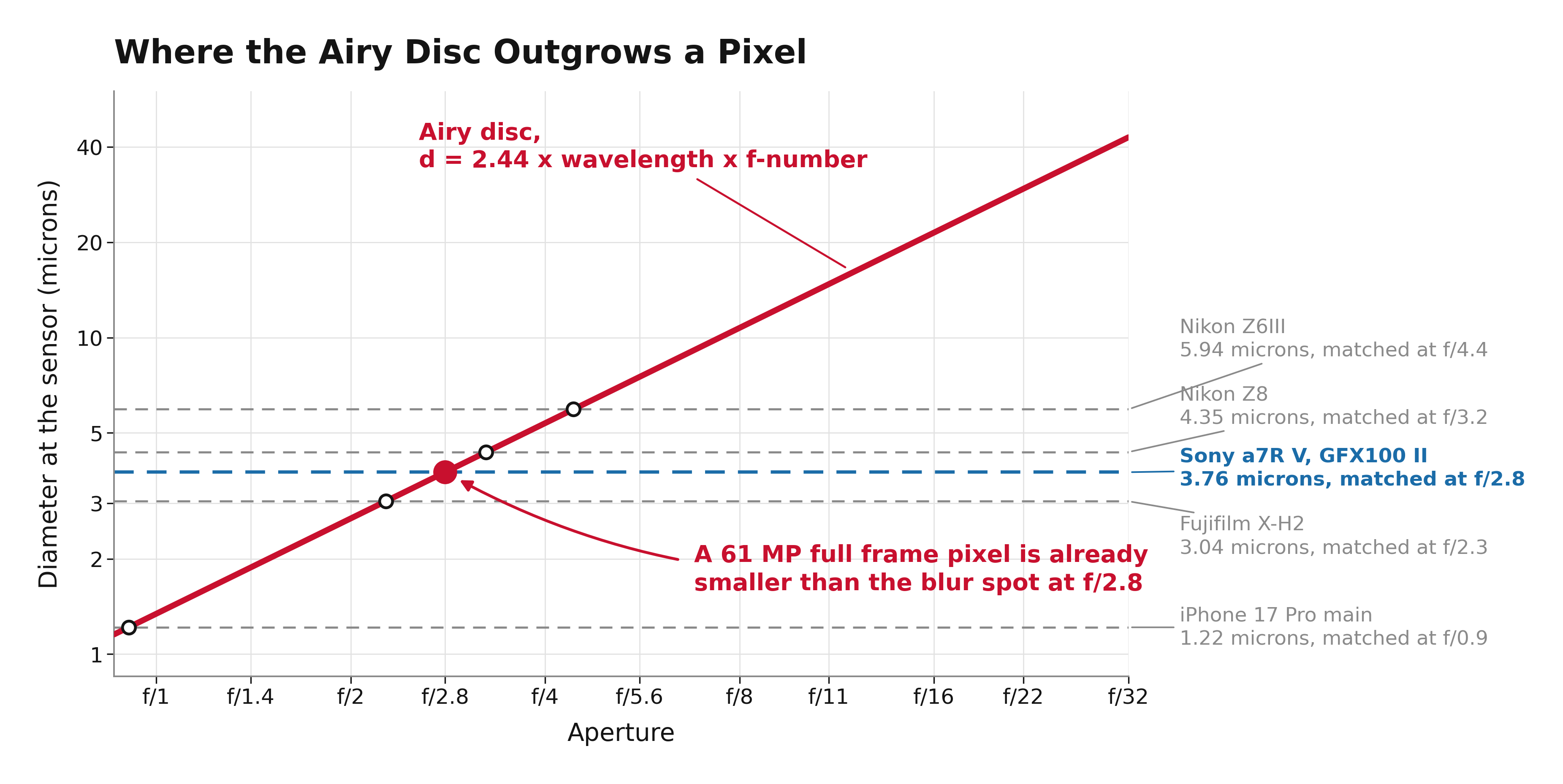
Read that the wrong way and you conclude the high-resolution body is worse at small apertures. It is not, and the arithmetic says so plainly. The Airy disc on the sensor is 10.73 microns at f/8 whether the silicon underneath it is Micro Four Thirds, APS-C, full frame, or 44 x 33 medium format. The 102 MP Fujifilm GFX100 II has the same 3.76-micron pitch as the a7R V and behaves identically at the pixel level, on a sensor 1.7 times larger in area that needs less enlargement to reach the same print. Jim Kasson's simulations reach the same result from the other direction: at a fixed print size, finer pixels never make diffraction worse, and generally make it slightly better.
A 61 MP file at f/16 contains more real detail than a 24 MP file at f/16. What it loses is the advantage you paid for. Higher resolution does not create the degradation; it lets you see a degradation that was always in the file.
Why Every Lens Has a Best Aperture
Two things move in opposite directions when you turn the aperture ring. Residual aberration, the part of the blur that comes from the glass failing to bring every ray to the same point, falls as you stop down, because the narrower opening uses less of the lens and the outer zones where the errors are worst stop contributing. Diffraction rises in exact proportion to the f-number. Blur from independent causes adds in quadrature, so the total is the square root of the sum of the squares, and a quantity that falls against a quantity that rises has a minimum somewhere in between. That minimum is the lens's best aperture, and it is why one exists at all.
The position of that peak says something counterintuitive about optical quality. A superb lens is already close to its own build limit wide open, so there is little aberration left for stopping down to remove, and diffraction takes over early: it peaks wide, around f/2.8. A more modest design keeps improving further down the range before diffraction catches it, so it peaks narrow, around f/5.6. The better lens peaks at the wider aperture. What separates them is the height of the peak, not its location.
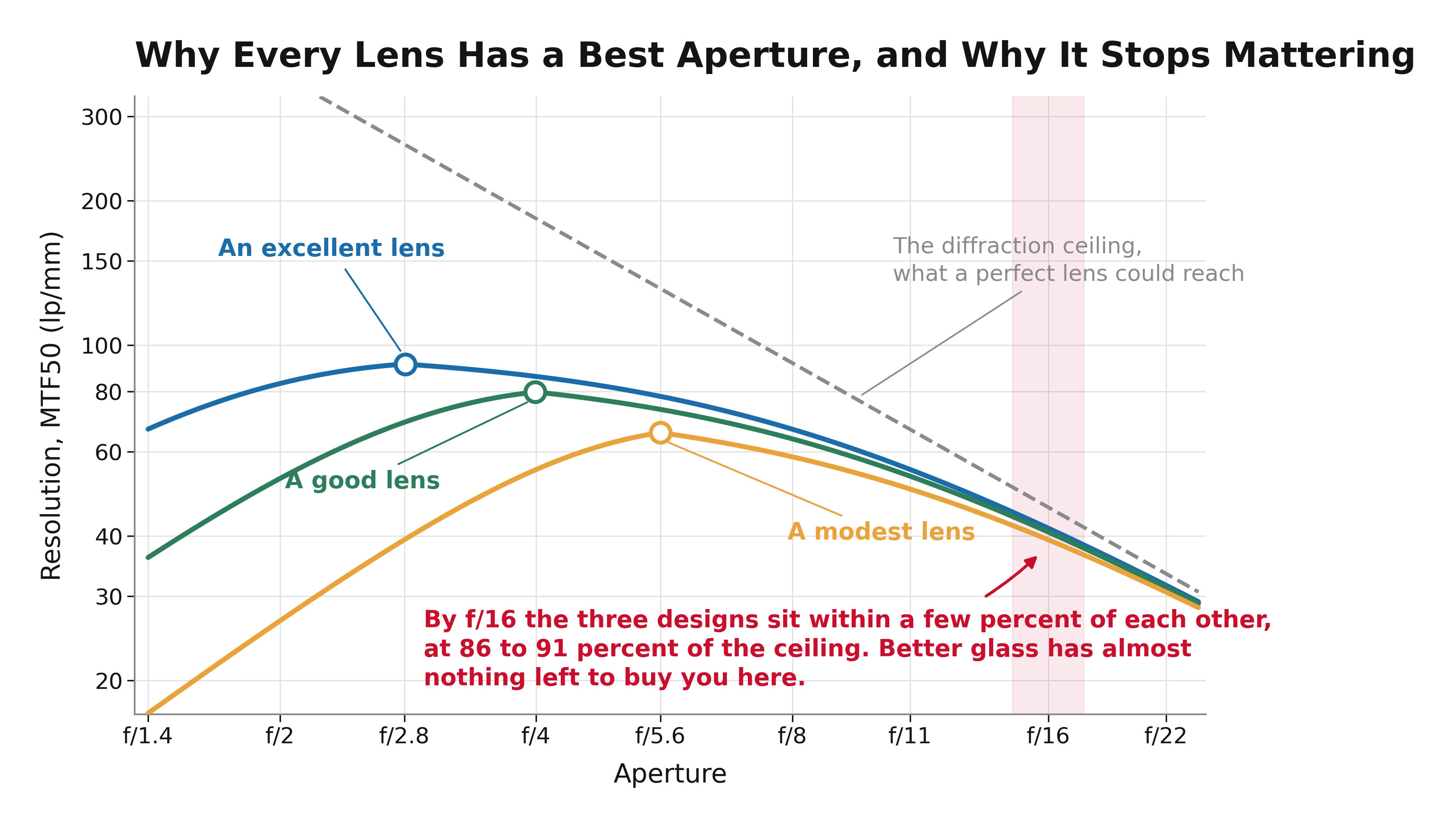
The right-hand side of that picture is the part worth internalizing. Once the diffraction term dominates, the aberration term stops mattering, and three designs that shared nothing at f/2 arrive at f/16 within a few percent of each other and of the ceiling. Published bench tests from the optics labs show the same shape on real glass, which is worth checking for whatever lens you own before you assume your copy is the exception. Past roughly f/11, better glass has almost nothing left to sell you, because you are no longer measuring the glass.
One caution about the number those tests usually report. MTF50 is the spatial frequency at which contrast has fallen by half, and it sits at roughly 0.4 of the cutoff, not at the finest detail the lens still delivers. It is tempting to take the ratio of two MTF50 figures, square it, and read off an equivalent megapixel count, and the move does not survive contact with what the number is. At f/16 a system keeps transmitting well past its MTF50 frequency, out to the cutoff. MTF50 measures what the aperture cost you in contrast, not how much of the sensor it took away.
That distinction also explains why two labs can test the same lens and disagree. MTF50 measures contrast, and sharpening raises contrast, so any measurement made on a processed file carries the processing in the result. The physics gives you a way to catch it: no unsharpened optical system can beat its own diffraction ceiling. When a published figure implies a lens has resolved past the limit its aperture allows, the sharpening is in the measurement, not in the glass.
Macro Is Where the Arithmetic Turns Brutal
The f-number engraved on the barrel is defined at infinity focus. Rack the lens closer and the image plane moves back, the cone of light reaching the sensor narrows, and the working f-number climbs. For an asymmetric design, the correction depends on the ratio between the exit and entrance pupil diameters, which telephoto constructions push below one and retrofocus wide angles push above it.

At life size with a symmetric lens, the multiplier is exactly 2. A marked f/8 is a working f/16 and a 21.5-micron Airy disc, which is 5.7 pixels across on a 3.76-micron sensor. A marked f/16 is a working f/32 and 11.4 pixels. To hold the disc to two pixels at 1:1 on that body, you would have to shoot at a marked f/2.8, and no macro lens delivers usable depth of field there. Push to five times life size, the range where the discontinued Canon MP-E 65mm operated, and on that same symmetric assumption a marked f/16 becomes a working f/96 with an Airy disc 129 microns wide, about 34 pixels.
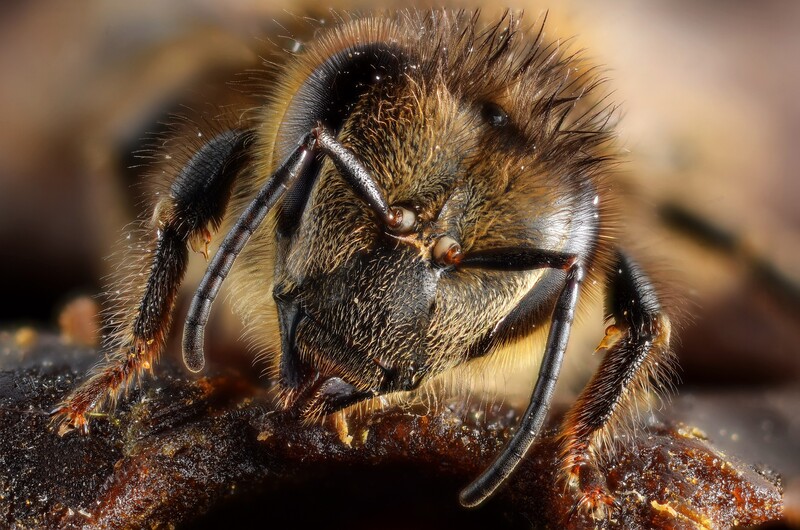
This is why the minimum apertures on macro and macro tilt-shift lenses look absurd and are not. The Canon TS-E 90mm f/2.8L Macro stops to f/45, and Canon's two non-macro tilt-shifts stop at f/22. The macro lenses got the narrow settings because magnification eats most of what they offer. Venus Optics goes the other way on its 25mm 2.5-5X and stops at f/16, and that lens is the best argument in the article for why the pupil term is not a footnote. The symmetric shortcut would call a marked f/16 a working f/96 at five times life size. Enrico Savazzi measured the lens's pupil ratio at 1.79 at that magnification, and running the real formula gives about f/61, a difference of roughly one and a third stops, with an Airy disc near 81 microns rather than 129. Still punishing, and not the number the shortcut produces.
The real answer in macro is not an aperture at all. Shoot at the lens's sharpest setting and buy depth of field with frames. The same arithmetic holds in landscape: at f/22 on a 42 MP full frame body, the diffraction blur circle is 6.5 pixels wide at the plane of perfect focus, while the worst-focused point in a properly spaced f/8 stack carries about 2 pixels of defocus plus 2.4 pixels of diffraction. The stack's worst point beats the single frame's best point. Elia Locardi's landscape course covers the capture and blending side of that workflow.
Sunstars Are the Same Physics, Aimed at Something You Want
A straight edge diffracts light into a fan running perpendicular to itself, the one-dimensional relative of the Airy pattern. A polygonal iris is a ring of straight edges, so a bright point in the frame throws a streak along the normal of every blade. That is the entire mechanism behind a sunstar, and the reason the effect gets stronger as you stop down is that the pupil becomes more sharply polygonal and the edges become a larger fraction of its perimeter.
The blade-count rule is exact for a regular polygon iris. Every edge throws its streak in both directions, so n blades always generate 2n streak directions. The only question is whether any of them land on top of each other. With an even number of blades, opposite blades are parallel and share a normal, so the directions collapse in pairs and you see n rays. With an odd number, no blade is parallel to any other, every direction is distinct, and you see 2n. I checked this by building regular polygon pupil masks and taking the squared magnitude of their two-dimensional Fourier transform, which is exactly the diffraction pattern they produce: five blades gave 10 rays, six gave 6, seven gave 14, nine gave 18, thirteen gave 26, and every recovered ray angle sat on a blade normal.

Rounded blades, chosen to keep out-of-focus highlights smooth, wash the star out at wide and middle apertures, because there is very little straight edge left to diffract from. Close them far enough and even a rounded iris folds into a polygon, which is why lenses with rounded blades still throw stars at f/8 and beyond. Cosina's M-mount Voigtlander lenses use 10 or 12 straight blades and are the enthusiast reference for tight, well-defined rays. Among autofocus lenses, the nine-bladed Nikon Z 14-24mm f/2.8 S gives the 18 points the odd-blade rule predicts. More blades does not mean a better star; the energy in the streaks is fixed, so more rays generally means each one is fainter.
Most lenses need about f/11 before the star is pronounced. That is the same aperture the internet spends its time warning you away from, and on a 61 MP body it costs you 90% of your contrast at the pixel level while leaving 77% of it at print-relevant detail. Next time you stop to f/16 for a sunstar over a ridge, count the rays. A nine-bladed lens will give you eighteen, and every one of them is built from light your aperture threw sideways, the same light that is quietly spreading every other point in the frame to 21.5 microns while you watch.
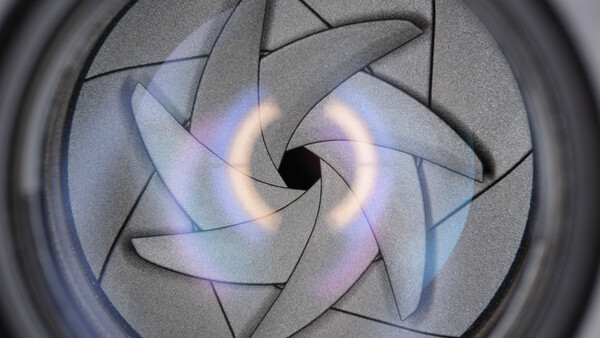
Lead image by D-Kuru/Wikimedia Commons, CC BY-SA 4.0. Source.







Join the Fstoppers community for free
-
Post comments and join in the discussions
-
Browse the site ad-free
-
Share your work and get featured in the community
-
Compete in the photo contests for fun and prizes
10 Comments
Very interesting and well explained - it's a very tough topic!
I am just a bit puzzled about some figures in the "What more megapixels actually change" chapter: your Nyqist limit is indeed at 133lp/mm for a 3.76um sensor. But your contrast figures at f2.8 appear to be from Ny/2 which, according to my charts, would be about 80% at f2.8 (60% at f8 and 30% at f16). At full Ny the contrast would be about 45%, 20% and 0% respectively.
Lens designers often use Ny/2 for much of their design work because it's less theoretical than Ny which suffers from phase alignment issues in the real world. Just wondering if you mixed them up...
Having said that, it's entirely possible I have this wrong - it's just that your article popped up very soon after a recent discussion about this exact subject that I had with Peter Karbe, the man behind most of Leica's recent lenses. Maybe I misunderstood his charts and explanation, so hopefully you can put me straight!
An excellent article, and I would like to use it as the basis of a brief to my photo club (in France). To help give a little more context I am planning to add real data points to the "why every lens has a best aperture ..." graph. Having done a bit of digging around, even the best known lenses seem to fall on the "good lens" curve. I understand that the graph is illustrative, but is there some reasoning behind the excellent curve. (For example other physical limits to performance)
For me the discussion here should make everybody rethink their equipment purchases. And of course key tips , in particular to the macro community
A really interesting deep dive into light behaviour, thank you. While the classical view treating light much the same as other waves does correspond with most of what we observe, it completely ignores current understanding of light. Huygens’ explanations need wave fronts, but photons do not travel in flat planes all holding hands! Apparently, single photons can be diffracted and their final point of arrival depends upon probability, not the classical way that other waves interact with each other. I find the quantum models of light equally fascinating and incomprehensible! Don Lincoln at Fermilab has made some videos explaining the current understanding of light, including the refraction that our lenses rely upon. Huygens gets short shrift, I’m afraid. I don’t know of equally clear and authoritative explanations for diffraction.
I use a Fujifilm GFX with the 20 to 35 and I often shoot F16. It's minimal defraction and that's because it's medium format. It has a slight softening in the mountains in the background but it's still pretty sharp for three-quarter of the image using focal method. I'm just not a fan of taking three or four images and then stacking them in post if there's something in my foreground, I will shoot F16 without a problem. But there is no way I would shoot F16 on my Fuji XT5 or my Leica Q3... This is typically a shot where I would use F-16 because I want the rock in the four grand to the left to be sharp but I want the rock at the background to be sharp and the waves are also pretty sharp but there's a slight fall off at the back on the horizon line with the mountain, but I don't have a problem with that but it certainly not diffraction to the same degree that you would get with other cameras and I did research this and I've pixel peeped a lot. The focus point for this image was actually the rock in the middle of the frame using the hyper focal method which gives acceptable sharpness throughout the images. I prefer to talk about real life examples as opposed to crunching numbers on some mathematical equation.
I thought we were photographers no pysicist ? This article is way too complicated for someone who has not studied these subjects. It would be better suited to a scientific journal, but NOT a photogogrphy web site.
Photographers love to throw that term around 'diffraction'. It rolls off the tongue smoothly and makes them sound smart. The truth is, not many know what it is, or how it affects their potography much less trying to explain it. I use f16 and sometimes f22 regularly without any major problems Why ? because they are there ! If they were not supposed to be on a lens then why put them there in first place ? Here is a much simpler explanation of what diffraction is. I got this by doing a simple search on Google.
DIFFRACTION: the physical bending and spreading of light waves as they pass through a small camera aperture (such as f/16 or f/22), which causes a loss of fine detail, contrast, and overall image sharpness.
Brilliant. You have explained this for all the photographer physicists that already understood it. The rest of us have no idea what you are on about. So 'Diffraction bad', yeah? :-)
I set my aperture and focus point more by observation and priorities than math and science... mainly because I don't have much aptitude for the latter. With landscape photography, if the main subject and large majority of the photo is far away (a mountain range perhaps) with a small scattering of trees closer but restricted to a corner of the photo, I focus on the mountain range, push my aperture up to between F/18 and F/22, depending on the focal length of the lens and how close the trees are to me in the foreground. My settings are based on my priorities and main subject in the picture. If the priorities are reversed (major part of the picture devoted to a foreground flower), I still set the aperture to between F/18 and F/22 but move the focus point to the back of the flowers instead of the distant mountains. If something falls out of sharp focus slightly, I want it to be a secondary element, not the main subject. If everything in the photo is far away and light is good, I set the aperture to F/8. Diffraction and hyper-focal distance are the least of my concerns.