
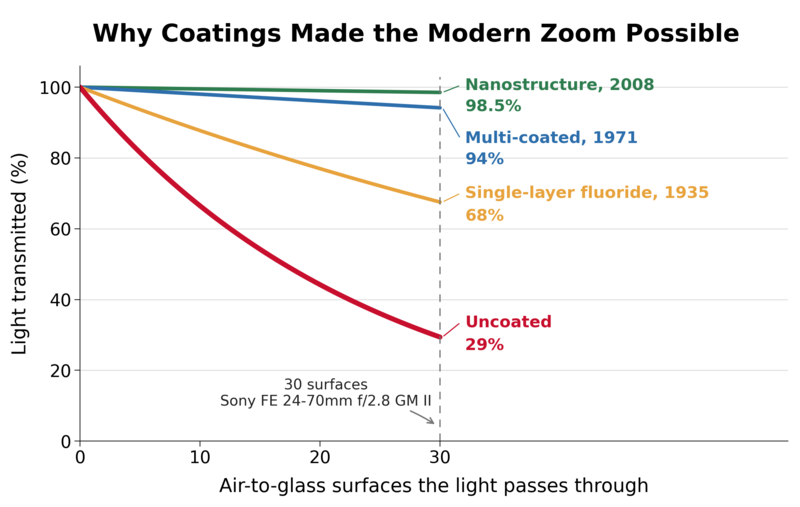
A bare, uncoated air-to-glass surface sends roughly 4 percent of the light striking it back the way it came, and a current professional 24-70mm f/2.8 zoom stacks about 30 of those surfaces in a row. Uncoated, less than a third of the light entering the front would reach the sensor as part of the image. Most of the rest heads back out the front of the lens, and flare is what happens when the fraction that turns around again lands on your picture.
Ghosts Are Reflections That Bounced an Even Number of Times
Flare is a catchall term for non-image-forming light, meaning light that reaches the sensor by a path the optical designer never drew. It arrives by two unrelated routes, and separating them is the whole trick to controlling it.
The first route is specular reflection. Light hits an element and a slice of it bounces off the surface instead of passing through, heading back toward the front of the lens. One bounce and it leaves the way it came in. A second bounce off another surface turns it around again, and now it is pointed at the sensor, arriving badly out of focus and in the wrong place. Only an even number of reflections can put a ray back on the image, which is why lens designers spend their time hunting two-bounce and four-bounce ghost paths through a design.
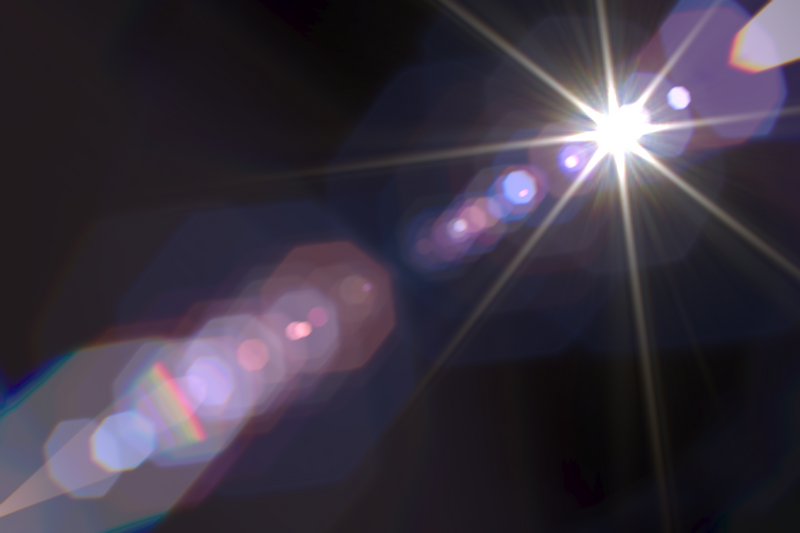
What lands is rarely a formless blob. Many ghosts, especially those built from reflections on opposite sides of the diaphragm, arrive as defocused images of the aperture opening, because the diaphragm limits that stray bundle much as it limits the real one. Others mimic the light source itself, or land as rings, or even come through in surprisingly sharp focus. Stop down to f/16 and the aperture-shaped ones sharpen into hard-edged polygons with as many sides as your lens has blades. Open up to f/1.4 and the blades retract clear of the light path, so those ghosts go round and soft. The Sony FE 24-70mm f/2.8 GM II, the lens behind that 30-surface count, runs 20 elements in 15 groups behind an 11-blade diaphragm, so its aperture-shaped stopped-down ghosts are 11-sided. That count comes from the groups rather than the elements, and the distinction is the whole reason lens makers publish both numbers. A group is one or more elements cemented into a single block, so light meets air only at its front and back face. Twenty elements standing separately would present 40 air-to-glass surfaces; cementing five of them to a neighbour replaces ten of those faces with five internal joints, leaving 30. Those joints are not free either, but the index step from glass to optical cement is small enough that each one reflects a fraction of a percent instead of four, which is why the count that matters is 30 and not 40.
Their placement is just as lawful. A camera lens is rotationally symmetric around its optical axis, so a ghost built from reflections between those surfaces has to fall on the line running from the bright source through the center of the frame and out the other side. Put the sun in the top right corner and the chain of ghosts marches down through the middle toward the bottom left. That is the artifact everyone recognizes and every flare plugin imitates, and it is the least mysterious part of the whole business.
The imaging surface itself plays this game too. Film did it first, bouncing light off the emulsion and pressure plate back into the lens, but a digital sensor stack is more strongly reflective and, crucially, patterned. A bright source can strike the sensor, reflect back into the rear element or filter stack, and return to the sensor as a ghost, and in some mirrorless lens-and-camera combinations, where the design parks the rear element close to the sensor and light meets it steeply, the sensor's regularly spaced microlens grid turns that round trip into a lattice of small red dots ringing the sun.
Veiling Glare Just Makes the File Look Bad
The second route is scatter, and it has no shape at all. Light bounces off the ground edges of elements, off the inside of the barrel, off the diaphragm blades, off the sensor stack, and off every fingerprint, dust mote, and micro-scratch on the front element. None of it forms an image of anything. It spreads across the frame as a broad, even wash that raises the black point and pulls the contrast out of everything at once.
Veiling glare is why a backlit frame can look flat and gray with no visible artifact anywhere in it. Your blacks are not black anymore. They are dark gray with a thin haze sitting on top, and dragging the black slider down will not bring back the local contrast that already got smeared away. Grease is the worst offender, because a fingerprint is a diffuser bonded directly to the first surface light touches.
Ninety Years of Making Glass Disappear
That 4 percent is not folklore, but it is not universal either. It falls out of the Fresnel equation for the refractive indices on either side of the boundary: light arriving head on at ordinary optical glass with an index near 1.5 loses about 4 percent, and the figure climbs for higher-index glasses and for light striking at steep angles, which is why Canon sometimes quotes the typical uncoated loss as closer to 5.

Stack that loss across every surface in a modern lens and the arithmetic turns brutal, because the transmitted fraction compounds rather than adding up.

That calculation deliberately follows only the light that goes straight through, which is the light that forms your picture. It is not the whole energy budget. A ray that bounces backward is not necessarily finished, because it can reflect off a surface behind it and set off toward the sensor again, and the bookkeeping has to follow that series all the way down. Do that for an uncoated 30-surface lens and about 44 percent of the entering light reaches the sensor rather than 29. The extra 15 percent is not a bonus. It is precisely the light that took an unplanned route, so it lands defocused and in the wrong place, and it is the entire raw material of ghosting and veiling glare. Roughly 56 percent genuinely leaves back out the front and is gone.
Which reframes what coatings actually bought. Going from bare glass to a single magnesium fluoride layer lifts image-forming transmission from 29 to 68 percent, and that is the number everyone quotes. The quieter number is the stray fraction, which falls from about 15 percent to 4. Multi-coating drops it near 0.2 percent, and nanostructure coating effectively to nothing. Coatings did not merely make lenses brighter. They collapsed the pool of misdirected light that had been washing out contrast, which is why a 20-element zoom is a sane thing to build now and was not in 1930.
The fix has always been to attack the reflection at the surface itself. In 1935, Alexander Smakula, working at Zeiss, patented a practical vacuum-deposition process for laying a thin low-index film onto a lens surface; the patent's own worked example was calcium fluoride, and the industry soon standardized on the more durable magnesium fluoride. Magnesium fluoride has a refractive index near 1.38, sitting between air at 1.0 and typical optical glass around 1.5, and at a thickness of roughly a quarter wavelength it makes the reflection off the top of the film and the reflection off the bottom cancel each other out. That one layer takes a surface from about 4 percent down to roughly 1.3 percent near the wavelength it is tuned for. Germany held the process back for military optics at first, and Smakula's patent was not published until December 1939.
A single layer reaches its lowest reflectance at one design wavelength and drifts upward on either side, which is why single-coated lenses tend to flare with a colored cast. Stacking films of different indices and thicknesses holds the reflectance lower and more evenly across the visible band. Asahi Optical brought that idea to amateur photographers at scale in 1971, drawing on patents from the American firm Optical Coating Laboratory, Inc., and renamed its entire lens line Super-Multi-Coated Takumar to make sure nobody missed the point. The seven-layer process brought each air-to-glass surface down to roughly 0.2 percent.
Thin films still leave a hard edge where one refractive index meets another, and modern coatings go after that edge instead of the reflection. Canon's Subwavelength Structure Coating, announced in September 2008 and first used on the EF 24mm f/1.4L II USM, grows a forest of wedge-shaped aluminum oxide structures 220 nm tall directly on the glass. Because each wedge is smaller than a wavelength of visible light, light never resolves the individual spikes. It sees a medium whose refractive index climbs smoothly from air to glass with no boundary to reflect off, and Canon puts the residual reflection at about 0.05 percent. Antireflective nanostructures on a moth's eye work on the same principle.
Every manufacturer has a version of the idea. Nikon's Nano Crystal Coat builds a porous film of nanometer-scale particles with air gaps between them, lowering the layer's effective index toward that of air, and its newer Meso Amorphous Coat, introduced in 2022, uses amorphous particles smaller still to open up more gaps in an ultra-fine mesoporous structure and push the index lower. Canon's Air Sphere Coating suspends 10 nm air spheres in a silica layer for the same reason. Sony's Nano AR Coating uses a regular nanostructure, and the second-generation version was engineered to go on evenly over large, steeply curved elements. Fujifilm's Nano-GI grades the index at the surface specifically to handle light arriving at an oblique angle.
Two industries now pull the same physics in opposite directions. A 20-element zoom can hold its contrast against a sun sitting just outside the frame in a way a four-element uncoated lens from the 1920s never could. Every one of those surfaces is also one more opportunity to fail, and every coating on them is tuned for a particular range of angles and wavelengths. Feed light in from an angle nobody optimized for and the whole stack can give up at once, which is why two lenses with identical spec sheets can behave completely differently with the sun at the frame edge.
Sunstars Are Diffraction, Not Reflection
The spikes radiating off a stopped-down streetlight get filed under flare constantly, and they come from different physics. Nothing reflects. Light waves bend as they pass the straight edge of an aperture blade, spreading perpendicular to that edge, and every edge throws a pair of spikes 180 degrees apart.
That gives you a rule you can count on your fingers. A diaphragm with an even number of blades produces that many spikes, because the pair thrown by each blade lines up with the pair from the blade directly opposite and the two merge. An odd number of blades produces twice the blade count, because no blade sits opposite any other to merge with. Nine blades give you 18 spikes. Seven give 14. Six give six, which is why some older lenses throw such bold, clean stars. That 11-blade Sony gives 22.

Blade shape matters as much as blade count. Manufacturers round the blades so out-of-focus highlights stay circular at moderate apertures, and a rounded edge is a poor diffractor, so lenses praised for creamy bokeh usually produce mushy sunstars. Straight blades give crisp spikes and slightly polygonal bokeh instead. The tension is real but not absolute: a diaphragm can stay nearly circular at the wide apertures where bokeh is judged and grow more polygonal as it closes down to where sunstars live, a compromise some makers, Pentax among them, engineer for deliberately. Which balance your lens strikes is not printed anywhere on the box.
The Half of the Business That Pays Extra for It
Anamorphic cinema lenses carry cylindrical elements with optical power in one axis only, squeezing a wide field horizontally onto a standard frame so it can be stretched back out later. Those cylinders do the same one-axis thing to stray light. A reflection that would form a compact round ghost in a spherical lens gets spread along the horizontal axis into a long streak, and the de-squeeze pulls it further. The blue tint that reads as cinematic is not inherent to the geometry. It is the residual color the anti-reflection coatings on those elements leave behind, which is why streak color varies by manufacturer and vintage.
J.J. Abrams turned that streak into a signature. On the 2009 "Star Trek," he and cinematographer Dan Mindel shot anamorphic Panavision glass and went looking for flares on purpose, with crew waving high-powered flashlight beams at the lens during takes. Abrams has been blunt about overdoing it since. In a 2013 CraveOnline interview around the home-video release of "Star Trek Into Darkness," he said, "I know it's too much, and I apologize," and described having Industrial Light & Magic remove lens flare from a couple of shots, a decision he called "moronic."
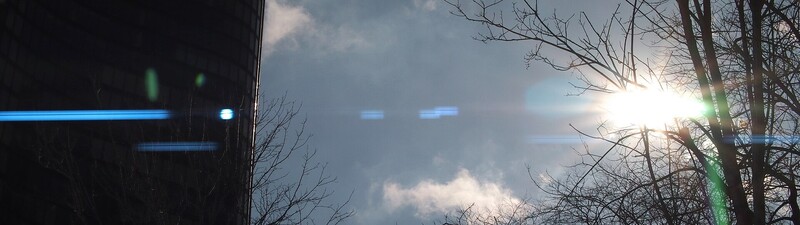
The industry now sells the effect at every price point. Streak filters such as the Tiffen Blue Streak hold parallel optical elements inside clear glass to draw a streak off any point source, and rotating the filter aims it. Rental houses keep uncoated and single-coated vintage glass on the shelf precisely because it blooms. Gaffers rig a lamp just past the frame line and let it graze the front element. Software recreates the whole effect afterward for anyone who did not capture it in camera. If you are a photographer moving into video, this is one of the first places the two crafts stop agreeing about what a good frame looks like.
Both sides are right, because flare is information about the light in the scene. A veiled, streaking frame tells you something bright and hot is sitting just off camera, and your eye reads that as presence. A surgically clean frame tells you nothing about the light at all, which is exactly what you want when the subject is a product, a face, or a landscape headed for a print. The artifact does not change. Only the intent does.
What Actually Works When You Want It Gone
If your lens shipped with a hood, that hood is still the most effective tool you own for this, and it cost you nothing. It blocks oblique light from ever reaching the front element, which kills veiling glare before any coating has to do its job. Check that the inner surface is still matte and intact, because a hood with worn or shiny inner walls turns into a reflector aimed at your front element.
Clean the front element and mean it. Grease and dust multiply scatter, and a fingerprint on the outermost surface costs you more contrast than a small scratch buried deep inside a group, because the front element is the surface that light from bright sources outside the frame reaches first, and whatever it scatters washes across the entire image.
Reconsider the clear protective filter. It adds two more air-to-glass surfaces at the most exposed point in the system, and it introduces a failure mode the bare lens does not have. The filter's rear surface is flat a nd square to the optical axis, so light bouncing off the sensor can reflect straight back off it and return, producing a ghost that is a mirror image of the bright source, inverted through the center of the frame and often in sharp focus. Cheap filters do this readily. Good ones do it less. None of them stop doing it entirely, and the ghost is easiest to trigger at night with a fast lens wide open, which is exactly when you least want it.
Flag the light. Your hand, a hat, or a piece of black card held just outside the frame line does what the hood does with more precision, and it reaches sources the hood cannot. Watch the frame edge while you do it and stop the moment your shadow creeps in. Then move. A step to the left that tucks the sun behind a branch, a lamppost, or a roofline pulls the source out of the optical path entirely, shutting down both families of flare at once.
Modern coatings are extraordinary. None of that changes the underlying situation. The photographer screwing on a hood and the cinematographer screwing on a streak filter are running the same experiment from opposite ends, both answering the same question about how much of the light source belongs in the picture, and the glass does not care which answer you give it.
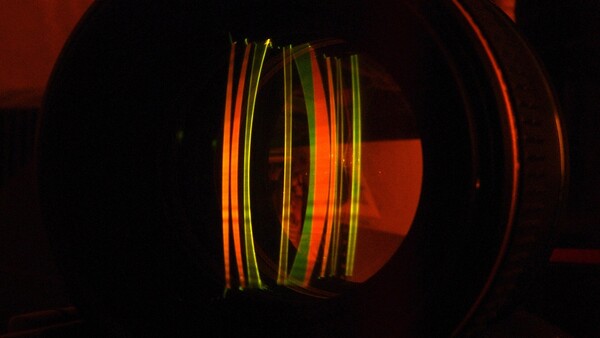
Lead image: the glass elements inside a Pentax DA* 55mm f/1.4 SDM lens made visible by a 405 nm violet laser sent straight through the front, each type of optical glass fluorescing a different color. Photo by yellowcloud, CC BY 2.0. Source.







_(14929131291).jpg)

Join the Fstoppers community for free
-
Post comments and join in the discussions
-
Browse the site ad-free
-
Share your work and get featured in the community
-
Compete in the photo contests for fun and prizes
2 Comments
Great info to get or not!!!
the image is with the Laowa 10mm f/2.8 Zero-D Camera Lens pointed right at the sun must be a great lens.
Did I just attend a master class in lens design? I think yes.