
A batch of packaging board made at a mill on the Wabash River on August 6, 1945 came out radioactive, and the X-ray film stacked against it fogged after roughly two weeks in the box. A physicist at Eastman Kodak worked backward from those spots to a bomb test about 1,000 miles away in the New Mexico desert. He then sat on the finding for four years before publishing it.
Kodak Was Already Hunting Radiation in Its Packaging
Photographic emulsion is a radiation detector that happens to make pictures. Silver halide grains do not care whether the energy that trips them arrives as visible light, as X-rays, or as a beta particle from a decaying atom. Leave sensitized film next to anything mildly radioactive for long enough and it will record the fact as fog or as spots, with no lens involved anywhere in the process. That is how Henri Becquerel found radioactivity in 1896, using uranium salts and a wrapped photographic plate, and it is also why a film manufacturer has to worry about the radioactivity of its own boxes.
Kodak had learned that lesson commercially during the war. Webb's own account of the background is blunt about the cause: the wartime paper salvage program mixed stock from plants where radium instrument dials were made into general paper supplies, so specks of radium paint could turn up in almost any packaging paper, and board like that would quietly ruin film sitting against it in a warehouse. So the company arranged for a mill in Indiana to produce board from carefully selected raw materials, and it tested what came back. The material was strawboard, a cheap, stiff paperboard pressed from cereal straw and used as the interleaving stiffener between sheets of film.
That arrangement is what made the 1945 anomaly legible. Kodak had a clean supply, a known baseline, and people whose job was to measure the difference.
What Julian Webb Found in the Strawboard
The trouble surfaced in August 1945. X-ray film that had sat in contact with the stiffener board came out of the developer carrying anywhere from ten to several hundred small dark spots on a single 14 by 17 inch sheet, and the radiation had punched through several layers of film and cardboard on the way. Julian H. Webb, a physicist in the company's research laboratories in Rochester, New York, took the problem apart and found that the fault was not in the emulsion but in the board packed against it. He narrowed it to a single production run: strawboard made on August 6, 1945 at the mill in Vincennes, Indiana, on the Wabash River.
The radiation survey ruled out the obvious suspect immediately. The contamination gave off fairly strong beta radiation, some gamma, and no detectable alpha, which is the wrong signature for radium or for natural uranium. Webb measured a maximum beta energy of about 0.6 MeV and a decay period of roughly 30 days, and a limited radiochemical analysis placed the material in the rare earth series. Those values pointed at cerium-141, a fission product with a half-life of about 32.5 days, though Webb was careful to say only that his numbers were compatible with cerium-141 rather than that he had pinned the isotope down. Nothing growing in an Indiana field makes cerium-141. Reactors and bombs do.
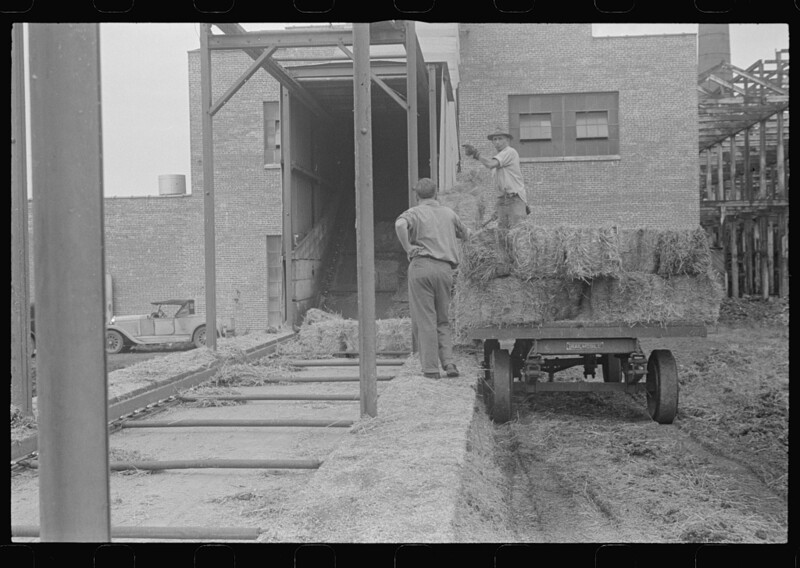
Webb then got a second data point. A contaminated run turned up at another strawboard mill, this one in Tama, Iowa, several hundred miles from the first and drawing on a different watershed. He tested the straw itself and could not make it the carrier, because a run made from straw that had been stored indoors rather than standing in a field showed the same contamination. What fit was the water. Both mills drew process water from river systems that had been rained on, activity in the board rose after each heavy local precipitation, and the material ended up filtered out of the pulp and pressed into the board that Kodak then stacked against its most sensitive product.
He set it down in Physical Review four years later, in a paper titled "The Fogging of Photographic Film by Radioactive Contaminants in Cardboard Packaging Materials," and he named the source in it. "The most likely explanation of the source of this radioactive contaminant appears to be that it consisted of wind-borne radioactive fission products derived from the atom-bomb detonation in New Mexico on July 16, 1945," Webb wrote.
He had worked that out within months of the event and waited until 1949 to say it in the open literature. A Los Alamos consultant wrote to him in 1947 asking for details, which indicates the weapons program knew what Kodak had measured long before the finding reached print.
What Kodak Knew, and What the Public Did Not
The popular version of this story overshoots, so we'll be precise about it. By the time those spots turned up in Rochester, the bomb was no longer a secret. The Trinity shot on July 16, 1945 was covered at the time with a story about an ammunition magazine exploding at the Alamogordo Army Air Base, and the real explanation became public after Hiroshima on August 6. Kodak did not learn that the United States had built an atomic weapon before the rest of the country did.
What Kodak's board established was where the debris went. A single device of roughly 21 kilotons fired in the New Mexico desert put measurable fission products into rainfall over the Midwest, roughly 1,000 miles downwind, in concentrations high enough to contaminate an industrial supply chain and spoil a commercial product. That is the actual discovery, and it is stranger than the version where a film company stumbles onto the existence of the bomb.
The guess reached print quickly too, which is worth knowing before anyone calls this a buried finding. TIME ran the strawboard story on November 12, 1945. Chauncey Suits of General Electric suspected bomb fallout, and Robley Evans of MIT named the two mechanisms that turned out to matter: that residues carried into the upper atmosphere over New Mexico had come down with the rain, or that the Wabash River water used at the strawboard plant carried radioactive silt. What Webb spent the next four years adding was not the idea. It was the measurement, the decay curve, and the second mill in Iowa that made the water explanation hold.
There is a corporate wrinkle underneath all of it. Tennessee Eastman, a subsidiary of Eastman Kodak, operated the Y-12 electromagnetic separation plant at Oak Ridge during the war years, which is where the enriched uranium for the Hiroshima weapon was produced. Trinity was a plutonium device, so Y-12's output is not what fogged the film. The compartmentalization angle usually hung on this story gets harder to sustain once you know who Webb was. He had spent about two and a half years on the Manhattan Project himself, at Berkeley and at Oak Ridge, and came out of it trained in radiation safety, measurement standardization, and monitoring. That background is most of the reason a fogged sheet of X-ray film could take him to a beta energy, a decay period, and the rare earth series. What it did not give him was any way to know that Trinity debris had come down on Indiana. That part he had to get out of the board.
Kodak's practical response was to start watching. The company installed air samplers in the intake for its building ventilation system, according to the Museum of Radiation and Radioactivity, which turned a film manufacturer into a private fallout monitoring operation built purely to protect inventory.
Rochester Snow and the Deal With the Atomic Energy Commission
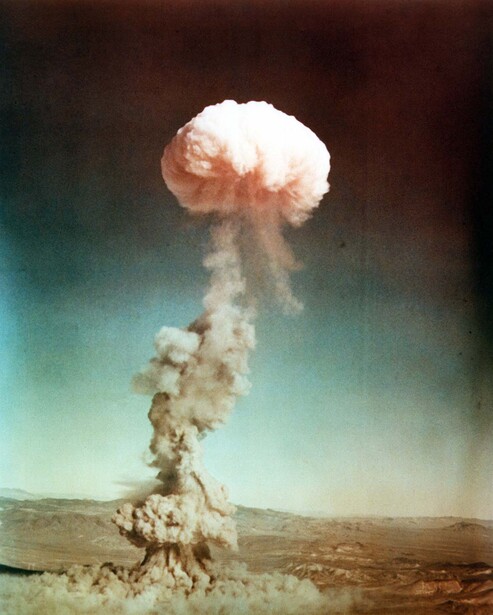
Testing came home to Nevada in 1951. Shot Able of Operation Ranger, an air-dropped device of roughly 1 kiloton, went off over Frenchman Flat on January 27, 1951, the first detonation at what became the Nevada Test Site. Not long after, snow fell on Rochester, about 2,000 miles east. The Geiger counters at Kodak's plant read 25 times higher than they should have.
Kodak took the problem to the Atomic Energy Commission. The agency agreed to give the company advance information about future tests, including, in the wording later read into the congressional record, the "expected distribution of radioactive material in order to anticipate local contamination." The arrangement did not stop with Kodak. The government warned the photographic industry as a whole and supplied maps and forecasts of potential contamination so manufacturers could protect stock in warehouses and in transit.
Sit with what that means operationally. Somebody in a federal agency was producing fallout deposition forecasts in the early 1950s, those forecasts were good enough to act on, and they were handed to an industry so that boxes of film would not be ruined.
What the Record Documents and What It Does Not
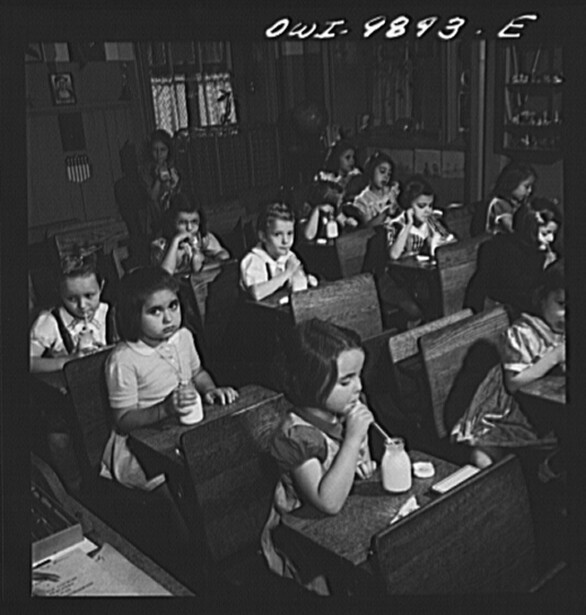
The story came back in 1997 because of milk. Iodine-131, another short-lived fission product, settles onto pasture, gets eaten by dairy cattle and goats, concentrates in milk, and then concentrates again in the thyroid of whoever drinks it, most sharply in children. Congress directed the study in 1982, and the National Cancer Institute spent roughly 15 years reconstructing those doses county by county, releasing its exposure estimates on August 1, 1997 and the detailed report behind them on October 1.
The numbers are grim and uncertain in both directions. The study put the average cumulative thyroid dose across the American population at roughly 2 rad, with far higher doses for children in high-fallout counties and for anyone whose milk came from a backyard cow or a goat. NCI director Richard Klausner told the subcommittee the tests "may have resulted in as many as 75,000 additional cases of thyroid cancer to the children alive at that time throughout the course of their lives, about a 20-percent increase from the expected number of thyroid cancers." A later National Academies review described NCI projections of between 11,300 and 212,000 excess lifetime cases with a central estimate of 49,000, a range wide enough to tell you how thin the underlying data was.
On October 1, 1997, a Senate Appropriations subcommittee held a hearing on that study, and the Kodak episode became its frame. Senator Tom Harkin of Iowa, who grew up in one of the hot spots in south central Iowa drinking milk from local cows and who told the subcommittee that his family had a history of thyroid problems, put the comparison in the record. "In fact, the Government warned the entire photographic industry and provided maps and forecasts of potential contamination," Harkin said. "Where, I ask, were the maps for dairy farmers? Where were the warnings to parents of children in these areas?" A few sentences on, he put it flatly: "The Government protected rolls of film, but not the lives of our kids."
Separate the documented part from the inferred part, because they do not carry the same weight. Documented, in the hearing transcript: Kodak complained, the AEC agreed to advance notice, the notice extended across the film industry, and the same agency sent no fallout maps to dairy producers or to parents living under the same predicted paths. Not documented: any memo in which somebody weighed film against children and chose film. Harkin did not claim to know why. "I am speculating here," he told the witness panel before asking them why the government would tell Kodak and not the public, and one of them, the epidemiologist Joseph Lyon, answered that he could "only assume that there was concern about the safety issue shutting down the test site." The AEC's public line throughout was that the fallout posed no hazard to people, a position the 1997 dose reconstruction does not support.
Give the other side its due, too. Film fogs at exposures far below anything that measurably harms a person, so a warning genuinely useful to a warehouse manager is not automatically a warning a parent needed. The asymmetry that survives that objection is narrower and much harder to argue with: the government was generating deposition forecasts, it decided who received them, and the list included an industry protecting inventory and excluded the families drinking milk produced in the same counties.
The retelling drifts as well, and not only in headlines. Harkin's own summary at the hearing described the 1945 packaging material as corn husks. Webb's paper says strawboard pressed from cereal straw, contaminated through mill water rather than through the crop. If you want to argue from this case, argue from the paper.
Film Is Still a Radiation Detector
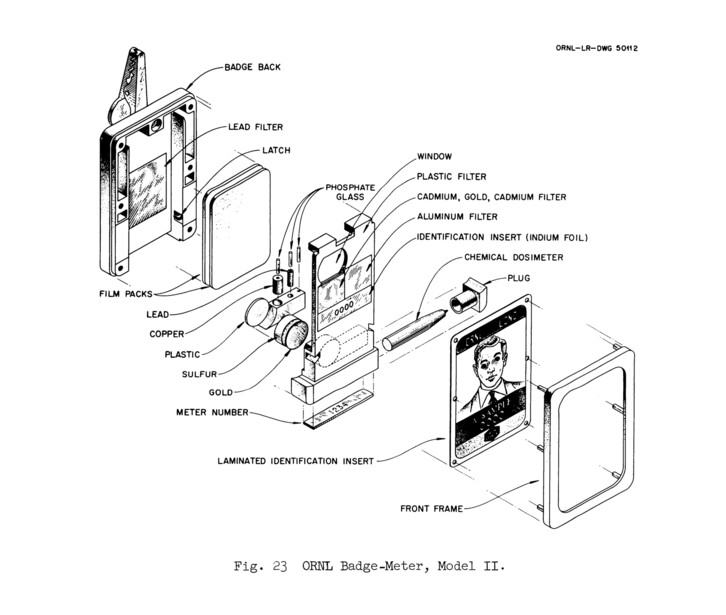
The property Webb spent 1945 fighting was already a product elsewhere. For decades the standard personal dosimeter for radiation workers was a film badge, a small holder carrying a strip of emulsion behind a set of metal filters. You developed the strip, read the density, and got the dose. The same sensitivity that ruins a box of X-ray film is the entire point of the badge.
The era left marks on materials that have nothing to do with photography. Instruments that need an extremely low background are still built from steel smelted before 1945, often salvaged from ships sunk before the atmospheric testing era, because steel produced afterward can carry trace activity picked up from the air used in the process.
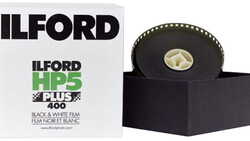
You still run into the same physics at the airport. When the TSA began deploying computed tomography scanners for carry-on bags, Kodak Alaris and Ilford both warned that the machines can damage undeveloped film. Kodak ran its own tests, putting rolls of Kodak Professional Portra 400 through a CT unit before processing them, and it advises against putting any unprocessed film through a CT scanner. Ilford says the same, reporting that it considers the CT machines unsafe for its film range regardless of speed, which would cover a sheet of ISO 50 stock as much as it covers a roll of Ilford HP5 Plus. TSA's own published guidance is simply to put undeveloped film in your carry-on and ask for a hand inspection at the checkpoint.
Digital did not repeal any of this either. A long exposure on a CMOS sensor collects cosmic-ray hits as short bright streaks and stray bright pixels that were never in the sky, which is why frame stacking with outlier rejection is standard practice in serious astrophotography work rather than an optional refinement.
Kodak's boxes were never special. They were simply the most sensitive uncontrolled instrument in the country in August 1945, stacked against board pressed in Indiana and Iowa, integrating whatever came down in the rain and reporting it in spots. Ask for the hand inspection next time you fly with film. The emulsion in your bag is doing the same job, and it has never once been wrong about what hit it.
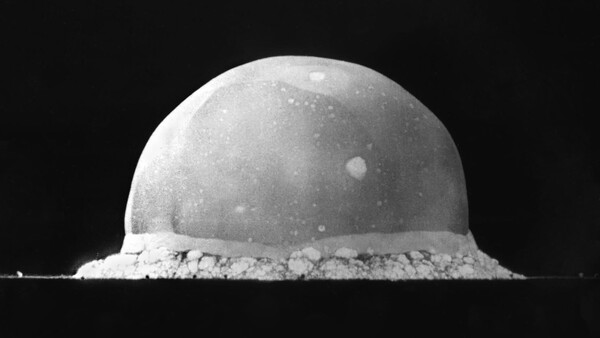
Lead image: the Trinity fireball 0.016 seconds after detonation, July 16, 1945, photographed by Berlyn Brixner for Los Alamos National Laboratory. Public domain. Source.



Join the Fstoppers community for free
-
Post comments and join in the discussions
-
Browse the site ad-free
-
Share your work and get featured in the community
-
Compete in the photo contests for fun and prizes
5 Comments
Wow! Great article.
As a retired nuclear medicine technologist and a photographer, I found this article super interesting! Thank you!
Truly enjoying your deep dives into historical photos and events.
Thanks!
All very interesting for all today who work with the weapons in everyday places. I had to wear one of those dosimeter badges as well today many x-ray techs. The one point everyone should know is those proving grounds either in New Mexico or some where in the Pacific or tests done high in the atmosphere before our huge number of satellites is the use of can be used in a number of places at the press of a button.
Here is one for you you know the watches and paint that glows in the dark, I used to work on instruments that had the paint on them and when I worked on them i was required to wear a body armor like suit in the early 70's BUT the watches everyone wore, including me, to see the time in the dark it was never mentioned in the paper work of the watches. How many use the paint on camera buttons when doing Astro captures, in comes off on your fingertips.
Not to be political, I can not be ever for still in the military even at 70+, but all the wars that happen are mainly to control all things. With all those satellites for communications (5 watts each) and for GPS just one will make everyone blind to where one is and no streaming of things. It will be back to paper maps and DVD's.
I was one of those kids going under my desk in the 60's (yea right what for), and the many with bomb shelters back then and even those with the money building them during Y2K and even when Covid broke out all just delaying every thing.
Ever been to one of these OLD launch sites that give tours this in Arizona. You can even buy one, without the missel, but deep under ground in Montana a whole bunch all together in a neighborhood like. Just for some info the window at the top is there so whoever monitors what we have can still know one is still on a launch pad and where.
A look back to the past or back to the future in some places. Not to scare but letting everyone know what a big silver bullet looks like and do not go digging now but know there is one of those shelters in an old neighborhood near you a great photography find.
Also some aircraft that can spy and also carry things have to be on display for all to see we are not going to reuse them.
History also can be great images!
1. A reason to have a 12mm with you, today with 10mm f/2.8 and something also small the Sony 2013 APS-C E 10-18mm (15-27mm in 35mm) f/4 OSS but in Full Frame 12-18mm smaller than even the 10mm f/2.8 and still a little more than I paid in 2014.
2. on a bus tour how taken, with a LensSkirt blocks refection's from windows say indoors when high up in a city hotel/hospital or on that train/bus observation deck, it folds up flat.
As a PhD scientist and photographer I found the article an accurate scientific story that held my interest to the end. Great job of presenting scientific information in a format accessible to all readers. Your research is spot on.