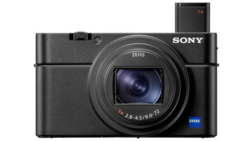
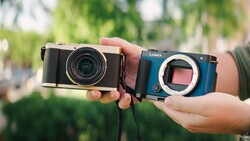
Choosing a premium fixed-lens compact camera is harder than it looks, because the category spans everything from true shirt-pocket cameras to chunky near-mirrorless bodies, and the right answer depends almost entirely on what you actually shoot. The Canon PowerShot V1, Fujifilm X100VI, Panasonic Lumix LX10, Panasonic Lumix ZS300, and Sony RX100 VII are not variations on the same theme; they make fundamentally different tradeoffs across sensor size, lens range, portability, and price.
Coming to you from Gordon Laing, this thorough video puts all five cameras through brand-new, side-by-side tests shot on the same subjects at the same time, not a stitched-together compilation of older reviews. Laing walks through startup speed, autofocus response, optical zoom coverage in both photo and video modes, noise performance across the full ISO range, background blur at portrait and close-up distances, and real-world vlogging usability with each camera's built-in mic. The sensor size spread alone is significant: the Fujifilm X100VI runs a 40-megapixel APS-C sensor, while the Sony RX100 VII and Panasonic Lumix ZS300 share a 1-inch-type sensor measuring just 13.2 x 8.8 mm. That gap has real consequences for noise, dynamic range, and how much background blur you can realistically pull from each camera. The Canon PowerShot V1 sits in the middle with its 1/4-type sensor and a 16–50mm f/2.8–4.5 lens that gives it by far the widest coverage of the group.
The resolution comparison is one of the more revealing sections. At 35mm equivalent, the X100VI leads clearly, but Laing also tests what happens as you force the prime-lens camera to crop while the zoom cameras pull ahead optically. At 50mm, the X100VI's 40-megapixel sensor means cropping still leaves you with around 20 megapixels, roughly matching the others. Push to 75mm and the optical zoom cameras take over. By 200mm, only the Sony RX100 VII and Panasonic Lumix ZS300 are working at native resolution, and Laing finds the Sony delivers a noticeably crisper result at that focal length. The ZS300's 15x optical zoom reaching 360mm is unmatched in this group, but the autofocus trails the others, and the 4K mode applies a substantial 1.5x crop that pushes the effective range to 36–540mm.
Two of the five cameras stand out for specific use cases based on what Laing actually finds in testing. The Canon PowerShot V1 earns his recommendation for video and vlogging, largely because of that ultra-wide 16mm starting focal length, plus the built-in ND filter, cooling fan, flip screen, and both mic and headphone jacks. The Fujifilm X100VI is the clear stills leader with its hybrid viewfinder, dedicated aperture ring, shutter dial, and the cleanest high-ISO output of the group. The Panasonic Lumix LX10 surprises with uncropped 4K up to 120p and a 24–75mm f/1.7–2.8 lens that genuinely delivers impressive bokeh for a zoom compact. All three are priced above $1,300, so the two cameras at around $900 each, the V1 and the ZS300, serve a different buyer with different expectations.
Check out the video above for the full breakdown, including the vlogging tests, the close-up bokeh comparisons, and Laing's complete verdict on each camera.

Join the Fstoppers community for free
-
Post comments and join in the discussions
-
Browse the site ad-free
-
Share your work and get featured in the community
-
Compete in the photo contests for fun and prizes
2 Comments
Very apples vs oranges comparison.
I guess today everyone is carrying a Cell phone and use it most of the time anyways! BUT yes with the choices mentioned one will be good good for your needs.
But take a trip back in time to the mid 2000's when digital point and shoots took the place of that small in pocket Kodak camera. Then the start of the SD card in place film.
One still being sold is the Fujifilm FinePix Z33WP yes even waterproof. Photo Sensor Technology CCD, 3x optical zoom; 2.7-inch LCD screen with Micro Thumbnail View, 50 MB built-in memory. Standard SD Cards: Up to 2GB capacity. SDHC Cards: 4GB up to 32GB capacity (recommended).
An 8GB memory card can store roughly 1,600 photos at maximum 10-megapixel resolution.
Jpeg format where some of the cameras are tiff format but not like todays tiff if editing.
there is a lot of help on line. Extra batteries easy to get and a charger.
I just add this for a REAL Small camera if need be and i till keep in my pocket when out and about. It is a 10MP, where a Sony 12MP is good for poster size prints. good to have in the car armrests just in case and no one will look at twice black or green and so small, smaller than a cell phone too.
There are many more of cameras of this era with zoom lenses and very small and great for those who just want to use the auto function and no editing but can be!
1. on a cruise at Paradise Island (edited in Lrc years ago) 2. Zoomed in from my front porch, just handier than using my phone (edited in Lrc years ago)