
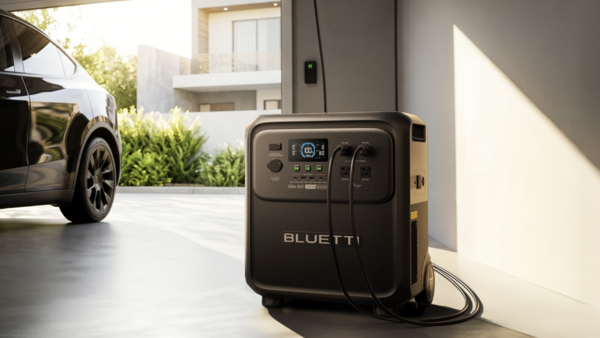
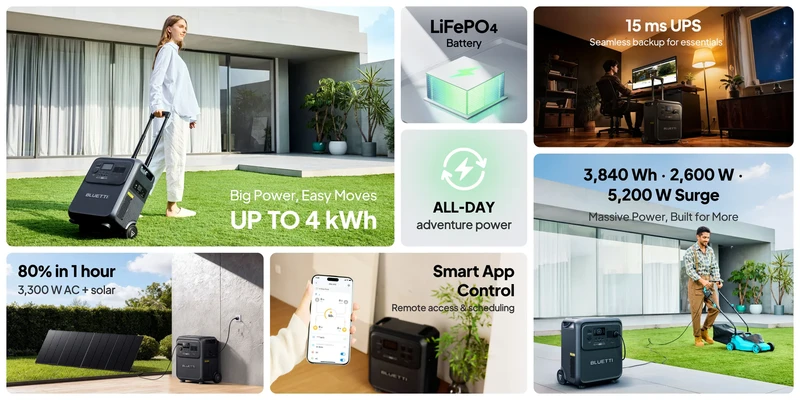
The Bluetti Elite 400 is a 3,840 Wh portable power station that rolls, and that second detail turns out to matter almost as much as the first. This is a nearly 4 kWh LiFePO4 battery with a 2,600 W pure sine wave inverter, built into a case with luggage wheels and a telescoping handle, and it is aimed squarely at the gap between the little 1,000 Wh boxes you carry with one hand and the 100-pound bricks you never actually move. That gap is exactly where a lot of real-world power lives: a computer you do not want to lose in an outage, a fridge to keep cold when the grid goes down, a campsite to run, and a permanent pile of batteries and devices that need charging.
I tested the base Elite 400 (no expansion, since there is no expansion to add) on the things I actually plug in: a computer and a monitor, a refrigerator and a couple of fans during a power outage, a steady rotation of camera and device batteries, and the unit itself hauled along as travel power. I am not an off-grid survivalist and I did not test this thing for a week-long blackout. I used it the way anyone who wants a big, movable wall outlet would, which is to say I asked it to behave like one wherever I did not have the real thing.
The headline is simple: the capacity and the wheels are the whole pitch, and both deliver. The caveats are equally simple, and they are about weight and expandability.
Specifications and Configuration
- Capacity: 3,840 Wh
- Battery chemistry: LiFePO4 (LFP)
- Rated AC output: 2,600 W continuous, pure sine wave
- Power Lifting mode: up to 3,900 W sustained for resistive loads (heaters, kettles)
- Peak surge: 5,200 W
- AC outlets: 4 x 120 V, 20 A each, 2,600 W total
- USB-C: 2 x 100 W
- USB-A: 2 x 15 W (30 W total)
- DC car port: 1 x 12 V / 10 A (120 W)
- DC / solar (PV) input: 12 to 60 V, 20 A, 1,000 W max
- AC charge input: up to 1,800 W on AC alone; up to 2,800 W combined AC + solar. 0 to 80% in 70 minutes requires AC and solar together; roughly 2.5 hours full on AC alone
- UPS / EPS switchover: 15 ms (line-interactive, not true online double conversion)
- Standby draw: 3 W
- Cycle life: 3,000+ cycles to 80% capacity
- Expandable: No. The Elite 400 is a standalone unit with no expansion battery port
- Weight: about 86 lb (39 kg)
- Dimensions: 17 x 11.34 x 19.29 in (432 x 288 x 490 mm)
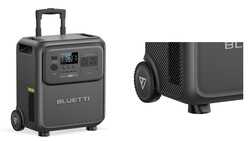
- Mobility: integrated rear wheels, telescoping trolley handle, molded side handle
- Display: color LCD showing input, output, state of charge, and time remaining
- Control: Bluetti app over Bluetooth and Wi-Fi
- In the box: Elite 400, AC charging cable, grounding screw (M5 x 10 mm), documentation
- Warranty: 5 years
- Price: around $1,849 on sale at the time of writing
Getting It to Set: The Weight, the Wheels, and the Truth About 86 Pounds
Every review of a big power station has to start here, because portability is the entire reason this one exists, and portability is also where the marketing and the reality have their first argument. The Elite 400 weighs about 86 pounds. That is not a number you carry. It is a number you roll.
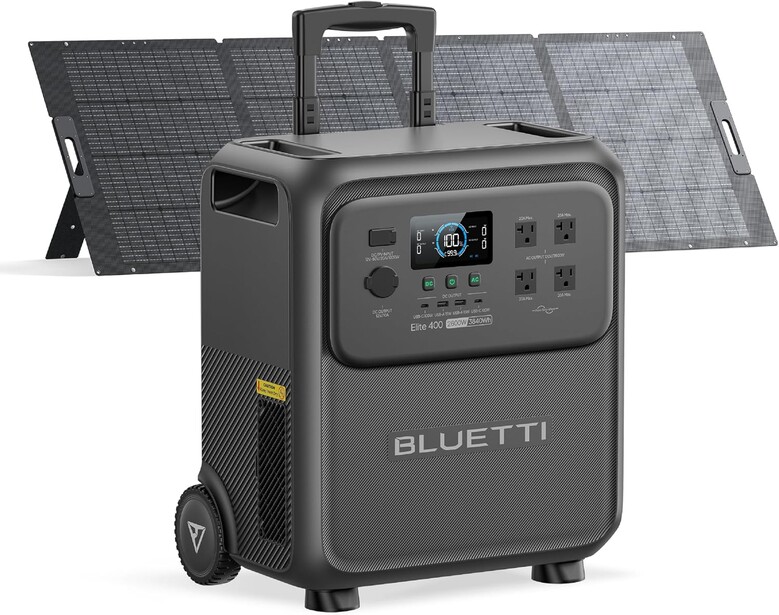
The good news, and it is genuinely good, is that Bluetti built the thing like a rolling suitcase rather than a battery with an afterthought handle bolted on. The rear wheels are real rubber-tired wheels, not hard plastic casters, and the telescoping handle locks at a sensible height. On flat ground, moving it feels like wheeling a heavy carry-on, and I could get it from the car to wherever I needed it without a second person. That is the difference between bringing serious power along and leaving it at home because it was too much to deal with.
The reality check is everything that is not flat ground. Lifting 86 pounds into a car trunk is a two-hand, mind-your-back heave, and stairs are a chore. Gravel, grass, a sandy approach, a flight of stairs: the wheels stop helping and you are back to the raw weight.
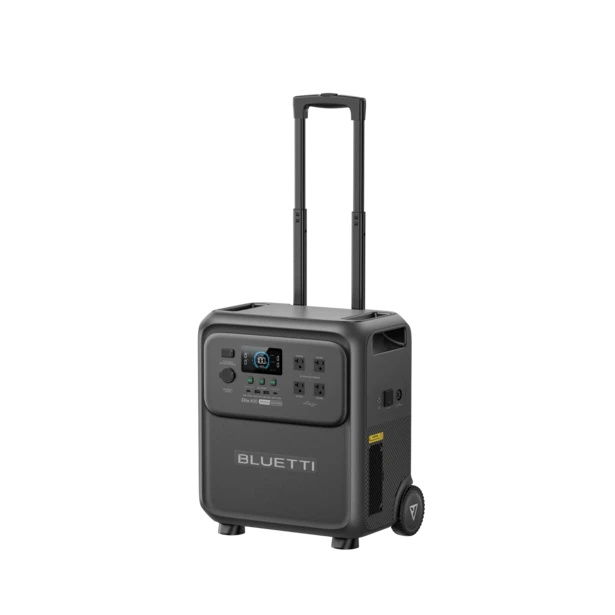
None of that is a design flaw, it is physics. Capacity means weight, and a nearly 4 kWh LiFePO4 pack weighs what it weighs. Bluetti's claim that it is "35% lighter than others" of the same capacity is plausible and beside the point when you are the one lifting it. Plan your access, and if stairs are involved, have a hand, hand truck, or helper ready.
Powering the Things That Actually Matter: Computers, a Fridge, and a Day of Charging
A battery is only interesting once it is running your actual stuff, and for me that stuff is not exotic. It is a computer and a monitor, a refrigerator and some fans when the power goes out, phones and camera batteries that always need topping up, and whatever else I want to run somewhere there is no outlet. The Elite 400 handles all of it without drama, and the reason it does starts with the inverter.
The 2,600 W output is pure sine wave, which is the part that lets you trust it with a computer and anything else that has a sensitive power supply. Cheap modified sine wave inverters can be hard on electronics and make some devices buzz or misbehave. A clean sine wave is what makes a power station safe for the machine your work lives on, and running my computer and monitor off it, there was simply nothing to notice, which is exactly what you want.
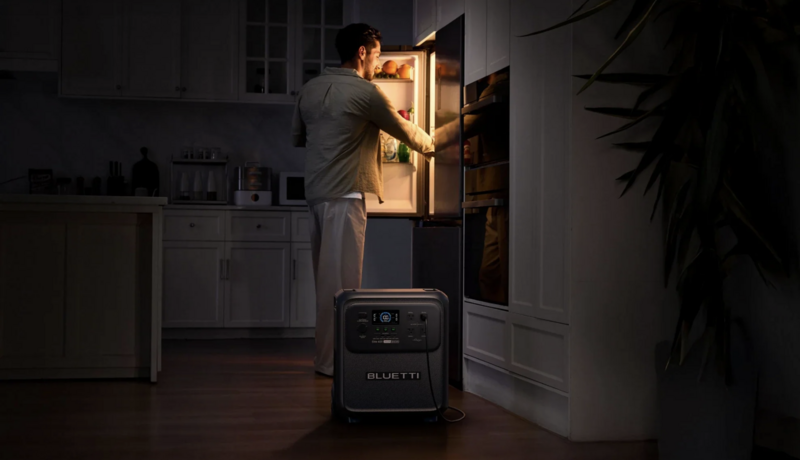
The number you might not appreciate until you need it is the 5,200 W peak surge. A refrigerator draws very little while it runs, but its compressor pulls a hard spike every time it kicks on, and that inrush is what trips undersized inverters. The surge headroom means something hungry like a fridge starts cleanly every cycle, so the Elite 400 can genuinely keep the food cold through an outage rather than choking the first time the compressor cycles. Fans, a modem and router, chargers, a computer: these are light, steady loads, and 3,840 Wh of capacity turns them into hours and hours of runtime. I never came anywhere near the 2,600 W ceiling with the things I actually plug in, and the front LCD shows your exact draw in real time if you ever want to check.
If you're wondering what that translates to: say you have a power outage (which I frequently do). A standard fridge pulls about 1.5 kWh a day, which means with no topping up via solar panel, you could keep your food safe for 2.5 days off this device alone. If you're camping or working outdoors and runnings things like lights, a laptop, etc., expect days or functionally indefinite capacity if you're topping off with solar panels. And frankly, depending on the windows in your house or access to outside, with solar panels, you might even keep that fridge running indefinitely too.
The Ports, and the Way You Actually Charge Things
Beyond the AC outlets, the port selection is sensible. The two USB-C ports are 100 W each, which is enough to fast-charge almost any laptop and to top up camera batteries, phones, and other devices at full speed. Keeping a rotating pile of batteries and gadgets charged off these ports was a set-and-forget affair; I never thought about it.
The USB-C ports top out at 100 W rather than 140 W or 240 W, and in practice that was a non-issue: my laptop charged off them just fine. If you were running a 140 W laptop flat out while charging, a 100 W port would not quite keep up under that peak load, but plugging into one of the four AC outlets with the laptop's own charger sidesteps that entirely, and for normal use the USB-C ports simply work. Unless you're doing something like rendering video on a 16-inch laptop for literally hours at a time, you're not going to out run the 100 W output. The two USB-A ports are 15 W each, fine for phones and accessories and nothing you need to think about.
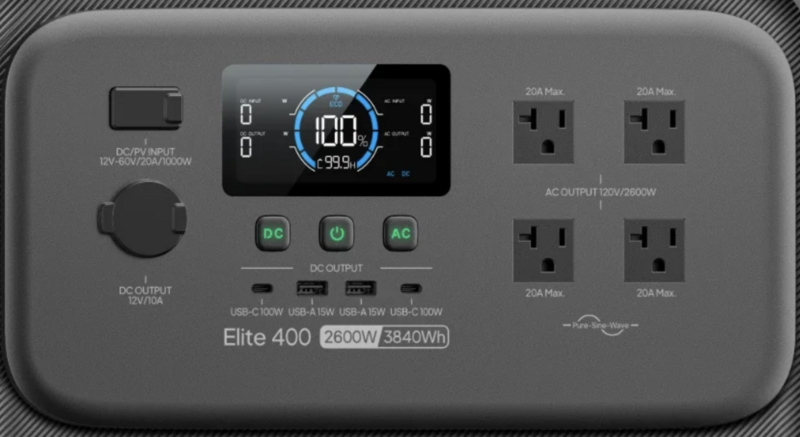
The 12 V car port (120 W) is there for the DC accessories that want it, and the front-panel LCD is useful: it shows input wattage, output wattage, state of charge, and an estimated time remaining that updates as you add and remove loads. I frequently glanced at it to gauge how much runtime I had left, and the estimate tracked reality well. When you are stretching a battery across a long day or an outage, watching the live draw is how you avoid surprises.
Charging It Back Up: The 70-Minute Claim Versus the 2.5-Hour Reality
Bluetti leads with "0 to 80% in 70 minutes," and that number is real, but read the asterisk before you plan around it. The 70-minute figure requires roughly 2,800 W of combined input, which in practice means AC and solar at the same time. On a wall outlet alone, a full charge is closer to 2.5 hours, and independent testing of a 15 to 85% run landed right around that mark.
For most people, 2.5 hours from empty on a standard outlet is the number that actually matters, and it is fine. The genuinely useful part is the fast partial charge: if you have 40 minutes and an outlet, you can claw back a meaningful chunk of capacity, which is worth more day to day than the headline time.
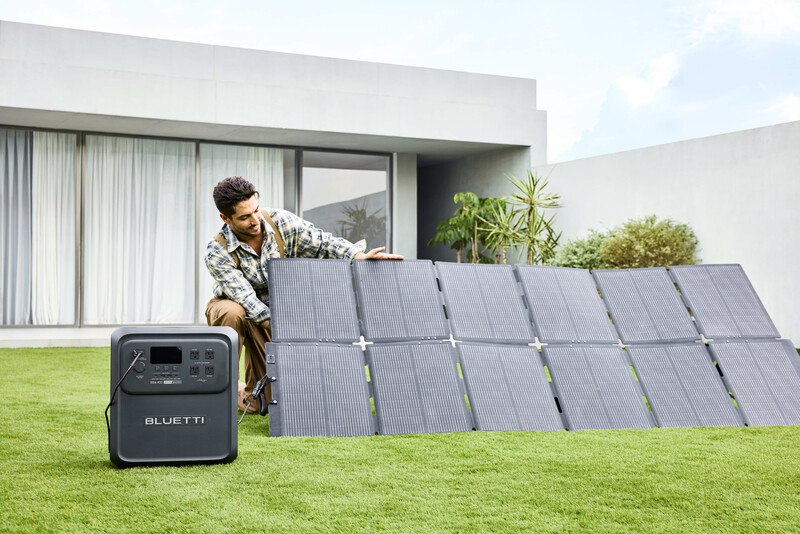
Solar is where the Elite 400 gets genuinely fun. It accepts up to 1,000 W of PV (12 to 60 V, 20 A), and paired with panels, it changes the math completely. Under the normal, steady loads most people actually run, incoming sun keeps pace with what you are drawing, so you can essentially run indefinitely without ever touching a wall outlet. For camping, van life, or any stretch off the grid, that is the whole game: the panels feed the battery while the battery feeds your gear, and as long as the sun is doing its part, you never watch the number tick down. A full solar recharge from empty in good sun takes around six hours, so treat it as a top-up-as-you-go story rather than a fast refill, but as a way to stay powered indefinitely while you use it, it works beautifully.
Double Duty at Home: The 15 ms UPS and the Editing Room
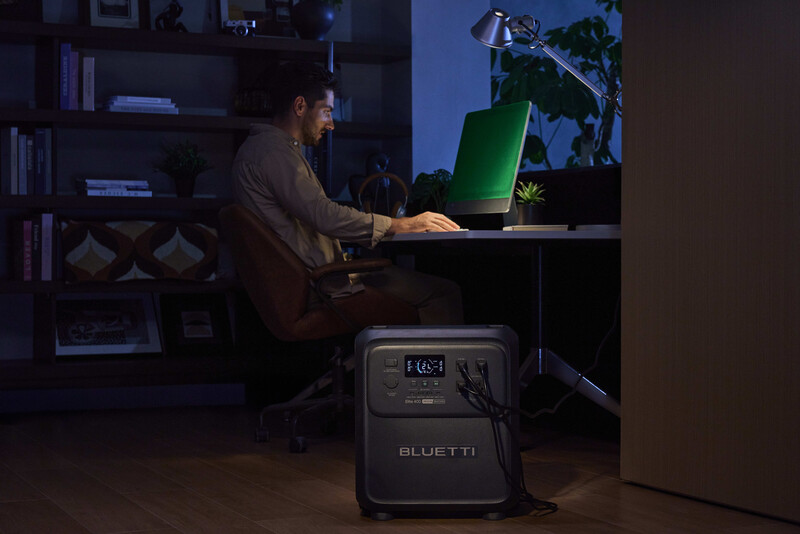
A power station this size earns its keep at home too, and the Elite 400's other job is home backup and a workstation UPS. The pass-through UPS switches to battery in 15 ms, fast enough that connected gear does not notice the grid dropping. I ran my computer and monitor through it and flipped the outlet off deliberately, and the machine did not so much as blink. That alone makes it even more useful at home than on the road.
Two honest technical notes. First, 15 ms is an EPS or line-interactive switchover, not a true online double-conversion UPS that has zero transfer time; for a desktop, a NAS, or networking gear it is entirely sufficient, but a lab running something that cannot tolerate any interruption would want a dedicated online UPS. Second, the 3 W standby draw is genuinely low, which is what makes leaving it plugged in as an always-ready backup practical rather than wasteful. With 3,840 Wh in the tank, an editing desk, a router, and a modem can ride out a long outage, and a fridge can limp through a much longer one. For context, 3 W equated to a couple dollars a year in most places.
This dual-use is a real part of the value. The same battery that runs your campsite or rides in the trunk as travel power is the one protecting your computer when a storm takes the grid down, and for anyone whose work lives on that machine, that second job is not a footnote.
The App and Living With It
Control lives in the Bluetti app over Bluetooth and Wi-Fi, and it does the expected things: monitor state of charge and draw remotely, toggle AC and DC, set charging behavior, and update firmware. I mostly used the front panel and dipped into the app to check the charge from across the room. It is functional if you want to use it. For a device you operate mostly with three physical buttons and a clear LCD, the app being merely adequate is a minor complaint, but it is worth knowing that the software is not the selling point here. The hardware is.
What Is Missing
The single biggest limitation is not weight, it is expandability, or the lack of it. The Elite 400 is a sealed 3,840 Wh unit with no port for an add-on battery. Bluetti's own lineup includes expandable systems that scale to five figures of watt-hours, so the Elite 400's fixed capacity is a deliberate choice rather than a technical necessity, and it defines the ceiling of what this unit can ever be. What you buy is what you get. If you outgrow 3.8 kWh, your only move is to buy a second complete unit. For a product positioned partly as home backup, that is the decision that most deserves a hard think before you commit. That being said, this is not meant to be a dedicated home backup, and you shouldn't treat it as such. Rather, it's a do-it-all travel device that has the capacity to step in when needed in an emergency.
Summary
What I Liked
- Nearly 4 kWh of LiFePO4 capacity in a case you can actually move by yourself, on real wheels with a real trolley handle.
- Clean 2,600 W pure sine wave output you can trust with a computer and other sensitive electronics.
- 5,200 W peak surge, enough headroom to start a refrigerator compressor cleanly every cycle.
- Two 100 W USB-C ports that charge laptops fast and keep camera batteries and devices topped up.
- Genuinely fast recharge: 2.5 hours full on AC alone, with a 70-minute 0-to-80% option using AC plus solar.
- Pairs beautifully with solar: under normal loads, incoming sun keeps pace with your draw, so you can run essentially indefinitely off-grid.
- Clearly labeled ports.
- Useful, legible LCD showing live input, output, and time remaining.
- 15 ms UPS and a low 3 W standby draw make it a practical always-ready backup for a computer or workstation.
- LiFePO4 longevity: 3,000+ cycles before meaningful capacity loss, so it should outlast several laptops.
- Real dual-use value: travel and camping power on one hand, home outage backup on the other.
What I Didn't Like
- Not expandable. The fixed 3,840 Wh capacity is a hard ceiling, which is the one real limitation on a unit that doubles as home backup
- The 70-minute charge headline needs simultaneous AC and solar; the everyday AC-only number is 2.5 hours.
Conclusion
The Elite 400 is the rare piece of gear whose gimmick is also its best idea. Putting wheels on a 4 kWh battery sounds like marketing until you are the one moving it, at which point it becomes the reason you actually bring serious power along instead of leaving it in a closet. It hits a genuine sweet spot: enough capacity to matter, clean enough power to trust with a computer, efficient enough to sit plugged in as always-ready backup, and mobile enough to wheel out to the car or across the house to wherever the outage is. Buy it if you want one big battery that covers travel and camping power, everyday charging, and home outage backup in a package you can move by yourself, especially paired with solar for indefinite off-grid runtime. Think hard before buying if your access is all stairs and rough terrain. Within those honest limits, it is one of the more useful batteries you can own.





Join the Fstoppers community for free
-
Post comments and join in the discussions
-
Browse the site ad-free
-
Share your work and get featured in the community
-
Compete in the photo contests for fun and prizes
No comments yet