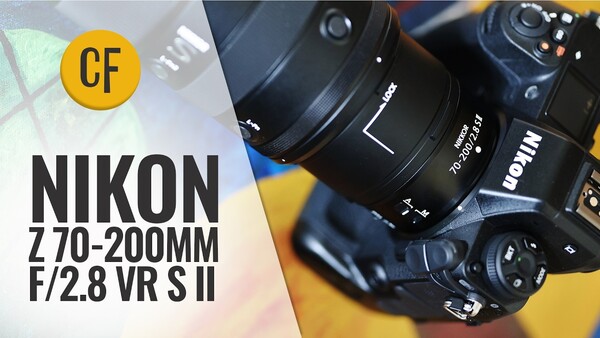
The Nikkor Z 70-200mm f/2.8 VR S has been a flagship zoom for Nikon's mirrorless system since it launched roughly six years ago, and the original version earned a reputation as one of the sharpest lenses in its class. Now Nikon has released a Mark II version, and the question isn't whether it's good; it's whether the improvements justify the $3,196 price tag.
Coming to you from Christopher Frost, this thorough video puts a final production copy of the Nikkor Z 70-200mm f/2.8 VR S II through a full review, testing it on a Nikon Z 9 with its 45-megapixel sensor. The most immediately noticeable change is the weight: the new version comes in at 998 g with the tripod collar removed, which is 26% lighter than the original. Frost also notes it's 12 mm shorter, has an 11-blade aperture instead of nine, offers a shorter minimum focus distance, and Nikon claims 3.5 times faster autofocus at the telephoto end. The lens ships with two tripod collars, one of which is Arca-Swiss compatible, plus a plastic cosmetic ring if you'd rather go collarless entirely.
On the handling side, the lens ditches the OLED information panel from the original in favor of an additional customizable button, which Frost considers a straightforward trade. There's a customizable control dial that can be set to turn smoothly or with clicks, useful as an aperture ring or mappable to other functions. The manual focus ring is described as extremely smooth and responsive, and focus breathing is very low across the zoom range, a genuine advantage if you shoot video. Autofocus, tested against moving subjects, locks on quickly and accurately, and Frost says it did feel noticeably faster than the original in real-world use.
Image quality is where things get interesting. At 70mm and f/2.8, the center is excellent, and the corners are nearly as sharp. Performance at 120mm and 200mm follows a similar pattern, with the center razor sharp wide open and corners just slightly softer but still impressive. Frost concludes it's marginally sharper overall than the original, though only barely, because the original was already at the top of its class. Close-up image quality is a genuine improvement over the previous version, with strong sharpness even at f/2.8, and longitudinal chromatic aberration is minimal. Bokeh is smooth and flattering, even with difficult specular highlights in the background. There is one real drawback, though: flare. Frost describes being genuinely surprised by how much flaring and ghosting appears when bright light sources enter the frame, regardless of focal length. For a lens at this price, that's a notable weak point worth knowing before you buy.
Check out the video above for the full rundown from Frost, including his complete sharpness comparisons, stabilization footage, and distortion and vignetting results.
1 Comment
I don't understand why both versions of this lens put the (virtually useless) focus ring close to the body of the camera and the (very necessary) zoom ring far away from the camera body. This makes it impossible to brace your elbow on your body to support the weight of the camera and lens and maintain the ability to zoom the lens. My imperfect solution is to attach the tripod mounting base to the lens and use that to hold the lens while bracing my elbow against my body to support the weight of the lens. Then I use my index finger to zoom in and out. It is awkward and far from ideal.