The OM SYSTEM M.Zuiko Digital ED 50-200mm f/2.8 IS PRO lens is one of those rare releases that feels like it fills a genuine gap. Long telephoto reach paired with a bright f/2.8 aperture is not something you often get in a relatively compact package. If you work in forests, at dawn, or in any setting where light is scarce but reach is essential, this lens immediately stands out.
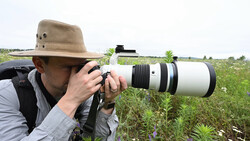
Coming to you from Emilie Talpin Photography, this detailed video introduces the new OM SYSTEM M.Zuiko Digital ED 50-200mm f/2.8 IS PRO lens. From the start, the design choices show real attention to usability. The rotating tripod collar detaches to make travel easier, and the build maintains a balance of portability and sturdiness. Buttons around the lens can be customized, echoing the controls from the 150-400mm. It accepts 77mm filters, which is a practical size if you already have accessories in that range. Talpin points out how light the lens feels in hand despite its reach, which matters when you spend long hours in the field.
The video demonstrates how much of a difference f/2.8 makes in real-world conditions. Shooting owls in the White Mountains at dawn, Talpin compared it to the 150-400mm f/4.5 and showed that the extra stop of light allowed shots that would have otherwise been impossible. That faster aperture also opens doors for subjects like hummingbirds and insects, where you need a high shutter speed to freeze motion. The ability to balance shutter speed, aperture, and ISO without sacrificing as much image quality is a clear advantage. Add in the option of pairing it with a teleconverter, and you have a flexible setup that can stretch to 800mm equivalent when needed.
Key Specs
-
Focal Length: 50 to 200mm (35mm Equivalent: 100 to 400mm)
-
Maximum Aperture: f/2.8
-
Minimum Aperture: f/22
-
Lens Mount: Micro Four Thirds
-
Minimum Focus Distance: 2.6' / 78 cm
-
Macro Reproduction Ratio: 1:4
-
Optical Design: 21 Elements in 13 Groups
-
Aperture Blades: 9, Rounded
-
Autofocus with Image Stabilization
-
Filter Size: 77 mm
-
Dimensions: 3.6 x 8.9 in. / 91.4 x 225.8 mm
-
Weight: 2.8 lbs / 1,250 g
Talpin also noted how well the lens handled macro-style shots of bees and butterflies, which is not something you typically expect from a super-telephoto. The 1:4 reproduction ratio combined with f/2.8 gave strong subject separation and smooth background blur. In overcast conditions, that brightness paid off again by keeping shutter speeds high enough for handheld use. The lens fits into a small backpack or even a waist pack, which is not what you usually say about a 400mm equivalent. Check out the video above for the full rundown from Talpin.

Join the Fstoppers community for free
-
Post comments and join in the discussions
-
Browse the site ad-free
-
Share your work and get featured in the community
-
Compete in the photo contests for fun and prizes
3 Comments
The f2.8 aperture is nice because this brings it up to a solid 100-400mm f5.6 equivalent.
With the MFT sensor cameras, depth of field has always been a weak point, relative to their full frame equivalents. But it looks like OM Systems is conscious of this, and doing something about it, by offering a lens that will produce out-of-focus areas that look as nicely blurred as a 100-400mm f5.6, which is a staple in any lens system.
Is this something you have struggled with Tom? I haven't found it to be an issue. Here's one straight out of camera, OM1, 40-150 mm f/4.0 lens. 150 mm, f/5.6, 160 sec, ISO 200. I read many comments of this nature but i haven't experienced these issues myself. I'm not suggesting that this is an amazing photo, just the first shot I came across as an example.
Well of course you can get wonderfully blurred backgrounds from any camera and lens, when you are able to get good distance between the subject and the background, as you have done here. But, often, we can not get that type of subject to background distance, and the backgrounds are multi-colored, ugly, and distracting, and this is when we need our optics and frame size to give us super shallow depth of field, because circumstances prevent us from shooting from ideal positions.
This photo you have shown here, imagine if that flower were at an arboretum that had fences lining the walkways, and you are not allowed to hop over the fence. Now imagine that the flower is 4 feet from the walkway, so you can not get your camera any closer than 4 feet. And there is a flowering shrub with coarse leaves right behind it, like just 24 inches behind this flower you are shooting. And imagine that the flowers on that shrub are dying and wilted and starting to turn brown. In such a case, you would need optics to blur that nasty bush out of your background, because there is no way to position yourself to avoid that being right behind your flower,