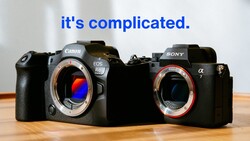
Sony’s a7 V is being framed as the hybrid body to watch going into 2026, and it’s getting a head-to-head test against the Canon EOS R6 Mark III. If you shoot both stills and video, this matchup hits the exact problems that waste time later: skin tone cleanup, shadow recovery, and how far you can push footage before it turns weird.
Coming to you from James Reader, this methodical video compares the Sony a7 V and Canon EOS R6 Mark III. Both cameras are set up in a way that keeps the comparison honest, using each maker’s own raw workflow: Sony Imaging Edge and Canon Digital Photo Professional. The takeaway is not “one brand wins,” it’s that the gap is tighter than you might expect if you still think Sony color needs heavy fixing. You see how one camera leans warmer and more contrasty out of camera, while the other stays cooler and more neutral even with the same white balance. There’s also a specific portrait scenario that usually exposes ugly weaknesses, where underexposure and back light can make faces go cold or lifeless.
The video then shifts into landscape-style stress tests where you actually care about files, not feelings. Both cameras sit in that 32–33 megapixel range, which means heavy crops are on the table without turning storage into a daily problem. Reader pushes overexposure recovery and then goes after shadow lifting, because that’s where sensors separate in real edits. The interesting part is how small the practical dynamic range gap can look until you force a worst-case frame, and then you start to see the cleaner shadow lift advantage show up. If you regularly shoot harsh contrast, the difference is less about “can it do it” and more about how clean the last 10% looks when you refuse to bracket. That kind of difference shows up in the edit bay, not in spec sheets.
Low light is handled in a way that’s useful if you shoot events, streets, or indoor run-and-gun. Reader compares noise and fine detail across ISOs and points out a shift at extreme settings, including what happens to color and contrast when things get ugly. There’s also a burst and buffer segment that ties frame rate to the number of raw frames you can fire before the camera hits a wall. One camera clears buffer faster and holds a much deeper run, while the other lets you keep shooting even while it’s clearing, which changes how you work a sequence. Pre-capture gets a close look too, and the difference is not just whether it exists, but how much you can tune it before it floods your card.
On the video side, Reader compares log profiles, calling out S-Log3 versus Canon Log 2, and the color behavior is not what you’d assume if you default to “Canon is always the natural one.” One camera tends to come in more saturated than expected, to the point where you may pull saturation back instead of pushing it up, and you see how that affects color separation and skin in shadow. Sharpness is also treated as a look, not a win, with comments about what appears to be in-camera noise reduction and sharpening that you cannot fully undo later. Frame rate modes get compared with real tradeoffs, including how a crop can help one camera deliver a cleaner high-speed image while changing depth of field and framing decisions. Internal raw and open-gate recording come up as hard dividing lines between these bodies, and the overheating segment is handled with real record-time behavior, including what happens when you try to fill a 256 GB card. Stabilization is where the “best” answer depends on focal length, with a specific example using the Canon RF 16-28mm f/2.8 IS STM Lens at 16mm and a comparison to the Canon EOS C50, plus a quick reality check on media choices like CFexpress Type A, CFexpress Type B, and an SD card. Check out the video above for the full rundown from Reader.




Join the Fstoppers community for free
-
Post comments and join in the discussions
-
Browse the site ad-free
-
Share your work and get featured in the community
-
Compete in the photo contests for fun and prizes
No comments yet