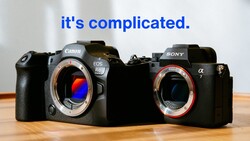
Choosing between the Canon EOS R6 Mark III and the Sony a7 V at the same price point is genuinely difficult, and the spec sheets don't tell the whole story. Both cameras launched within a month of each other in late 2025, making a direct comparison not just useful but necessary before you hand over that kind of money.
Coming to you from Gordon Laing, this thorough video puts the Canon EOS R6 Mark III through its paces against the Sony a7 V and the Panasonic Lumix S5 II, covering resolution, noise, dynamic range, rolling shutter, autofocus, burst performance, and more. Laing also compares the R6 Mark III directly to the Canon EOS R6 Mark II, which will continue selling at a lower price, making the upgrade question very real. One of the more surprising findings is that the R6 Mark III's sensor, though not stacked or back-illuminated like the a7 V's, performs almost identically in real-world resolution, noise, and even rolling shutter tests. Laing shoots side by side with both cameras on the same rig, so the comparisons are as controlled as you're likely to see outside a lab.
On autofocus, Laing tests both cameras simultaneously in his garden, then takes them to Brighton Seafront to shoot seagulls in flight with the Canon RF 100-500mm zoom. The R6 Mark III picks up birds at a noticeably greater distance than the a7 V and holds subject lock more consistently as subjects turn away. With the electronic shutter running at 40 frames per second versus the a7 V's 30, the buffer and card speed differences between CFexpress Type B and SD also get a proper real-world workout. The R6 Mark III also handles pre-burst, focus bracketing, multiple exposures, and interval shooting in ways that directly beat or meaningfully differ from what the a7 V offers, and Laing walks through each one concretely.
One issue that doesn't get resolved by any firmware update is Canon's continued restriction on third-party full-frame autofocus lenses. If you shoot Sony, you have access to a wide ecosystem of Sigma, Tamron, and other native lenses with full autofocus. On Canon's RF mount, native full-frame autofocus lenses are Canon-only for now. That's a real cost consideration, especially if you're building a kit from scratch. Laing also notes that the R6 Mark III drops to 12-bit raw when using the electronic shutter, while the a7 V maintains 14-bit raw even at 30 frames per second electronically. In most field conditions, Laing finds the difference hard to see in practice, but it's worth knowing before you commit. The camera does add a CFexpress Type B slot alongside SD, a full-size HDMI port replacing the old micro connector, and a face-registration priority system borrowed from the Canon EOS R5 Mark II that works particularly well for weddings and sports.
Check out the video above for the full rundown, sample images, and Laing's final verdict on whether the R6 Mark III, R6 Mark II, or a7 V deserves your $2,800.


Join the Fstoppers community for free
-
Post comments and join in the discussions
-
Browse the site ad-free
-
Share your work and get featured in the community
-
Compete in the photo contests for fun and prizes
No comments yet