

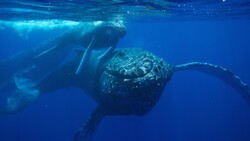
On July 10, 2013, Natalia Botero-Acosta photographed a humpback whale's tail going down in the Gulf of Tribugá, on Colombia's Pacific coast. On August 22, 2022, Ekaterina Kalashnikova photographed a fluke off Fumba, in the Zanzibar channel, on the far side of the planet. The two frames belong to the same animal, and the two sighting points sit 13,046 kilometers apart.
The Three Frames That Made the Record
A third photograph sits between them. On August 13, 2017, the same whale surfaced in Bahía Solano, about 78 kilometers up the Colombian coast from where he had been photographed four years earlier, and E. D. Mesa of Madre Agua Colombia got the fluke. All three images went into Happywhale, the open photo-identification platform run out of Santa Cruz, California, and the match came back linking a Colombian breeding ground to a Tanzanian one.
The result was published on December 11, 2024, in Royal Society Open Science by Kalashnikova and eight coauthors. In the paper's terms, the whale connected breeding stock G in the eastern South Pacific with breeding stock C in the southwest Indian Ocean, across 120 degrees of longitude. Two claims come with it, both made by the authors themselves. No photo-identified adult male humpback has been logged across a greater great-circle distance between two breeding grounds, and no individual had previously been recorded alternating breeding grounds between the Pacific and Indian Oceans. The distance record holds. The second claim is looser than it sounds: a 2011 paper to the IWC Scientific Committee had already matched a whale photographed on the east Australian breeding ground in 1987, in the Pacific, to the west Australian breeding ground in 1995, in the Indian Ocean. Among the longest separations previously documented between two humpback sightings was 11,261 kilometers, between the Mariana Islands and Mexico, with a year in between.

He is catalogued as BGT-0047, and he is a male. The 2013 encounter produced a photograph of the genital area showing no hemispherical lobe, the swelling that females carry and males do not, and all three sightings put him in a competitive group, the jostling cluster of males that forms around a female on a breeding ground. Assuming humpbacks reach sexual maturity at a minimum of six years, the authors put him at 15 or older by the time he showed up off Zanzibar.
What makes the match improbable is the size of the two haystacks. As of March 2024, Happywhale held more than 91,000 individually identified humpback whales across more than 335,000 encounters, and inside that global pile the Tanzanian catalog was 103 individuals and the Colombian catalog was 1,168. Nobody was hunting for a Colombia-to-Zanzibar link. The algorithm compared everything against everything, and this fell out.
What the Matcher Actually Looks At
Humpbacks were the first great whales to be individually recognized from photographs, because the pigment pattern on the underside of the flukes is distinctive and largely stable across a lifetime, and because the trailing edge picks up a personal profile of notches, nicks and scars. Researchers matched those by eye for close to five decades. At ocean-basin scale, eye matching does not stop being possible. It stops being affordable. The two landmark humpback surveys, the Year of the North Atlantic Humpback and SPLASH in the North Pacific, were matched by hand across 4,207 and 18,469 identified encounters respectively, at a cost the algorithm's authors put at thousands of hours. They also supply the arithmetic that explains why nobody wants to do it that way again: a full reconciliation of the SPLASH dataset alone would have meant more than 170 million pairwise comparisons.
The system Happywhale runs came out of a Kaggle competition that drew 2,129 teams, whose top five entries scored between 0.9678 and 0.9731. Happywhale implemented the third-place entry, written by Jinmo Park. It uses one densely connected convolutional network to find the fluke in the frame and extract keypoints, then a second network trained to read features inside those keypoints, and it compares the resulting feature vector against every reference whale. Landmarking orients the image using the two fluke tips and the central V notch. Above a similarity score of 0.385, a proposed match is treated as probably real.
Speed is the whole point. Building reference features for 28,902 whales across 59,295 images took about 25 hours on a single NVIDIA Tesla K80, roughly 1.5 seconds an image, and after that each new submission matches in about five seconds. A trained data manager still confirms or rejects every proposal before it becomes a record.

Why a Mediocre Frame Can Beat a Beautiful One
The team's published accuracy testing is unusually specific about what the system tolerates, and the results invert most of what a photographer assumes about a usable image. Tested against new fluke photographs of known whales from Glacier Bay National Park and Preserve, the algorithm returned the correct animal as its first proposal in 99.2% of excellent-quality images and in 84.6% of images rated very poor. From the "poor" tier upward, the correct match appeared somewhere in the top five proposals more than 95% of the time.
Resolution barely registers. The team took excellent-quality images of 50 individuals and resampled them down through 1,600, 800, 400, 200, 100, 50 and 25 pixels wide. Match rates held at 100% on the first proposal all the way down to 100 pixels wide, which is under 2% of the frame width of a current camera. At 50 pixels, the correct whale still came back in the top five 86% of the time, at which point a human being cannot verify the match by looking at it.
Soft focus, low contrast, murky light and heavy diatom staining on Antarctic flukes all survive the process. So do the flukes photographers dislike shooting: the almost entirely black North Pacific tails and the almost entirely white Oceania tails that carry no obvious pattern. The authors found no bias against them.
What kills a submission is geometry. Partial flukes were mostly kept out of the training set, and the authors are blunt about the consequence: the algorithm "often fails to correctly understand the context of what portion of flukes are presented" when part of the trailing edge is cut off, especially without the central V notch in view. It is a failure of object detection and landmarking rather than of pattern reading, and it is a tendency rather than a rule. A human matcher supplies that context instinctively. The network frequently does not. Extreme rotation angles cost accuracy too, though far less than you would expect. A tack-sharp, beautifully lit tail shot at 60 degrees off axis with one tip out of frame is worth less to the database than a soft, distant, badly exposed tail that happens to be square to the lens with both tips and the notch inside the borders.
In a head-to-head test against experienced photo-ID technicians working the North Atlantic Humpback Whale Catalog, the humans missed 6.66% of the available matches and the algorithm missed 0.83%. Manual matching of that test set consumed 318 hours of skilled labor. The software took a little over four, including the time a person spent verifying its answers.
How to Shoot a Fluke That Counts
Work from behind and slightly off the animal's line, so the ventral surface comes up facing you. Aim to hold the sensor plane roughly parallel to the fluke, which is to say shoot straight into the ventral surface rather than across it. That single choice matters more than your lens, your body or your light.
Frame both tips and the central notch with room to spare, and resist the urge to crop tight in the field. The resolution testing means you can afford to be loose; you cannot afford to clip a tip. Watch for the arch, since a humpback rounds its back for a couple of seconds before it lifts the tail, and shoot a burst through the whole lift rather than trying to time one frame.
On a moving boat, shutter speed is protecting you from your own platform more than from the whale, which is barely moving during a fluke-up. Keep it well above the reciprocal of your focal length, accept the ISO cost, and let continuous autofocus ride the tail up rather than locking onto the water in front of it. If the animal surfaces on the wrong side and all you have is an oblique angle, shoot it anyway. An off-axis fluke often still matches, and a whale you photographed badly is worth more than a whale you did not photograph.

Expose for the white. A humpback fluke is a high-contrast object over dark water in hard tropical light, and once the white patches clip, the pattern inside them is gone and no slider recovers it. Underexpose by up to a stop, keep the highlight side intact, and pull the dark half back afterward, which is exactly the sort of tonal work a solid Lightroom foundation makes routine. Keep the raw file rather than a camera JPEG, because the raw is what still holds detail in a plain black tail.
Then handle the metadata, which is the half photographers skip. Set the camera clock to local time before the trip and leave it alone. Record position, either through in-camera GPS, a phone-based logger you sync later, or a written note of where the boat was. A fluke with no date and no coordinates is a picture. A fluke with both is a data point. Uploading is free and takes an account: Happywhale's submission instructions walk through it, and if the algorithm finds your whale, the platform tells you where else it has been seen and by whom.
What the Photographs Actually Prove
The story ran in December 2024 as a record migration, with headlines describing a whale that swam more than 13,000 kilometers from South America to Africa. The underlying finding deserved the attention, because a male crossing between the breeding stocks of two different ocean basins is genuinely extraordinary and nobody had documented it between these two. The distance framing, though, quietly upgrades what a pair of photographs can establish.
The number 13,046 is a great-circle distance: the shortest path across a sphere between two coordinates where a camera happened to be pointing at this whale. It is not a measured route, and it is not a journey anyone observed. Happywhale's own entry for the animal is careful about it, describing a minimum distance of at least 13,046 kilometers. Nine years and six weeks separate the Colombian frame from the Zanzibar frame, and humpbacks run a feeding-to-breeding migration every year, so whatever this male actually swam in that window is a much larger number by an unknown multiple, along a path nobody recorded, crossing whenever he crossed.
The follow-up work states the limitation outright: distances like these reflect the separation between sighting locations rather than distances traveled, because photo-identification captures only the endpoints of an individual's movement. Two frames prove that one whale was in two places on two dates. Everything between those dates is inference, and the paper is honest about that even where the coverage was not.
The Record Held for Seventeen Months
On May 20, 2026, Royal Society Open Science published another record-setting inter-basin study, this one led by Cristina Castro Ayala with Ted Cheeseman again among the authors. It was not the second such match. Long-distance cross-basin exchanges were already on record, including ones running in both directions, with whales moving between Brazil and South Africa each way over two decades. What was new was narrower and worth stating precisely: the first documented exchange in both directions between the eastern Australia and Brazil breeding populations. Working through 19,283 curated photo-ID images collected between 1984 and 2025, the team found two humpbacks that had been photographed in both eastern Australia and Brazil, moving in both directions. The sighting locations are separated by 14,200 and 15,100 kilometers, with resighting intervals of six and 22 years.

By the authors' count, exchanges like this turned up in 0.01% of identified whales, which is the ratio that makes the method worth the trouble. No tagging program will ever put transmitters on enough animals to catch a one-in-ten-thousand event spread across four decades and two ocean basins, and no research budget covers a boat in every breeding ground for forty years. A photo library gets there anyway, provided enough people keep pointing cameras at tails and uploading what they get.
The whale that beat BGT-0047 was first photographed at Abrolhos Bank, off Brazil, in 2003, and reported accounts place the second sighting in Hervey Bay, Queensland, in September 2025. The frame that would eventually break the record sat in a catalog for 22 years before the other half of it existed. The next one is already on somebody's card, unlabeled, waiting for its pair.
Lead image by Giles Laurent, CC BY-SA 4.0. Source.



Join the Fstoppers community for free
-
Post comments and join in the discussions
-
Browse the site ad-free
-
Share your work and get featured in the community
-
Compete in the photo contests for fun and prizes