A backpack is what you carry when photography is the plan. A sling is what you carry when it isn't. That distinction decides almost everything here, because a sling does one thing a backpack physically cannot: it swings around to the front of your body and opens while you are still standing, still walking, still in the middle of the moment. You never take it off. You never set it on wet pavement. The trade is capacity, and it is a steep one. Six liters is a body, two lenses, and a short list of things you were willing to leave behind.
Three axes decide this purchase. The first is access speed, a function of how the bag opens and how far it travels around your torso to get there. The second is how loudly the bag announces itself, because a tactical sling with a brand patch reads very differently on a street corner than a waxed canvas satchel that could be holding a sandwich. The third is whether the bag must carry anything besides camera gear, since a laptop, or even a tablet, eliminates most of this category outright.
Every bag below is currently shipping, and every dimension, weight, and material figure comes from the manufacturer's current spec sheet, checked against a live retailer listing. Several of these bags have been through a full Fstoppers review, and those entries link to it. Where a bag has not, the description of how it behaves in use is drawn from its published specifications and construction, and the entry says so. If your kit has outgrown a sling, our camera backpacks guide picks up where this one stops.
At a Glance
- Best Overall: Peak Design Everyday Sling 6L
- Best for Travel: Bellroy Venture Camera Sling 10L
- Best for Bad Weather: WANDRD ROGUE 6L Sling V2
- Best Premium Sling: Gura Gear Kiboko City Sling 6L
- Best Value: PGYTECH OneGo Solo V2 6L
- Best Budget: Tenba Skyline v2 8 Shoulder Bag
- Best Classic Shoulder Bag: Billingham Hadley Small Pro
- Best Bag That Does Not Look Like a Camera Bag: ONA Bowery
Best Overall: Peak Design Everyday Sling 6L
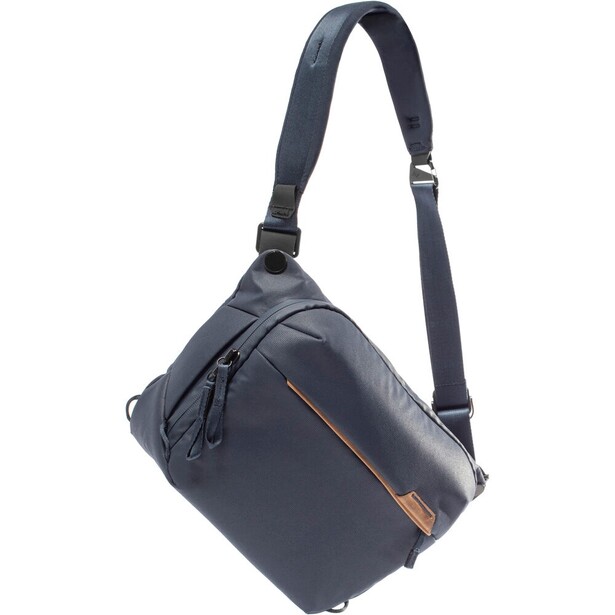
- Capacity: 6 L
- Exterior dimensions: 34 x 24 x 13 cm (13.4 x 9.4 x 5.1 in)
- Weight: 0.78 kg with dividers, 0.58 kg without
- Materials: 100% recycled 400D double poly-coated nylon canvas with a PFAS-free C0 DWR finish, UltraZip external zippers, aluminum hardware
- Fits: one mirrorless body with a lens attached plus one to two additional lenses
- Tablet or laptop: padded sleeve for tablets up to 11 inches; no laptop compartment
- Price: $90.97 (B&H)
Peak Design has been iterating on the Everyday Sling for most of a decade, and the version now on shelves (retailers call it V3, and the B&H SKUs end in -3) is less a redesign than a quiet cleanup. The shell is the same 100% recycled 400D nylon canvas and the layout is unchanged; the substantive change is that the water-repellent treatment is now a PFAS-free C0 DWR. Know that before you pay full price for the newest one, because a discounted V2 is functionally the same bag. The external zippers are worth a note too: these are not YKK, they are Peak Design's own UltraZip, developed with the Taiwanese zipper maker Zoom.
What makes it the default recommendation is the divider system. The FlexFold dividers are stiff origami panels rather than the floppy hook-and-loop slabs most bags ship with, and they fold into shelves, so a body sits on the bottom while a small prime lives on a platform above it. In a bag this small, that vertical stacking is the difference between carrying two lenses and carrying one. The strap's quick-adjuster drops the bag from your back to your chest with one pull and cinches it up with another, without unclipping anything or breaking stride.
The honest problems come from the design and Peak Design's published figures rather than our own miles. At 0.78 kg with the dividers in, it is not light for its size, and loaded near capacity it creeps down your back on a long walk. The waist-pack mode Peak Design promotes has the same flaw: with a full 6 L of gear in it, it is an uncomfortable way to carry the bag. The FlexFold dividers can fray at the cut edges after a few months of hard use. And it is a logoed rectangle, which is fine in a national park and less fine in a train station.
Buy it if you want the most refined small camera bag on the market and do not need to carry a computer. Skip it if you want something invisible. Otherwise, check the price of the Peak Design Everyday Sling 6L at B&H. Also consider the Peak Design Everyday Sling 10L if you want the same design with room for a 13-inch laptop, though its strap does not unclip for waist carry the way the 6 L strap does.
What We Like
- FlexFold dividers stack gear vertically, adding real capacity
- One-pull strap adjuster swings the bag around to your chest without unclipping anything
- Wide main opening with dual zip pulls shows the whole interior at once
- Lifetime warranty and a decade of refinement behind it
What Could Be Better
- Heavy for its capacity at 0.78 kg with the dividers fitted
- Slides down your back when loaded near capacity
- Divider edges are known to fray with hard use
- Waist-pack mode is uncomfortable with a full load
Best for Travel: Bellroy Venture Camera Sling 10L
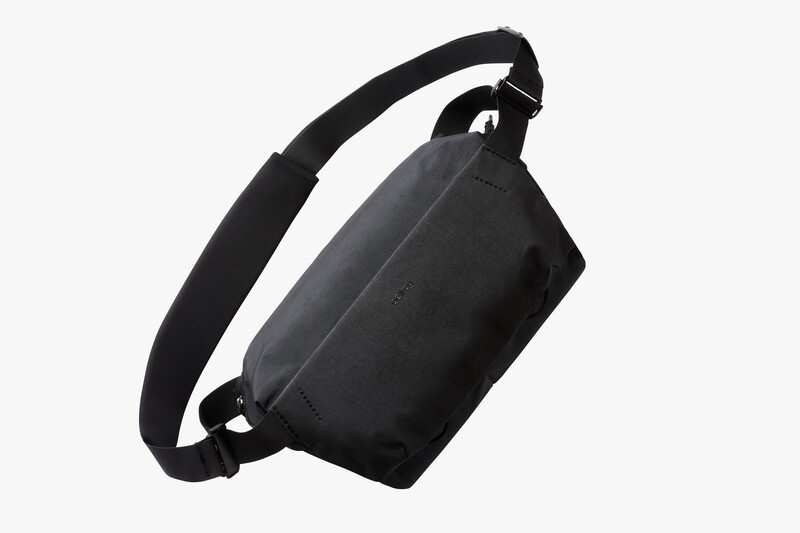
- Capacity: 10 L
- Exterior dimensions: 36 x 22 x 12 cm (14.2 x 8.7 x 4.7 in)
- Weight: 500 g
- Materials: water-resistant ripstop Baida nylon, 75% recycled nylon and 15% recycled polyester by content
- Fits: one body with a lens attached plus two lenses; lenses up to 175 mm carried vertically, 230 mm horizontally
- Tablet or laptop: none
- Price: $189 (Amazon)
Ten liters is the right size for a travel day, and the Venture Camera Sling hits it while weighing 500 g, lighter than several 6 L bags in this guide. Bellroy came to camera bags from the wallet and everyday-carry world, and it shows in the parts that have nothing to do with photography: a wide, properly padded strap, a matte ripstop shell with almost no branding, and a body that hangs flat against your back instead of standing off it like a turtle shell.
The camera-specific move is a set of padded pop-out dividers that flex rather than detach. They are sewn in, which sounds like a limitation and mostly is, but they cannot slide out of position while you rummage one-handed, and they spring back into shape when you pull a lens. The main zipper runs the full length of the top, so the bag opens like a duffel with everything reachable, and Bellroy rates the bag for a lens up to 175 mm standing vertically, or 230 mm laid on its side, which is enough for a 70-200mm f/4 from most systems. Pull two dividers together and the space that held a second lens holds a jacket instead. On a trip where the camera comes out for twenty minutes and the other eight hours are logistics, the camera bag that is also a good day bag is the one you actually carry. Andy Day carried ours across rough desert terrain for our review and came away calling it the best camera bag he has owned, singling out the self-compressing gussets that pull the bag slim when it is only half loaded.
Two things will annoy you. The first is storage for a screen: there is no laptop compartment, and when we reviewed the bag our verdict was that no internal pocket runs the full height of the shell, so anything larger than an iPad mini is out. For a bag pitched at travelers that is a real omission and the main reason to look at the WANDRD or the PGYTECH instead. The second is the front pocket, whose angle means you cannot slide a camera into it vertically the way you can with some competing slings. The shell is water-resistant ripstop and the main compartment inspires confidence, but our testing happened in the desert rather than in sustained rain, and no rain cover is included.
For a photographer who wants one bag for a two-week trip and shoots a body and two lenses, check the current price of the Bellroy Venture Camera Sling 10L at Amazon.
Read our full review: The Best Camera Bag I've Ever Owned? Fstoppers Reviews the Bellroy Venture Camera Sling 10l
What We Like
- Only 500 g for 10 L of usable space
- Self-compressing gussets keep it slim when it is not full
- Sewn-in dividers stay put and spring back
- Clean, unbranded exterior that does not read as a camera bag
- Converts easily into a general day bag when the camera stays home
What Could Be Better
- No laptop compartment, and nothing bigger than an iPad mini will fit
- The front pocket's angle blocks sliding a camera in vertically
- Dividers are not removable, so layouts are limited
- No rain cover included
Best for Bad Weather: WANDRD ROGUE 6L Sling V2
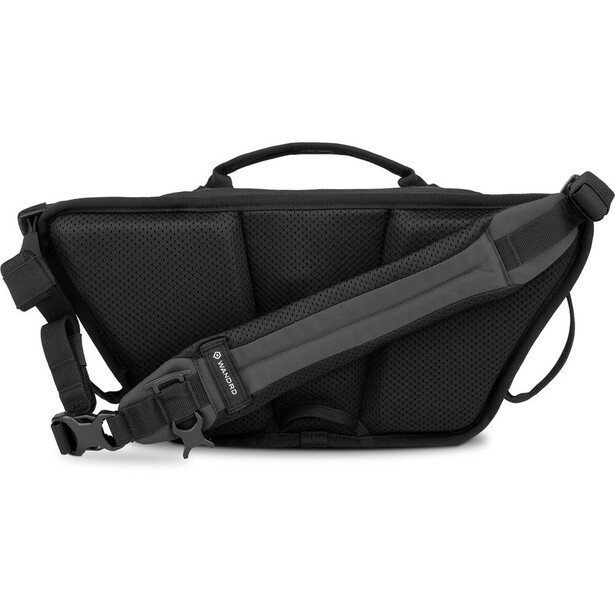
- Capacity: 6 L
- Exterior dimensions: 30.5 x 18.4 x 14 cm (12 x 7.25 x 5.5 in)
- Weight: 0.7 kg (1.5 lb)
- Materials: P900D tarpaulin and N840D ballistic nylon shell, YKK zippers, P200D liner
- Fits: one body with a lens attached plus one to two lenses
- Tablet or laptop: laptops up to 16 inches via WANDRD's patented rear carry, which requires a WANDRD Laptop Case sold separately
- Price: $159 (B&H)
Most sling shells are woven nylon with a coating that gives up after a season. WANDRD wrapped the ROGUE V2 in tarpaulin, the slick rubbery material used for truck covers and dry bags, and rain beads and rolls off it rather than soaking in. When we reviewed the ROGUE V2, the tarpaulin and ballistic nylon shrugged off fingerprints and wiped clean without fuss, though the material does pick up marks over months of use. WANDRD is careful to call the result weather-resistant rather than waterproof, and so are we, but this is the bag here we would hand to someone shooting a Pacific Northwest winter.
The V2's real upgrade is the harness. WANDRD's five-point adjustment system lets the strap be tuned in more places than a sling normally allows and then locked, so the bag stops migrating as you walk. The strap runs from 56.5 cm out to 133.4 cm, long enough to wear over a winter coat, which is not a given here, and it detaches entirely so the bag can be carried by any of its three grab handles instead. Our reviewer's one gripe with it was that the strap twists a little too easily and could stand to be wider.
Then there is the laptop trick, which needs describing precisely because WANDRD's marketing does not. A 6 L sling cannot swallow a 16-inch laptop internally. What it does is carry one against its back panel, in a compartment that expands outward rather than eating into the gear space: unzip the top and bottom of the rear panel, slide the machine in vertically inside a WANDRD Laptop Case, and strap it down. Nothing else in this guide comes close to that. The catch is that the compartment is unpadded at the bottom and open at both ends, so the separately sold laptop case is effectively mandatory rather than optional, and the true cost of the bag as a laptop carrier is higher than the sticker.
Inside, WANDRD gets the small things right: three SD card slots, an AirTag pocket, configurable dividers. What you give up is elegance. This is a busy bag with more straps and buckles than anything else here, the foam dividers are thick enough to cost you usable volume, the smaller pockets get tight once the main compartment is full, and at 0.7 kg it carries a weight penalty for its 6 L because the padding that makes it tough also eats the interior. If your shooting happens outdoors and the weather is not a hypothetical, check the current price of the WANDRD ROGUE 6L Sling V2 at B&H. Also consider the WANDRD ROGUE 9L Sling V2 if you carry a second body or a longer zoom, since it is the same design at 0.8 kg with meaningfully more room.
Read our full review: We Review the WANDRD ROGUE 6L Sling V2: Big Function in a Compact Sling
What We Like
- Tarpaulin shell sheds rain without a cover and wipes clean easily
- Five-point harness keeps the bag from wandering as you move
- Rear-panel carry takes a 16-inch laptop without stealing interior space
- Three SD card slots and a hidden AirTag pocket built in
What Could Be Better
- Laptop pocket is unpadded and open-ended, so the separate WANDRD case is a must
- Thick foam dividers eat into an already small 6 L interior
- Strap twists too easily, and smaller pockets get tight when the bag is full
- Busy, strap-heavy exterior is not for everyone
Best Premium Sling: Gura Gear Kiboko City Sling 6L
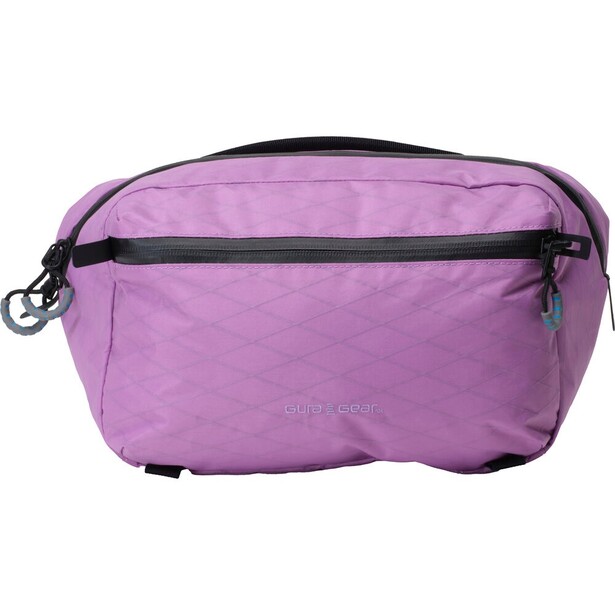
- Capacity: 6 L
- Exterior dimensions: 33 x 19 x 15 cm (13 x 7.5 x 6 in)
- Weight: 0.6 kg (1.3 lb)
- Materials: X-Pac VX-21 shell by Dimension Polyant, waterproof YKK zippers, light gray nylon liner
- Fits: one rangefinder or mirrorless body plus one to two lenses, in a removable padded insert
- Tablet or laptop: padded sleeve for an iPad mini; no laptop compartment
- Price: $129.95 (B&H)
Gura Gear built its name on safari bags that get thrown into Land Cruisers, and the Kiboko City Sling brings that engineering down to a bag you would wear to lunch. The shell is X-Pac VX-21 from Dimension Polyant, a laminated sailcloth with a visible diamond grid, lighter and stiffer than the nylon everyone else uses. At 0.6 kg it is the lightest 6 L bag here on published weights, and it holds its shape when empty instead of collapsing into a pouch. Nothing about it feels cheap in the hand: when we reviewed it, the stitching, the zippers, and the interior all held up to the price, and there is an integrated rain flap over the main zipper that keeps water out without snagging.
Its signature feature carries the slightly grand name Dynamic Leveling System, which describes a simple, correct idea: the strap anchors are placed so the bag sits flat and level at your waist when it swings forward, rather than tipping and dumping gear toward one corner. Anyone who has changed a lens standing up, pinning a bag open with a forearm while it tries to rotate, will understand why that matters. The strap is also fully reversible, so left-handed shooters get the same experience right-handers do.
The interior organization is the most thorough in this guide. The padded camera insert lifts out entirely, so the bag drops from camera sling to normal day bag in one motion, and it slides into a Kiboko 2.0 backpack if you own one. Around it sit a hidden RFID-blocking pocket, an AirTag compartment, an iPad mini sleeve, pen sleeves, a key lanyard, and Hypalon SD card holders with color-coded pull tabs so a full card is distinguishable from an empty one by feel.
The recurring caveat is size, and it is the price of the bag's compactness. Our review kit was a Leica Q3 with spare batteries, a charger, an SD wallet, a small flash, and a cloth, and that went in comfortably; this is a bag built around a compact mirrorless body or a rangefinder and a lens or two, not a working DSLR kit. A Nikon Z8 with a 24-120mm attached will not sit in it as one unit. Put a full frame body with a 24-70mm f/2.8 in it and the bag is used up. There is no laptop provision, and the tripod straps are sold separately. For the photographer with a small kit who wants the nicest possible object to carry it in, check the current price of the Gura Gear Kiboko City Sling 6L at B&H.
Read our full review: Gura Gear's Kiboko City Sling 6L: The Perfect Photo/Video Daytripper?
What We Like
- Lightest 6 L bag here at 0.6 kg, in X-Pac VX-21
- Leveling strap geometry keeps the bag flat during lens changes
- Removable insert turns it into an ordinary day bag instantly
- Reversible strap plus genuinely useful SD and AirTag organization
What Could Be Better
- The insert is narrow; larger bodies are a tight fit
- No laptop compartment, and tripod straps cost extra
- Priced at the top of the mainstream sling market
- X-Pac's laminated finish is loud when it creases
Best Value: PGYTECH OneGo Solo V2 6L
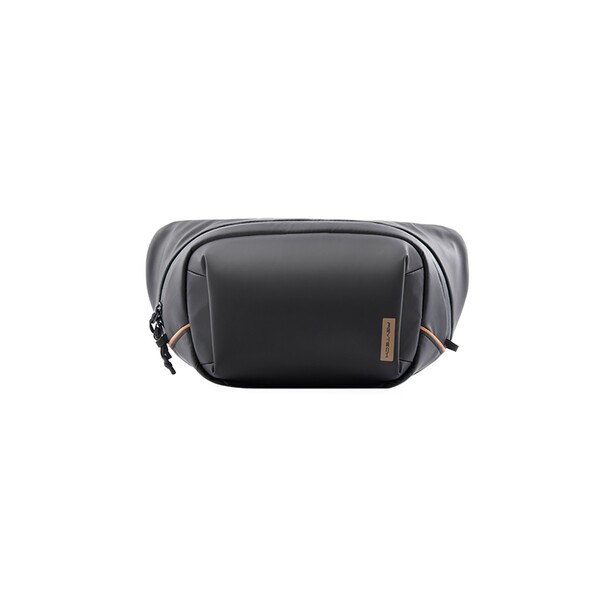
- Capacity: 6 L
- Exterior dimensions: 39 x 22 x 14 cm (15.4 x 8.7 x 5.5 in)
- Weight: 0.65 kg (body only, excluding dividers and strap)
- Materials: PU-coated polyester with a splash-resistant finish (85% polyester and 15% polyurethane in Moss Green, 70/30 in Obsidian), YKK zippers
- Fits: one body with a lens attached plus two lenses
- Tablet or laptop: rear compartment for an 11-inch iPad Pro; no laptop compartment at this size
- Price: $99.95 (B&H)
Nothing else here gives you this much bag for this little money. The OneGo Solo V2 holds a body and two lenses, takes an 11-inch iPad Pro in a dedicated rear compartment, has a concealed drawstring pocket at the back sized for a 550 ml bottle and straps underneath for a tripod, and it lands at roughly half the price of the premium slings. Its polyurethane-coated polyester shell has an almost leather-like hand and looks considerably more expensive than it is.
The layout is three compartments: a small front pocket for what you grab constantly, a padded main compartment with movable dividers, and a generous rear sleeve. That sleeve is the pick's whole argument. Most 6 L slings have no real provision for a tablet, and the few that do treat it as an afterthought. If your day is a camera plus an iPad for culling on the train, this bag does a job the Bellroy and the Gura Gear cannot.
What you are paying less for shows up in details rather than fundamentals. The finish is splash-resistant rather than waterproof, so a downpour is a problem in a way it is not for the WANDRD. The dividers are conventional hook-and-loop panels, so you cannot stack gear vertically the way Peak Design's FlexFolds allow, and usable capacity is lower than the 6 L figure suggests. The hardware is functional and nobody will mistake it for a Billingham.
PGYTECH sells the same design in 4 L and 10 L. If you are building a first serious kit and would rather put the money into glass, check the current price of the PGYTECH OneGo Solo V2 6L at B&H. Also consider the PGYTECH OneGo Solo V2 10L if a laptop has to come along, since it takes a 14-inch MacBook Pro and a body with three lenses at 0.73 kg.
What We Like
- A real 11-inch tablet compartment at a budget price
- Looks and feels more expensive than it is
- Hidden water bottle pocket and a working tripod attachment
- Sold in 4 L, 6 L, and 10 L, so the range fits most kits
What Could Be Better
- Splash-resistant only, not built for sustained rain
- Plain hook-and-loop dividers waste vertical space
- Usable capacity is less than the 6 L figure implies
- Hardware is functional rather than premium
Best Budget: Tenba Skyline v2 8 Shoulder Bag
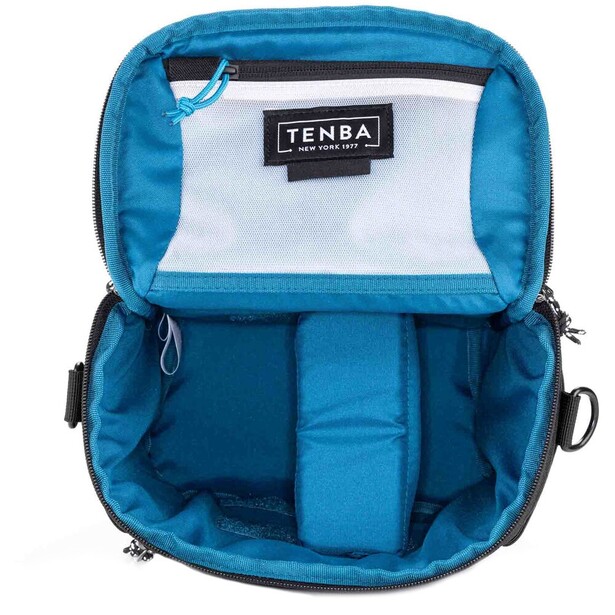
- Capacity: not rated in liters by Tenba; interior measures 19 x 18 x 13 cm
- Exterior dimensions: 20 x 19 x 14 cm (8 x 7.5 x 5.5 in)
- Weight: 0.29 kg (0.65 lb)
- Materials: water-repellent 300D fabric, YKK zippers, reinforced stitching
- Fits: one mirrorless or DSLR body plus one to two lenses
- Tablet or laptop: none
- Price: $49.95 (B&H)
Every photographer eventually needs a small bag that does one thing and costs almost nothing. The Skyline v2 8 is that bag. At 0.29 kg it is by a wide margin the lightest thing in this guide, less than half the weight of the Peak Design, and Tenba backs it with a five-year warranty at a price that undercuts everything else here several times over.
The one design idea in it is a good one. The lid opens away from your body, so when the bag hangs at your hip and you flip it open, the flap falls forward instead of into your chest. That sounds trivial until you have fought a bag that does the opposite while holding a camera in one hand. Inside are a padded main compartment, a zippered pocket for cards and batteries, and side mesh stretch pockets. The 300D shell is water-repellent, and the bag feels like what it is: honest, well-stitched, unglamorous.
The compromises are the ones you would predict, and Tenba's spec sheet is candid about them. There is no tablet sleeve, no laptop provision, no tripod carry, and no crossbody sling geometry, so it will swing if you move fast. Tenba publishes no liter rating, which is telling: the interior at 19 x 18 x 13 cm is roughly four and a half liters of box, and a full frame body with a 24-70mm f/2.8 attached will fill it with nothing left over.
Buy it as a first camera bag, a glovebox bag, or the thing you take to a family event when the good bag is too much. For roughly the price of a decent filter, check the current price of the Tenba Skyline v2 8 Shoulder Bag at B&H. Anyone pairing it with a first mirrorless body should read our beginner cameras guide alongside it.
What We Like
- Lightest bag here at 0.29 kg
- Lid opens away from your body for genuinely fast access
- Five-year warranty at a throwaway price
- Water-repellent 300D shell and YKK zippers, not corner-cut hardware
What Could Be Better
- No tablet, laptop, or tripod carry of any kind
- Genuinely small; a professional zoom fills it
- Shoulder-bag geometry swings during fast movement
- Tenba does not publish a capacity rating
Best Classic Shoulder Bag: Billingham Hadley Small Pro
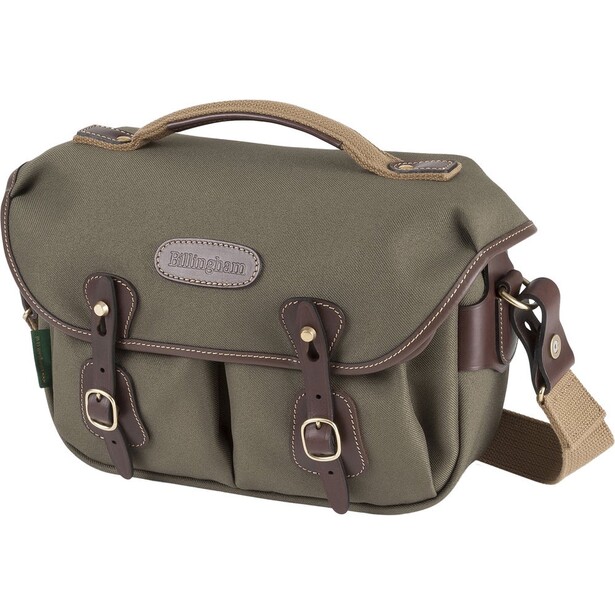
- Capacity: 5 L total; 3.5 L in the main compartment with the padded insert fitted
- Exterior dimensions: 34 x 25 x 14 cm (width x height x depth)
- Weight: 1.03 kg (2.27 lb), insert and shoulder sling included
- Materials: three-layer waterproof canvas or FibreNyte with leather trim and brass fittings
- Fits: one body with a lens attached plus one to two lenses, in a removable padded insert
- Tablet or laptop: rear zipped document pocket; no padded tablet sleeve
- Price: $321 (B&H)
Billingham has been sewing bags in England since 1973, and the Hadley Small Pro is the version of its best-known shoulder bag that most photographers end up with. The material is the reason. Billingham's canvas is a three-layer sandwich with a butyl rubber core, so the bag is waterproof rather than water-resistant, and it does not depend on a coating that degrades. People are still shooting out of Hadleys they bought in the 1990s.
The Pro designation adds three things to the standard Hadley Small: a top handle with a leather underside, a rear document pocket with a weatherproof zip, and a luggage trolley strap. The padded insert lifts out entirely, so the bag becomes an ordinary shoulder bag when there is no camera in it. One warning on sizing: the 5 L figure in the retail listings is Billingham's number for the whole bag, pockets included, and Billingham separately publishes 3.5 L for the main compartment once the padded insert is in it. Plan around the 3.5 L, which is a body with a lens mounted plus one spare lens.
Closure is where opinion splits. The flap fastens with two brass quick-release buckles that take a deliberate two-handed motion, slower than a zipper and always will be. Some photographers find that pace maddening. Others consider it the best thing about the bag, because a Hadley never accidentally hangs open, never snags a zipper on a strap, and never wears out its closure mechanism.
The weaknesses, none of which we have suffered through personally: it is expensive, it is heavy for what it holds at 1.03 kg with the insert and sling, there is little rear padding so a loaded kit rides against your hip, and the sage-and-chocolate colorway everyone photographs is the most photographer-coded object on earth in certain cities. You buy this because you want a bag that outlives the camera inside it. If that is you, check the current price of the Billingham Hadley Small Pro at B&H. Also consider the Think Tank Retrospective 5 V2.0 if you want the same muted canvas look for a good deal less money, with a rain cover in the box and fabric Sound Silencers that mute the hook-and-loop flap for quiet street work.
What We Like
- Three-layer butyl-cored canvas is genuinely waterproof, not coated
- Removable insert makes it a normal shoulder bag in seconds
- Handle, document pocket, and trolley strap are real upgrades over the base Hadley
- Built to outlast several camera systems
What Could Be Better
- Buckle closure is slow and needs two hands
- Heavy at 1.03 kg for a 3.5 L main compartment
- Little back padding against a loaded kit
- Expensive, and the 5 L headline figure counts the pockets, not just the camera space
Best Bag That Does Not Look Like a Camera Bag: ONA Bowery
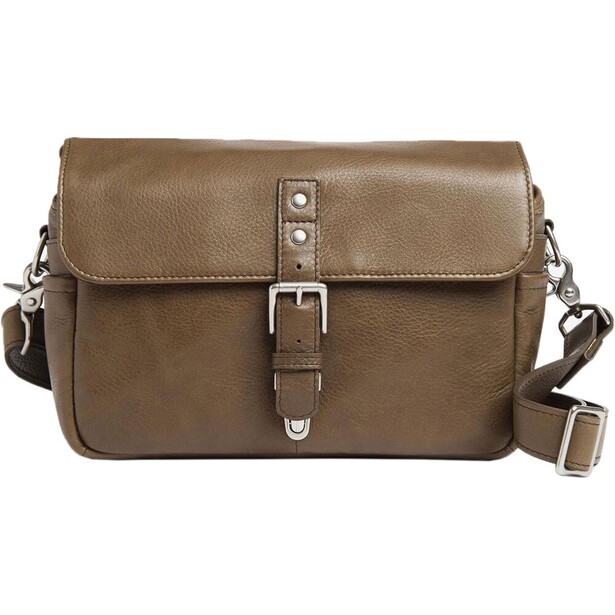
- Capacity: not rated in liters by ONA; interior measures 26.7 x 15.2 x 8.9 cm
- Exterior dimensions: 28 x 19 x 10 cm (11 x 7.5 x 4 in)
- Weight: 0.9 kg (2.0 lb)
- Materials: waxed canvas or Italian leather, antique brass hardware
- Fits: one DSLR or mirrorless body with a lens attached plus one to two small lenses
- Tablet or laptop: room for an iPad mini and a notebook; no padded sleeve
- Price: $219 (B&H)
Set the Bowery on a restaurant table and nobody in the room knows there is a camera in it. That is the entire point, and nothing else here pulls it off as completely. It is a small waxed-canvas or Italian-leather satchel with a tuck-clasp flap and brass hardware, and its camera credentials are invisible from outside: a padded interior, a removable divider, and weather flaps down the sides.
The second trick is that the strap detaches. Pull it off and the Bowery becomes a padded insert that drops into a tote, a duffel, or a carry-on, and plenty of photographers buy it for that job alone. The interior takes a mirrorless body with a lens mounted plus one or two compact primes, or a DSLR with a single lens, and the front has space for an iPad mini and a notebook.
Now the parts ONA's own photography does not show you, and we are relying on published specs rather than a review of our own. At 0.9 kg it is heavy for how little it holds, because leather and waxed canvas are heavy. The tuck clasp is slow, slower even than the Billingham's buckles, and one-handed access is awkward. The padding is thin by camera-bag standards, fine for a stroll and not for a bag you are going to swing into a subway pole. The strap is a strap, not a harness, so a loaded Bowery sits on one shoulder and stays there.
Price is the last obstacle: canvas versions sit near the top of this guide, and the Italian leather versions cost substantially more again. You are paying for material and for the fact that it does not look like photography equipment. Waxed canvas patinas and can be re-waxed indefinitely, so this is a bag you keep. Check the current price of the ONA Bowery at B&H before deciding between canvas and leather, because the gap between them is substantial.
What We Like
- Reads as a normal satchel, not camera gear
- Strap detaches so it works as an insert in a bigger bag
- Waxed canvas and Italian leather that age rather than wear out
- Small enough to actually carry every day
What Could Be Better
- Heavy at 0.9 kg for a small interior
- Tuck-clasp closure is slow and awkward one-handed
- Padding is thin next to purpose-built camera bags
- Expensive, and the leather versions dramatically so
How to Choose a Camera Sling or Everyday Bag
Start with capacity, because everyone gets it wrong in the same direction. The liter rating on a camera bag is the volume of the box, not the volume of gear it will hold, and padding eats a lot of that box. A 6 L sling realistically carries a mirrorless body with a lens attached, one more lens, and small items. It will not carry a body, a 24-70mm f/2.8, a 70-200mm f/2.8, and a flash, whatever the marketing image shows. If your kit list runs to three lenses, you want 9 or 10 liters, or a backpack.
Then decide whether the bag has to carry a computer, because that one requirement eliminates most of this category. Only the WANDRD, with its separately sold laptop case, and the 10 L PGYTECH and Peak Design models will take a real laptop, and the Peak Design tops out at a thin 13-inch machine. Everything else stops at a tablet, and several, including the Bellroy, do not even do that. If you tether, cull on site, or commute with a machine, settle that first.
The spec that matters more than people expect is the closure, and specifically how it sounds. Zippers are fast, secure, and loud when they snag. Hook-and-loop is fast and extremely loud, which is why Think Tank engineered flaps to silence it. Buckles like Billingham's are slow, quiet, and completely reliable. Match the closure to how and where you shoot: a wedding photographer working through vows and a hiker photographing a canyon have opposite requirements, and no single bag is optimal for both.
The spec that matters less than people expect is the shell material. Every bag here will keep light rain off your camera, and the difference between coated nylon, X-Pac, and tarpaulin only shows up in sustained downpours or across years of abrasion. If you shoot somewhere that is a weekly reality, you already know it. Everyone else is buying weather resistance they will use twice.
Last, weigh the geometry. A true crossbody sling with a swivel strap rotates to your chest and stays put while you work in it. A traditional shoulder bag swings, bumps your hip, and slides off when you crouch. Slings are better bags to shoot from. Shoulder bags are better to look at and easier to load. That trade matters more day to day than any number in a spec block. If a tripod is part of your kit, external attachment points on bags this size are minimal, and our tripods guide covers which travel models are light enough to lash to one.
What We're Looking For
We weigh access speed, real-world capacity against the stated liter rating, the quality of the divider and closure systems, weather protection, how discreet a bag looks in public, and whether the carry geometry suits the way photographers actually move. Every specification in this guide was verified against the manufacturer's current spec page and a live retailer listing at the time of writing, and prices are current B&H figures, which move. Most picks across our buying guides come from gear our writers have used and reviewed hands-on. Where a description of how a bag behaves in use is not drawn from our own testing, it rests on the bag's published specifications and construction, and the entry says so instead of implying a testing history it does not have.
Frequently Asked Questions
How Much Camera Gear Fits in a 6 L Sling?
A mirrorless body with a lens attached, one additional lens, and small accessories like batteries, cards, and a filter. A full frame body with a 24-70mm f/2.8 mounted consumes most of a 6 L bag on its own. If you need three lenses or a flash, move up to 9 or 10 liters.
Is a Sling Better Than a Shoulder Bag?
For shooting, yes. A crossbody sling rotates to your chest and stays there while you swap a lens, and it does not slide off when you crouch. A shoulder bag swings and needs a hand to steady it. Shoulder bags win on looks and on being easy to load and set down, which is why classic designs like the Billingham and the ONA still sell in volume.
Can a Camera Sling Carry a Laptop?
Almost none can. The WANDRD ROGUE V2 carries up to a 16-inch laptop against its back panel using a separately sold WANDRD Laptop Case, and the PGYTECH OneGo Solo V2 10L takes a 14-inch MacBook Pro internally. Most 6 L slings top out at an 11-inch tablet, and the Bellroy Venture Camera Sling has no tablet or laptop provision at all.
Are Waterproof Camera Bags Worth the Extra Money?
Only if you shoot outdoors in real weather. Billingham publishes its three-layer, butyl-cored canvas as waterproof, and WANDRD's tarpaulin shell sheds rain better than any coated nylon here, though WANDRD itself stops at calling it weather-resistant. For a photographer working mostly in cities and in daylight, a DWR-coated nylon shell and a cheap rain cover do the same job for far less.
Which Camera Bag Is Least Likely to Attract Attention?
The ONA Bowery, by a clear margin, because it looks like a leather satchel and nothing else. The Bellroy Venture Camera Sling is close behind, being matte, unbranded, and shaped like an ordinary crossbody, and the Think Tank Retrospective 5 V2.0 pairs muted canvas with a closure engineered to open quietly. Any bag with a large logo, a tactical shell, or a bright colorway does the opposite.
Fstoppers may earn a commission from purchases made through links in this article. Our picks are made independently by our editorial team.