In-body stabilization got good enough that a lot of photographers quietly sold their gimbals. Then they tried to walk backward down a hallway while their subject talked, watched the footage bob like a boat, and bought another one. Sensor-shift stabilization fixes small hand tremor. It does nothing about the up-and-down of your own gait, and that is the exact problem a three-axis gimbal was built to solve. If you shoot anything that moves through a space, this is still the piece of gear that separates footage that looks made from footage that looks captured.
Three things decide which one you buy. Payload, which is not a suggestion: a gimbal running at the edge of its rating burns battery, whines under load, and shakes when you move fast. Tracking, which has become the real dividing line in 2026 now that most of these things carry their own camera and can follow a subject with nobody holding the handle. And weight, because the finest stabilizer in the world is worthless in a bag at the hotel.
One thing that is specific to this moment: DJI was added to the FCC's Covered List on December 22, 2025, which blocks new equipment authorizations and has kept several new DJI products out of official US retail. DJI still dominates this category on merit, so it wins several slots below, but where the FCC situation affects what you can actually buy, we flag it in the entry. Every number in the spec blocks below comes from the manufacturer's current published specification, checked against a live retailer listing, and where a claim rests on a product's documented design rather than a published figure, the text says so.
At a Glance
- Best Overall Camera Gimbal: DJI RS 5
- Best for Mirrorless: Zhiyun Crane 4E
- Best for Heavy Rigs: DJI RS 4 Pro
- Best Compact and Travel Gimbal: DJI RS 4 Mini
- Best Do-Everything Gimbal: Hohem iSteady MT3 Pro
- Best Smartphone Gimbal: DJI Osmo Mobile 8
- Best Smartphone Gimbal for iPhone: Insta360 Flow 2 Pro
- Best Budget Gimbal: Insta360 Flow 2
- Best All-in-One Stabilized Camera: DJI Osmo Pocket 3
Best Overall Camera Gimbal: DJI RS 5
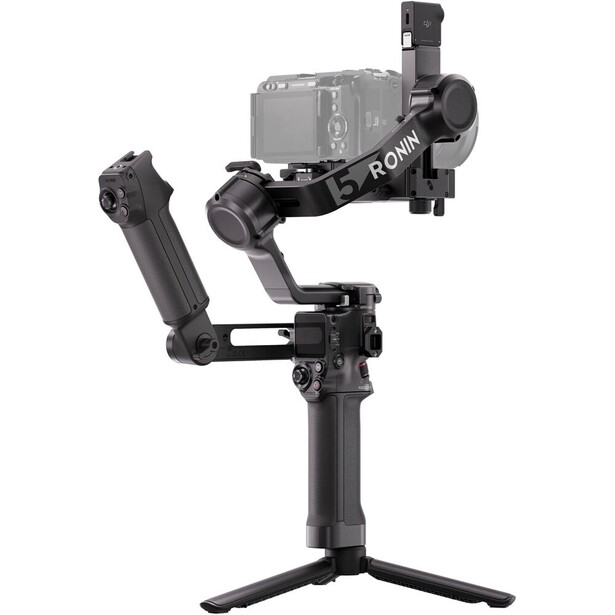
- Payload: 3 kg (6.6 lb) tested
- Gimbal weight: 1,193 g, plus a 274 g BG33 battery grip
- Battery runtime: approx. 14 hours (stationary)
- Charging time: approx. 1 hour with a 65W PD charger
- Vertical shooting: 3rd-gen native, rotate the horizontal plate 90 degrees, no rebalance of tilt or pan
- Price: $719 (B&H)
The RS 5 arrived in January 2026 and did not chase a bigger number. Payload stayed at 3 kg, exactly where the RS 4 sat, and DJI spent the engineering budget on the parts of the job that actually waste your day. Balancing is the obvious one. There are fine-tuning knobs on each axis now instead of the shove-and-hope sliding plates, the plates are Teflon-coated so they glide instead of stick, and a Z-axis indicator tells you when the camera's center of gravity is where the motors want it. Anyone who has crouched on a sidewalk trying to trim a front-heavy 24-70mm rig by feel will understand why that is the headline.
The motors got a real upgrade underneath. DJI's 5th-generation stabilization algorithm raises peak torque by 50 percent, and the practical effect is that the gimbal holds composure at the top of its rating rather than only in the comfortable middle. Charging is the other quality-of-life change worth paying for: a full charge in roughly an hour on a 65W PD brick, with about 14 hours of standby runtime, which means the gimbal is not the thing that ends your shoot. Vertical shooting is now a knob, a 90-degree rotation, and back to work, with no rebalancing of the tilt and pan axes.
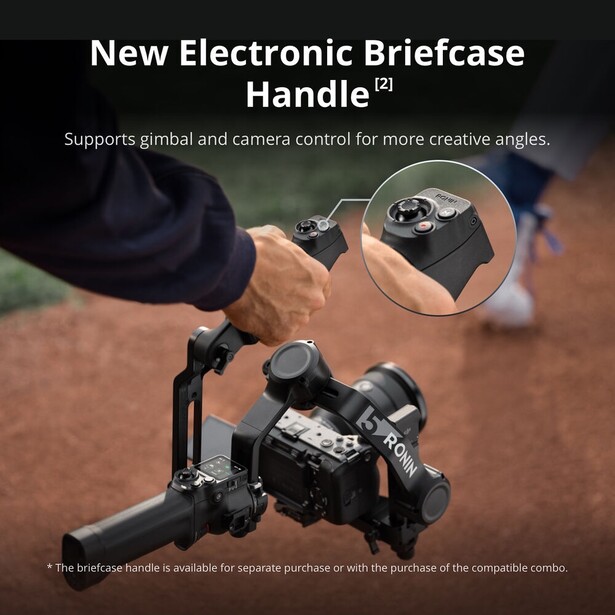
The RS 5 is the least annoying gimbal DJI has made, which sounds like faint praise until you have spent a shoot fighting one. The Combo adds the RS Enhanced Intelligent Tracking Module and the electronic briefcase handle, and it is the version to buy if you work alone: the module tracks people, pets, vehicles, and arbitrary objects from the gimbal's own 1.8-inch touchscreen, out to 10 m on a human subject, with no phone app in the loop.
The honest complaint is the payload. Three kilograms covers a full frame mirrorless body with a fast standard zoom and a small on-camera monitor, and it runs out fast once you add a cine lens, a matte box, or a wireless video transmitter. There is also the availability wrinkle: DJI's own US store does not sell it, though B&H does, and stock across US retail has been uneven since the FCC listing. Buy it when you see it rather than waiting for a sale. For a solo shooter on a mirrorless body, it is the one to get, so check the current price of the DJI RS 5 at B&H.
What We Like
- Fine-tuning knobs and Teflon plates make balancing genuinely quick
- 50 percent more peak motor torque than the previous generation
- Roughly one-hour full charge and about 14 hours of runtime
- Tracking module works from the gimbal, with no phone in the loop
What Could Be Better
- Payload is unchanged at 3 kg and fills up fast with accessories
- Tracking module and briefcase handle only come in the pricier Combo
- US supply is inconsistent because DJI cannot get new FCC authorizations
- Still too big to carry casually
Best for Mirrorless: Zhiyun Crane 4E
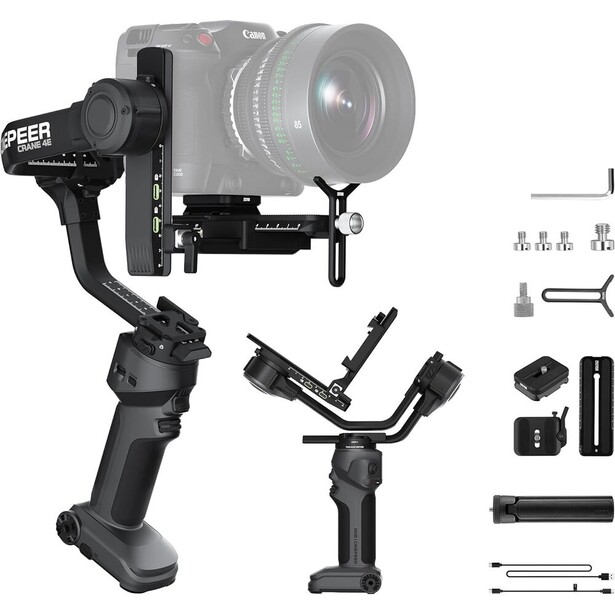
- Payload: 4.5 kg (9.9 lb)
- Gimbal weight: 1,630 g
- Battery runtime: 12 hours
- Charging time: approx. 2 hours with a 15V PD fast charger
- Vertical shooting: native, via an integrated horizontal and vertical lock structure
- Price: $379 (B&H)
Zhiyun's answer to DJI is to give you more arm for less money. The Crane 4E carries 4.5 kg, half again what the RS 5 will take, on longer arms designed with telephoto lenses in mind. That matters more than the raw number suggests. A 70-200mm f/2.8 on a full frame body is not especially heavy, but it is long, and shorter-armed gimbals run out of tilt clearance before they run out of torque. The 4E has the reach for it, and Zhiyun's own compatibility list runs from mainstream full frame mirrorless bodies through compact cinema cameras from Blackmagic and Z Cam.
The rest of the design is aimed squarely at the person shooting a wedding or a corporate spot alone. Vertical mounting is built into the quick-release structure rather than bolted on, so switching to a vertical frame for social deliverables is a matter of unlocking, side-mounting, and locking again. Zhiyun puts a 1.22-inch color touchscreen on the body with pan, tilt, and roll control, and the 2,600 mAh pack gives a rated 12 hours of runtime with a two-hour recharge on a 15V PD charger. The sling grip is the part longtime Zhiyun users are loyal to, because the underslung position is what saves your wrist on hour three, and Zhiyun rates it as taking 20 percent of the load off your arm.
You get more payload capacity per dollar here than anywhere else on this list. When we reviewed it, our reviewer flew a Sony a7 IV with the notoriously front-heavy Tamron 35-150mm f/2-2.8 on it and the motors never complained, which is the practical demonstration of what that 4.5 kg rating buys you.
The compromises are real. At 1,630 g the 4E is the heaviest gimbal in this guide, roughly 440 g more than the RS 5 before you add a camera, and our reviewer found that in Vortex mode with a heavy body and lens the weight felt overwhelming on the arm without the wrist support, which Zhiyun sells separately. Balancing is the other sore point: there are none of the RS 5's fine-tuning knobs, and Zhiyun dropped the balancing indicator lights that the Crane 4 has, so getting a heavy lens trimmed took our reviewer several stressful passes. If you are shooting long glass or a compact cinema body and want the payload headroom without cinema-gimbal pricing, check the current price of the Zhiyun Crane 4E at B&H. Also consider the Zhiyun Crane 4 if you want a built-in 10W fill light on the gimbal itself.
Read our full review: We Review the Zhiyun Cinepeer Crane 4E
What We Like
- 4.5 kg payload and long arms that clear a 70-200mm lens
- Native vertical mounting built into the quick-release system
- 12-hour rated runtime and a two-hour recharge
- Sling grip that takes the strain off your wrist
What Could Be Better
- Heaviest gimbal here at 1,630 g bare
- Balancing is slower without fine-tuning knobs or the Crane 4's balance indicator lights
- No carry case in the box, and the wrist support is a separate purchase
- Subject tracking is not built in
Best for Heavy Rigs: DJI RS 4 Pro
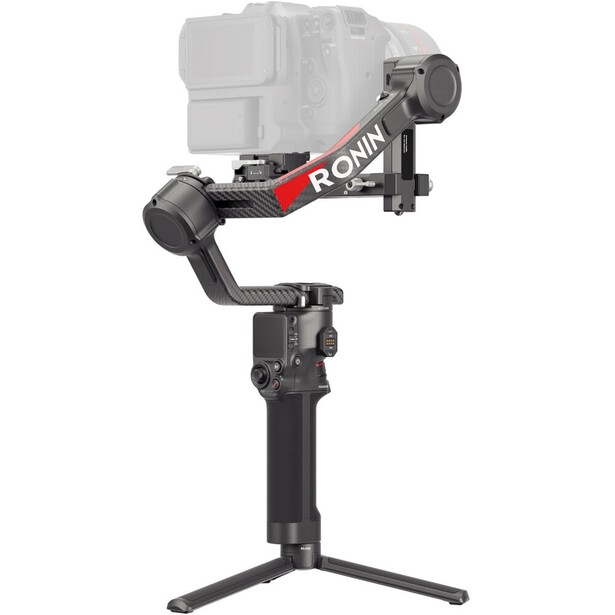
- Payload: 4.5 kg (10 lb) tested
- Gimbal weight: 1,242 g
- Battery runtime: 13 hours (stationary)
- Charging time: approx. 1.5 hours with a 24W charger
- Vertical shooting: 2nd-gen native, no accessories required
- Price: $869 (B&H)
Load a Canon C70 or a Blackmagic 6K with a proper lens, a monitor, and a battery plate onto an RS 5 and it will tell you, politely, that it is done. The RS 4 Pro is the machine for that rig. It carries 4.5 kg at 1,242 g of gimbal weight, which is a remarkable ratio and comes from carbon fiber arms, and it is the only pick in this guide built around the assumption that other hardware will be hanging off it. There are two RSA accessory ports (the standard RS 4 gets one), a USB-C focus-motor port, and a second USB-C port for video transmission or DJI's LiDAR range finder, which is the piece that turns a manual cine lens into an autofocus lens.
That LiDAR system is the whole argument for spending Pro money. Bolt it on, and a rig with no autofocus at all gains subject tracking and pull-focus behavior driven by an actual depth map rather than contrast guesswork. For a documentary operator running a cine prime on a gimbal with nobody pulling focus, that is not a luxury feature. The RS 4 Pro also gets second-gen automated axis locks, a fixed 1.8-inch OLED touchscreen that dims and locks itself to stop your palm from changing modes, and second-gen native vertical shooting.
What the spec sheet does not tell you is the size of the thing. This is a two-hands, both-arms gimbal, and the moment you put 4 kg of camera on it, you are looking at a working weight north of 5 kg and a set of forearms that will remember it. That is the price of the payload, and there is no way around it.
The other honest note is timing. The RS 4 Pro launched in April 2024 and the standard-tier RS 5 replaced its sibling in January 2026, which leaves the Pro tier as the oldest hardware in DJI's gimbal lineup. DJI has not announced a Pro-tier successor, and the LiDAR ecosystem is not going anywhere, but you are buying at the back end of a cycle and the price should reflect that. Like the rest of DJI's lineup, US stock now depends on retailer inventory rather than DJI's own store. If you are supporting a real cinema rig, check the current price of the DJI RS 4 Pro at B&H.
What We Like
- 4.5 kg payload from carbon fiber arms weighing only 1,242 g
- LiDAR range finder brings autofocus to manual cine lenses
- Two RSA ports and a dedicated focus-motor port
- Self-locking OLED screen prevents accidental mode changes
What Could Be Better
- Big, and heavy once loaded
- The oldest hardware here, launched in April 2024
- The LiDAR unit is a separate purchase
- US availability depends on retailer stock
Best Compact and Travel Gimbal: DJI RS 4 Mini
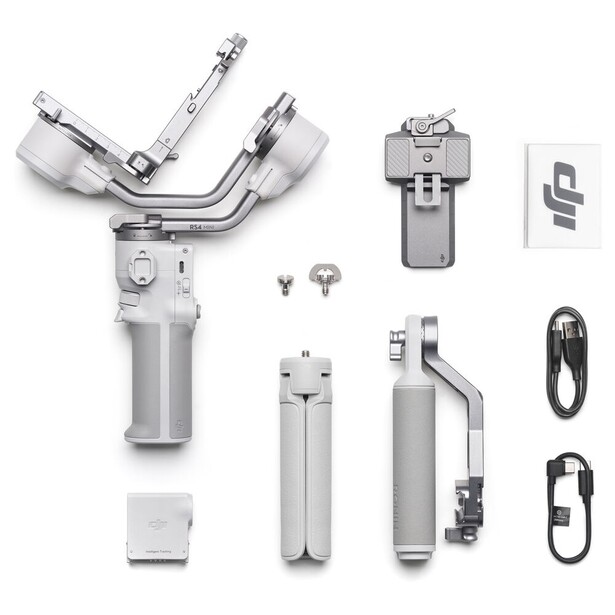
- Payload: 0.4 to 2 kg (0.88 to 4.4 lb) tested
- Gimbal weight: 890 g including the quick-release plate
- Battery runtime: 13 hours (stationary)
- Charging time: approx. 1 hour 50 minutes with a 30W charger
- Vertical shooting: supported
- Price: $369 (B&H)
Travel is where gimbals go to die. They are the first thing cut from a carry-on and the last thing you want strapped to a day pack, which is why the RS 4 Mini exists. At 890 g it weighs about three quarters of what the RS 5 does, it folds down small enough to live in a sling bag, and it still handles 2 kg, which covers a Sony a7 IV with a 24-70mm f/2.8, a Fujifilm X-T5 with almost anything, or an a6700 with room to spare. Below its 0.4 kg floor it will not balance properly, which is worth knowing before you try to mount a tiny compact on it.
The feature that earns it a slot rather than a footnote is the DJI RS Intelligent Tracking Module, which came to this gimbal first. It is a 19 g magnetic camera that clips to the top of the gimbal and tracks a human subject from 0.5 to 10 m away, on any camera, with or without the DJI Ronin app in the loop. Start and stop tracking with a trigger pull or an open palm. For a solo traveler recording pieces to camera, that is the difference between a gimbal and a one-person crew. Auto axis locks fold the arms for you at power-off, so it goes from bag to running in a few seconds.
The limitations are easy to enumerate. Charging is slow by DJI's current standards at close to two hours on a 30W charger, and the gimbal loses the RS 5's fine-tuning knobs, so balancing is back to sliding plates and patience. The 2 kg ceiling also means a 70-200mm f/2.8 is off the table, and even a 24-70mm plus a small monitor puts you near the limit.
Buy it if the gimbal you actually carry beats the gimbal you theoretically own, which for most traveling shooters it does. If you want the same idea in a package that also holds a phone and an action camera, the Hohem below is the more flexible answer. Otherwise, check the current price of the DJI RS 4 Mini at B&H, and buy the Combo, because a Mini without the tracking module is a lesser product. Note again that US supply of DJI gear now depends on retailer inventory.
What We Like
- 890 g and folds small enough for a sling bag
- Intelligent Tracking Module works on any camera, app-free
- Auto axis locks make setup nearly instant
- 13-hour runtime
What Could Be Better
- 2 kg ceiling rules out heavier lenses
- No fine-tuning balance knobs
- Slow charging at close to two hours
- Tracking module is Combo-only
Best Do-Everything Gimbal: Hohem iSteady MT3 Pro
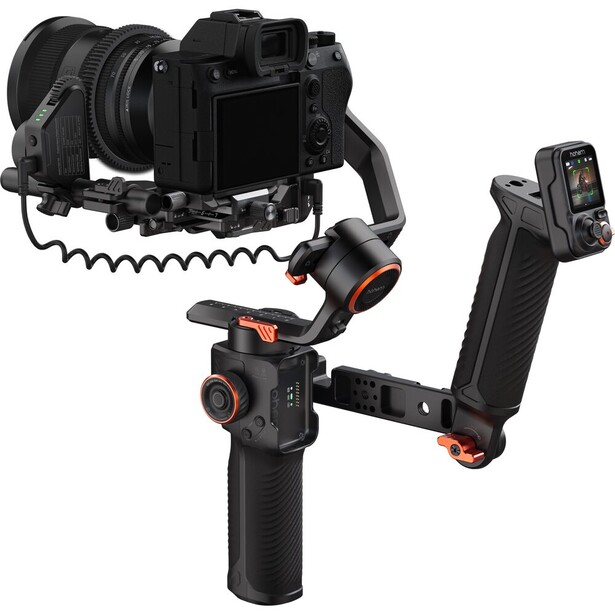
- Payload: 2.5 kg (5.5 lb)
- Gimbal weight: approx. 1,070 g
- Battery runtime: approx. 20 hours stationary, approx. 14 hours with AI tracking active
- Charging time: approx. 3.5 hours over USB-C
- Vertical shooting: 2nd-gen fast vertical switch, camera stays attached
- Price: $549.99 (B&H)
Most people who own a gimbal own two, because the one that holds a camera will not hold a phone. The iSteady MT3 Pro is Hohem's attempt to end that, and it is the most convincing attempt anyone has made. An Arca-Swiss mount takes a full frame mirrorless body up to 2.5 kg, and swapping to a phone clamp or an action camera cradle takes seconds. The AI tracker is not an accessory you buy later: there is a 2 MP camera in the head, and it tracks people, pets, and vehicles out to 7 m for humans and 15 m for cars, with gesture control from half a meter to 5 m.
The battery is the number that stops people mid-sentence. Hohem rates 4,350 mAh at roughly 20 hours stationary, and roughly 14 hours with AI tracking running, which is not a figure any DJI gimbal comes close to. The tradeoff is a 3.5-hour recharge, the slowest here by a wide margin, so this is a gimbal you charge overnight rather than over lunch. The detachable 1.4-inch touchscreen remote is the other party trick, letting you set the gimbal down on its own and drive framing from 10 m away, which is a genuine solo-shooter tool rather than a spec-sheet line.
Hohem has been chasing DJI for years and the gap that remains is in the details. When we reviewed it, the 40 percent stronger motors held a heavy lens setup without drama and the vertical switch proved fast and intuitive, but the AI camera sees a wider field of view than the camera it is driving, so what the tracker has locked onto is not necessarily what your frame shows, and our reviewer ended up nudging the joystick to fix the framing. The battery is also sealed in, so when it goes flat mid-shoot you are charging rather than swapping. The payload rating is one to take seriously rather than optimistically: at 2.5 kg with a big lens hanging off the front, this gimbal is working hard.
The person this is for is obvious. If you shoot a mirrorless body for client work, a phone for social, and an action camera on the weekend, one gimbal that does all three at a price below the RS 5 is worth more than a marginal stabilization advantage. If you only ever mount one camera, buy the DJI. For everyone else, check the current price of the Hohem iSteady MT3 Pro at B&H. Also consider the Hohem iSteady MT3 if your camera is light, since it does the same tricks at 765 g with a 1.4 kg payload ceiling.
Read our full review: Hohem iSteady MT3 & MT3 Pro: Versatile Gimbal Review 2026
What We Like
- Holds a mirrorless camera, a phone, or an action camera
- AI tracking camera is built in, not an add-on
- Around 20 hours of runtime, the longest here
- Detachable touchscreen remote enables true solo shooting
What Could Be Better
- 3.5-hour recharge is the slowest in this guide, and the battery is not removable
- The AI camera's wider view does not match your camera's framing
- No auto axis locks and no weather sealing
- Working near its 2.5 kg ceiling strains the motors
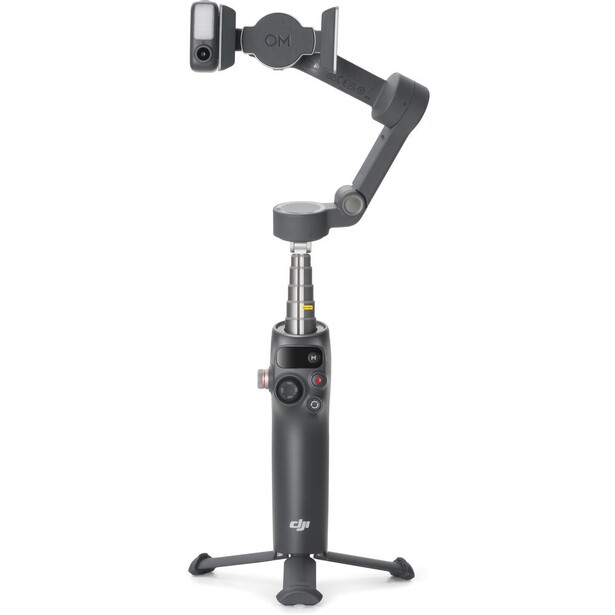
Best Smartphone Gimbal: DJI Osmo Mobile 8
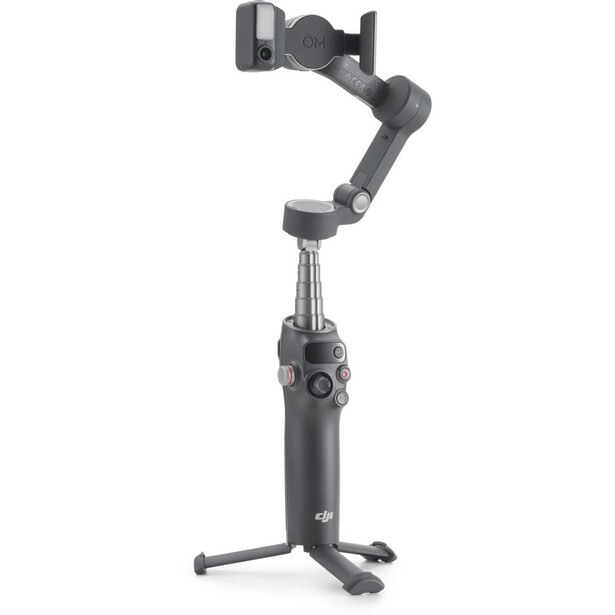
- Phone compatibility: 170 to 300 g, 67 to 84 mm wide
- Weight: approx. 370 g with tripod, clamp, and module
- Battery runtime: approx. 10 hours, approx. 5 hours with tracking on, approx. 4 hours with tracking and the fill light at maximum
- Charging time: approx. 2.5 hours with a 10W USB-C charger
- Extension rod: built in, extends to 215 mm
- Price: $149 (B&H)
Phone gimbals stopped being about stabilization a few years ago, because phones are already fairly steady. They are about tracking now, and the Osmo Mobile 8 tracks better than anything else you can clamp a phone into. The Multifunctional Module carries its own camera and its own brain, which means ActiveTrack works in the native camera app and in third-party apps, not just inside DJI's software. That is the trap most phone gimbals fall into: tracking that only works if you shoot in the manufacturer's app, which nobody wants to do.
The module also carries a fill light rated at 40 lux at 0.6 m with color temperature adjustable from 2,500K to 6,000K, which is enough to make a face look intentional in a dim restaurant instead of accidental. Gesture control starts and stops recording from across a room. The pan axis rotates 360 degrees without limit, so the gimbal can follow you in a full circle instead of hitting a stop and giving up. Everything folds into a 370 g package with the tripod and extension rod built in, and it charges your phone off its own battery.
Read the battery numbers carefully, because DJI's headline figure of about 10 hours assumes a level, stationary gimbal doing nothing interesting. Turn tracking on and it is roughly 5 hours. Turn tracking on with the fill light at full brightness and it is roughly 4. That is still a full day of realistic use, but it is not 10 hours, and DJI's own spec sheet is where those smaller numbers come from.
The change that mattered most when we reviewed it was the 360-degree pan motor, because the gimbal stops hitting its pan-axis limit and awkwardly resetting itself in the middle of a shot, which is the single most annoying behavior of every phone gimbal that came before it. The complaints our reviewer came away with are smaller but real: you cannot see what the tracking module has locked onto or pick a target manually, the glossy status screen collects fingerprints, the extension rod goes front-heavy at full length, and FPV and SpinShot modes switch off while tracking is running.
The catch is availability. The Osmo Mobile 8 launched globally in November 2025 without an official US release, and the newer Osmo Mobile 8P skipped the US entirely, which is a direct consequence of DJI's FCC Covered List designation. B&H sells the Osmo Mobile 8, and it is legal to buy and use, but the stock is finite and the successor is not coming to fix it. Buy the Advanced Tracking Combo rather than the standard bundle, because the module is the product, then check the current price of the DJI Osmo Mobile 8 at B&H.
Read our full review: DJI Osmo Mobile 8 Review: A Gimbal That Finally Delivers
What We Like
- Tracking works in the native camera app and third-party apps
- Adjustable fill light built into the module
- 360-degree unlimited pan follows a subject in a full circle
- Extension rod and tripod are built in
What Could Be Better
- The 10-hour battery claim collapses to about 4 hours with tracking and the light on
- You cannot see what the module is tracking or choose the subject yourself
- The tracking module costs extra unless you buy a combo
- No official US release, so stock is finite
- Slow 2.5-hour charge
Best Smartphone Gimbal for iPhone: Insta360 Flow 2 Pro
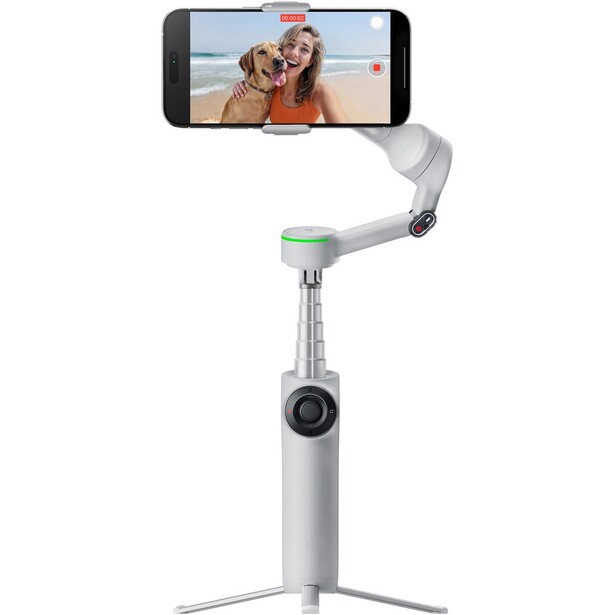
- Phone compatibility: 130 to 300 g, 64 to 84 mm wide
- Weight: 357 g, plus a 25 g phone clamp
- Battery runtime: approx. 10 hours from an 1,100 mAh cell
- Charging time: 55 minutes to 80 percent, approx. 80 minutes to full with a 10W charger
- Extension rod: built in, extends to 210 mm
- Price: $189.99 (B&H)
Apple quietly changed this category when it shipped DockKit, and the Flow 2 Pro was the first gimbal to take it seriously. DockKit means the iPhone itself drives the gimbal's motors, so subject tracking works in the stock camera app and in more than 200 other iOS apps, including video calls and streaming tools. There is no companion app to open, no pairing ritual, and no separate tracking module to remember. Mount the phone, open whatever app you were going to use, and the gimbal follows you. It needs an iPhone 12 or later on iOS 17 or newer, and Insta360 recommends iOS 18 to get native tracking across every camera mode.
Insta360 built the rest of the hardware around the same idea of not making you think. There is a built-in selfie stick reaching 210 mm and a metal tripod in the handle, a 10-hour battery that will also charge your phone, and 360-degree infinite pan tracking so the gimbal can spin with you rather than stopping at a limit. A small ring light on the head glows to tell you tracking is locked, which is a better solution than glancing at your phone screen mid-shot. It weighs 357 g and folds flat enough for a jacket pocket.
The limitation is torque, and it is worth being blunt about it. The Flow 2 Pro balances a large phone without complaint, but Insta360 rates the clamp for phones from 130 to 300 g, and that ceiling is a hard one. Clip an anamorphic or a 58mm telephoto adapter onto the front of the phone and you are asking the motors to hold weight, at the worst possible leverage, that they were never rated for. This gimbal was designed for a phone and nothing else.
The other thing to know is the AI Tracker, the clip-on module Insta360 sells to move tracking outside its own app, which is the answer for Android owners and for anyone who wants tracking in a third-party camera app. When we reviewed it on the Flow 2 Pro, we found it does exactly that, with fast gesture control and a handy LED spotlight, but the tracking itself is jumpier than the DockKit path: it tends to lock onto the nearest face regardless of your framing, it introduces small jitters, and there is no display telling you what it has grabbed. On an iPhone, DockKit remains the better route.
For an iPhone shooter the DockKit integration is worth more than DJI's slightly better raw stabilization, because a tracking system that works in every app you already use gets used. Android owners get less out of it and should look at the Osmo Mobile 8 instead. If you shoot on an iPhone and you want a gimbal you will not have to think about, check the current price of the Insta360 Flow 2 Pro at B&H.
Read our full review: We Review the Insta360 Flow 2 Pro Latest AI Tracker, Bringing AI Tracking to Any Phone Camera App
What We Like
- Apple DockKit tracking works in the native camera app and 200-plus iOS apps
- No app to launch and no separate tracking module
- Selfie stick and metal tripod built into the handle
- 357 g and pocketable when folded
What Could Be Better
- The 300 g clamp rating rules out clip-on phone lenses
- Android users lose the DockKit advantage
- Raw stabilization is a small step behind DJI
- The AI Tracker module grabs the nearest face and shows you nothing about what it locked
- DockKit tracks people only, so pets and objects send you back into the Insta360 app
Best Budget Gimbal: Insta360 Flow 2
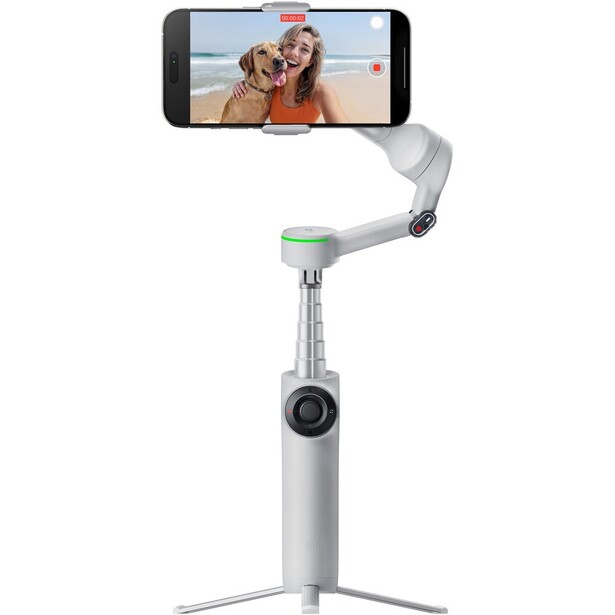
- Phone compatibility: 130 to 300 g, 64 to 84 mm wide
- Weight: 348 g, plus a 25 g phone clamp
- Battery runtime: approx. 10 hours from an 1,100 mAh cell
- Charging time: 55 minutes to 80 percent, approx. 2 hours to full with a 10W charger
- Extension rod: built in, extends to 200 mm
- Price: $189.99 (B&H)
Cheap gimbals used to mean bad gimbals: weak motors, a plastic clamp that let the phone sag, and an app that crashed. The Flow 2 is the one that broke that rule. It is the same physical platform as the Flow 2 Pro, within 9 g of the same weight, with the same 1,100 mAh battery, the same 10-hour runtime, and the same built-in selfie stick and metal tripod. Two things get cut. The pan axis is bounded here, running from minus 210 degrees to 120 degrees rather than the Pro's unlimited 360-degree rotation, so a subject that circles you can walk out of the gimbal's reach. And DockKit is a Pro feature, so tracking runs through Insta360's own app using Deep Track 4.0, with multi-person tracking and active zoom tracking.
For a huge number of buyers that is the right trade. If you shoot your videos in the Insta360 app anyway, or you are Android and DockKit was never going to help you, you are paying for a badge you cannot use. Deep Track 4.0 is quick to lock on and reasonably stubborn about staying locked, and it will hold multiple people in frame, which is more than most gimbals at any price will do. NFC one-tap shooting means tapping the phone to the clamp launches the app and starts the gimbal, which removes the most annoying 20 seconds of using one of these things.
The honest caveat is the one all app-dependent tracking shares. When your tracking lives inside the manufacturer's app, you shoot in the manufacturer's app, and that app's camera controls are never as good as your phone's native ones. Insta360 also sells the AI Tracker separately, a clip-on tracking camera with its own fill light that moves tracking outside the app on both iOS and Android, and if you are on Android that is the accessory that makes the Flow 2 worth owning.
This is the gimbal to hand to someone who is not sure they want a gimbal. It costs less than any other pick here, it does 90 percent of what the Pro does, and it will not sit in a drawer because it is too much trouble to set up. If your budget is the constraint, check the current price of the Insta360 Flow 2 at B&H. Also consider the Hohem iSteady V3 Ultra if you want a detachable touchscreen remote and a built-in fill light for a little more money.
What We Like
- Same 348 g chassis and 10-hour battery as the Pro
- Deep Track 4.0 holds multiple people in frame
- NFC one-tap shooting gets you filming fast
- Built-in selfie stick and metal tripod
What Could Be Better
- No Apple DockKit, so tracking is tied to Insta360's app
- The app's camera controls are weaker than your phone's native ones
- Escaping the app means buying the AI Tracker separately
- Pan axis is bounded rather than the Pro's unlimited 360 degrees
- Same limited torque as the Pro
Best All-in-One Stabilized Camera: DJI Osmo Pocket 3
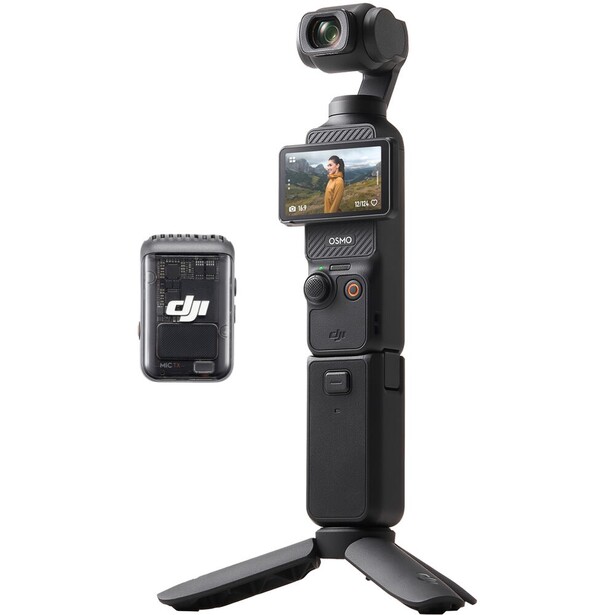
- Sensor: 1-inch CMOS
- Lens: 20mm equivalent, f/2.0
- Video: 4K up to 60 fps, 1080p slow motion up to 240 fps
- Screen: 2-inch rotating touchscreen, 700 nits
- Weight: 179 g
- Battery runtime: 166 minutes at 1080p/24p
- Price: $512 (B&H)
Every other pick in this guide asks you to bring a camera. The Osmo Pocket 3 is the camera, with a real mechanical three-axis gimbal built around a 1-inch sensor, and the whole thing weighs 179 g. That sensor is the reason it matters. A 1-inch chip behind an f/2.0 lens is a different class of image from the tiny sensors in action cameras, and it holds together indoors and at dusk where those cameras fall apart. Three microphones handle audio, and the 2-inch screen rotates, which flips the camera into a vertical format instantly.
What it is really for is the shot you would otherwise skip. Nobody balances a full-size gimbal to film their kid running down a dock. You pull a Pocket 3 out of a jacket, it wakes with the screen rotation, ActiveTrack finds a face, and the footage is stable and sharp with no setup at all. It has become the default b-roll camera for a lot of working shooters for exactly that reason, and it runs 166 minutes at 1080p/24p, which is long enough that the battery stops being a factor in how you shoot.
Its weakness is the fixed lens. You get a 20mm equivalent field of view and that is the whole menu, so a portrait framing means walking closer and a distant subject stays distant. Low light is decent for the size, not good in absolute terms. The 4K ceiling is 60 fps, and slow motion above that drops you to 1080p, where it runs to 120 or 240 fps.
Then there is the elephant. DJI announced the Osmo Pocket 4 on April 16, 2026, with a 1-inch sensor, 10-bit D-Log, 14 stops of claimed dynamic range, and 107 GB of internal storage, and it did not go on sale in the United States, because DJI's FCC Covered List designation blocks the new equipment authorization it would need. Imported units turn up without a US warranty. The Pocket 3 was authorized before the cutoff, remains legal to buy new, and is still stocked by B&H, which makes it the current answer for US buyers rather than a compromise. If you want a gimbal you will actually carry every day, check the current price of the DJI Osmo Pocket 3 at B&H. Pair it with a wireless mic from our wireless microphones guide and you have a complete one-bag video kit.
What We Like
- 1-inch sensor in a 179 g body with a real mechanical gimbal
- Rotating screen switches to vertical instantly
- ActiveTrack and three built-in microphones
- 166 minutes of recording per charge
What Could Be Better
- Fixed 20mm equivalent lens with no zoom
- 4K tops out at 60 fps
- Its successor is not sold in the US, so this line is frozen here
- Low light is fine for the size, not genuinely good
How to Choose a Gimbal
Start with payload, and then subtract. Manufacturers quote a tested maximum, and a gimbal running at 95 percent of its rating is a gimbal that runs hot, drains its battery early, and gets twitchy when you move quickly. Weigh your heaviest realistic setup, body plus lens plus whatever else lives on the cage, then look for a gimbal rated at least 25 percent above that number. The mistake people make is weighing the body and the lens they use most, then discovering the 70-200mm f/2.8 they bought for weddings puts them 400 g over.
Then think about arm length, which almost nobody does. Payload capacity tells you how much weight the motors can hold. It does not tell you whether a long lens will physically clear the tilt arm. This is why the Zhiyun Crane 4E advertises longer arms as a feature and why telephoto shooters keep running into gimbals that are strong enough but too short. If your lens is long, check the manufacturer's compatibility list for your exact body and lens combination rather than trusting the payload number.
Tracking is the axis that has changed most. In 2026 the question is not whether a gimbal can follow a subject, it is whether it can do so without you shooting inside the manufacturer's app. Three approaches are on offer here. DJI and Hohem put a small camera on the gimbal, which works with any camera and any app. Apple's DockKit lets an iPhone drive the motors natively, which is the cleanest solution if you are on iOS. App-based tracking is the cheapest and the most limiting, because it locks you into software with worse camera controls than the one already on your phone. If you shoot alone, pay for one of the first two.
Finally, be honest about weight and workflow. A 1,630 g gimbal plus a 1,500 g camera is over 3 kg held out in front of you, and your arms will decide how long that shoot lasts. Balancing is the other tax: the gimbals with fine-tuning knobs get you shooting in a couple of minutes, and the ones without will cost you five or ten every time you change lenses. Neither shows up in a spec comparison, and both determine whether the thing gets used. If you are new to shooting video with a stills background, our hybrid camera guide covers the body side of the same decision, and Fstoppers' Introduction to Video: A Photographer's Guide to Filmmaking covers how to use the movement once you have it.
What We're Looking For
We weigh payload capacity against real working weight, the honesty of the battery figures, how fast a gimbal balances and locks, and whether its subject tracking works outside the manufacturer's own app. Every specification in this guide was verified against the manufacturer's current published spec page and cross-checked against a live retailer listing, and where a manufacturer's headline number depends on conditions you will never shoot in (a level, stationary gimbal with tracking off), we quote the working figure instead. Most picks across our buying guides come from gear our writers have used and reviewed hands-on. Where a pick section carries no linked Fstoppers review, the description rests on the published specification and the product's documented design, and the text says which.
Frequently Asked Questions
Do I Still Need a Gimbal if My Camera Has In-Body Stabilization?
Yes, if you move while shooting. In-body stabilization corrects small, high-frequency hand shake and does an excellent job of it. It cannot correct the vertical bob of your own walking gait or the roll of your body turning a corner, which is what a three-axis gimbal exists to remove. For static or slow handheld shooting, in-body stabilization is enough.
Can I Buy DJI Gimbals in the US in 2026?
Yes, but with a caveat. DJI was added to the FCC's Covered List in December 2025, which blocks new equipment authorizations, so newer products like the Osmo Pocket 4 and the Osmo Mobile 8P are not officially sold in the US. Products authorized before that date, including the RS 5, RS 4 Pro, RS 4 Mini, Osmo Mobile 8, and Osmo Pocket 3, remain legal to buy and are stocked by B&H.
How Much Payload Capacity Do I Actually Need?
Weigh your heaviest setup and add at least 25 percent. A full frame mirrorless body with a 24-70mm f/2.8 lands around 1.5 kg, so a 2 kg gimbal is tight and a 3 kg gimbal is comfortable. Add a 70-200mm f/2.8, a monitor, or a wireless transmitter and you are into 4.5 kg territory quickly.
Is a Smartphone Gimbal Worth It if My Phone Already Stabilizes Video?
It is, for two reasons that have nothing to do with shake. Modern phone gimbals track a subject and keep them framed while you have both hands free, and they give you smooth, motorized pans and reveals that electronic stabilization cannot fake. Phone stabilization is very good at removing jitter and useless at composing a shot for you.
What's the Difference Between a Gimbal and a Stabilizer?
In common use they are the same thing, but strictly a gimbal is the motorized three-axis kind, while a stabilizer can also mean a passive, counterweighted rig like a Steadicam. Motorized gimbals are easier to learn, need power, and can track subjects. Passive stabilizers never run out of battery and handle heavier rigs, and they take real practice to fly well.
Fstoppers may earn a commission from purchases made through links in this article. Our picks are made independently by our editorial team.