Bad audio kills a video faster than bad footage. Viewers forgive a soft focus pull and a blown highlight, but they click away from a hissy, roomy, wind-battered voice within seconds, and every photographer moving into video learns that the hard way. The wireless clip-on microphone is now the cheapest meaningful upgrade in the kit bag. It is also the most confusing, because a dozen companies sell nearly identical two-transmitter kits with nearly identical marketing, and the differences that matter are buried three clicks into a spec sheet.
Three things decide this purchase. First, does the transmitter record internally, so a dropout or a clipped shout does not cost you the take? Second, what does it plug into, because a system built around a USB-C phone receiver is useless on a camera with a 3.5mm input, and several of the cheapest kits are phone-only. Third, how far and through what will the signal actually travel, since the headline range figures are all measured across an empty field with nothing in the way.
This guide is organized by the job, not by the price. There are picks for the person filming a wedding speech from 40 yards away, the person shooting talking-head clips on an iPhone, and the person who needs a microphone a broadcast client will accept. Every judgment below is built from the manufacturers' current published specifications, each one re-verified against the maker's own spec sheet, and, for the systems we have put through a full Fstoppers review, from shooting with them ourselves.
At a Glance
- Best Overall: DJI Mic 3
- Best Budget: Saramonic Air SE
- Best for iPhone and Android: Rode Wireless Micro
- Best Compact Clip-On: Hollyland LARK M2S
- Best for Professional and Broadcast Work: Sennheiser EW-DP ENG Set
- Best Range: Hollyland LARK MAX 2
- Best With Internal Recording: Rode Wireless PRO
- Best for Stereo and Ambient Sound: Shure MoveMic 88+
Best Overall: DJI Mic 3
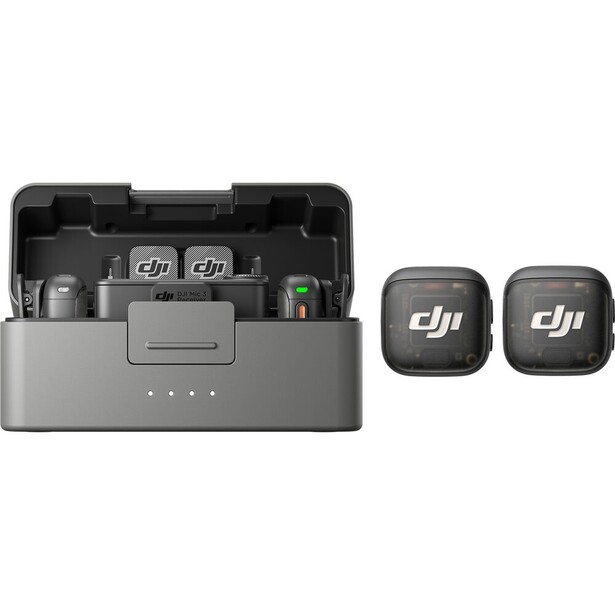
- System: up to 4 transmitters, 1 receiver with a 1.1-inch touchscreen, charging case
- Wireless: dual-band 2.4 GHz and 5.8 GHz with automatic frequency hopping
- Rated range: 400 m line of sight with Lossless Audio off, 80 m in DJI's simulated high-interference test
- Battery: 8 hours transmitter, 10 hours receiver, 28 hours with the charging case
- Internal recording: 32 GB per transmitter, 32-bit float or 24-bit, single or dual file
- Audio: 48 kHz, 32-bit float or 24-bit, 126 dB max SPL at 1% THD
- Transmitter weight: 16 g with the magnet
- Price: $219 (B&H)
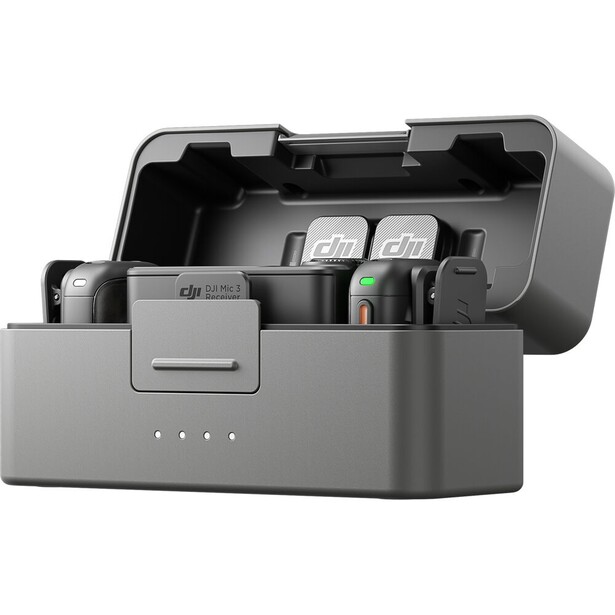
The Mic 3 is the system that makes the fewest demands on you and gives away the least in return. Its transmitters are 16 g each, small enough to wear on a shirt placket without pulling the fabric, and they carry 32 GB of internal storage that records a 32-bit float safety file the whole time they are transmitting. The receiver hangs on a hot shoe, runs a 1.1-inch touchscreen and a dial, and shows you two channels of levels at a glance instead of burying gain in an app.
What separates it from the pack is the radio. DJI runs a dual-band scheme across 2.4 GHz and 5.8 GHz and hops automatically when a band gets crowded, which is the exact failure mode that ruins wedding and conference audio. DJI quotes 400 m in the open and 80 m in a lab-simulated interference storm, and when we took the Mic 3 through a working hotel shoot the link stayed stable at the distances that job asked for. A single receiver now takes up to four transmitters, so a three-person panel does not need a second kit.
The catch is one DJI does not advertise loudly. Turn on Lossless Audio, the mode you would use for paid work, and the company's own specification notes say the transmitter loses roughly 2 hours of battery life and about half its range. That 400 m headline is a compressed-audio number. The receiver's 3.5mm output to a mirrorless camera is also analog, so the 32-bit float file lives on the transmitter and gets pulled off over USB-C in post rather than landing in your camera. Two things our reviewer hit in the field are worth knowing before you buy: the transmitters have no 3.5mm input, so you cannot plug in a lavalier when a subject wears a jacket, and with noise cancellation and Bluetooth running the battery drained a little faster than the 8-hour rating suggests.
For most people making most videos, that is a fair trade. This is the mic I would hand to a photographer shooting their first paid interview, and the one I would still be happy carrying on a documentary. If you shoot with a stabilizer, the receiver's direct pairing with the DJI gimbals in our gimbals guide removes a cable from the rig. Check the current price of the DJI Mic 3 at B&H. Also consider the DJI Mic 2 if you find the outgoing model discounted and can live with a single-band radio.
Read our full review: DJI Mic 3 Review: Compact Wireless Audio for Creators
What We Like
- Dual-band radio that hops away from congested 2.4 GHz
- 32 GB of 32-bit float internal recording on every transmitter
- Touchscreen receiver with real, visible level meters
- One receiver now handles up to four transmitters
What Could Be Better
- Lossless Audio roughly halves the rated range
- Camera output is analog, so the float file needs a separate transfer
- Transmitters have no 3.5mm input, so no plug-in lavalier
- No weather or splash rating published
Best Budget: Saramonic Air SE
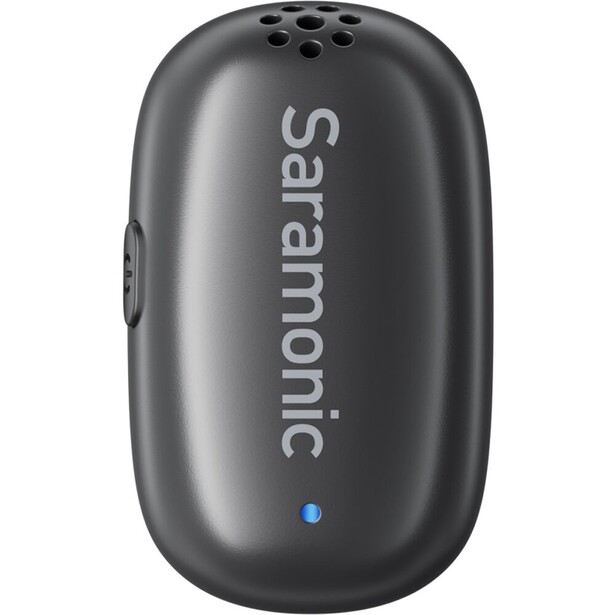
- System: 2 transmitters, 1 plug-in receiver (USB-C or Lightning), charging case
- Wireless: 2.4 GHz
- Rated range: 200 m line of sight
- Battery: 6 hours transmitter, receiver powered by the phone, 28 hours with the charging case
- Internal recording: none
- Audio: 48 kHz, 24-bit, above 120 dB max SPL
- Transmitter weight: 5 g
- Price: $49.99 (B&H)
Cheap wireless microphones used to mean hiss, hollow midrange, and a clip that fell off. The Air SE is the clearest sign that era is over. Each transmitter weighs 5 g, roughly the mass of a sheet of paper, and records 48 kHz 24-bit audio with a signal-to-noise ratio above 80 dB, numbers that would have cost five times as much three years ago. Saramonic quotes a 200 m line-of-sight range and 6 hours per charge, with the charging case taking the total to 28 hours.
What earns it the slot is that it does not sound like a $50 microphone. When we reviewed it, our reviewer came away preferring its sound slightly over the far pricier DJI Mic 3, and found its range actually outperformed the DJI system, which is not a sentence anyone expected to write about the cheapest kit in the category. Setup is the other half of the appeal: you plug in the receiver, pull a transmitter out of the case, and it connects. Saramonic's AI noise cancellation is rated to strip up to 40 dB of background noise across two levels, strong and light, with gain and noise reduction handled in the companion app.
Now the limitation that decides whether this mic is for you. The Air SE is a phone and action-camera system. Its receiver plugs into a USB-C or Lightning port and draws power from the host device, and there is no 3.5mm TRS output, so it will not feed a mirrorless camera at all. Saramonic lists compatibility with DJI Osmo Pocket and Action bodies and with Insta360 cameras, which makes it a neat phone-and-action-cam kit and dead weight in a bag that only holds an a7 IV. The 6-hour transmitter runtime is also the shortest here.
Buy it if your camera is your phone, or as a second set kept in a jacket pocket for the interview you did not plan. It is the least money you can spend and still get audio that sounds intentional. Check the current price of the Saramonic Air SE at B&H. Also consider the Hollyland LARK A1 if you want a similar phone-only kit with a longer 9-hour transmitter runtime.
Read our full review: Compact, Convenient, and Complete: Saramonic Air SE Review and Demo
What We Like
- 5 g transmitters that disappear on camera
- Sound and range that held up against systems four times the price in our testing
- 48 kHz 24-bit audio at the lowest price in this guide
- Works with phones, Osmo Pocket, and Insta360 bodies
What Could Be Better
- No 3.5mm output, so it cannot feed a mirrorless camera
- Shortest transmitter battery life here at 6 hours
- No internal recording, so a dropout is a lost take
- Transmitters clip magnetically to the outside of the charging case rather than sitting enclosed in it
Best for iPhone and Android: Rode Wireless Micro
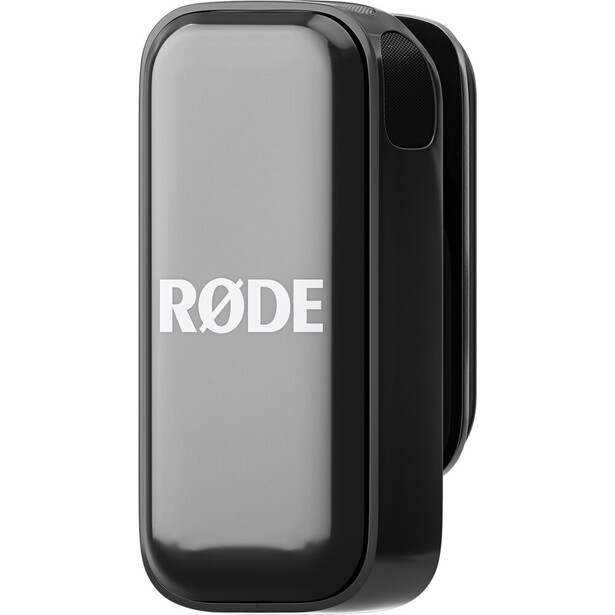
- System: 2 transmitters, 1 dual-channel plug-in receiver (USB-C or Lightning), charging case; a separate Camera Kit adds an on-camera receiver
- Wireless: 2.4 GHz digital transmission
- Rated range: over 100 m line of sight
- Battery: 7 hours transmitter, receiver powered by the phone, 21 hours with the charging case
- Internal recording: none
- Audio: 48 kHz, 24-bit, 135 dB max SPL
- Transmitter weight: 12 g, 18 g with the magnet
- Price: $86 (B&H)
Rode built the Wireless Micro around a single idea: nothing to set up. There is no gain knob, no menu, no pairing dance. You pull the receiver out of the case, push it into the phone's port, clip the transmitters on, and Rode's GainAssist rides the levels for you. For the creator who films a piece to camera between clients and does not want to think about audio, that is the whole product, and it is why this is the phone mic to buy.
The specification that gets overlooked is the 135 dB maximum SPL, the highest figure in this guide by a wide margin. That is the number that stops a capsule crunching when your subject laughs into it or a truck goes by, and it is why the Wireless Micro handles loud, close, chaotic situations better than its size suggests. Range is quoted at over 100 m, modest against DJI's 400 m but more than you will ever need from a phone. Rode's Direct Connect feature also lets the transmitters pair straight to an iPhone over Bluetooth through the Rode Capture app with no receiver at all, which helps when your only USB-C port is feeding power.
The weaknesses follow from the simplicity. There is no internal recording, so a dropped link leaves you nothing to fall back on. There is no manual gain either, so you are trusting GainAssist, which is good but not infallible in wildly dynamic scenes. Shop the bundle carefully, too. The standard kit ships with a plug-in receiver in either USB-C or Lightning form, and the two are not interchangeable, so buy the one that matches your phone. If you also want to feed a camera, you need the Wireless Micro Camera Kit, a separate purchase whose on-camera receiver carries a 3.5mm TRS output alongside USB-C and adds a 1.1-inch AMOLED screen. Rode announced that receiver in October 2025; it is not in the box with the phone kits.
If your video work is phone-first and you want a system that never asks you a question, this is the one. Photographers coming to video from stills, particularly anyone working through Fstoppers' Introduction to Video: A Photographer's Guide to Filmmaking, tend to want exactly this level of friction. Check the current price of the Rode Wireless Micro at B&H.
What We Like
- Genuinely no setup: plug in and talk
- 135 dB max SPL, the most headroom in this guide
- Direct Bluetooth to iPhone through the Rode Capture app
- Rode's build quality and locking case at a phone-mic price
What Could Be Better
- No internal recording and no safety file
- No manual gain control at all
- Camera use requires the separate Camera Kit receiver
- USB-C and Lightning versions are separate purchases
Best Compact Clip-On: Hollyland LARK M2S
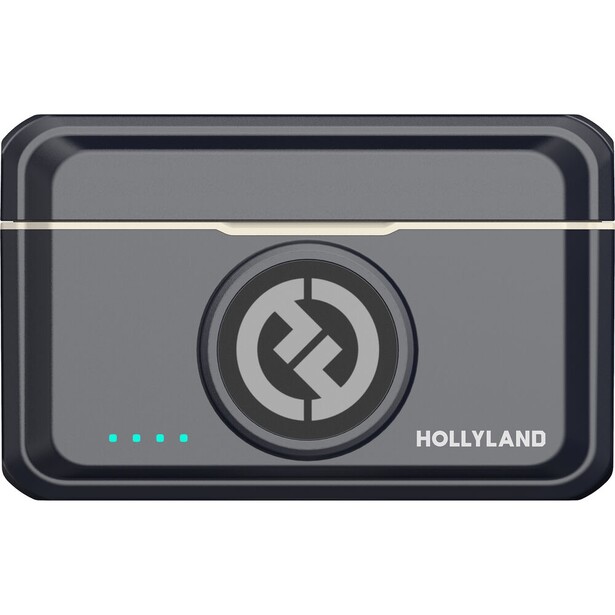
- System: 2 transmitters, choice of camera, USB-C, or Lightning receiver, charging case
- Wireless: 2.4 GHz
- Rated range: 300 m line of sight; 60 m non-line-of-sight with the mobile receiver, 40 m with the camera receiver
- Battery: 9 hours transmitter, 8.5 hours camera receiver, 30 hours with the case
- Internal recording: none
- Audio: 48 kHz, 24-bit, 116 dB max SPL
- Transmitter weight: 7 g
- Price: $99 (B&H)
Every wireless mic claims to be invisible. The LARK M2S comes closest. Its transmitter weighs 7 g and rides on a titanium clip that grips a collar, a tie, or the neckline of a t-shirt directly, without the magnetic backing plate that most rivals hide under the fabric. On camera it reads as a small piece of jewelry rather than a lump of gear, which matters enormously if you shoot corporate talent, fashion, or anyone who is going to object to a matchbox on their chest.
Hollyland did not sacrifice much to get there. The rated range is 300 m line of sight, longer than anything from Rode or Shure in this guide. Through obstacles Hollyland rates it at 60 m with the mobile receiver and 40 m with the camera receiver, which is the version most readers here will buy. Battery life runs 9 hours in the transmitter and up to 30 hours with the case, and audio is 48 kHz and 24-bit with two-level noise cancellation you toggle from the LarkSound app. The combo kits also include a camera receiver carrying both a 3.5mm TRS jack and a USB-C port, so one purchase covers a mirrorless body and a phone, which is not true of any cheaper system here.
The compromise is headroom. At 116 dB, the maximum SPL is the lowest of any pick here, 19 dB below the Rode Wireless Micro. The M2S is a fine mic for conversational speech and a risky one for a rock show or a subject who laughs hard into it, and there is no internal recording, which is the price of the size. Pick it if a discreet clip matters more to you than a safety file, and check the current price of the Hollyland LARK M2S at B&H. Also consider the DJI Mic Mini 2S, which adds 14.5 GB of internal 24-bit and 32-bit float recording to a 12 g transmitter, though it launched on July 2, 2026 in China with other markets following, and US availability is still rolling out. We reviewed the Mic Mini 2S outdoors, and its internal recording closes the one gap our reviewer found in the original Mic Mini.
What We Like
- 7 g transmitter on a titanium clip, the least visible rig here
- 300 m rated range, longer than pricier systems
- Camera receiver with both 3.5mm and USB-C outputs
- Up to 30 hours of runtime with the case
What Could Be Better
- 116 dB max SPL is the lowest in this guide
- No internal recording
- Noise cancellation requires the phone app to configure
- Bundle names and receiver types are confusing to shop for
Best for Professional and Broadcast Work: Sennheiser EW-DP ENG Set
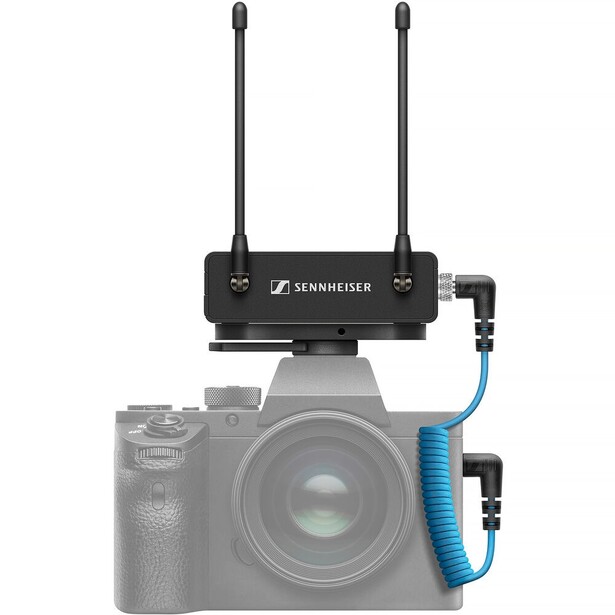
- System: EW-DP EK receiver, EW-D SK bodypack, EW-DP SKP plug-on transmitter, ME 2 lavalier
- Wireless: UHF, tunable across up to 56 MHz (sold in fixed bands: Q1-6, R1-6, R4-9, S1-7 and others by region)
- Rated range: 330 feet (100 m) as listed by B&H
- Battery: receiver 7 hours on the BA 70 pack; bodypack 12 hours on the BA 70 or 8 hours on 2 AA cells
- Internal recording: none
- Audio: 20 Hz to 20 kHz, 134 dB dynamic range, 1.9 ms latency
- Transmitter weight: 120 g (bodypack, without batteries)
- Price: $799 (B&H)
Everything else in this guide lives on 2.4 GHz, the same crowded band as every phone, laptop, and smart bulb in the building. The EW-DP ENG Set does not. It is a digital UHF system with up to 56 MHz of tuning bandwidth and an automatic scan that finds a clean channel, and that single architectural difference is why it is the kit a broadcast sound recordist will accept and a 2.4 GHz clip-on is not. In a hotel ballroom with 400 phones in it, UHF is the reason your audio still works.
The set is built for news and documentary work rather than vlogging. You get the EW-DP EK camera-mount receiver, an EW-D SK bodypack for a lavalier, the ME 2 omnidirectional lav itself, and, critically, the EW-DP SKP plug-on transmitter that turns any XLR handheld or shotgun into a wireless mic. Sennheiser rates the system at 134 dB of dynamic range and 1.9 ms of latency, with no companding, so speech comes out with a weight and neutrality that clip-on MEMS capsules never quite manage.
The downsides are what you would expect, and you should not talk yourself out of them. This is the most expensive system here and the least convenient: the bodypack is 120 g without batteries, and there is no internal recording, no 32-bit float, no charging case, and no app-driven noise cancellation. You run AA cells or BA 70 packs and monitor levels like an adult. You also buy a specific frequency band, so a kit that is clean and legal in Los Angeles may be neither in Berlin. Buy it if you get hired, if you work in RF-hostile rooms, or if a client's sound department has opinions, and check the current price of the Sennheiser EW-DP ENG Set at B&H.
What We Like
- UHF, so it sidesteps the congested 2.4 GHz band entirely
- Up to 56 MHz of tuning bandwidth with automatic channel scan
- Plug-on transmitter makes any XLR mic wireless
- 134 dB of dynamic range with no companding
What Could Be Better
- By far the most expensive system in this guide
- No internal recording and no 32-bit float safety
- Heavy bodypack and no charging case
- You buy a specific frequency band, so it is not a global travel kit
Best Range: Hollyland LARK MAX 2
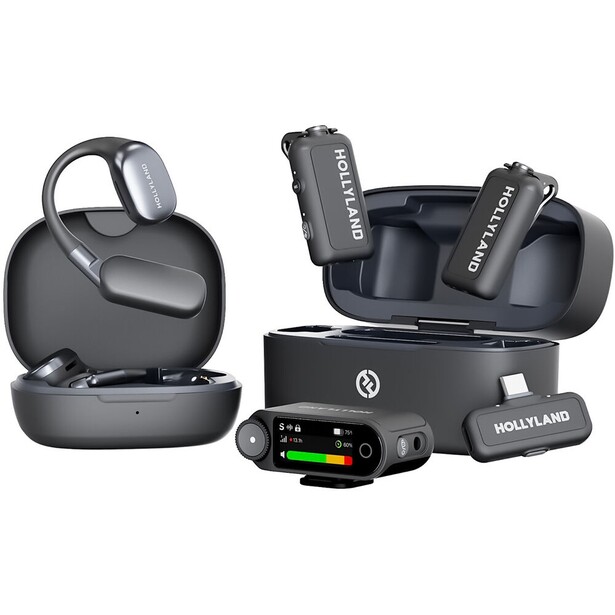
- System: 2 transmitters, camera receiver plus USB-C receiver, charging case, monitoring earphones on the top kit
- Wireless: 2.4 GHz with adaptive frequency hopping
- Rated range: 340 m line of sight, 60 m non-line-of-sight
- Battery: 11 hours transmitter, 12 hours receiver, 36 hours with the case
- Internal recording: 8 GB per transmitter, 14 hours at 24-bit or 10 hours at 32-bit float
- Audio: 48 kHz, 32-bit float or 24-bit, 128 dB max SPL, 20 ms latency
- Transmitter weight: 14 g
- Price: $299 (B&H)
Range claims deserve suspicion, so read this one carefully. Hollyland rates the LARK MAX 2 at 340 m line of sight, which is less than DJI's 400 m headline. The difference is what happens when you switch to your best audio setting. DJI's own specification notes that enabling Lossless Audio on the Mic 3 cuts the transmission range roughly in half. Hollyland publishes no equivalent caveat: the LARK MAX 2's 32-bit full-chain transmission is simply how it runs. If your working mode is the highest-quality one, this is the system that reaches farthest.
The rest of it is unusually complete. Each 14 g transmitter carries 8 GB of storage and doubles as a 32-bit float recorder with a built-in timecode generator, so a dropout at 300 m costs you nothing but a file transfer. Maximum SPL is 128 dB, latency is 20 ms, and battery life runs 11 hours in the transmitter and 36 hours with the case. The Ultimate Combo bundles open-ear monitoring earphones so you can hear the live feed, a real advantage on a two-person shoot with no sound assistant. When we reviewed the system, the audio came through with a full, natural vocal presence, and that wireless monitoring turned out to be more than a gimmick.
Three things to know before you commit. The 60 m non-line-of-sight figure is a reminder that walls take a brutal bite out of any 2.4 GHz system, whatever the open-field number says. The kit ladder is confusing, with combo, ultimate combo, and color variants that look alike and price very differently. And the timecode is generated in the transmitter rather than jam-synced from a master clock, so on a multi-camera shoot expect to nudge things in post; in our testing, encoding that timecode also costs you one of the recording channels. The full-chain 32-bit float transmission is a headline feature that most cameras simply cannot accept, so for many shooters the float file will still be something you pull off the transmitter afterward. This is the pick for outdoor interviews and weddings where the officiant is 60 yards down an aisle, so check the current price of the Hollyland LARK MAX 2 at B&H.
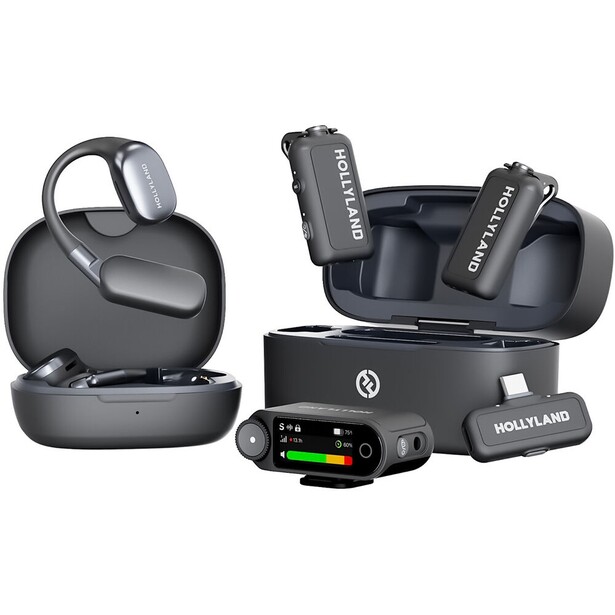
Read our full review: Hollyland LARK MAX 2: Feature-Rich Wireless Audio
What We Like
- 340 m rated range with no quality-mode penalty published
- 32-bit float internal recording and timecode in a 14 g transmitter
- 128 dB max SPL and 20 ms latency
- Optional open-ear monitoring earphones in the top kit
What Could Be Better
- Non-line-of-sight range collapses to 60 m, like every 2.4 GHz system
- Confusing ladder of near-identical bundles
- Timecode is generated, not jam-synced from a master clock
- 8 GB of storage, a quarter of the Rode Wireless PRO's 32 GB
Best With Internal Recording: Rode Wireless PRO
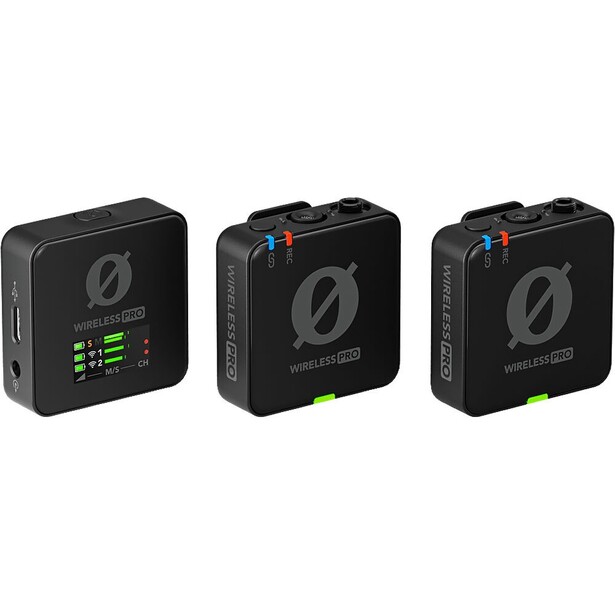
- System: 2 transmitters, 1 receiver, 2 Lavalier II mics, smart charging case
- Wireless: 2.4 GHz Series IV with 128-bit encryption
- Rated range: 260 m line of sight
- Battery: 7 hours transmitter, 21 hours with the charging case
- Internal recording: 32 GB per transmitter, over 40 hours of uncompressed 32-bit float WAV
- Audio: 48 kHz, 32-bit float, 123.5 dB max SPL
- Transmitter weight: 35 g
- Price: $299 (B&H)
Nothing else here gives you 32 GB per transmitter and over 40 hours of uncompressed 32-bit float WAV. The Wireless PRO was designed backward from the post-production problem: it records everything, all the time, at a bit depth where clipping does not exist, and it stamps the files with timecode from an internal generator so they drop onto a timeline in sync instead of being clapped and nudged. If you shoot weddings, documentary, or anything you cannot reshoot, that combination is the whole argument.
Rode also ships it with things other companies charge extra for: two Lavalier II microphones with locking 3.5mm connectors, so you are not stuck with the transmitter's built-in capsule when a subject wears a jacket, plus furry windshields, MagClip GO magnets, and a case that charges everything twice for about 21 hours. GainAssist rides levels automatically, and a safety channel records at a lower level as a second line of defense on the camera feed. Rated range is 260 m, with 128-bit encryption on the link.
The cost is size and stamina. At 35 g per transmitter it is more than twice the weight of the DJI and five times the Hollyland LARK M2S, and it is visibly a box on a shirt. Seven hours of transmitter battery is mid-pack, and the float-recording and safety-channel workflow has a learning curve the plug-and-play crowd will find fussy. One more thing to weigh: Rode announced the RØDELink II at NAB 2026, a UHF flagship that records 32-bit float to removable microSD, positioned above the Wireless PRO at a substantially higher price rather than replacing it. The Wireless PRO stays in the lineup.
Buy it if losing a take is a professional problem rather than an inconvenience. Anyone shooting the kind of work covered in Fstoppers' Tips for Shooting Professional Video Interviews will use the safety channel within a month. Check the current price of the Rode Wireless PRO at B&H. Also consider the Saramonic Ultra, which delivers timecode, 8 GB of 32-bit float recording, 130 dB of headroom, and an IPX5 splash rating for less money, at the cost of a 6-hour transmitter battery.
What We Like
- 32 GB and 40-plus hours of 32-bit float recording per transmitter
- Internal timecode generator for painless sync
- Two Lavalier II mics with locking connectors included
- Encrypted link and a genuine safety channel
What Could Be Better
- 35 g transmitters are the bulkiest clip-ons here
- Seven hours of transmitter battery is unremarkable
- Deeper feature set means a real learning curve
- Two years into its cycle, with a pricier UHF sibling now above it
Best for Stereo and Ambient Sound: Shure MoveMic 88+
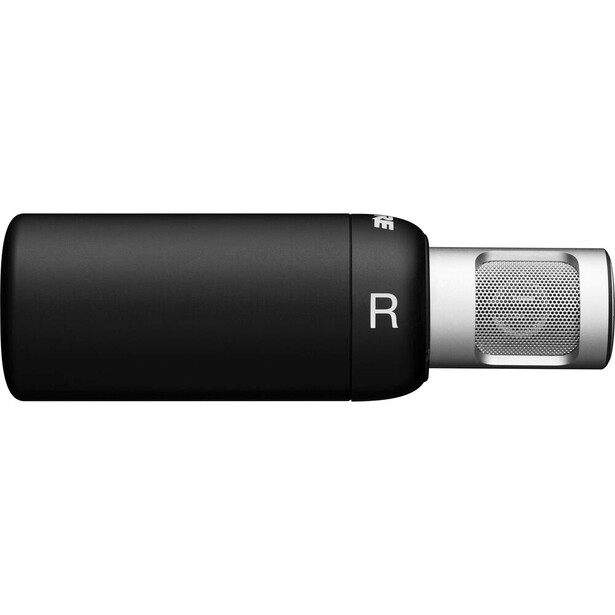
- System: 1 stereo microphone, optional MoveMic Receiver, mic clip and cold shoe clip
- Wireless: Bluetooth 5.0 or higher direct to phone, or the MoveMic Receiver
- Rated range: 100 feet (30 m)
- Battery: up to 8 hours
- Internal recording: none
- Audio: 44.1 or 48 kHz, 16-bit to a phone or 24-bit through the receiver, 122.4 dB max SPL
- Transmitter weight: 99 g
- Price: $263 (B&H)
Every other pick in this guide records one voice in mono. The MoveMic 88+ is a wireless stereo mini-shotgun, and it exists for the shots the clip-ons cannot do: a market street, a live band, a crowd reaction, a car interior, a room tone you will actually want to use. Four polar patterns are selectable, stereo adjustable from 60 to 135 degrees, mono cardioid, mono bi-directional, and raw mid-side, which means one small mic covers an interview, a two-hander across a table, and a wide ambient bed.
The Shure part shows in the DSP. Gain, compression, EQ, a high-pass filter, channel swap, and noise reduction are all onboard and adjustable from the MOTIV app, and the capsules sound like Shure capsules: clean, slightly forward, with none of the plasticky midrange that betrays a cheap MEMS clip-on. It pairs to a phone over Bluetooth with no dongle at all, and if you add the MoveMic Receiver you get 24-bit audio out to a camera over 3.5mm or USB-C. The hardware backs the spec sheet up: our reviewer found it built from metal and reassuringly heavier than expected, and rated it as sounding noticeably better than a Rode Wireless GO II, with the real payoff being the ability to capture ambient sound and foley as their own tracks alongside dialogue.
Read the specification honestly, though, because this is not a lav replacement. The range is 100 feet, about 30 m, a tenth of the DJI's, so the talent has to be near you. Battery life is 8 hours, there is no internal recording, and at 99 g it lives on a cold shoe, a stand, or in your hand rather than on a shirt. Connected straight to a phone the audio is 16-bit, and 24-bit requires the separate receiver. One limitation we ran into is worth flagging for interview shooters: you cannot record a MoveMic lavalier and the 88+ to separate channels at the same time, so it does not slot neatly into a two-person sit-down. Get it as your second microphone, the one that makes your videos sound like a place rather than a voiceover booth, and check the current price of the Shure MoveMic 88+ at B&H.
Read our full review: Shure’s New MoveMic 88+ Is Versatile and Impressive
What We Like
- True wireless stereo with four selectable polar patterns
- Onboard DSP for gain, EQ, compression, and noise reduction
- Bluetooth to a phone with no dongle required
- Shure capsule quality in a mic this size
What Could Be Better
- 30 m range, the shortest in this guide by far
- 16-bit unless you buy the separate receiver
- 99 g, so it is not a practical clip-on lav
- No internal recording backup
How to Choose a Wireless Microphone
Start with the port, not the mic. Many of the cheapest and smallest systems, including the Saramonic Air SE and the Hollyland LARK A1, ship with a receiver that plugs into a USB-C or Lightning socket and nothing else. They are excellent phone mics and useless on a camera with a 3.5mm input. If you own a mirrorless body, or expect to within a year, buy a kit whose receiver has a 3.5mm TRS output, and confirm the specific bundle in your cart includes the camera receiver. This is the most common buying mistake in the category.
Next, decide whether you need internal recording. The transmitter records a full-quality file on its own storage while it transmits, so a radio dropout, a dead receiver battery, or a subject who screams into the capsule costs you nothing. When that file is 32-bit float, clipping stops being possible at all: the format carries enough dynamic range that you can pull a distorted-looking waveform back down in post and find clean audio underneath. If you are being paid, or the moment cannot be repeated, that is worth more than any other feature here. If you shoot b-roll you can redo, it is a luxury.
Then look hard at range and discount the headline. Every open-field figure here, from the Shure's 30 m to DJI's 400 m, was measured with clear line of sight. The number that predicts your experience is the non-line-of-sight figure, where Hollyland quotes 60 m and DJI quotes 80 m in a simulated interference environment. Walls, bodies, and a room full of phones on 2.4 GHz take a hundreds-of-meters spec down to tens. That is the argument for UHF, and why broadcast crews still carry the Sennheiser.
The spec that matters more than people think is maximum SPL, the ceiling before the capsule itself distorts. It ranges from 116 dB on the LARK M2S to 135 dB on the Rode Wireless Micro, and a laugh at close range is louder than most people assume. The spec that matters less is the transmitted bit depth, because most of these receivers hand your camera an analog 3.5mm feed anyway and the camera's preamp becomes the weak link. Set the camera input to manual, ride it around 60 percent, and you will gain more than any marketing number gives you.
What We're Looking For
Our picks weigh how a system behaves when things go wrong: whether it records a backup, how much headroom the capsule has before it crunches, what happens to the link in a crowded room, and whether the receiver can feed the camera you own. Every specification here was verified against the manufacturer's current published data and a live retailer listing at the time of writing, and the price line is the current B&H figure, which will move. Most picks across our buying guides come from gear our writers have used and reviewed hands-on. Where we have published a full review of a system, the entry links to it and speaks from that testing; where we have not, the entry is written from those verified specifications rather than implying an experience we did not have.
Frequently Asked Questions
Do I Really Need 32-Bit Float Recording?
Only if you are shooting something you cannot repeat. A 32-bit float file carries so much dynamic range that clipping effectively cannot happen, so a shouted line or a sudden laugh that would have destroyed a 24-bit take can be pulled back down in post. For weddings, documentary, and paid interviews it is genuine insurance. For scripted talking-head videos you can reshoot, it is a nice extra.
Will a Wireless Microphone Work With My Mirrorless Camera?
Only if the kit includes a receiver with a 3.5mm TRS output. Several of the smallest and cheapest systems here ship with a USB-C or Lightning plug-in receiver designed for phones and have no camera output at all. Check the exact bundle, since brands sell phone-only and camera versions of the same microphone under nearly identical names. Every body in our beginner cameras guide takes a 3.5mm input.
What Is the Real-World Range of a Wireless Mic?
Far less than the box says. The 100 m to 400 m figures quoted for the clip-on systems here are open-field, line-of-sight measurements. Put a wall, a crowd, or a room full of 2.4 GHz devices between the transmitter and receiver and the usable distance drops to tens of meters, which is why manufacturers publish separate non-line-of-sight numbers such as Hollyland's 60 m.
Are Cheap Wireless Microphones Any Good in 2026?
Yes, dramatically better than they were. An entry-level kit like the Saramonic Air SE now delivers 48 kHz 24-bit audio, AI noise cancellation, and a 200 m rated range for the price of a decent lunch for two. What you still give up at that price is internal recording, camera compatibility, and headroom, which is exactly what the systems three times more expensive are selling you.
Should I Use the Built-In Mic or a Lavalier?
Use the transmitter's built-in capsule when the subject's chest is exposed and the clip can sit 20 to 25 cm below the chin. Switch to a plug-in lavalier when the mic must be hidden under a collar, a scarf, or a jacket, which is why the Rode Wireless PRO's included Lavalier II mics matter more than they look. Either way, keep the capsule off the fabric that rubs.
Fstoppers may earn a commission from purchases made through links in this article. Our picks are made independently by our editorial team.