
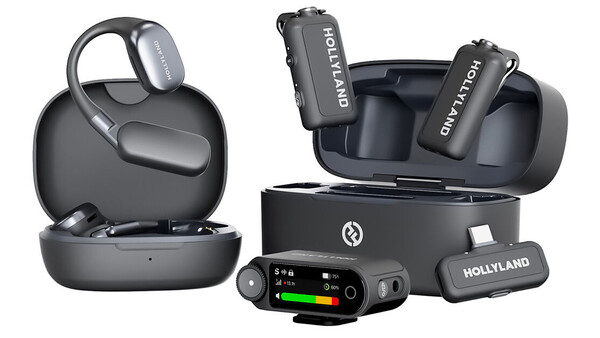
Hollyland has consistently been at the forefront of wireless audio capture, and their latest flagship, the LARK MAX 2, represents a push to consolidate nearly every desirable modern audio feature into a single comprehensive system. Are all these features important, or is the result overly complicated?
The LARK MAX 2 is positioned as an all-in-one solution for everyone from solo vloggers to small production crews. It features a dual-transmitter setup, 32-bit float recording, advanced noise cancellation, and a unique wireless monitoring system. The question is whether this ambitious feature set translates into a practical, reliable tool in the field. After my hands-on testing, it’s clear that Hollyland has engineered a system with remarkable depth and flexibility.
Build and Design
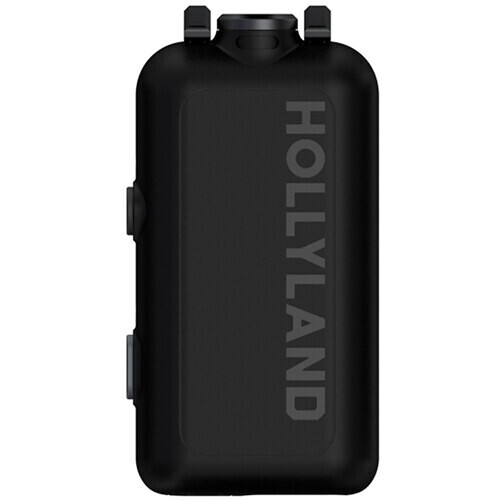
The LARK MAX 2 system starts with its two ultracompact transmitters. Weighing a mere 14 grams (0.5 oz), they are among the lightest in their class and are small for high-end 2.4 GHz transmitters. The transmitters feature a matte “nano-coated” finish that is both discreet and skin-friendly. Attachment options are varied, with a traditional clip design and an alternate included magnetic clip system.
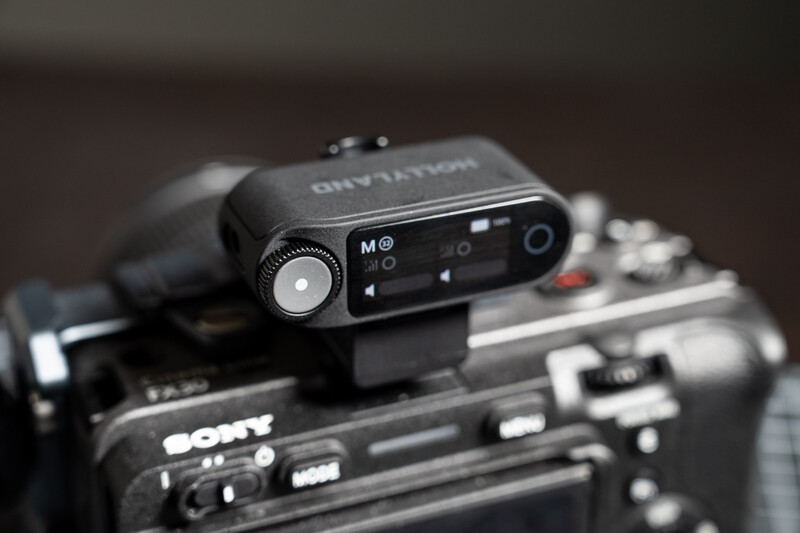
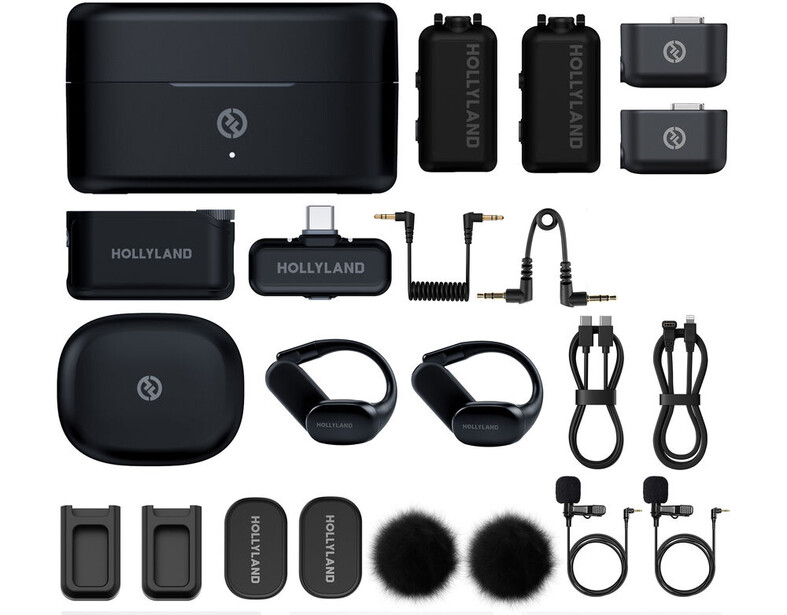
The system includes two distinct receivers. The primary camera-mount receiver is a conventional unit featuring a color touchscreen and a tactile control wheel for quick adjustments to settings like gain, recording modes, and monitoring levels. A smaller USB-C plug-in receiver is also included for direct connection to smartphones and computers, enabling an extremely streamlined mobile setup. The transmitters and main receiver can be housed in a charging case that provides up to 36 hours of total operating time.
Core Audio Performance
The LARK MAX 2 delivers excellent sound with a 48 kHz sample rate. The audio signature is clean and full-bodied. The system uses Hollyland’s FocalClear Technology, a proprietary processing system designed to enhance vocal frequencies while naturally attenuating background noise. The microphones can handle a maximum sound pressure level of 128 dB, ensuring that even in very loud environments, the audio remains free of distortion.
The headline feature is its implementation of 32-bit float audio. Each transmitter contains 8 GB of internal storage, enabling it to function as a standalone recorder. It can capture up to 10 hours of 32-bit float audio (or 14 hours in 24-bit). Uniquely, the LARK MAX 2 also supports full-chain 32-bit float audio transmission. This allows the system to send a 32-bit float signal from the transmitter, through the receiver, and directly into a compatible recording device.
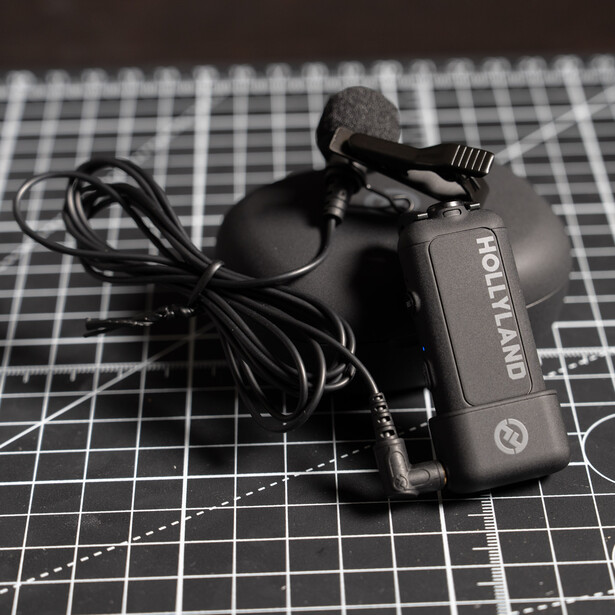
While the transmitters sound great on their own, you can run them with 3.5 mm lav mics, thanks to the USB-C to 3.5 mm adapters included. This opens up how you mount the mic and wire up the talent, and is a key feature for a 2.4 GHz system aimed at this tier of user.
A Closer Look: What Is 32-Bit Float Audio?
For creators who are not audio engineers, the term "32-bit float" might sound like technical jargon, but its practical benefit is easy to understand. Think of it like the difference between shooting a JPEG and a RAW photo.
With traditional 24-bit audio (the standard for most recorders), setting your input level, or "gain," is a delicate balancing act. If you set the gain too low, your audio will be quiet, and when you boost it in post-production, you also boost the underlying noise floor, resulting in hiss. If you set the gain too high and the person you are recording suddenly speaks loudly or laughs, the audio signal will "clip." This creates a harsh, squared-off waveform and audible distortion that is almost impossible to repair. It is the audio equivalent of a blown-out highlight in a JPEG; the data is permanently lost.
32-bit float recording solves this problem. It captures an immense dynamic range, far greater than what a 24-bit file can hold. In practice, this means it is virtually impossible to clip the audio at the recording stage. You do not have to think about perfectly setting your gain. If an audio file sounds distorted on playback, you can simply lower its level in your editing software, and the clean, unclipped waveform will be revealed. It offers peace of mind, especially for solo operators in unpredictable environments.
The main limitation for a system like the LARK MAX 2 is that while the transmitters can always record internally in 32-bit float, most cameras cannot accept a 32-bit float signal. Therefore, the benefit for most users will only come with using the internal recordings.
Advanced Features and Control
Beyond its core audio capabilities, the LARK MAX 2 is equipped with a suite of intelligent features. The AI noise cancellation is a simple example. Rather than an on/off switch, it offers stepless adjustment from 5 dB to 25 dB. This allows for fine-tuned control, enabling users to subtly reduce ambient noise for a natural sound or aggressively cut down the din in loud environments.
In the settings, there are even helpful guides like a recommended audio setup for a huge array of cameras (but no Sony FX30, oddly enough), as well as controls for the transmitter LEDs. All the expected basics, like stereo, mono, and safety track recording, are also present, although the receiver UI will take a few minutes to understand, as it combines swipes, taps, a clickable scroll wheel, and a capacitive button.
The system also incorporates a built-in timecode generator. This provides a frame-level reference to simplify the synchronization of video and the internal audio recordings in post-production.
A Closer Look: Understanding Timecode Sync
Syncing audio and video from separate sources is a fundamental challenge in post-production. The classic method is using a slate or a clap to create a sharp visual and audible spike that can be manually aligned on a timeline. This works, but it can be tedious and imprecise.
Timecode is the professional solution to this problem. It is essentially a clock that stamps every frame of video and every moment of audio with a unique address (in hours, minutes, seconds, and frames). When all your devices, including cameras and audio recorders, are running on the same clock, syncing them in your editing software becomes an automated, one-click process. It saves a lot of time and ensures perfect alignment.
The LARK MAX 2 works by sending the timecode signal as an audible pulse down one of the audio channels recorded by your camera. Your editing software can then read this audio track and use it to automatically sync with the internally recorded files from the transmitters.
The primary limitation of this method is that it requires sacrificing an audio channel. For example, if you are recording a stereo track to your camera, the left channel might contain your microphone audio while the right channel is dedicated solely to the inaudible timecode signal. For workflows that demand perfect sync, this is a worthwhile trade-off, and it brings this powerful feature to a more accessible price point compared to dedicated timecode solutions.
An Innovative Monitoring System

The Ultimate Combo package includes a pair of OWS (Open Wireless Stereo) monitor earphones, which are a novel approach to audio monitoring. These earphones connect to the receiver via a dedicated 2.4 GHz wireless signal, not Bluetooth, ensuring an ultra-low latency of just 25 ms. This allows a camera operator or another crew member to monitor the audio from up to 100 meters away without being tethered by a cable.

The open-ear design sits on the ear rather than in the ear canal. This has the dual benefit of increased comfort for long sessions and helping the user remain aware of their surroundings. The downside is a lack of noise isolation, which could be a challenge in noisy settings. However, for most production scenarios, this is a highly effective monitoring solution.
Conclusion
The Hollyland LARK MAX 2 is an exceptionally comprehensive and forward-thinking wireless microphone system. It successfully combines excellent audio quality with a host of intelligent, practical features that address the real-world challenges faced by content creators. The inclusion of dual receivers, 32-bit float internal recording, and the unique wireless monitoring system make it one of the most versatile packages available today.
The Hollyland LARK MAX 2 is an exceptionally comprehensive and forward-thinking wireless microphone system. It successfully combines excellent audio quality with a host of intelligent, practical features that address the real-world challenges faced by content creators. The inclusion of dual receivers, 32-bit float internal recording, and the unique wireless monitoring system make it one of the most versatile packages available today.
What I Liked
- Excellent audio quality with a full and natural vocal presence
- 32-bit float internal recording
- Extremely lightweight transmitters
- OWS wireless monitoring system is innovative
- Comprehensive Ultimate Combo kit includes everything needed for various scenarios
What Could Be Improved
- Wider camera support for full-chain 32-bit float is needed from camera manufacturers
- Audio-based timecode occupies a recording channel, which can be a limitation





Join the Fstoppers community for free
-
Post comments and join in the discussions
-
Browse the site ad-free
-
Share your work and get featured in the community
-
Compete in the photo contests for fun and prizes
2 Comments
Alex: Thanks for the review and especially for explaining what the heck "32-bit float audio" is. Your description makes perfect sense. I used the LARK MAX 2 for the first time yesterday on a product overview video. You are correct: Boosting audio output in post is usually a fearful maneuver (with distortion, clipping, etc.), but it works great without artifact. The earphones are a real treat, but remember that just because you can monitoring audio does not mean you are recording audio!
Thanks Tom! Happy to hear you found it interesting.