Photographers spend months agonizing over carbon fiber leg sections and then bolt a cheap head to the top of the pile. That head is the part your camera actually touches, the part that sags after you lock it, and the part that decides whether a blue-hour session produces a stitched panorama or a folder of misaligned frames. A tripod holds still. A head is what you argue with.
Three questions settle almost every purchase here. What are you supporting (a mirrorless body and a 35mm prime is a different problem than a 600mm f/4)? How precisely do you need to aim it (fast and loose, or one twentieth of a degree at a time)? And what are you willing to carry? Those three axes explain why a wildlife photographer and an architectural photographer will never agree on what a good head is, and why both of them are right.
This guide is organized by job, not by brand. Every specification below was pulled from the manufacturer's current spec page and cross-checked against a live retailer listing in July 2026, and where a manufacturer does not publish a figure, we say so in the entry rather than borrowing a number from a retailer listing. We have not put these heads through formal Fstoppers reviews, and each entry says so plainly rather than implying a field history we do not have. If your legs are the weak link rather than your head, start with our tripods guide instead.
At a Glance
- Best Overall: Really Right Stuff BH-55
- Best Value Ball Head: Leofoto LH-40
- Best Budget: Sirui K-10X
- Best Geared Head: Arca-Swiss d4
- Best Geared Head for the Money: Leofoto GW-01
- Best Gimbal Head for Wildlife: Wimberley WH-200 Version II
- Best Fluid Video Head: Manfrotto Nitrotech 612
- Best Panoramic Head: Nodal Ninja 6
- Best Do-It-All Travel Head: Acratech GXP
Best Overall: Really Right Stuff BH-55
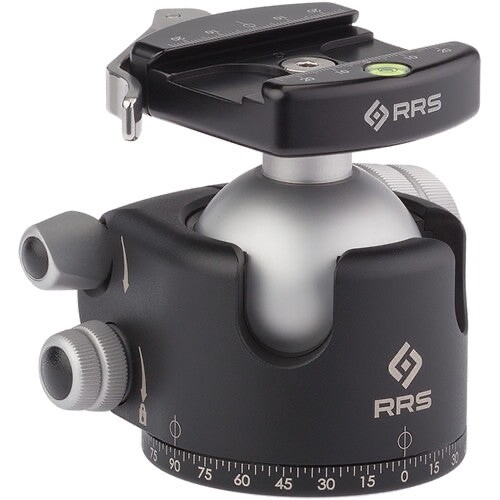
- Type: full-size ball head, 55 mm ball
- Load rating: 50 lb (23 kg)
- Weight: 1.9 lb (848 g) with the screw-knob clamp
- Height: 3.7 in (94 mm)
- Clamp: Arca-type, chosen at purchase (screw-knob, lever, panning, or dual Arca/Picatinny)
- Panning: 360-degree base, laser-engraved every 2.5 degrees
- Price: $560 (B&H)
Ball heads fail in one specific, maddening way: you compose, you lock, and the frame settles a hair as the ball takes the weight. Creep is the complaint that almost never attaches to the BH-55. A hollow 55 mm ball, an independent tension knob you set once for your body and lens, and a main lock sized to clamp a 50 lb rated load are the reasons it holds a locked frame dead still. Really Right Stuff machines it in Lehi, Utah, and rates it at 50 lb (23 kg).
We have not run a BH-55 through a formal Fstoppers review, so nothing here is a shutter count of our own. Its design is what other ball heads are measured against. Two drop notches spaced 90 degrees apart let you drop the camera into portrait orientation from either of two positions, which matters when a tripod leg is in the way. The knobs are sized so you can operate them with gloves on and find them without looking.
It is expensive, and there is no honest way around that. The head alone costs more than several complete tripod kits, and Really Right Stuff sells the BH-55 in seven clamp configurations at seven different prices, so changing your mind later means buying another clamp rather than adjusting the one you have. It is also not light. At 1.9 lb it adds real mass to a travel kit, which is exactly why the Acratech below exists in this guide. And a ball head, however good, is still the wrong tool if your work is measured in millimeters of shift rather than degrees of tilt.
For a landscape photographer with a heavy body and a long zoom, or a working pro who wants to buy a head once, this is the one that ends the search. Check the current price of the Really Right Stuff BH-55 at B&H.
What We Like
- Hollow 55 mm ball and an oversized main lock rated to 50 lb, with a very low center of gravity
- Independent tension knob you can dial in for a specific body and lens
- Two drop notches, 90 degrees apart, for vertical shooting around a tripod leg
- Panning base laser-engraved every 2.5 degrees for repeatable rotations
What Could Be Better
- Costs more than many complete tripods
- Heavy for a travel kit at 1.9 lb
- Changing clamp style later means buying a second clamp
- No geared precision for architectural or product work
Best Value Ball Head: Leofoto LH-40
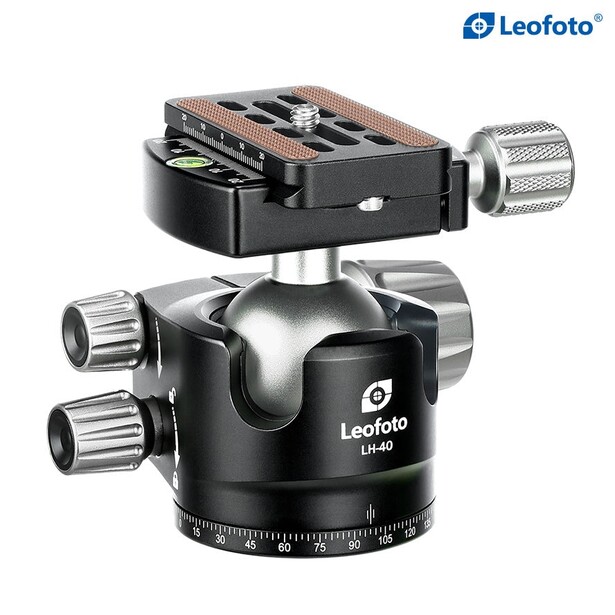
- Type: low-profile ball head, 40 mm ball
- Load rating: 44 lb (20 kg)
- Weight: 1.08 lb (491 g)
- Height: 3.42 in (87 mm)
- Clamp: Arca-type screw-knob clamp with included quick release plate
- Panning: 360-degree base with independent pan lock, engraved every 2.5 degrees
- Price: $136.08 (B&H)
Leofoto built its reputation by copying the geometry of heads that cost four times as much and then pricing the result like an accessory. The LH-40 is the clearest example. It has the parts that matter: a 40 mm ball machined from hard-anodized aluminum, an independent friction dial nested inside the main lock, a separate panning lock, and a 90-degree drop notch.
Leofoto rates it at 44 lb (20 kg) and lists it at 491 g, about 350 g lighter than the BH-55. We have not reviewed the LH-40 in house. The friction control is what separates it from cheaper heads: you can set the drag so a mirrorless body with a mid-size zoom stays exactly where you left it while you still nudge it with one finger. That is the behavior that makes a ball head feel expensive.
The compromises are the ones you would expect at the price. The knobs are smaller than Really Right Stuff's and less pleasant in cold weather. The finish is good, not immaculate, and the clamp jaws are less confidence-inspiring under a big telephoto. Load the LH-40 to the edge of its rating with a long lens hanging off one side and you will feel more flex in the system than a BH-55 shows.
This is the head we would put on a mid-size travel or landscape tripod for someone who wants 90 percent of the flagship experience and would rather spend the difference on glass. If you want a lever clamp instead of a knob, the Leofoto LH-40LR is the same head with a lever-release clamp. Check the current price of the Leofoto LH-40 at B&H.
What We Like
- Genuinely good friction control, not a token second knob
- Independent panning lock, still rare at this price
- Low profile and light at 491 g
- Arca-type clamp and plate included
What Could Be Better
- Smaller knobs are harder to work with gloves
- More flex than premium heads when loaded near its rating
- Clamp jaws are the weakest part of the design
- Fit and finish is a step below the American-made competition
Best Budget: Sirui K-10X
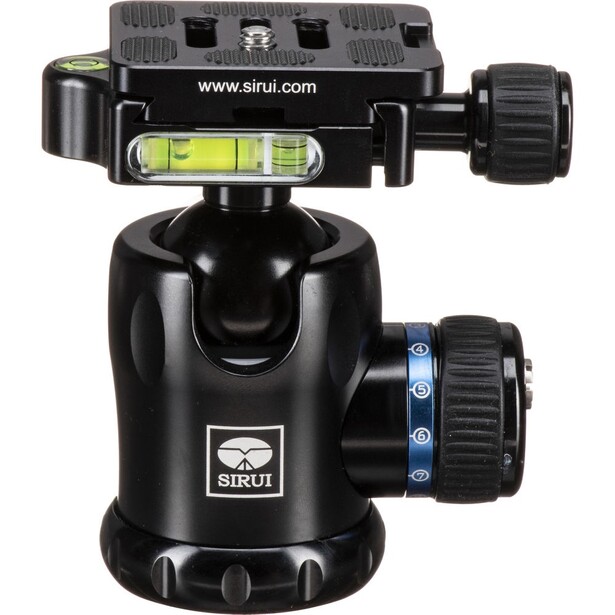
- Type: compact ball head, 33 mm ball
- Load rating: 44.1 lb (20 kg)
- Weight: 0.9 lb (390 g)
- Height: 3.8 in (96 mm)
- Clamp: Arca-type with included TY-50X plate
- Panning: 360-degree base with independent pan lock, two bubble levels
- Price: $69.90 (B&H)
Cheap ball heads usually fail at the same place: the ball is too small, the friction control is fake, and the whole thing droops the moment you tighten it. The K-10X is the smallest head in Sirui's long-running K-X line, and it avoids all three problems. Sirui publishes a 33 mm ball, a 20 kg (44.1 lb) rating, and a 390 g weight, with a separate tension knob and an independent panning lock.
Sirui's spec sheet claims a sphere tolerance of 0.01 mm on the ball. Two bubble levels sit on the body and the clamp accepts any Arca-type plate, so it drops into an existing workflow without a conversion project. We have not tested this one, and the 44.1 lb rating is a laboratory figure that no sane person should take literally: treat it as a head for a mirrorless or DSLR body with a normal zoom, not for a 400mm f/2.8.
Where you feel the price is in the details. The knobs are small and closely spaced, so operating tension and lock separately in the dark takes practice. The finish scuffs. And the K-10X is short on ball diameter for heavy work, which is why Sirui also sells the Sirui K-30X, a 44 mm ball rated to 66 lb (30 kg) at 0.55 kg. Sirui's own store lists the K-10X on backorder as of this writing, so retailer stock is worth checking before you commit.
If you own a good tripod with a bad head, or you are building a first serious kit and the money has to go somewhere else, this is the honest floor of the category. Check the current price of the Sirui K-10X at B&H.
What We Like
- Real friction control and an independent pan lock at a budget price
- Light at 390 g and small enough for a travel tripod
- Standard Arca-type clamp, so no proprietary plates
- Two bubble levels for quick leveling
What Could Be Better
- Small, closely spaced knobs
- The 44.1 lb rating is optimistic for real telephoto work
- Finish marks easily
- Listed on backorder at Sirui's own store
Best Geared Head: Arca-Swiss d4
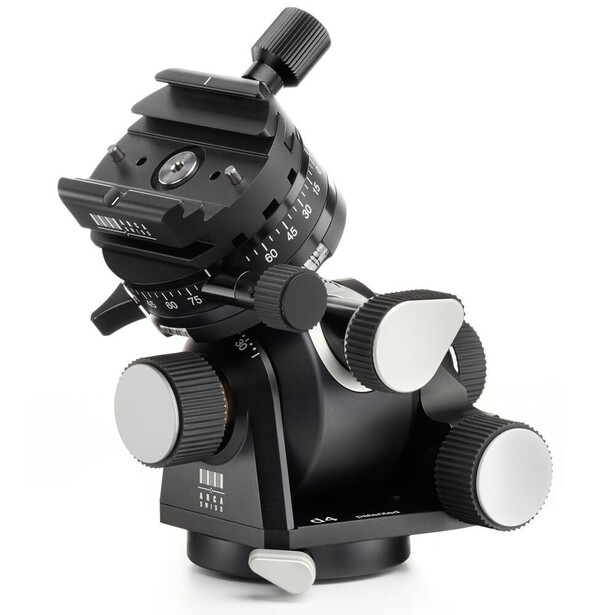
- Type: geared head with quick-release clutches
- Load rating: 66 lb (30 kg)
- Weight: 2.2 lb (980 g)
- Height: not published as a single figure (125 x 110 x 90 mm overall)
- Clamp: choice of Classic knob, flipLock lever, or monoballFix
- Panning: 360-degree base and 360-degree top panning (geared panning on the d4 gp)
- Price: $2,034.50 (B&H)
Architecture photographers do not tilt a camera. They correct it, by fractions of a degree, until a 40-story building stops leaning. A ball head cannot do that job, because the moment you release the lock you lose the composition you spent five minutes building. The d4 is the head that industry settled on, and the reason is its clutch system: flip the locking levers open and it moves like a fast 3-way head, close them and every axis becomes a worm-gear micrometer.
Arca-Swiss rates the d4 at 66 lb (30 kg) at 980 g, with 40 degrees of tilt each way laterally, 90 degrees up and 40 down in front, and manual 360-degree panning at both the base and the top platform. That top panning platform is the piece people underrate: it lets you level the head on uneven legs and then pan through a stitched sequence without reintroducing tilt. The d4 gp variant replaces the manual top pan with a geared one, which is what you want if you shoot multi-row panoramas with a shift lens. Fstoppers has not run a formal review of the d4, so this entry rests on its published specification and its clutch-and-gear design.
Three real problems. It is expensive enough to be a business expense rather than a purchase. Availability has been erratic, and Arca-Swiss USA currently lists all three quick-release variants as unavailable at its own store, so buy from a dealer who has stock in hand rather than one taking a backorder. And a geared head is slow by design: chasing a bird with one is a bad joke, and even landscape work in fast light can feel like operating a machine tool.
If your compositions are drawn rather than found, and if you have ever cursed a ball head for losing a frame you had perfect, this is the fix. Check the current price of the Arca-Swiss d4 at B&H. Mike Kelley's Where Art Meets Architecture 1 tutorial covers the workflow this head is built to serve.
What We Like
- Clutch system gives you fast coarse framing and geared fine control in one head
- Geared panning available on the top platform, not just the base
- Rated to 66 lb, so a technical camera or medium format body is no strain
- Repeatable to a degree no ball head can match
What Could Be Better
- Availability is inconsistent and backorders are common
- Very expensive
- Too slow for wildlife, sports, or fast-changing light
- Heavier than most ball heads at 980 g
Best Geared Head for the Money: Leofoto GW-01
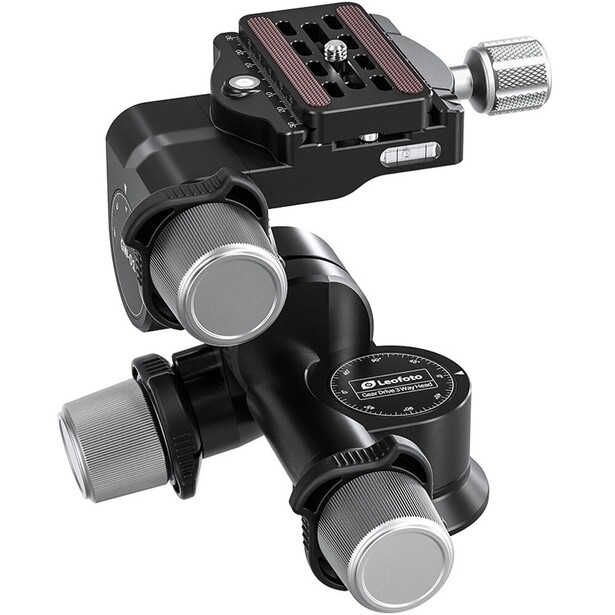
- Type: 3-way geared head with snap-lock knobs
- Load rating: 17.6 lb (8 kg)
- Weight: 2.2 lb (1 kg)
- Height: not published by Leofoto (58 mm base diameter)
- Clamp: Arca-type with included quick release plate
- Panning: 360-degree base, 90 degrees forward tilt, 30 degrees back, 90 degrees to portrait
- Price: $183.20 (B&H)
Most photographers who want geared precision cannot justify the Arca-Swiss, and until recently their only option was a heavy Manfrotto with a proprietary plate. The GW-01 fixed that. It borrows the idea that makes the d4 work, star-shaped snap-lock knobs that swing an axis into rough position quickly and twist knobs that drive the same axis through gears for fine adjustment, at a fraction of the price and with a standard Arca-type clamp.
Leofoto publishes an 8 kg (17.6 lb) load rating at 1 kg, with numbered angle scales on all three axes. Those scales are the feature that pays for itself: shoot a bracketed architectural sequence, note the numbers, and you can return the camera to the same position after swapping a lens. We have not put the GW-01 through an Fstoppers review, so this entry rests on its published specification and geared design. The one caveat that design invites is stiffness.
Geared heads trade rigidity for gearing, and inexpensive geared heads trade more of it. The GW-01's design invites the usual weak points, backlash in the gear train and flex in the narrow neck between the clamp and the body, so it will not feel as locked-down as a premium geared head. The 8 kg rating is the most conservative in this guide, so a gripped body with a 70-200mm is near the sensible limit.
Leofoto's larger G4 and G4 Pro geared heads are the serious models in the line, and they are worth a look if you shoot this way full time, though B&H does not carry them and you will be buying through Leofoto's own dealer network. The same is true of Rogeti's RG-1, a niche worm-drive geared head sold direct to photographers who work with tilt-shift lenses. For everyone else, check the current price of the Leofoto GW-01 at B&H.
What We Like
- Snap-lock knobs make a geared head usable at normal speed
- Numbered scales on every axis for repeatable setups
- Standard Arca-type clamp instead of a proprietary plate
- A fraction of the cost of the heads it imitates
What Could Be Better
- Less rigid than premium geared heads, with gear backlash and a narrow clamp neck
- Modest 8 kg load rating
- Leofoto does not publish an overall height
- Heavy for its capacity at 1 kg
Best Gimbal Head for Wildlife: Wimberley WH-200 Version II
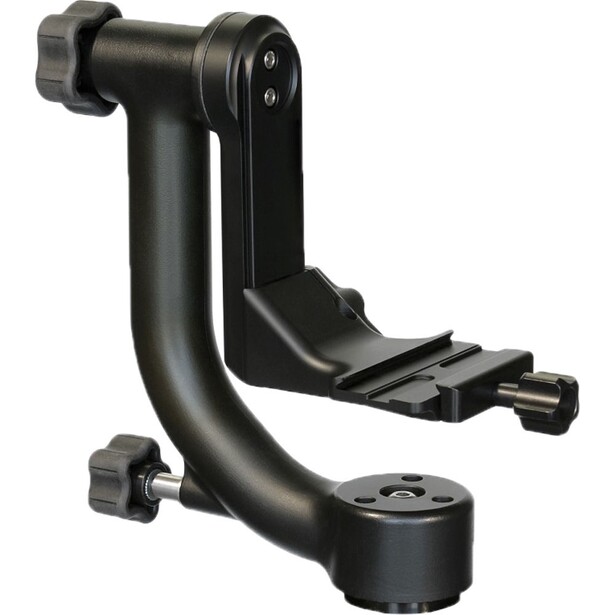
- Type: full gimbal head
- Load rating: greater than 100 lb (45 kg)
- Weight: 3.15 lb (1.4 kg)
- Height: 9.25 in (23.5 cm)
- Clamp: built-in Arca-type quick release base
- Panning: 360-degree base with independent lock
- Price: $595 (B&H)
Put a 600mm f/4 on a ball head and physics wins. The lens wants to fall, you fight it with friction, and by the third hour your right hand aches and the bird has left. A gimbal hangs the lens from its center of gravity so the whole rig floats and stays wherever you point it. The Wimberley WH-200 Version II defined the category, and its balance-from-center design still sets the standard for smooth long-lens tracking.
Wimberley builds it in Virginia, rates it at over 100 lb (45 kg), and lists it at 3.15 lb (1.4 kg) with a built-in Arca-type quick release base. The Version II is more compact than the original, with a redesigned panning base and soft-touch knobs. Balance it once for a given lens and the movement is genuinely frictionless: you can track a heron across a marsh with one finger on the lens hood and stop precisely where you want. We have not tested one at Fstoppers, but the mechanism is simple physics: a lens balanced through its center of gravity takes almost no force to move or to hold in place.
Two honest problems. It is heavy. At 3.15 lb it is the heaviest stills head in this guide, and newer gimbals undercut it: ProMediaGear's GKJr Katana Pro does the same job at 2.4 lb, which matters on a long hike into a hide. And it is a specialist. A gimbal is nearly useless for landscape work, so this is a second head you own alongside a ball head. It also demands a lens with a tripod collar and an Arca-type foot.
If you shoot birds, big mammals, or motorsport with a lens you can barely lift, this is the purchase that makes the lens usable. Check the current price of the Wimberley WH-200 Version II at B&H. Also consider the Leofoto PG-1, which is a pound lighter at 1 kg and rated to 55 lb (25 kg), if you want most of the function for meaningfully less money. Our telephoto and wildlife lenses guide covers the glass that goes on top.
What We Like
- The smoothest long-lens tracking in the category
- Rated beyond any lens you can realistically mount
- Built-in Arca-type clamp and a redesigned panning base
- Made in the United States with a long service record
What Could Be Better
- Heaviest stills head here at 3.15 lb
- Newer gimbals do the same job lighter, including the 2.4 lb ProMediaGear GKJr Katana Pro
- Useless for anything except long lenses
- Requires a lens collar with an Arca-type foot
Best Fluid Video Head: Manfrotto Nitrotech 612
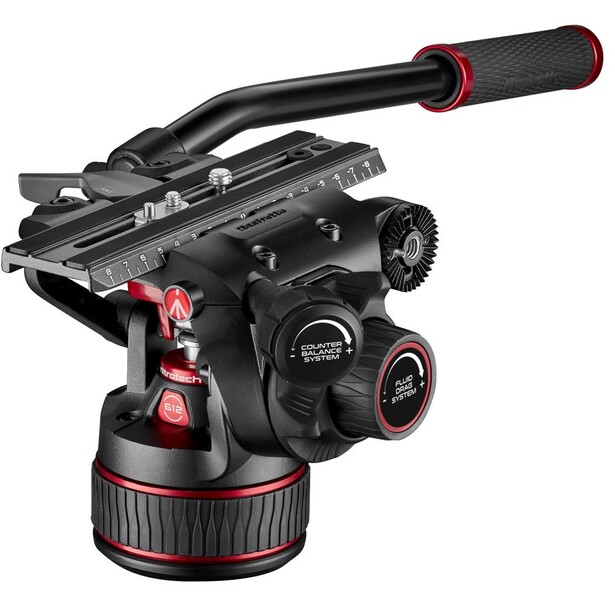
- Type: fluid video head with continuous nitrogen counterbalance
- Load rating: 39.7 lb (18 kg) safety payload
- Weight: 5 lb (2.27 kg)
- Height: 5.91 in (15 cm) working height
- Clamp: 504PLONGRL side-lock sliding plate (not Arca-type)
- Panning: 360 degrees with continuously variable fluid drag
- Price: $549 (B&H)
Photographers who start shooting video discover the problem in about four seconds: a ball head cannot pan. It rotates jerkily while the horizon tips, and the footage looks like security camera output. A fluid head fixes that with damped cartridges on both axes and a counterbalance system that holds the camera wherever you stop tilting. The Nitrotech 612 is the one we would put on a photographer's existing tripod, because it brings a professional counterbalance mechanism down to a price a stills shooter will pay.
The clever part is the nitrogen piston. Instead of the stepped counterbalance settings on cheaper heads, where your rig is always slightly too heavy for setting 3 and too light for setting 4, the 612 is continuously variable across a 4 to 12 kg (8.8 to 26.5 lb) range, so you dial it until the camera hangs motionless at any tilt angle. Manfrotto rates the head at an 18 kg (39.7 lb) safety payload and lists it at 2.27 kg with a flat 3/8-inch base, so it bolts straight to a photo tripod. We have not reviewed this head at Fstoppers.
The honest cost is weight and workflow. At 5 lb it is the heaviest head in this guide, and it will make a carbon travel tripod feel silly. Its 504PLONGRL sliding plate is not Arca-type, so a hybrid shooter ends up with two plate standards and a small pile of resentment, and the flat base means you get no bowl-style leveling and will be adjusting tripod legs to level the horizon. If you are shooting a mirrorless body and a small prime rather than a rigged cinema camera, the lighter Manfrotto MVH500AH gives you fluid drag at 0.9 kg with a fixed 2.4 kg counterbalance, which is enough for most hybrid work.
For a photographer whose video is turning into a real part of the business, this is the head that makes a pan look intentional. Check the current price of the Manfrotto Nitrotech 612 at B&H.
What We Like
- Continuously variable counterbalance from 4 to 12 kg, not stepped settings
- Smooth, judder-free fluid drag on both axes
- Flat 3/8-inch base bolts to an ordinary photo tripod
- 18 kg safety payload covers a fully rigged camera
What Could Be Better
- Heaviest head in this guide at 5 lb
- Proprietary sliding plate, not Arca-type
- Flat base gives no bowl leveling
- Overkill for a photographer shooting occasional clips
Best Panoramic Head: Nodal Ninja 6
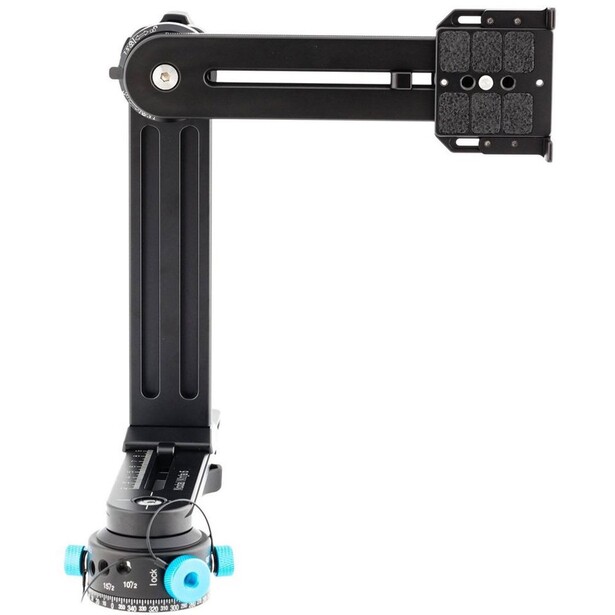
- Type: multi-row panoramic head with detented rotator
- Load rating: not published; rated for lenses up to 200mm equivalent
- Weight: 2.02 lb (920 g)
- Height: 190 mm vertical rail (200 mm lower rail)
- Clamp: Arca-compatible rails
- Panning: Advanced Rotator D10 (RD10) with 10 detent settings from 90 to 5 degrees, plus 7.5-degree detents on the upper rotator
- Price: $359.95 (B&H)
Stitching software has become good enough that most photographers think a pano head is obsolete. It is, right up until the moment you include something close to the camera. Rotate around the camera body rather than the lens' entrance pupil and the foreground shifts against the background between frames, and no amount of Lightroom fixes the parallax error that results. The Nodal Ninja 6 is the most practical way to buy a head that puts the rotation axis where it belongs.
Fanotec, the company behind Nodal Ninja, machines the NN6 from aluminum and ships it with the Advanced Rotator D10, which is the piece that makes the system worth owning. It offers 10 click-stop settings from 90 degrees down to 5, changeable in the field, so you set the detent to match your lens' angle of view and shoot a full row by feel without looking at a scale. The upper rotator adds 7.5-degree detents for the vertical rows. Rails are Arca-compatible, the starter package weighs 920 g, and Fanotec rates the system for lenses up to a 200mm equivalent with the camera in portrait orientation with the detent lock engaged. We have not tested this head, and its load capacity is not something Fanotec publishes, which is worth knowing before you hang a gripped body and a heavy zoom off it.
It is also fussy in ways a ball head is not. You must find and set the entrance pupil position for every lens you use, note the rail settings, and repeat the process when you change focal length on a zoom. The NN6 needs a level base under it, which usually means a leveling base or a head with top panning, and it is one more object in a bag that is already too heavy.
For real estate, virtual tours, gigapixel landscape work, or any panorama with a foreground, this is the difference between a stitch that works and one that almost works. Also consider the Really Right Stuff PG-02 MK2 if you want a single head that does multi-row panoramas and doubles as a gimbal for long lenses. Check the current price of the Nodal Ninja 6 at B&H, and if the stitching side is what intimidates you, The Complete Panoramic Stitching Workshop covers the software half of the job.
What We Like
- Field-changeable detents from 90 to 5 degrees on the D10 rotator
- Eliminates parallax error properly, including for close foregrounds
- Arca-compatible rails work with clamps you already own
- CNC-machined and hard-anodized, at 920 g for the full starter package
What Could Be Better
- Fanotec does not publish a load rating
- Requires calibrating the entrance pupil for every lens
- Needs a level base underneath it
- Slow to set up compared to any general-purpose head
Best Do-It-All Travel Head: Acratech GXP
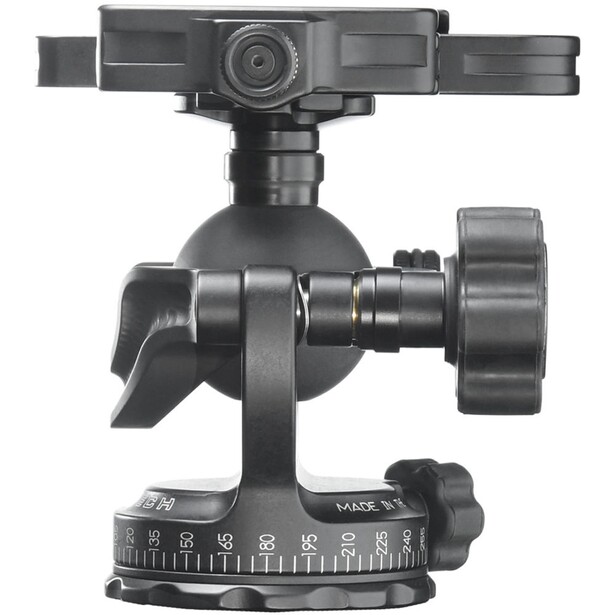
- Type: ball head that converts to a gimbal and a leveling panoramic head
- Load rating: 50 lb (22.6 kg)
- Weight: 1 lb (0.45 kg)
- Height: 4.2 in (106 mm)
- Clamp: Arca-type, knob or lever version, removable from its stem
- Panning: 360-degree base with independent pan lock
- Price: $559.95 (B&H)
Every other head in this guide does one job. The Acratech GXP does three, and it does them at 1 lb, which is the trick that makes it interesting to anyone carrying a kit up a mountain. Its Arca-type clamp lifts off its stem and remounts at the base of the head, and in that position the GXP becomes a gimbal for a lens with a tripod foot, rated for glass up to a 400mm f/4. Inverted, it works as a leveling panoramic head for single-row stitches.
Acratech machines it in California with the skeletal, open design the brand is known for, which exists for a practical reason as much as an aesthetic one: there is nowhere for sand, dust, or grit to collect, and you can rinse the head under a tap after a beach shoot. Acratech publishes a 50 lb (22.6 kg) load rating at 106 mm tall with a 38 mm ball, and backs it with a 10-year warranty. We have not run one through an Fstoppers review, so we cannot claim a field history of our own.
The compromises are real. As a gimbal it is a compromise gimbal, fine for a 400mm f/4 or a 100-400mm zoom and out of its depth with a 600mm f/4 that belongs on the Wimberley. As a pano head it handles single-row work only and cannot correct parallax for a close foreground the way the Nodal Ninja can. And it costs about as much as a very good dedicated ball head, so you are paying for the versatility whether you use it or not.
For a traveling photographer who shoots a bit of everything and refuses to carry three heads, nothing else in this guide comes close. Check the current price of the Acratech GXP at B&H.
What We Like
- Ball head, gimbal, and leveling pano head in one 1 lb package
- 50 lb load rating despite the weight
- Open design sheds sand and dust and rinses clean
- Made in the United States with a 10-year warranty
What Could Be Better
- Gimbal mode runs out of capability with the biggest telephotos
- Single-row panoramas only, with no parallax correction
- Priced like a premium dedicated ball head
- The skeletal look is divisive
How to Choose a Tripod Head
Start with the heaviest thing you will ever mount, then ignore the load rating printed on the box. Those numbers come from static laboratory tests and tell you almost nothing about how a head behaves with a long lens hanging off one side. A better rule: a 40 mm ball is the practical minimum for a full frame body with a 70-200mm f/2.8, a 50 mm or larger ball is what you want for anything bigger, and anything beyond a 400mm f/4 should be on a gimbal, whatever the rating claims.
Next, decide how you aim. If you find compositions by moving the camera until the frame looks right, buy a ball head, because speed is the whole point and everything else is friction. If you build compositions to a plan, straightening verticals and aligning edges by degrees, a geared head will save you time and temper even though it moves more slowly. Wildlife is its own answer: a gimbal, or nothing. Video is its own answer too, and a fluid head is the only one.
The spec that matters more than people think is the panning lock. A head that pans only by loosening the ball is a head that cannot shoot a level panorama, because the moment you rotate you also tilt. An independent panning base, and better still a panning clamp on top of the ball, lets you level the head once and then rotate through a sequence with the horizon fixed. Every ball head in this guide has one, which was a selection criterion rather than an accident.
The spec that matters less than people think is weight, within reason. Photographers agonize over 200 g in a head and then carry two lenses they never mount. What actually ruins a session is a head that creeps, and stiffness costs mass.
Finally, standardize on Arca-type. It is the closest thing photography has to a universal clamp, it is what L-brackets, lens feet, nodal rails, and leveling bases are built around, and it means a plate you buy today still works on a head you buy in five years. The one place you may have to break that rule is video, where sliding plates rule, and the annoyance of running two systems is the tax hybrid shooters pay.
What We're Looking For
Our picks weigh stiffness and creep resistance under real loads, the quality of the friction and locking controls, whether the head has an independent panning lock, clamp standardization, and how honestly the manufacturer's numbers hold up in real use. Every specification here was verified against the manufacturer's current spec page and cross-checked against a live retailer listing in July 2026. Where a maker publishes no figure at all, as Fanotec does with the Nodal Ninja 6's load capacity and Leofoto does with the GW-01's height, the entry says so instead of repeating a number a retailer invented. On testing, we are being straight with you: none of these nine heads has come through Fstoppers for a formal hands-on review, and each entry says so. Where the text describes how a head behaves, that comes from the manufacturer's published specification and the head's documented design. Most picks across our buying guides come from gear our writers have used and reviewed hands-on.
Frequently Asked Questions
Is an Expensive Tripod Head Actually Worth It?
Yes, more than an expensive tripod is. The head is where creep, sag, and vibration enter the system, and a good one holds the composition you set. The clearest upgrade is from a cheap head with no real friction control to any head with an independent tension knob and a panning lock. Past that, you are buying stiffness under heavy lenses.
What Is the Difference Between a Ball Head and a Geared Head?
A ball head moves freely in every direction at once and locks with a single knob, which makes it fast and imprecise. A geared head moves one axis at a time through worm gears, which makes it slow and extremely precise. Landscape and travel photographers generally want the first. Architecture and product photographers generally want the second.
Do I Need a Gimbal Head for a 100-400mm Lens?
Not necessarily. A 100-400mm zoom sits comfortably on a good 40 mm or larger ball head, or on a convertible head like the Acratech GXP. A gimbal becomes the right answer at around 500mm f/4 and above, where the lens is heavy enough that friction alone cannot hold it and tracking a moving subject by hand becomes exhausting.
What Does Arca-Swiss Compatible Mean?
It refers to the dovetail plate standard originated by Arca-Swiss and now used by nearly every serious head maker. A plate with the correct dovetail profile fits any Arca-type clamp, which means L-brackets, lens feet, and nodal rails are interchangeable across brands. Tolerances still vary, so a plate that fits loosely in one clamp may sit tight in another.
Can I Use a Ball Head for Video?
Only for static shots. A ball head has no fluid damping, so any pan or tilt you attempt while recording will look jerky and the horizon will drift. If you shoot locked-off interviews and product clips, a ball head is fine. If you want a pan to look deliberate, you need a fluid head such as the Manfrotto Nitrotech 612 or the lighter MVH500AH.
Fstoppers may earn a commission from purchases made through links in this article. Our picks are made independently by our editorial team.