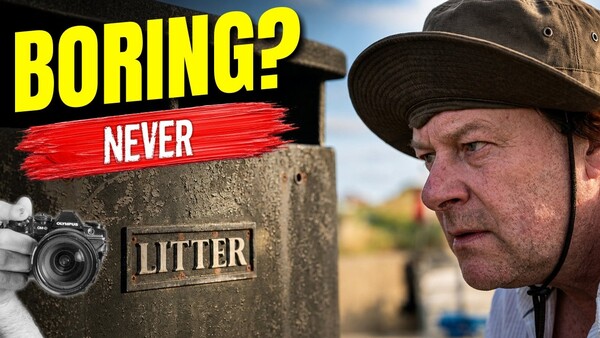
A litter bin by the beach with the front panel missing became a compelling black-and-white image, and the whole thing took a change of approach rather than a change of location. The idea runs through the entire session: the most mundane object can hold your attention if you photograph it the right way.
Andrew Banner works his way along a short stretch of Norfolk seafront, treating a bin, a bench, a footpath sign, and a post as legitimate subjects. He shoots the bin at around f/3.2, focusing on the word "litter" on the front and letting the rest of the scene fall soft, using the bin as a leading line into the frame. Banner leans on high-contrast black and white because it strips out color that adds nothing and leaves a punchier image. He also demonstrates something most guides skip: how your own shadow ruins a shot when the light sits directly behind you, and how a more acute angle toward the subject can hide it. The advice on shadows lands as awareness rather than avoidance, since the sun moves and clouds change everything mid-shoot.
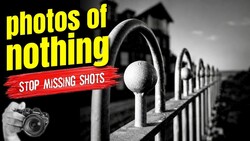
Benches get a lot of attention here, and for good reason. Banner shows four of them facing the sea and points out that a bench works as a leading line, a resting point, and a story all at once, whether it sits on a coastline or in a park. He shoots a post half-swallowed by marram grasses in high-contrast mono so the eye reads only the structure while the feathery seed heads set the scene behind it. A railing on the sea wall becomes a minimalist study of straight lines, shot with a Brandon Li polarizer to control the light. There's a practical color tip in there too, about how digital sensors carry two green channels in the Bayer filter and tend to push greens harder than the eye wants, which is why Banner dulls them down in processing.
The strongest thread to pull from this is the shift toward found photography as a discipline in its own right. Street furniture, vents, spy holes, and painted doors have become a recognizable corner of contemporary work, partly because instantly recognizable objects give a viewer a fast way in. When Banner photographs a spy hole in a red door, the image works on color contrast and shared memory, since almost everyone has stood at one. You can apply this anywhere: pick a single familiar object, place it against a plain or textured background that carries no competing detail, and let the recognition do the heavy lifting. A slow shutter around a half second over grasses adds motion that holds the eye a beat longer. None of this needs a coastline. A silver birch against a gray concrete wall carries the same juxtaposition in any city, and the principle travels to train stations, industrial estates, and housing blocks equally well.
Banner keeps returning to imagination as the real skill. Adults stop asking what happens if they get low, look up, or turn a corner they've already walked, and he argues that curiosity is the thing worth reclaiming. He makes a genuinely useful point about backtracking on a dead-end road, since walking a route in reverse hands you a fresh perspective and reveals subjects you missed the first time. That habit matters in woodland and it matters here. A lone plantain growing from a pavement, paired with a bare wall and the absence of anything else, turns into a small color image that holds together purely on simplicity.
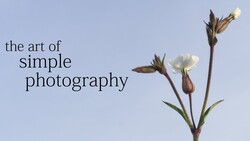
Take a look at the video above to see how Banner builds each of these shots and hear his full argument for finding pictures in the things you keep walking past.


Join the Fstoppers community for free
-
Post comments and join in the discussions
-
Browse the site ad-free
-
Share your work and get featured in the community
-
Compete in the photo contests for fun and prizes
No comments yet