
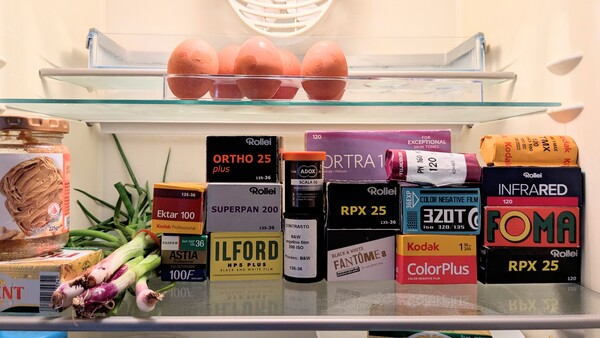
I know exactly where this starts: standing in front of the fridge, door open, chilly air spilling out, pretending I’m just “checking what I have” when I already know every box and canister by heart.
On the outside, it’s just a normal family fridge: milk, leftovers, a suspicious jar of pickles. But crack open the deli drawer and you hit the real nerve center of my photography: a chaotic, overstuffed archive of hope, anxiety, nostalgia, and way too many “special occasion” rolls that never seem to meet a special-enough occasion.
The Emotional Inventory of a Film Fridge—and Why So Many of Us Are Hoarding Film We’re Secretly Afraid to Shoot
The Top Shelf of “Someday”
If you pull open my drawer, the first thing you see is the “respectable” stuff: the film I don’t mind people knowing I have.
There’s a half-finished brick of Ilford HP5 Plus, a few rolls of Kodak Gold, and some random C-41 I grab for family outings. These are the workers. The “sure, why not” rolls. They’re not precious; they’re just film. They get shot, processed, scanned, posted, forgotten—no emotional drama.
But under that layer of comfort food, there’s a smaller row tucked tight against the back wall. That’s where things get weird.
Three rolls of Kodak Portra 400, still sealed, glaring at me like a gym membership I’m not using. A lone roll of CineStill 800T that absolutely deserves a neon city night, not the Walmart parking lot I keep offering it. A couple of Fujifilm Pro 400H I managed to snag before it vanished, now riding the line between “investment piece” and “expired mistake.”
These aren’t just emulsions. They’re expectations.
Every time I reach for one, I hear the little internal monologue:
“You can’t waste that on just anything. Save it for something important.”
Important becomes this elusive, mythical thing—some perfect trip, perfect light, perfect moment where my skills magically level up to match the price tag. And so, the rolls sit. Month after month. Year after year.
We tell ourselves we’re being practical. Really, we’re procrastinating—not on shooting, but on facing the possibility that the photos in our head might not match the film in our hand.
The Nostalgia Drawer
Slide the HP5 to the side, and you’ll find the real time capsule: the nostalgia rolls.
An expired roll of Fujichrome Velvia 50, 120 format, that I keep strictly for emotional pain. I bought it when I first got serious about medium format. In my mind, it was going to be the landscape roll: sunrise on a cliff, mist over mountains, something that deserved that Velvia look.
Instead, it’s been aging in my fridge like a rare wine I don’t know enough to drink.
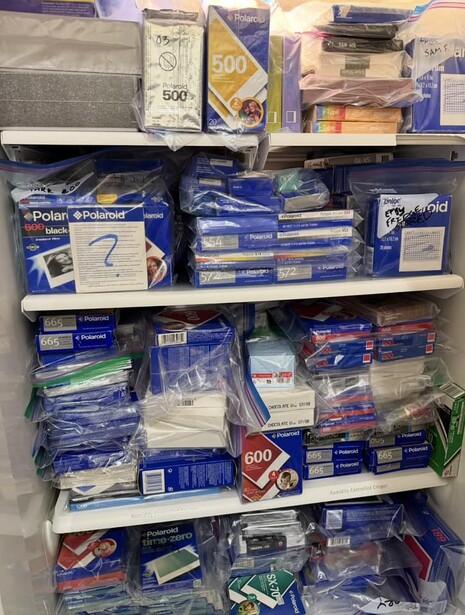
Next to it, there’s a pair of discontinued emulsions I grabbed in a mild panic when the “we’re shutting this down” announcements rolled through the internet. I didn’t particularly love them. I just felt like I should care—like I was buying a little slice of history I didn’t want to miss.
Some of this is scarcity, sure. Film stocks disappear all the time. Prices climb. We’ve all watched a $4 roll become a $17 roll and thought, “Okay, maybe I’ll just… ration this.”
But underneath the scarcity is something else: nostalgia for futures that never happened.
That Velvia roll is less about the film and more about the version of me I thought I’d be by now—the one who wakes up early, chases light, and shoots medium format landscapes like it’s nothing. The discontinued stocks are less about chemistry and more about belonging to a particular moment in film culture, a way of saying, “I was here when this mattered.”
We’re not just hoarding film. We’re hoarding the identities that came with it.
The “Perfect Project” Myth
In the very back, behind the everyday workhorses and the expired dream films, are the truly cursed objects: rolls I’ve explicitly promised I would only use “for a Serious Project.”
You probably have your own version of this.
For me, it’s a small stash of black-and-white I bought with a specific idea: a personal documentary series on my hometown. Gritty, honest, imperfect—full of quiet corners and peeling paint and the kind of faces you only see if you’ve stuck around long enough.
I wrote notes. I drafted shot lists. I made a folder on my hard drive with a title that sounded like a photo book I’d be proud to hand someone in ten years.
And then I did the most dangerous thing an artist can do: I started imagining the finished work instead of making the first messy attempt.
In my head, this project became perfect. In my fridge, those rolls became sacred. And once something is sacred, it becomes untouchable.
“Not today,” I’d think. “I’m tired. The light’s not right. I need more time to plan. I should wait until I upgrade my scanner. I should wait until I really know what I’m doing.”
The film didn’t just represent a project. It became a test.
If I shoot it badly, what does that say about my skills? My taste? My ability to do justice to the place I grew up?
So, I did what a lot of us do: I kept buying “casual” rolls to shoot instead, telling myself I was warming up, practicing, getting ready. Meanwhile, the “serious” film sat untouched.
Perfectionism loves this script. It tells us restraint is discipline, when really, it’s fear in a nice jacket.
The Fridge as a Mirror
If you’ve been shooting film for any length of time, your fridge (or shoebox or cabinet) is probably more honest about your emotional life than your Instagram.
That box of bulk-loaded Kodak Tri-X you tore through during the pandemic? That was your coping mechanism. The stack of color negatives you burned on family road trips? That’s your evidence that time is moving faster than you want to admit.
And the handful of “special” rolls you haven’t shot?
Those are the stories you’re still afraid to tell—or afraid you won’t tell well enough.
Sometimes it’s about money. Film is expensive. Processing is expensive. If you’ve got a limited budget, it makes total sense to hesitate before loading a $20 roll into a camera with unreliable shutter speeds and a light meter you don’t fully trust.
But a lot of the time, the cost is just a convenient shield. The real fear is that we’ll spend all that time and money and still end up with something… ordinary.
That Velvia 50 might render the sky beautifully and still be a boring composition. That CineStill 800T might give gorgeous halation to an image that doesn’t say anything. The “perfect project” rolls might come back from the lab and feel like a half-formed thought.
So, we keep them cold and safe, quietly convincing ourselves that potential is better than disappointment.
The Day I Finally Broke the Seal
This went on for years.
Then, one boring Tuesday, something shifted—not because I suddenly became brave, but because I opened the drawer for the hundredth time and realized I didn’t feel excitement anymore. Just… guilt.
The hoarded rolls weren’t inspiring me. They were nagging me.
I picked up that lone Velvia 50 in 120, turned it over in my hand, and realized I could name the exact year I bought it. I could also name the season in my life I’d just entered when I did: new job, new responsibilities, less time for those sunrise fantasies.
If I kept waiting for the “right” conditions, I was going to watch this thing die by increments of half a stop every year.
So, I stopped negotiating with my fear and made a much lower-stakes deal with myself:
You’re going to shoot this roll this week. Not on a mountain, not on a postcard vista, but in the actual place you live, with the actual time you have.
I loaded it into my medium format camera, tossed it in the passenger seat, and decided to just… go for a drive.
No grand plan. No grand statement. Just a short loop through the places that quietly define my days: the grain elevator at the edge of town, the half-empty strip mall, the river bridge that catches late evening light in a way that’s prettier than it has any right to be.
Was the light perfect? Of course not. It was fine.
Was my composition flawless? Definitely not. I made a few frames I knew were duds the second I hit the shutter.
But somewhere around frame seven, leaning against my car and watching the sky slide toward blue hour, I felt something I hadn’t felt in a long time:
Not the pressure to justify the film.
Just the pleasure of using it.
When the scans came back, they weren’t portfolio-defining masterpieces. But they were real. They existed. The Velvia wasn’t some theoretical future; it was a series of imperfect, saturated, slightly off-kilter photographs that reflected my life as it is, not as I wished it might be.
And that was enough.
Film Is for Using, Not Worshiping
That one roll broke the spell.
It didn’t cure my perfectionism overnight, but it did change the way I saw the drawer. Instead of a tiny shrine, it became what it was always supposed to be: a staging area.
Those “saved” rolls weren’t meant to spend their best years in climate-controlled limbo. Every emulsion, no matter how rare or expensive, is ultimately a disposable recording medium. Its entire purpose is to be changed by light, chemistry, and whatever chaos you aim it at.
If we never let it do that, we’re not protecting it. We’re wasting it.
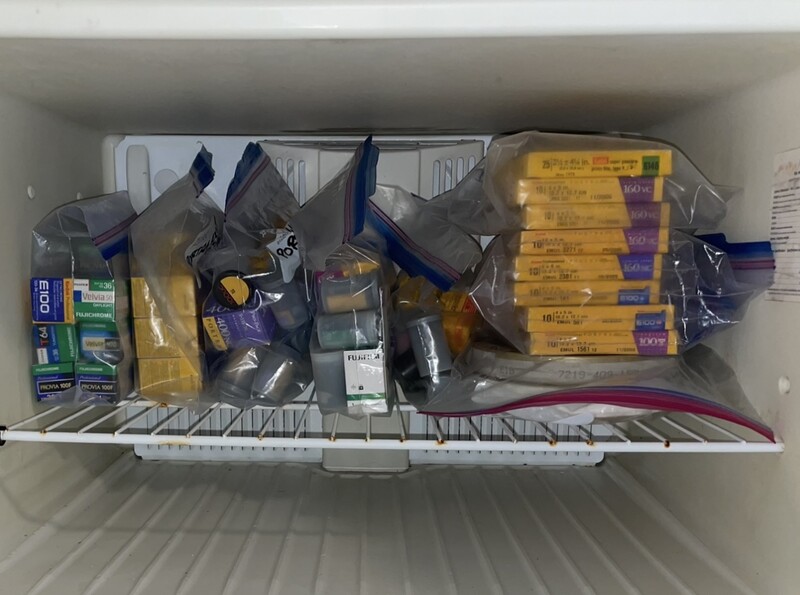
Yes, some film stocks are gone for good. Yes, prices are climbing. Yes, there are rolls in my fridge I may never be able to replace.
But holding onto them forever doesn’t make me a better photographer. It just makes me a more anxious collector.
The images that matter most to me now are rarely the ones where I matched a legendary stock to a perfectly pre-visualized scene. They’re the ones where I got over myself long enough to actually press the shutter on the thing in front of me, with whatever film happened to be loaded.
The magic was never in the box. It was in the moment that I was too scared to risk it.
Your Turn: The Hoarded Roll Challenge
Here’s my challenge to you.
Sometime this week, go stand in front of your own film stash. Open the fridge, the shoebox, the drawer, the Tupperware container you keep under your bed so your partner doesn’t know how bad it’s gotten.
Find one roll you’ve been saving.
Not the cheap stuff you blast through on a Sunday. The roll you keep saying you’re not “ready” for. The last of a discontinued stock. The film you swore you’d only use on a trip you still haven’t booked. The one that makes you hesitate when your hand gets close.
Pick it up. Acknowledge the little story you’ve attached to it: the version of you it represents, the project it was supposed to serve, the fear that’s kept it wrapped in plastic instead of light.
Then load it anyway.
Don’t wait for the perfect day. Give it a remarkably simple assignment: document your real life in the next seven days. Your town. Your commute. Your family. The place where you get coffee. The corner you always walk by but never photograph.
Shoot the whole roll. Send it off. Scan it. Look at what’s there, not what you hoped it would be.
Will every frame be incredible? Absolutely not. But some might surprise you. And even if they don’t, you’ll have turned a source of quiet anxiety into a finished, tangible record of your life.
That, to me, is the actual point of film photography in 2025 and beyond: not building a freezer full of potential, but spending it—roll by roll, frame by frame—on the messy, imperfect reality we’re living right now.
The emotional inventory of your film fridge doesn’t have to be a list of what you’re too scared to touch.
It can be a record of everything you were brave enough to shoot.
Lead image taken by Sroyon Mukherjee. The photos in the body belong to Nick Woltersdorf.




Join the Fstoppers community for free
-
Post comments and join in the discussions
-
Browse the site ad-free
-
Share your work and get featured in the community
-
Compete in the photo contests for fun and prizes
No comments yet