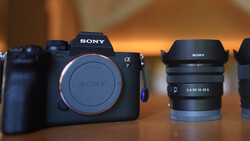
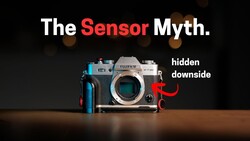
Full frame cameras dominate headlines, but APS-C models are quietly outselling them by a wide margin. Shipments in 2025 show a gap that challenges the idea that bigger sensors are the obvious end goal.
Coming to you from Arthur R, this data-driven video looks at current CIPA shipment numbers and forces a hard question: if full frame is the upgrade everyone talks about, why are smaller sensor cameras moving nearly twice as many units? In 2025, APS-C and Micro Four Thirds bodies shipped around 4,450,000 units, while full frame and larger formats shipped about 2,540,000. That is not a small edge. It is roughly 75% more units going to smaller formats. Yet scroll through YouTube and you would think the opposite is happening.
Arthur points out the disconnect between revenue and unit sales. Full frame bodies cost more. Lenses cost more. Even if fewer people buy them, companies still make more money per sale. That revenue focus shapes marketing and release cycles. You see frequent launches of high-end bodies while APS-C updates arrive less often. If four full frame cameras drop in a year and one APS-C body appears every few years, coverage follows the money. That creates the impression that everyone is “graduating” to full frame, even when sales data says most are not.
Look at current bestsellers and the pattern continues. Cameras like the Canon EOS R50, Sony a6700, Sony ZV-E10, and Fujifilm X-T5 continue to rank high at major retailers. These are not stripped-down toys. Many offer 4K video up to 120 fps, 10-bit recording, log profiles, in-body stabilization, and advanced autofocus. Feature gaps that once separated APS-C from full frame have narrowed to the point where, in day-to-day use, the difference is small.
Cost shifts the equation fast. APS-C bodies are often close to half the price of their full frame equivalents. Lenses can be half or even a third of the cost. Build a complete kit with two or three lenses for the price of one high-end full frame zoom. That changes how often the camera leaves your bag. Smaller bodies weigh less. They draw less attention. You worry less about damage or theft. Lower friction leads to more frequent use.
None of this cancels the strengths of full frame. If low light performance is critical, or large commercial prints are routine, the extra sensor area helps. If client perception plays a role, gear choice can influence that dynamic. There are situations where every bit of dynamic range and resolution counts. Those cases exist, and Arthur acknowledges them without dismissing the format.
The more interesting theme is psychological. The pressure to upgrade often has less to do with files and more to do with status. The idea that full frame equals “serious” lingers. That narrative affects buying decisions more than spec sheets. When most people are choosing APS-C with their wallets, it is worth questioning where that pressure comes from and whether it reflects real needs.
If you are weighing a switch, the numbers alone may shift your thinking. Check out the video above for the full rundown from Arthur.




Join the Fstoppers community for free
-
Post comments and join in the discussions
-
Browse the site ad-free
-
Share your work and get featured in the community
-
Compete in the photo contests for fun and prizes
6 Comments
Full frame sales differences will always happen since that mirrors every other industry.
For PC, high end video cards are awesome, yet the vast majority of the market are Nvidia xx60 series, and Radeon xx60 series.
Everyone in 2026, wants an RTX 5090, even when they end up purchasing an RTX 5060 or RTX 5070.
Aside from that, with the price gouging on full frame, it also opens the door for medium format.
The bigger issue is that the industry is ruining their own business. Rather than focusing on bringing in new people into their ecosystem, they are instead focused on trying to sell new cameras to existing ILC camera owners.
There is currently nothing to really bridge the gap between the smartphone camera and dedicated camera industry.
In the past, people could get a new entry level DSLR with a kit lens for about $400 (sometimes even less on sale at stores like costco). Furthermore at lower price point, users could get a range of point and shoot cameras, which at the time offered more manual controls, and a variable optical zoom.
This overall meant that there were stepping stones to ease people into the ILC camera ecosystem. and the entry costs were lower, thus lower risk investments.
These days, what the average user sees is a smartphone camera, and if they want to step beyond the smartphone camera, they are stuck spending over $1000 for an ILC camera and a kit lens. There isn't really even much in between because that same industry also to make 1 inch sensor point and shoot cameras cost well over $1000.
To the average basic user, these jumps are far too large to risk such an investment, especially since this new pricey entry point actually has the largest number of unknowns in the dedicated camera segment.
When it comes to the fruits of the pressing of the shutter button, what those users see is either smartphone camera images, or ILC camera images taken with a $5000+ camera body, and a $2000+ lens. They are simply unlikely to ever encounter content from class of cameras that would be seen at the new entry point into the ILC camera ecosystem.
This ultimately means, that someone who shows an interest in moving beyond the smartphone camera, will immediately get sticker shock and decide that the smartphone camera is probably good enough. Especially when the entry point is largely unknown to them, since their exposure to the ecosystems mainly just the top of the line stuff.
Imagine if other industries did what the ILC camera industry did. For example, get rid of all of the lower cost microphones, and leave people with either the mic built into a laptop (or equivalent), or an entry point that is the equivalent of (and priced as such) Neumann TLM 103 ($1200 mic) with pricing going up from there.
Then after that, start complaining that the podcasting industry because new people aren't entering as often anymore so it is dying out and that microphone sales are also plummeting.
If the jump after the mic in your basic laptop, was a $1200 mic, how many people would take a second look at their laptop's built in mic and decide "I guess it's good enough, I will just stick to zoom conference calls for work, and leave everything else to the pros with deep pockets"?
I'm not negating anything you said, however people love their phones and they want the latest and greatest and they're constantly upgrading their phones at a cost with better cameras. So why spend more money on "minor" improvements?
Spot on Naruto. Camera manufacturers have decided to cater to the elite market rather than working to make photography more accessible to the general market. It's a shame.
Hobbyists and amateurs outnumber professionals in any area. Measuring technical superiority by sales numbers is silly. Toyota sells more cars than Porsche. Does that mean the Camry is better than a 911?
Hi, I use full frame lenses and cameras because of a simple reason: When I started photography, APS-C simply did not exist and I kept all my gear, only changing the camera bodies when a new technologie was really nessessary. I often use wideangle and during the first digital years between 1998 and around 2005 it was nearly impossible to get a good wideangle for my APS-C and APS-H bodies. Thats all. And as a daily photographer for news I need cameras that work in rainy conditions, in cold and heat. The full frame bodies are more reliable. I do have a mirrorless camera too, but it is also full frame.
Of course low-end cameras are going to outsell high-end cameras. Of course click-bait is geared to the high-end cameras, The same is true with cars.
The strange thing is how many amateur-level egos are still being driven by 35mm-sensor GAS—all to share photos online. There is no rational economic man/woman!!