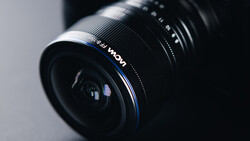
Fisheye lenses for medium format have been close to nonexistent, so if you shoot a Fujifilm GFX or Hasselblad body and want that look, you've usually had to adapt glass that doesn't cover the sensor properly. AstrHori's new 8mm fisheye goes after that gap with a circular image and a field of view wider than a full hemisphere.
A lens that sees 220 degrees will photograph your own knuckles if you hold the camera the usual way, and your feet if you tilt it even slightly down. Keith Cooper ran into both while walking around Leicester with the AstrHori 8mm f/2.4 Circular Fisheye mounted on a Fujifilm GFX100S, and he kept several of those frames in as honest examples. On a tripod, the legs creep into the shot just as easily. On the GFX's 44 x 33mm sensor, the circular image just fits the height of the frame, which works out to just under 60 megapixels of actual image data inside the circle. The lens also comes in Hasselblad's XCD mount, though AstrHori notes a slight crop at the top and bottom of the circle on that version. It's an all-metal manual lens at 517 g, with a front element that bulges out far enough that the cap should stay on whenever you're not shooting.
Nothing on the lens talks to the camera. There are no electronics, so the body doesn't know a lens is attached, the EXIF data won't record aperture, and in-body stabilization has little to work with beyond whatever focal length you enter by hand. Cooper's advice is to write your settings down if you plan to stitch, since the file won't tell you later. He shot most of his samples handheld anyway and had no trouble at 8mm. Focusing is easier than you might expect: at f/8 with the lens set to infinity, everything from about a foot away to the horizon is sharp, so he treats f/8 as the general working aperture. The 0.1 m minimum focus distance puts subjects about an inch from the glass, close enough to touch the front element by accident, and at f/11 or f/16, any dust sitting on it starts to appear in frames.
Lenses that see past 180 degrees aren't new, but they've always been rare. Nikon's 6mm f/2.8 Fisheye-Nikkor from the early 1970s covered 220 degrees on 35mm film and weighed more than 5 kg, and it was built mostly for scientific and industrial work. Most of the modern lenses with that kind of coverage have been small optics for small sensors, aimed at VR rigs and specialty capture. Medium format shooters have had a thinner menu. Fujifilm's GF lineup has never included a fisheye, and adapted full frame options like the Canon EF 8-15mm f/4L Fisheye USM throw a circle that leaves much of the larger sensor dark. Chinese makers such as Laowa and AstrHori have spent the last several years filling exactly these kinds of gaps with manual lenses the major brands don't see enough demand to build. If you shoot interiors for VR, the extra 40 degrees pays off directly: each frame overlaps the one facing the opposite way, so a full sphere can come from two exposures instead of four or six. Cooper's caveat is that the overlap zones are also where your tripod and camera mount show up.
The geometry takes some getting used to. Any straight line running through the center of the frame stays straight from edge to edge, and Cooper uses that as a compositional anchor, lining up a tree trunk so it stays dead straight while the buildings around it bow outward. Circles in a scene behave a little differently than they would with a 180-degree fisheye, because the projection changes once coverage goes past a hemisphere. Tilting the camera up bends architecture hard, and people near the edges get squeezed in ways that are interesting rather than flattering. Around the rim of the circle, bright scenes can leave a faint blue glow, which he routinely cleans up with a circular crop that gives the image a crisp black border. Getting close to a hot cup of coffee taught him one more lesson when steam condensed on the front element mid-shot.
Cooper's two-shot 360-degree stitch of his office is in the video above.
Join the Fstoppers community for free
-
Post comments and join in the discussions
-
Browse the site ad-free
-
Share your work and get featured in the community
-
Compete in the photo contests for fun and prizes
No comments yet