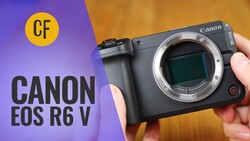
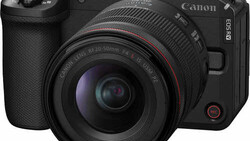
Canon now sells two compact full frame video cameras built around the same 32.5-megapixel 7K sensor, and $1,200 to $1,400 separates them, depending on whether the C50 is on sale. When the image coming off that sensor is nearly identical, your decision rests on heat, audio, stabilization, and how each camera behaves on an actual job.
Both bodies shoot 3:2 open gate, record raw internally, and deliver oversampled 4K up to 60 fps along with 4K at 120 fps. Josh Sattin puts the Canon EOS C50 and Canon EOS R6 V side by side with the same lens and the same settings, and the Canon Log 2 footage is close enough that a grade built for one carries over to the other with only small differences. The one fix he makes is white balance, since the daylight preset sits around 5,200 K on the R6 V and 5,600 K on the C50. If you plan to run them as A and B cameras, mismatched presets will throw off a quick match long before the sensors do. Dynamic range is where a gap shows up. In a window test exposed for the highlights, then pushed hard in the shadows and viewed at 200%, the C50 holds slightly more shadow detail, in raw and in the compressed codecs alike. The margin is small, and you'll only see it when you're pulling detail out of a deliberately dark frame.
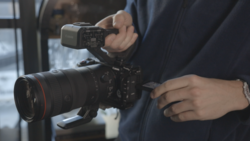
High ISO behavior is closer than the spec sheets suggest. The C50 officially has dual base ISOs of 800 and 6,400 in Canon Log 2 and raw, while Canon doesn't list a second base ISO for any of its mirrorless bodies. Sattin's lens cap test, shot in raw and brightened to reveal the noise pattern, shows the R6 V cleaning up at the jump from ISO 5,000 to 6,400, just like the C50. Audio splits the two more clearly. The C50 ships with a top handle carrying XLR inputs, simple level controls, a record button, a lock, a zoom rocker, a cold shoe, a switchable tally light, and extra mounting points, and it locks firmly to the body without a cage. On the R6 V, you'd add the Tascam CA-XLR2d-C, which passes audio through the hot shoe and sounds great, though Sattin finds its single shoe mount less sturdy than the C50's handle.
Canon has steadily added bodies without a viewfinder, from the EOS R50 V to these two, and the EOS R6 Mark III sits alongside them with a 32.5-megapixel sensor plus the EVF and mechanical shutter that stills shooters expect. Sony went down a similar road with the FX3, and Nikon followed with the ZR, each dropping the viewfinder in favor of a body shaped for rigs, gimbals, and monitors. Once the sensor stops being the deciding factor, you're really choosing an operating system, a cooling design, and an accessory ecosystem. The ISO result also points to a test you can run on any camera you own. Shoot a lens cap frame at each ISO step in raw, lift the exposure in post, and look for the step where the noise suddenly drops. Manufacturers don't always publish a second base ISO on hybrid bodies, and finding it yourself can show you that ISO 6,400 is a cleaner setting than 5,000 in a dim venue.
Heat is the other clear divide. Canon publishes recording limits in its specifications, and Sattin has found those figures accurate across years of his own testing. Rated at 73 degrees Fahrenheit, the R6 V can record raw at 60 fps and oversampled 4K at 60 fps for 120 minutes or longer, while oversampled 4K at 30 fps, 4K at 120 fps, and the non-oversampled modes carry no stated limit. Any mode with a listed limit will shrink in summer heat and humidity, which Sattin deals with much of the year in North Carolina. He expects oversampled 4K at 24 and 30 fps to stay safe, so the risk concentrates on higher frame rates and raw outdoors. The C50's thicker body houses a more serious cooling system, and none of Canon's cinema cameras have shut down on him, even in punishing conditions.
Sattin's take on stabilization, timecode, and more is in the video above.



Join the Fstoppers community for free
-
Post comments and join in the discussions
-
Browse the site ad-free
-
Share your work and get featured in the community
-
Compete in the photo contests for fun and prizes
No comments yet