

Buy a Canon EOS R7 this afternoon, and the manual will tell you that you can register up to six LP-E6P, LP-E6NH, LP-E6N, or LP-E6 battery packs to it. That last one is the cell Canon put on sale in the EOS 5D Mark II in November 2008, nearly ten years before the RF mount existed. A battery bought for a DSLR still runs a mirrorless camera you can order new today, and that continuity almost never appears as a line in a camera review.
Four Batteries, One Shell
Canon has revised the LP-E6 three times in nearly 18 years, and never once changed the shape. The original arrived with the EOS 5D Mark II at 1,800 mAh, and Canon's own camera museum credits it with 1.3 times the capacity of the pack it replaced. The LP-E6N followed in 2014 with the EOS 7D Mark II at 1,865 mAh. The LP-E6NH landed in July 2020 alongside the EOS R5 and R6, and Canon's product copy describes it as the same size as the LP-E6N with a larger 2,130 mAh capacity. The LP-E6P arrived with the EOS R5 Mark II in July 2024 at that same 2,130 mAh, and Canon says the difference is a maximum continuous discharge current of 6 A rather than any gain in stored energy.
Total capacity growth across the entire lineage works out to about 18 percent. Set that beside what happened to sensors, processors, and autofocus over the same span, and it looks like neglect until you notice it is the whole benefit. Canon spent nearly 18 years engineering around a fixed envelope instead of redesigning the envelope. The same LC-E6 and LC-E6E chargers still work. The same battery door still closes. The BG-R10 grip built for the 2020 EOS R5 still mounts on the R5 Mark II.
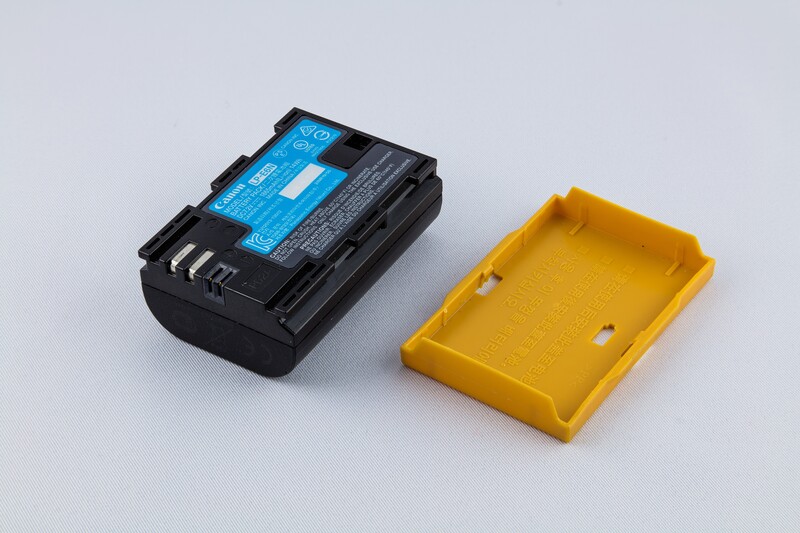
The format got entrenched enough that other companies built around it. Blackmagic Design's Pocket Cinema Camera 4K lists its battery type as Canon LP-E6 on Blackmagic's own tech specs page, which is a competitor deciding that Canon's 2008 cell was the closest thing the industry had to a standard. Third-party makers now sell LP-E6NH-shaped packs with USB-C ports built into the shell, because the shell is worth designing for.
Nikon Has Done Nearly the Same Thing Since 2010
The version of this story that circulates in forums treats battery continuity as a specifically Canon virtue, the one place a company famous for withholding features quietly does right by its customers. That framing does not survive contact with Nikon's catalog. Nikon announced the D7000 on September 15, 2010 with a new EN-EL15 rated for about 1,050 shots per charge, and that battery, revised three times since, is still the pack Nikon lists today.
Nikon's compatibility notice for the current EN-EL15c names the D850, D810, D780, D750, D610, D500, D7500, and D7200 in the same breath as the Z8, Z7II, Z7, Z6III, Z6II, Z6, Z5II, Z5, and Zf. That is one battery spanning F-mount DSLRs and Z-mount mirrorless bodies, from a 2013 enthusiast DSLR to a stacked-sensor flagship, out of the same charger. Canon's lineage crosses EF to RF; Nikon's crosses F to Z. Neither company is doing something the other one isn't.

So the honest claim is not that Canon is singular. It is that two of the three largest camera makers have held a battery form factor for roughly a decade and a half, that Pentax has done the same with the D-LI90 since the 2009 K-7, and that the companies that broke their form factor sent the bill to their customers. That is worth more to a working photographer than several specifications that get far more attention.
The Restrictions Are Real, and Both Companies Publish Them
Continuity is not a guarantee, and the caveats have gotten sharper in the last two years. Canon's EOS R5 Mark II manual carries a compatibility table that grades every power source as fully functional, partially functional, or not compatible. The original LP-E6 gets a cross in every column, with a footnote saying it cannot be used as a power source. The run that started in 2008 ended there.
The LP-E6NH and LP-E6N fare better, but they land in the middle tier. Canon's footnote spells out what you lose: network connectivity over Wi-Fi and wired LAN, the 8K DCI and 8K UHD movie sizes, the raw and SRAW recording sizes, Fine image quality, the 239.76, 200.00, 119.88, 100.00, 59.94, and 50.00 fps frame rates, HDMI raw output, still photos during movie recording, High Frame Rate movies, and pre-continuous shooting. Continuous shooting slows down. You also cannot draw the pack all the way down.
At launch, that list also included 24p, which is the frame rate most narrative and commercial work is delivered in, and the backlash was immediate. Canon walked it back in firmware version 1.0.2, released in December 2024, whose release notes state that it "Incorporates support for frame rates of 23.98fps/24.00fps when using the LP-E6NH and LP-E6N battery." Part of the fence was engineering. Part of it turned out to be reversible in software.
The engineering constraint underneath all of this is real. A stacked sensor read out at full speed, an 8K encode, a network stack, and an accessory shoe feeding power to an external device all pull current at the same time, and current draw is where the LP-E6P differs from everything before it. Canon's specification for the pack is 2,130 mAh and 6 A, the same stored energy as an LP-E6NH with a far higher ceiling on how fast that energy can leave. The R5 Mark II's Cooling Fan CF-R20EP is one of the casualties: install an LP-E6NH or LP-E6N, and Canon's table says the fan cannot be used. Canon has not lifted that restriction in firmware the way it lifted the frame rates. Two accessories drop off the list altogether: the older DR-E6 DC Coupler, and the WFT-R10 wireless file transmitter.
The EOS R6 Mark III, announced in November 2025, repeats the pattern. Its table marks the original LP-E6 as not compatible across the board. The LP-E6NH and LP-E6N are partially functional: no Wi-Fi, slower continuous shooting, and no access to the last of the charge. Canon's advice, printed in the manual, is to use the LP-E6P.
Nikon's version of this is milder, and it works the same way. The reference guides for the Z8 and the Z6III list the EN-EL15c, EN-EL15b, and EN-EL15a as usable, with the note that the older two yield fewer frames per charge. The original no-suffix EN-EL15 from 2010 does not appear on those lists. Charging has its own fence: Nikon says the EH-7P and EH-8P adapters handle only the EN-EL15c and EN-EL15b, that portable chargers work only with those same two, and that an EN-EL15a needs an MH-25a charger.
What both companies are actually offering is a ratchet rather than a promise. Old cells keep working until a new body's power draw outruns them, then they get demoted to a restricted tier, then they fall off the compatibility list. Sixteen or seventeen years of that is still an enormous amount of value, and it is not the same thing as forever.
What a Form-Factor Change Actually Costs
Sony's NP-FW50 powered the NEX line and the first two generations of a7 bodies. The NP-FZ100 arrived with the a9 in 2017 and became the standard from the a7 III onward, and it is a genuinely better battery, holding 2,280 mAh against the NP-FW50's 1,020 mAh. It is also a completely different shape. An a7 II owner who upgraded to an a7 III in 2018 replaced every spare and every charger on the same day they bought the camera. Sony did keep the NP-FW50 running in its APS-C bodies as late as the 2021 ZV-E10, so that half of the catalog was spared, but the full frame move offered no bridge.
Fujifilm did the same thing in 2020, introducing the NP-W235 with the X-T4 at what Fujifilm describes as 1.5 times the capacity of an NP-W126S. Fujifilm's compatibility list for the NP-W235 now runs through the X-T5, X-H2, X-H2S, X-S20, and the GFX bodies. None of that reaches back to an X-T3 owner's drawer.
Put a number on it. Canon lists the LP-E6P at $79.99. Four spares come to $319.96 before you add a second charger, and four is a modest count for anyone shooting a full wedding day, a two-camera event, or cold-weather work where a pack gives up half its runtime by mid-afternoon. It is not unusual for a photographer a decade into a career to have eight cells in rotation, several of them bought for bodies long since sold. Carried forward instead of rebought, eight packs is $639.92 you did not spend, which buys a decent lens. Anyone thinking seriously about the business side of photography already tracks depreciation on bodies and glass, and consumables get left out of that math even though they are the part you buy over and over.

There is a disposal side to this too. A camera battery is a sealed lithium-ion cell with a control board in it, so it cannot go in household recycling or the household bin; it has to reach a battery-recycling or hazardous-waste collection point. A form-factor change does not send those packs straight there, though. They keep working in the bodies they were bought for, and there is a real if unglamorous secondhand market for them. What a change does is cut what they are worth and shrink the set of cameras that will take them, which is the same pressure that sends a half-cycled cell to a drawer and eventually to a recycler. Continuity is the rare case where the environmentally better outcome and the cheaper one for the buyer are the same outcome.
The convenience is harder to price and probably matters more. When a body dies at a reception and you reach into a pocket without looking, a single form factor across your whole kit is the difference between a two-second swap and a missed moment. Rental houses feel the same thing at scale, which is part of why a long-lived cell keeps showing up in third-party accessories and dummy-battery adapters years after the camera it launched with left the catalog.
Put It on the Spec Sheet
Reviews cover sensor readout, autofocus subject detection, burst rate, codec support, and port selection. The battery designation shows up in the spec dump at the bottom and rarely gets a sentence of judgment attached to it. That is a gap, because the question a buyer actually faces is not how many shots the CIPA rating promises. It is whether the cell in the new body is the cell already in the drawer, and whether this manufacturer has changed the shape within the last ten years.
The place to check is the manual, not the marketing page. Canon publishes a power-accessory compatibility table in the front matter of its recent EOS manuals, with circles, triangles, and crosses and a numbered footnote for every restriction. Nikon publishes a compatible-accessories page in every reference guide. Both are free, both are searchable, and both are more honest about what an older battery will and will not do than any announcement post. Reading one takes about a minute.
Canon's table for the EOS R6 Mark III gives the LP-E6 row a straight line of crosses. That is a 2008 battery being formally retired in a 2025 camera's own documentation, and the LP-E6NH row above it still gets triangles. Nearly 18 years in, the argument for the format is not that nothing changed. It is that Canon had to print the table at all, because there was still something in your drawer worth checking.
Lead image by norio nakayama, CC BY-SA 2.0. Source.





Join the Fstoppers community for free
-
Post comments and join in the discussions
-
Browse the site ad-free
-
Share your work and get featured in the community
-
Compete in the photo contests for fun and prizes
No comments yet