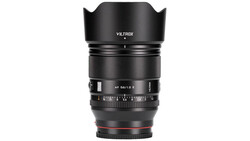
If you shoot Fujifilm and want the classic 85mm-equivalent portrait look at f/1.2, you have two serious, fully weather-sealed choices, and at B&H, one costs about half as much as the other. The Fujifilm XF 56mm f/1.2 R WR and the Viltrox AF 56mm f/1.2 Pro cover one of the most-used focal lengths in the system, and the gaps between them are smaller and odder than a spec sheet suggests.
Both lenses use metal bodies, full weather-sealing, and an aperture ring, which puts them in the same tier on paper. Pit Haupert has shot the Fujifilm XF 56mm f/1.2 R WR for a couple of years and the Viltrox AF 56mm f/1.2 Pro XF for several months, and he finds the build differences come down to details. The Fujifilm has a lock that keeps the ring from sliding past f/16 into the A position. The Viltrox lets it roll there with no added resistance, though Haupert rarely stops down that far and doesn't treat it as a deal breaker. His bigger gripe covers both brands: the Fujifilm's clicks are firm but hollow, the Viltrox's are softer and easier to bump, and each company's lineup varies from one lens to the next. The Viltrox also gets a custom button and a click/declick switch on its Sony E and Nikon Z versions, and Haupert questions why the declick option disappeared on X mount.
Haupert shoots street scenes and skips test charts, so his optical notes come from real frames. Wide open at f/1.2, both lenses are very sharp. His Fujifilm copy is slightly more consistent, though you'd only see it in a crop far beyond anything you'd print, and once you stop down, the Viltrox may edge ahead. Bokeh is lovely on both, with the Fujifilm rendering out-of-focus areas a touch softer. Neither showed chromatic aberration in his shooting. Flare is where a gap opens. With the sun in the frame, the Viltrox produces a more washed-out image and can throw the red ring artifacts the Pro series is known for, although he had to hunt for the angle that triggers them.
Fujifilm's original XF 56mm f/1.2 R arrived in 2014 and stayed the default premium choice at this focal length for years. Third-party X mount options back then were mostly cheaper, often manual focus, and rarely built to the same standard. That changed after Fujifilm opened its mount to licensed autofocus lenses from Tamron and Sigma around 2021 and 2022. At the same time, Viltrox moved upmarket with its Pro line, offering metal bodies, sealing, and f/1.2 apertures below Fujifilm's prices. A first-party lens now carries a premium mostly for integration with the camera, while a third-party lens can change after launch through firmware. Reviews written in a lens' first weeks can age quickly, so check which firmware a tester used and update your own copy before judging focus.
Handling separates the two more than the optics do. The Viltrox is heavier and a bit longer, which makes it front-heavy on the body. The shorter Fujifilm balances better, and over a few hours of carrying, that adds up. For autofocus, Viltrox uses twin linear motors that focus almost instantly and quietly. Fujifilm relies on an older DC coreless motor that is louder, hunts a little more, and isn't as quick. Haupert tests in single-point AF-C to keep Fujifilm's face and eye detection out of the results. He argues that the motor alone doesn't settle anything: Fujifilm designs its lenses alongside its own focus algorithms, while Viltrox has to reverse engineer them. In his shooting, the Fujifilm was slightly more consistent, and he got a few more missed frames on the Viltrox. He also finds an unexpected use for the Fujifilm motor's vibration, treating it as a physical cue that focus has landed. The Viltrox's launch firmware focused poorly, and an update improved it a great deal.
Haupert's pick between the two is in the video above.


Join the Fstoppers community for free
-
Post comments and join in the discussions
-
Browse the site ad-free
-
Share your work and get featured in the community
-
Compete in the photo contests for fun and prizes
No comments yet