
Sigma has announced the Sigma 85mm F1.2 DG | Art, a new large-aperture portrait prime for full frame mirrorless cameras. The lens will be offered in L-Mount and Sony E-mount versions, with a planned launch on October 6, 2026, at a suggested retail price of $1,599.
The 85mm is Sigma's third f/1.2 prime designed for mirrorless systems, joining its 35mm and 50mm options. Its combination of an 85mm focal length and f/1.2 maximum aperture places a clear emphasis on portraiture and other applications where subject isolation and low-light performance are priorities.
Sigma is also putting considerable emphasis on size and weight. The L-Mount version weighs 905 g, and Sigma describes the lens as the smallest and lightest autofocus 85mm f/1.2 lens for full frame mirrorless cameras as of September 2026. That is noteworthy for a lens in a category that has traditionally required photographers to accept substantial size and weight in exchange for an f/1.2 aperture.
Optical Design and Rendering
Sigma says the optical design uses two SLD glass elements along with glass featuring high anomalous dispersion. These elements are intended to reduce axial chromatic aberration, an issue that can become particularly visible with fast lenses when they are used near their maximum aperture.
Aspherical elements are also used to address spherical aberration and sagittal coma flare. Sigma says the lens is designed to maintain high resolving power at f/1.2 rather than requiring the photographer to stop down substantially for improved sharpness.
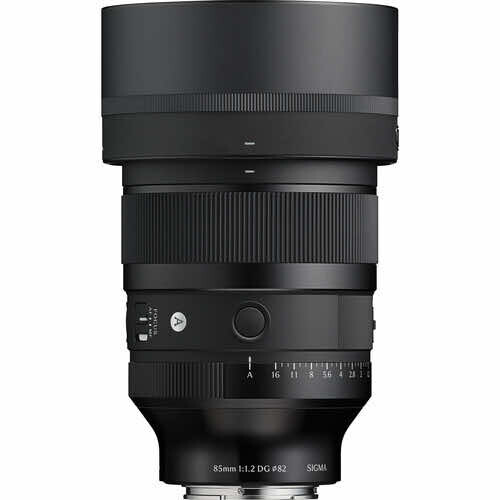
The diaphragm uses 13 blades. Combined with the f/1.2 maximum aperture and 85mm focal length, that design is intended to maintain relatively circular out-of-focus highlights even as the aperture is stopped down. Sigma also says the optical design has been developed to reduce color bleeding and double-line structures in out-of-focus areas.
Flare and ghosting have received attention as well, with Sigma saying it used optical simulation during development to improve performance when strong light sources are inside or near the frame.
Dual HLA Autofocus
Autofocus is driven by a dual HLA, or High-response Linear Actuator, system. Sigma says the design provides fast and quiet focusing for both still photography and video.
AF performance is especially significant on an 85mm f/1.2 lens because the depth of field can become extremely shallow at close and moderate shooting distances. Small focus errors that might go unnoticed at narrower apertures can be obvious at f/1.2.

For video shooters, Sigma has also designed the lens to minimize focus breathing. The company says it optimized the arrangement of the focusing groups and the shapes of the aspherical elements to reduce changes in framing as focus moves between distances.
Built for Professional Use
Despite the emphasis on reducing weight, Sigma says the lens retains the construction standards associated with its Art series. The body uses lightweight, high-strength components including TSC, or Thermally Stable Composite, a polycarbonate material with thermal expansion characteristics similar to aluminum.
The lens incorporates an aperture ring along with an aperture ring lock switch and a click switch. The click mechanism can therefore be disabled when smoother, quieter aperture adjustments are preferable for video work.

There are also two AFL buttons positioned on the lens barrel. On compatible cameras, these can be assigned to supported functions through the camera menu.
The construction is dust- and splash-resistant, although Sigma specifically notes that the lens is not waterproof. The front element also receives a water- and oil-repellent coating intended to make cleaning easier when working outdoors.
Key Specs
- Focal length: 85mm
- Maximum aperture: f/1.2
- Lens type: Large-aperture medium telephoto prime
- Format: Full frame
- Camera system: Mirrorless
- Available mounts: L-Mount and Sony E-mount
- Diaphragm: 13 blades
- Special glass: Two SLD elements plus high-anomalous-dispersion glass
- Aspherical elements: Used for correction of spherical aberration and sagittal coma flare
- Autofocus motor: Dual HLA (High-response Linear Actuator)
- Focus design: Floating mechanism
- Video optimization: Designed to minimize focus breathing
- Aperture control: Aperture ring
- Aperture ring controls: Lock switch and click/de-click switch
- Custom controls: Two AFL buttons
- Construction: Includes TSC high-strength composite components
- Environmental protection: Dust- and splash-resistant construction
- Front-element treatment: Water- and oil-repellent coating
- Weight: 905 g for the L-Mount version
- Announced launch date: October 6, 2026
- Suggested retail price: $1,599
Completing Sigma's f/1.2 Art Prime Trio
The new 85mm also fills the telephoto position in Sigma's current group of f/1.2 Art primes. It joins the Sigma 35mm F1.2 DG II | Art and Sigma 50mm F1.2 DG DN | Art.
The three lenses cover wide, standard, and medium telephoto focal lengths while maintaining an f/1.2 maximum aperture. Sigma's announcement positions the 85mm as the portrait-oriented member of that group, while retaining the same general priorities of high resolution at maximum aperture, fast autofocus, and comparatively compact construction.
Why It Matters for Photo and Video Creators
An 85mm f/1.2 lens is inherently specialized, but the specifications make the new Sigma relevant to several kinds of working photographers. Portrait, wedding, fashion, and event shooters can make use of the combination of an 85mm focal length and f/1.2 aperture for strong subject separation and shooting in limited available light.
The 905 g weight may be just as important in practical use. Fast portrait lenses can become tiring during long sessions, weddings, or location shoots, and reducing that burden without giving up an f/1.2 aperture makes the lens easier to integrate into an all-day kit.

There are several features aimed directly at hybrid and video creators as well. Quiet linear autofocus, reduced focus breathing, a de-clickable aperture ring, and two customizable AFL buttons make the lens more adaptable to motion work than an optical design focused solely on still photography. The de-clickable aperture control is particularly useful when aperture needs to be adjusted during recording, while reduced breathing should make focus transitions less visually distracting.
The 13-blade diaphragm also matters beyond still portraits. Out-of-focus rendering can remain prominent in interviews, detail shots, music videos, and narrative work, and a fast 85mm can provide substantial separation between a subject and the background.
There are some practical considerations. At f/1.2, depth of field can be extremely narrow, placing greater demands on both autofocus accuracy and shooting technique. And although 905 g is relatively light within this specific lens category, it is still a substantial prime compared with slower 85mm alternatives. For photographers who rarely need apertures faster than f/1.8 or f/2, a smaller lens may remain the more practical choice.
Conclusion
The Sigma 85mm F1.2 DG | Art expands Sigma's Art lineup with a fast portrait prime that attempts to address one of the traditional drawbacks of f/1.2 lenses: bulk. Its 905 g L-Mount weight, dual HLA autofocus system, 13-blade diaphragm, professional control layout, weather-resistant construction, and video-oriented features make it more than simply an exercise in achieving a large maximum aperture.
The main question will be how well Sigma's claims about wide-open resolution, autofocus performance, bokeh, and reduced focus breathing hold up in real-world use. On paper, however, the lens offers a notably complete feature set for portrait photographers and hybrid creators who specifically want an 85mm lens with an f/1.2 maximum aperture.



Join the Fstoppers community for free
-
Post comments and join in the discussions
-
Browse the site ad-free
-
Share your work and get featured in the community
-
Compete in the photo contests for fun and prizes
No comments yet