
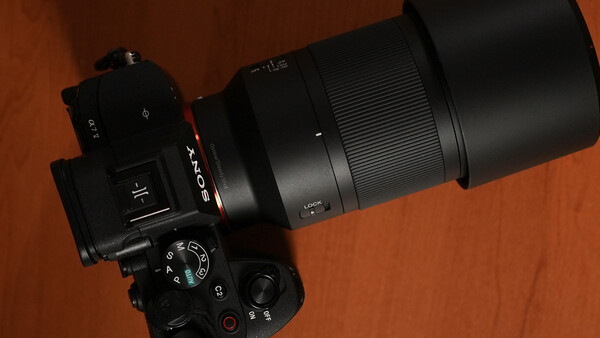
There’s a special role that affordable lenses play in the grand scheme of things, especially those that don’t compromise too much on optics. This new lens, while smaller than most of its kind, is sure to open many doors.
Since most camera bodies that you can buy right now in stores are already highly capable, for most people who are just beginning to learn photography and explore different genres, lenses actually become more crucial. For most beginners, especially those who don’t know many photographers yet and have no access to a variety of rental options, it often means that trying new things means spending and, in some cases, spending a lot.
However, most genres of photography can actually be tried out using a kit lens. Portraits can be done even with a variable-aperture kit lens, street photography can be done with a standard zoom, and most of the time, even landscape photography can be done with a trusty old kit lens. However, those genres that are often out of reach and hard to try are those that require much longer focal lengths. That is where the Sony 100-400mm f/5.6-8 offers to make a huge difference.
The Budget Sony 100-400mm
The new Sony 100-400mm f/5.6-8 OSS is a much smaller version of a lens type that, admittedly, the brand already has a lot of. It comes in at just 7.82 x 16.46 cm and weighs just 654 grams. It’s actually slightly lighter than the 24-70mm f/2.8 GM II, which, for its size, is already remarkably light.
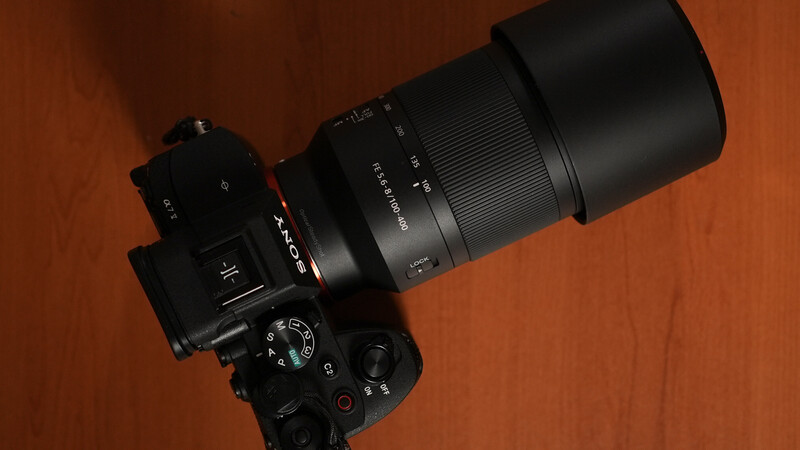
Physically, it seems like a really simple lens with really simple features, and we might actually agree with that, but the implications of this lens go way beyond the physical attributes.
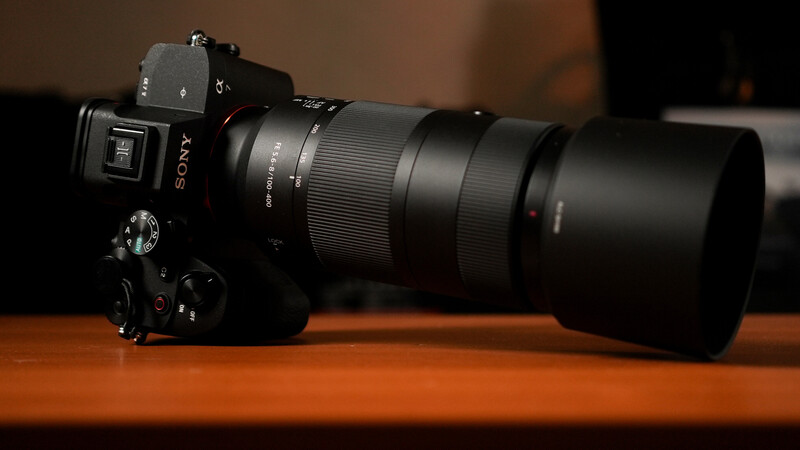
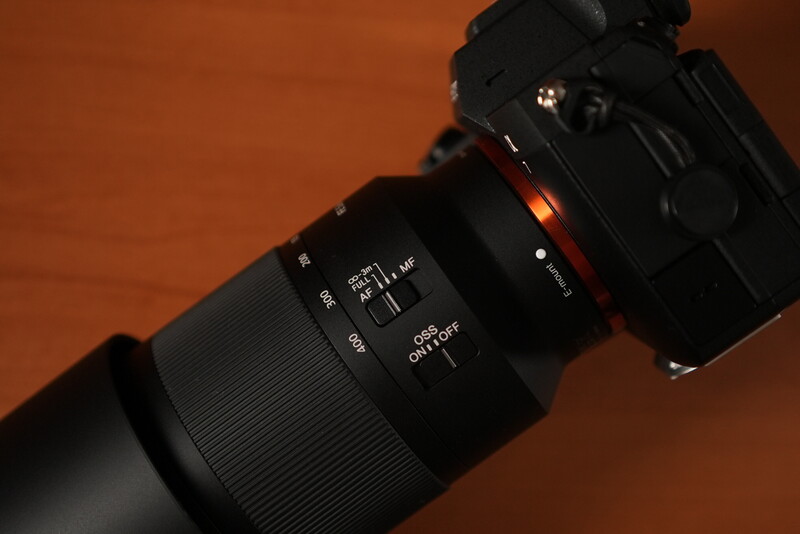
Up front, it comes with a removable and reversible lens hood, a front filter thread of 67 mm, and a standard focus ring on the most distal end. Below it is a zoom ring. As expected, the lens zooms externally, which means that the lens extends in length as you zoom in. On one side, it comes with a combined focus mode and focus range limiter switch with positions for AF FULL, AF ∞–3 m, and MF. This is accompanied by an OSS switch for stabilization, which is very much necessary with a lens of this range. The lens also has a separate customizable focus-hold button. On the other side, it comes with a zoom lock that prevents the lens from extending unintentionally when inverted.
The Obvious Benefits and Limitations
To be able to make a 100-400mm super-telephoto zoom that fits within a 16.46 cm barrel would obviously require some compromise. In fact, many older photographers would probably say that there have been countless other similar lenses to this lens, and yes, if we’re only talking about range, that would be true. In the last couple of decades, lenses like a 70-350mm or even a 28-400mm have existed, but the trade-off for them is the fact that optical performance would be very different between the wide end and the telephoto end. Of course, the aperture range is also a trade-off on its own. However, one can say that this aspect is more intentional in order to make the design possible.
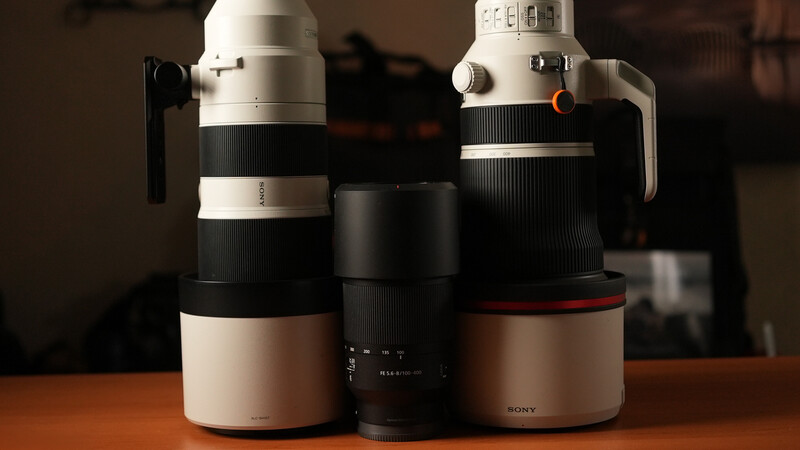
When it comes to benefits, obviously having a 100-400mm that barely feels like a 70-200mm will allow users to be able to explore more with this lens. It can be an extremely portable lens when carried alone or one that doesn’t add so much to the entire set when brought with other lenses. The mere size of it already opens up the user to more logistical possibilities, just as long as they’re able to circumvent the most impactful limitation of the lens, which is, of course, the small maximum aperture, f/8 when zoomed in maximally.
When Image Quality Is Factored In
The factor that makes the case for this lens stronger would be the image quality and how relatively consistent it is throughout the focal length range. As mentioned earlier, many other lenses with the combination of a portable form and long range have existed in the past, but almost all of them barely had considerably good image quality at the maximum focal length.

It was a pleasant surprise to find out that, in the same conditions, 100mm is considerably similar to 400mm when it comes to detail and sharpness at f/8. It was at that aperture that it was tested since the maximum aperture at 400mm is f/8. That means that though one would have to adjust either shutter speed or ISO when using the lens at 400mm, it can retain the relative image quality.

The Biggest Factor

With everything considered, the biggest factor at this point will be the price point. For most photographers, especially those who are just trying things out, it often means having to spend a ton of money just to be able to get to the perspective of 400mm and even try photographing things that are that much more distant. Whether it be for sports, travel, or photographing wildlife, this lens can be a great gateway into such genres, especially for those who need to work their way to a faster lens. In the simplest sense, they’ll be able to try out what they want to try, get to do it over and over, without having to go over such a steep wall to get started.
Application
Much like most other lenses, the usability of this lens will depend on the user’s distance to the subject and the intended composition. In addition, of course, the scarcity of light would matter much more because of the variable and relatively small maximum aperture. However, given the fact that most cameras that this lens is intended to be used with have great high ISO performance and dual base ISOs, the implications of such should be considerably less.
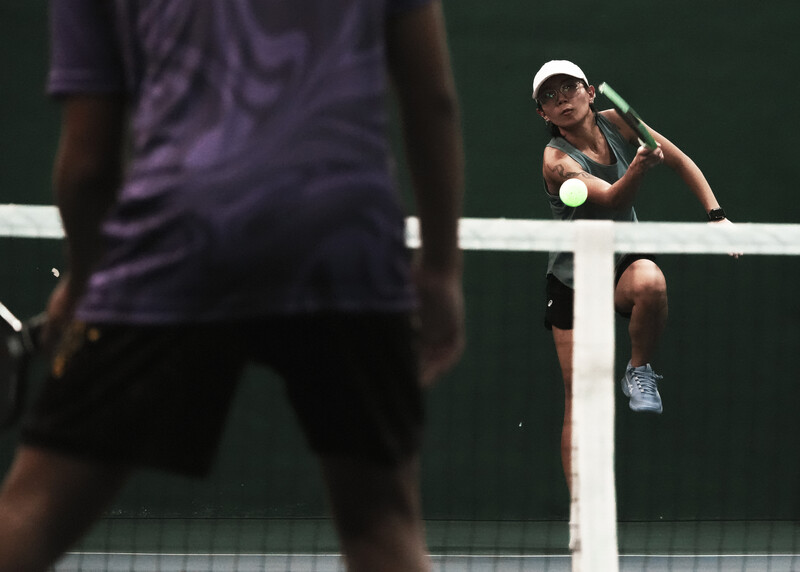
Obviously, this lens should be quite enabling for photographing sports, especially those done outdoors. At the same time, this can also be used well for photographing birds and wildlife, especially on days when the sun is out. The fact that this also works with the 2x and 1.4x teleconverters can also be an additional advantage. However, that would also mean increasing the impact of the limitation on aperture. In addition, this lens can definitely be used for shooting portraits either outdoors or inside a studio with ample lighting. Personally, I would consider swapping out my usual 70-200mm when traveling to be able to have more reach with a lot less gear involved.

What I Liked
- Compact with considerable range
- Consistent optics
- Affordable price
What Can Be Improved
- A slot for a tripod collar would have been nice
Join the Fstoppers community for free
-
Post comments and join in the discussions
-
Browse the site ad-free
-
Share your work and get featured in the community
-
Compete in the photo contests for fun and prizes
1 Comment