An ultra-wide lens can make a landscape feel like you're standing inside it, or it can shrink a dramatic scene into a flat strip of distant shapes. The difference usually comes down to where you put your feet and how you aim the camera, which makes it one of the hardest lenses to use well and one of the most rewarding once you get the hang of it.
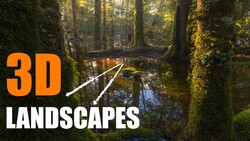
You've probably done this: walked up to a sweeping view, framed everything with your widest lens, and come home with a file where nothing seems to have any weight. William Patino shoots close to half of his portfolio with wide angle lenses, and he traces that flat look to a handful of recurring habits. The first is distance to the foreground. Patino wants you within a foot or two of whatever sits nearest the camera, which feels absurdly close until you see how much the lens still takes in behind it. That proximity builds a strong big-to-small transition, where near objects loom and everything else recedes in steps, and the image picks up a three-dimensional quality a standing-height snapshot rarely has. He also stresses leaving enough separation that the midground still reads clearly, so the foreground supports the scene without swallowing it.
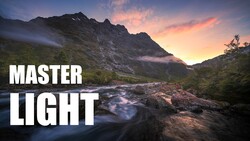
The second problem sits at the opposite end of the frame. Ultra-wide lenses make distant objects look far smaller than your eye perceives them, so a mountain range across a lake that stops you in your tracks can turn into a thin ridge along the horizon. Patino's fix is to move closer to the subject itself, whether that's a peak or a cluster of sea stacks, until it holds a commanding presence. Without that, you can build a perfect path for the eye and still lead the viewer to something that doesn't reward the trip.
Perspective is set by the distance between the camera and the subject, and focal length only decides how much of that perspective ends up in the frame. A rock 18 inches away and a mountain three miles away keep the same size relationship whether you shoot them at 14mm or 50mm from the same spot; the wider lens simply fits both into one picture. Moving toward the rock exaggerates its size relative to everything else, and moving toward the mountain closes that gap again, so your position is what controls scale. The same logic applies when you're using a standard zoom at its short end or the ultra-wide camera on a phone: step forward before you zoom out. Getting that close also pushes depth of field to its limit, which is why many landscape shooters pair near foregrounds with focus stacking, blending a frame focused on the closest rock with others focused farther out. Cameras from Nikon, Canon, Sony, Fujifilm, and others now offer built-in focus bracketing that fires off those frames in sequence, so the technique takes far less fiddling than it once did.
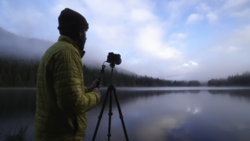
Patino also gets into camera height and horizon placement. On a tripod, it's easy to settle at one comfortable height and keep hunting for the same kind of composition, and he pushes you to shoot down near your ankles, up above your head, and through gaps in trees and rocks that act as natural frames. He's candid that busy environments make it tempting to grab a 24-70mm and punch in to simplify things, and he still makes plenty of quieter images that way. Choosing the ultra-wide means taking on the job of making all that clutter cohesive. His horizon advice is a small adjustment with a big effect: keep the horizon out of the dead center and tilt the lens down slightly so the lower portion of the frame carries more weight. A level or upward tilt tends to hand the viewer's attention to the sky, which usually has nothing in it to build depth or point toward the main subject. Angling down tells the viewer to start at their feet and travel through the landscape toward the distant focal point. In the field, he starts with the horizon dead center and then adds a very gentle downward tilt.
Patino's example images for each mistake are in the video above.


Join the Fstoppers community for free
-
Post comments and join in the discussions
-
Browse the site ad-free
-
Share your work and get featured in the community
-
Compete in the photo contests for fun and prizes
2 Comments
Great Info for those with a ultra wide or even the classified super ultra wides like 10mm and 12mm. Using these what you are capturing is a panoramic type image but in one capture. Like image one using my A7SM1 and using a bungee cord hooked to my belt in a V I got images at the Florida Caverns with more captured than all the post cards, no tripods allowed. Image two also but for that panorama but in just one capture. Image four with many photographers standing on the edge of the rocky part doing multi row panoramas with wind going every which way and no ropes on tripods or even them I played it safe getting a multi row like panorama image (many more) in one capture while sitting not standing and getting still clouds while others had to merge and work with moving clouds. Image three I used the Sony FE 12-24mm F4 G at 12mm and all others with Canon and Nikon DSLR's had nothing that wide in 20i7.
A 2013 Sony lens few know about is the APS-C FE 10-18mm (15-27mm in 35mm) F4 OSS that can be used in Full Frame mode at 12-18mm meaning the little small lens has a 12-27mm range in your bag.
One reason to use the many wide lenses is for Astro Milky Ways, Why? the MW arch panorama is a prize of a night and using a12mm or 14mm in portrait view you get more stars above the ARCH meaning the merged images you can get an non panoramic looking image. As a note using a ultra or super ultra like a 10mm, 12mm or even a 14mm straight on in landscape the trail of stars will go horizonal across the sky and Pegasus will look far away and small.
Today there is the Venus Laowa 10mm f/2.8 also small but great in the right spot for capture of getting a lot in like your peripheral vision is included all in one capture.
Just a reminder for indoor architectural a 16-35 is the better to use, like noted things will look too far away even in a small room.
1, 2 and 4 are using the Voigtlander HELIAR-HYPER WIDE 10mm F5.6.
3. Using the FE 12-24mm F4 G in 2017 the widest of the wide then.
just some added images. beware of ceiling fans and lights will be elongated or bent also aiming at a corner or straight on. All lenses have there place and playtimes.
1 and 2.Voigtlander 10mm
3 and 4The E 10-18mm in full frame 12mm