Fresh snow skimming the peaks, streams cutting through beaches, and moss-covered cascades that only exist because the storms haven't ripped them clean. Fiordland packs more usable foreground into a single beach than most locations offer in a week, and knowing how to read it is the difference between a snapshot and a photograph you'll return to for years.
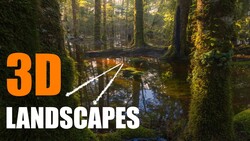
William Patino takes you through five days in the Southern Fiords on his yearly workshop, and the practical teaching starts on the first morning at a beach he's shot many times. He picks the stream over the forest as a starting point, explaining that dense, complex woodland overwhelms people before they've found their footing. The composition he builds uses water flowing through the frame with the peak sitting behind it, giving the eye a resting place. Patino works the classic layered approach here, foreground stream, mid-ground rocks and creek, background mountain, with fresh light catching the summit. A wide angle lens close to a fern does the heavy lifting, and he's specific about lens height: too low and you lose the mid-ground, so come up slightly to keep the separation between layers.
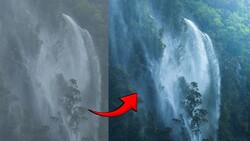
The waterfall section shows how much of landscape work happens before the tripod comes out. Patino scouts a topographic map, follows a stream around at high tide, and finds a spot he calls an absolute jackpot, with the right volume of water and greens arching over both sides. Timing runs the whole afternoon, because a bigger storm is on the way and the location will flood too much to work. He walks one participant through the fixes in real time: raise the ISO, kill the distracting sky in the corner, tilt the camera down to build lines, and slow the shutter for a long exposure. When he switches to white water at one second, he points out the bubbles in the foreground that turn into leading lines, then moves the composition entirely to pull a tree into the frame for more depth.
The through-line worth taking with you is Patino's habit of treating water as a design element rather than a subject. Streams and cascades give you a repeatable structure: a line that enters the frame, carries the eye through the middle, and lands on a fixed anchor like a peak or a tree. This is why he keeps returning to a comp he first found years ago, a natural window with ferns sweeping down one side and curving in from the other. The principle scales far beyond New Zealand. A drainage ditch, a creek in a local park, a wet trail after rain, all of them offer the same job for the same reason, and once you start seeing moving water as a leading line first and pretty texture second, your compositions gain direction. Pair that with the discipline of watching your highlights on the peak so the brightest part of the scene guides attention instead of stealing it.
Weather is the other lesson running underneath the whole trip, and it's a timely one. Long stretches of soft, overcast, rainy light are exactly what these mossy, fern-heavy scenes need, and Patino makes the point that the moss survives precisely because storms haven't blown it off. Shooting in cold rain sits well outside most people's comfort zone, but the flat light saturates the greens, the water flow peaks, and the whole environment thrives. If you've been waiting for blue skies before you leave the house, the fiords are a case study in the opposite instinct paying off. Bring a lens cloth, keep wiping the front element between frames, and accept that the best conditions often feel like the worst. And of course, stay safe out there.
Watch the full five-day journey in the video above to see how Patino reads each stream and builds his frames from the ground up.



Join the Fstoppers community for free
-
Post comments and join in the discussions
-
Browse the site ad-free
-
Share your work and get featured in the community
-
Compete in the photo contests for fun and prizes
No comments yet