Panasonic's Lumix S 20mm f/2.5 is a small, light, $498 ultra-wide prime for L-mount full frame bodies, and it sits at a focal length plenty of people treat as their everyday wide. At that price and size, the open question is how much optical quality Panasonic had to give up to keep the lens this compact.
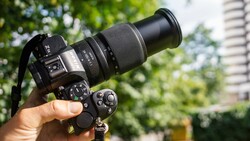
At under 200 g, the lens still feels solid in the hand, with a metal mount, a weather-sealing gasket, an AF/MF switch, and a plastic focus ring that turns very smoothly. Christopher Frost mounted the Lumix S 20mm f/2.5 on a Lumix S1RII and found the autofocus quick, accurate, and close to silent, with manual focus that responds precisely. Instead of focus breathing, the lens shows a fair amount of focus warping during big pulls, though those pulls are far larger than anything you'd normally do with a wide angle lens on a video shoot. The 62mm filter thread tolerates thick filters without physical vignetting in the corners. There's no hood in the box and no bayonet to add one later, and while the lens has no optical stabilization, it works well with the camera's in-body stabilization.
Sharpness is where the size tradeoff shows up. In the center at f/2.5, Frost sees excellent resolution and contrast right away, and by f/4, the middle of the frame is razor sharp. The corners tell a different story: soft at f/2.5 with obvious chromatic aberration, a little better at f/2.8, and much improved at f/4, though they never get fully crisp and the color fringing hangs around through f/8. Shooting raw without corrections reveals strong barrel distortion at f/2.5, while vignetting falls off gently enough that it rarely draws attention and cleans up well by f/4 or f/5.6. If your subjects tend to sit in the middle of the frame, that center performance carries a lot of weight, and if you shoot architecture or landscapes edge to edge, the corner behavior and distortion profile deserve a close look before you commit.
Electronic stabilization trims the edges of the sensor to give itself room to shift the frame, and many cameras also crop in for certain video resolutions or frame rates. Start at 20mm and you can lose a chunk of the frame to those features and still end up with a field of view that feels properly wide, which is why the focal length shows up so often in vlogging and handheld video kits. That same crop pushes the outer edges of the image, where most compact wide lenses are at their weakest, off the final frame. Panasonic already serves video shooters with its f/1.8 prime line, which keeps sizes and controls consistent so you can swap lenses on a gimbal without rebalancing, and this 20mm takes a different path by going slower and smaller. Within L-mount, you also have options like the Lumix S 18mm f/1.8 and the Sigma 20mm f/2 DG DN Contemporary, so the 20mm f/2.5 makes the most sense when weight and bag space top your list and an f/2.5 maximum aperture covers the light you usually shoot in.
The rest of Frost's testing digs into the situations where a small wide prime gets pushed hardest. The lens focuses down to 18 cm, and the close-up results change dramatically between f/2.5 and f/8, with blue fringing playing a big part in how those frames look wide open. He puts the lens against bright light to check flaring and glare, then moves to night scenes to measure coma in the corners at each aperture. Sunstars don't start forming until f/8, and they grow considerably as you stop down further. Bokeh and chromatic aberration get their own segments, and both show how the lens handles busy backgrounds and specular highlights at f/2.5.
Frost's full results are in the video above.





Join the Fstoppers community for free
-
Post comments and join in the discussions
-
Browse the site ad-free
-
Share your work and get featured in the community
-
Compete in the photo contests for fun and prizes
No comments yet