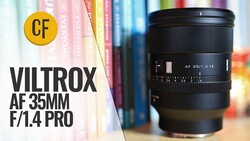
The Viltrox AF 35mm f/1.4 Pro sells for $829, and it brings a metal body, weather-sealing, and a clicked aperture ring at that price. Few focal lengths stay on a camera as long as a 35mm does, so how a lens like this behaves wide open, in the corners, and while tracking a moving subject affects a big share of everything you shoot.
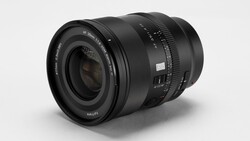
Andrei Dima took the Viltrox AF 35mm f/1.4 Pro through Vitoria and Oviedo in Spain, shooting stills and video, and the build gets attention first. The barrel and mount are metal, and a rubber gasket sits at the mount alongside a USB-C port. The metal aperture ring has clicks, and a switch on the side declicks it. Dima points out that the ring stays put in the A position, so it won't drift when you'd rather control aperture from the camera body. At around 760 g depending on the mount, it's a substantial lens, with 11 aperture blades, 16 elements in 11 groups, and a 77mm filter thread. The front element also carries a coating that repels water and smudges.
The controls lean toward people who switch between photos and video in the same outing. There's an AF/MF switch and a programmable function button, and the focus ring turns smoothly with good damping. For stills, Dima describes the autofocus as decently fast and very accurate, with only two missed frames during his time with it, both in harsh light. Video autofocus holds up just as well in his footage. Focus breathing is nearly absent, which keeps the frame from visibly shifting size as focus moves between subjects. Most of his street photos and video come from Vitoria, the capital of Spain's Basque region.
That USB-C port on the mount handles firmware updates, and with third-party lenses, firmware does a lot of quiet work. Camera makers don't hand every lens maker a complete map of how their autofocus systems talk to lenses, so independent brands depend on updates to keep pace when new bodies arrive or when a camera maker pushes its own firmware. A built-in port lets you update the lens with a standard cable instead of a separate dock. A good habit with any third-party glass is to check the maker's support page after you buy a new body or update your camera, and to do it days before an important job rather than the morning of. The same habit applies across the growing field of independent lens makers, from Viltrox to Sigma to Sirui, as they push further into premium territory once reserved for first-party lenses.
Image quality is where the review spends its most careful attention. At f/1.4, on a 60-megapixel sensor, the center is sharp with good contrast, and the mid-frame keeps up. The corners are sharp wide open as well, though slightly softer than the center and darkened by vignetting. Stopping down to f/2.8 adds contrast across the frame and lifts both brightness and detail in the corners. By f/4, the change is mostly brighter corners, since the rest of the image is already resolving fine detail with strong micro contrast. Close-up work behaves differently: at the 30 cm minimum focus distance, the lens is a bit soft at f/1.4 and needs f/2.8 to sharpen up.
You can see the lens' sun stars, which Dima says look best at f/8 to f/11, in his sample shots in the video above.


Join the Fstoppers community for free
-
Post comments and join in the discussions
-
Browse the site ad-free
-
Share your work and get featured in the community
-
Compete in the photo contests for fun and prizes
1 Comment