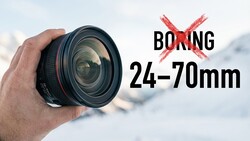
The 24-70mm lens is one of the most used focal ranges in photography, yet it often feels flat and uninspiring. That frustration usually has less to do with the lens and more to do with how you’re standing when you use it.
Coming to you from Martin Castein, this practical video breaks down why the 24-70mm lens gets dismissed as “boring” and what actually changes when you understand how it works. Castein shows a simple comparison: one image shot at 24mm up close, another at 50mm from farther back, framed similarly. The subject looks almost the same size, but the background feels completely different. At 24mm, the background stretches away. At 50mm, it feels compressed and closer. That’s not a trick of the lens. It’s a result of where you’re standing.
You’ve probably heard “zoom with your feet.” Castein calls that advice incomplete. When you move, you change perspective. The relationship between your subject and the background shifts. When you stay still and zoom, you’re only cropping tighter or wider. The perspective stays the same. Once you see this demonstrated, it becomes obvious. You can even crop a 24mm image to match a tighter focal length and get nearly the same result, as long as you didn’t move. The lens doesn’t change perspective. Your position does.
The problem with the 24-70mm lens starts when you treat the zoom ring like a solution to weak composition. You stand in one place and twist back and forth between 24mm and 70mm, hoping something clicks. It usually doesn’t. Composition isn’t fixed by zooming. It’s fixed by moving. If the foreground, subject, and background don’t relate well from where you’re standing, no focal length will repair that. The zoom ring is there to refine framing after you’ve chosen the right spot. When you rely on it first, everything feels random.
Castein explains that he often sets his lens to 35mm or 50mm and works as if he’s using a prime. That gives him a baseline. He walks, observes light, studies backgrounds, and judges distance. If something feels off, he knows quickly whether he needs to move or simply adjust framing. Only after he’s in the right position does he start zooming to fine-tune the edges of the frame. This approach builds instinct. You stop guessing. You start recognizing when you’re physically in the wrong place.
There’s also a hard truth here. A mid-range zoom exposes weak composition. With an ultra wide lens, you get drama. With a long lens, you get compression and easy simplification. The 24-70mm range sits in the middle. It doesn’t exaggerate. It doesn’t hide. If your framing lacks intention, you see it immediately. That’s uncomfortable, but useful. It forces you to make clear choices about distance and background rather than relying on visual extremes.
Castein suggests a simple exercise: pick 24mm and 50mm, then try to match framing by moving your feet. Watch how the background shifts as you change position. Then repeat the test without moving, only zooming. After a few rounds, you won’t confuse perspective and focal length again. Check out the video above for the full rundown from Castein.



Join the Fstoppers community for free
-
Post comments and join in the discussions
-
Browse the site ad-free
-
Share your work and get featured in the community
-
Compete in the photo contests for fun and prizes
1 Comment
I know you're the only one who can see this, Alex, but this is something I've always thought about and one of the reasons I get frustrated when people compare focal lengths by switching out prime lenses from the same location as if that explained the difference. But then, a lot of things frustrate me which is probably why I've been shadow banned, although I don't know the actual reason.