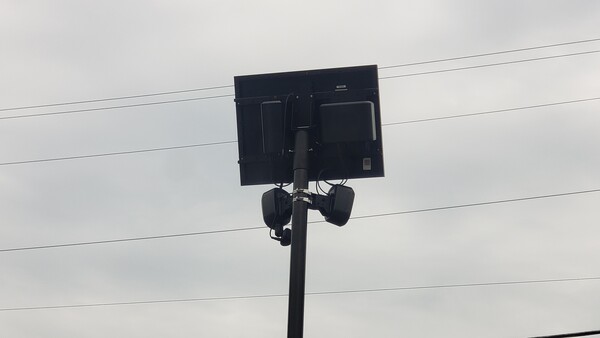
A Wisconsin woman was stopped by police with guns drawn twice in one week after an automated license plate camera wrongly linked her car to a Milwaukee homicide. Milwaukee police say the alert should have been deleted days earlier, but a staffer never cleared it.
According to Local 12, Amber Newell was driving on I-94 in Brookfield, west of Milwaukee, on the afternoon of August 6 when a Flock camera flagged her vehicle as connected to a homicide investigation. FOX6 Milwaukee reported that video from the interstate showed multiple officers with guns drawn and a passenger sticking their hands out the window. After Brookfield officers reached out to the Milwaukee Police Department to verify the alert, MPD responded that the vehicle and its occupants were no longer of interest, and the people were let go. Newell told FOX6 the same thing had happened to her earlier that week.
The issue was not the camera reading her plate wrong. Milwaukee police said this was a personnel problem, not a Flock problem: staff failed to remove a wanted vehicle alert from the system after it was no longer needed. Brookfield Police Chief Christopher Garcia has defended the stop, and Milwaukee police back him up, saying his officers acted on the information they had. Newell described the fear in plain terms. "I haven't been asleep since this has happened," she said. "Every time I close my eyes, all I can see is guns." She also said her young daughter is now afraid to ride in the car.
Flock Safety operates a network of roughly 120,000 cameras across the country, and the system works by photographing plates, timestamping them, logging a location, and checking each read against police hotlists. When a plate matches, officers get an alert. That means your car's movements can land in a searchable database whether or not you are suspected of anything, and the accuracy of any given stop depends entirely on whether the underlying list is correct and current.
The louder story this year has been deliberate abuse. Milwaukee alone has seen two officers charged: Josue Ayala, who prosecutors say searched a partner's plate and that partner's ex nearly 200 times, and internal affairs detective Tehrangi Chapman, who was later charged after allegedly misusing the same system he was assigned to investigate. The Institute for Justice has documented at least a couple dozen cases nationwide of officers using plate readers to track romantic interests, and a Washington Post review found at least 50 officers accused of misusing these systems. Cities are reacting. Chandler, Arizona pulled 40 Flock cameras this month after an audit turned up an anomaly it could not explain through normal police work.
What happened to Newell is different from stalking, but it comes from the same weak point: an audit trail and an accuracy check only work if a person is actually watching them. A separate running tally of reported Flock errors found drivers who were repeatedly stopped after their own plates were mistakenly added to hotlists, and one man who spent 13 days in jail after a camera capture misidentified his car. Flock has said its cameras are about 99% accurate, but at tens of billions of reads a month, even a tiny error rate becomes a steady stream of real people staring down real guns.
Lead image by Epicdeflocker64, CC0. Source.






Join the Fstoppers community for free
-
Post comments and join in the discussions
-
Browse the site ad-free
-
Share your work and get featured in the community
-
Compete in the photo contests for fun and prizes
1 Comment
AFAWK (As far as we know) the misinformation has not ended up in a police shooting yet. I am not sure why this is on Fstoppers...because there's a camera involved?