
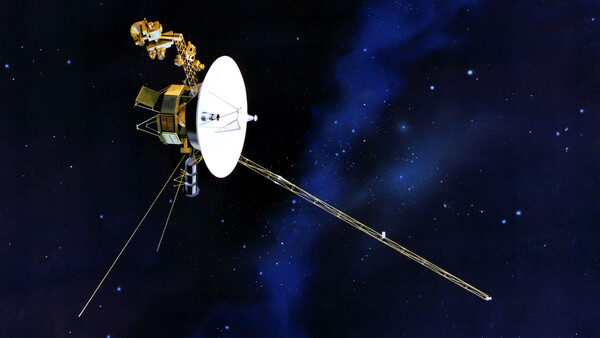
Imagine trying to photograph a moon the size of a fist while flying past it at 45,000 miles per hour, using a camera you cannot see through, cannot focus by hand, and cannot even talk to in real time. Every instruction you send takes hours to arrive. By the time you learn whether a shot worked, the target is long gone, and there is no second pass. That was the daily reality for the people who ran the cameras on Voyager 1 and Voyager 2.
The two spacecraft launched in 1977, Voyager 2 first on August 20 and Voyager 1 on September 5, and between them, they transformed our view of Jupiter and Saturn, which the Pioneer probes had first glimpsed up close a few years earlier, and gave us the first and still only close portraits of Uranus and Neptune. The pictures are so familiar now that it is easy to forget how strange the machinery behind them was: a pair of 1970s television tubes bolted to a motorized arm, aimed by commands written weeks in advance, on a spacecraft that could never be flown by hand.
This is the story of how those cameras were pointed and held steady across the solar system. Not the famous images themselves, but the engineering that made any of them possible.
Two Television Cameras on a Moving Arm
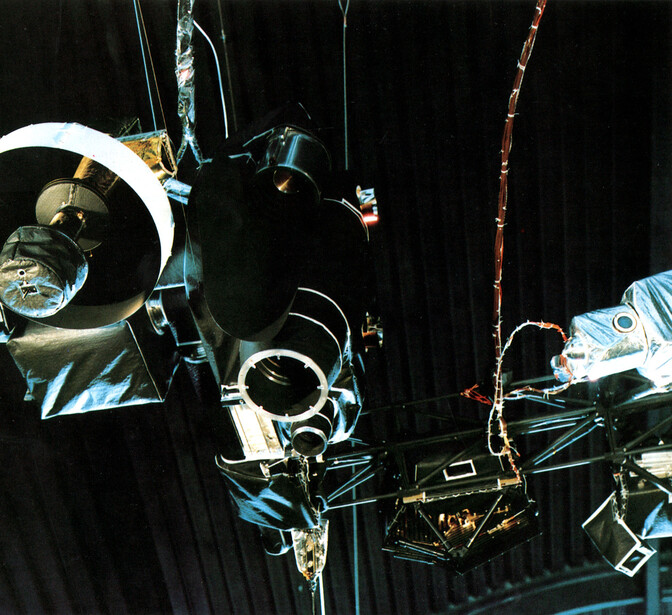
The imaging hardware on each Voyager was called the Imaging Science Subsystem, or ISS, and it was really two cameras working as a pair. One was a wide angle camera built around a 200mm f/3.5 lens with a field of view of about 3.2 degrees. The other was a narrow angle camera, essentially a long telephoto, with a 1,500mm f/8.5 lens and a field of view of just 0.42 degrees. The wide angle camera gathered more light and swept up context, atmospheric bands, whole crescents, ring systems. The narrow angle camera picked out fine detail, a storm cell, a crater field, the edge of a ring.
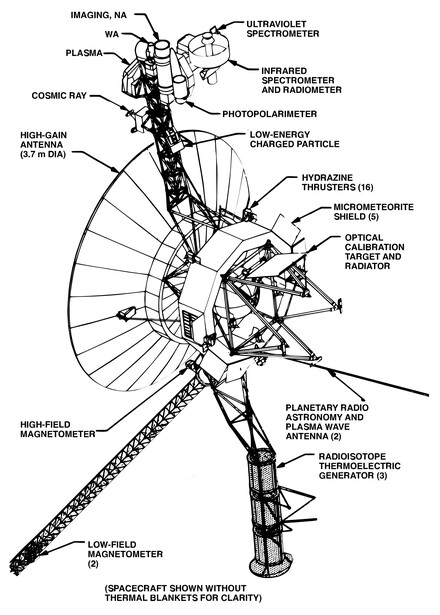
Neither camera was fixed to the body of the spacecraft. Both were mounted at the end of an articulated scan platform, a steerable arm driven by two actuators that could swing the instruments in azimuth and elevation. That mattered enormously. Voyager itself had to hold a fairly stable attitude to keep its big dish antenna pointed at Earth, so the cameras could not just be aimed by turning the whole vehicle whenever engineers wanted a new target. The scan platform let the imaging team point the cameras independently, slewing from a moon to a ring gap to the planet's limb without disturbing the antenna lock.
The platform carried more than the cameras. Voyager's infrared and ultraviolet spectrometers and its photopolarimeter rode there too, all looking in roughly the same direction, so a single pointing command could serve several instruments at once. When you read that Voyager captured a moon in multiple wavelengths during a single pass, that was the scan platform doing its job, holding a family of instruments on one target while the spacecraft raced by.
A Tube, Not a Sensor
The most surprising thing about Voyager's cameras, by modern standards, is that there is no digital sensor inside them. Each camera used a vidicon, a small television camera tube. Light from the lens fell on a photoconductive target, a coating of selenium and sulfur about 11 millimeters square, and formed a charge pattern that mirrored the scene. An electron beam then swept across that target to read the pattern out, line by line, the same basic idea as a broadcast TV camera of the era. For comparison, a full frame sensor is 864 millimeters square.
The numbers are modest. Each frame was 800 lines of 800 picture elements, so 640,000 pixels in total, with each pixel about 14 microns across on the target. A single frame took roughly 48 seconds to read out electronically. There was no memory card and no burst mode. The camera exposed, then spent the better part of a minute slowly shifting the image data off the tube and into the spacecraft's tape recorder or straight down the radio link.
Color came from a filter wheel in front of each vidicon. To build a color picture, the team shot the same scene several times in succession through different filters—orange, green, blue, and others—and combined the frames on the ground. That is why so many raw Voyager sequences show the same target many times in a row. Each of those frames is one color channel, and the vivid composites we know were assembled at the Jet Propulsion Laboratory after the fact.
The vidicon had one more quirk that shaped how the cameras were used. The tube could hold a high-resolution image for a long time before it faded, which helped during the slow readout, but it also meant the camera behaved less like a snapshot device and more like a small darkroom that had to be exposed, developed, and drained in careful steps. Every one of those steps had to be scripted in advance.
Commanding a Camera Hours in the Past
Here is the constraint that governed everything: you cannot steer a camera in real-time when your signal takes hours to arrive. Radio waves travel at the speed of light, and light is not instant across the solar system. At Jupiter, a command from Earth reached Voyager after roughly 35 to 50 minutes, and a reply took just as long to come back. At Saturn, the one-way trip stretched past an hour. At Uranus, it was about two and a half hours each way, and at Neptune, it was slightly over four hours.
Think about what that does to the idea of aiming. If an operator at JPL watched a live feed and nudged a joystick the moment a moon drifted out of frame, the correction would not reach the spacecraft for hours, by which point the encounter would be finished and the moon millions of miles behind. Real-time control was physically impossible. There was no viewfinder to look through and no way to react to what the camera saw.
So the encounters were choreographed instead. Months ahead of each flyby, the imaging team worked out exactly where every interesting target would be, relative to the spacecraft, at every second of the pass. They translated that into a long sequence of stored commands: point the scan platform to these coordinates, open the shutter for this many seconds, switch to this filter, read the frame out, slew to the next target, repeat. The whole script was uploaded to Voyager's onboard computers in advance and executed automatically, with the spacecraft running its own show while Earth waited, hours in arrears, to see what it had done.
Voyager's operators never framed a single shot in the moment. They composed an entire planetary system on paper, weeks early, using predicted geometry, and trusted the machine to hit every mark on its own. A missed calculation meant a wasted frame with no retake.
Freezing a Moon at Tens of Thousands of Miles per Hour
Precise aiming solves half the problem. The other half is motion. Voyager did not gently drift past its targets. During the Jupiter and Saturn encounters, the spacecraft was moving at tens of thousands of miles per hour relative to the moons it was photographing, and at Uranus, it was crossing the system at roughly 45,000 miles per hour. At those speeds, even a fraction of a second of exposure can smear a surface into streaks, exactly the way a fast subject blurs when your shutter is too slow.
On a tripod at night, you would simply stop down and let the exposure run, because your foreground is not going anywhere. Voyager did not have that luxury, and the fix it used will feel familiar to anyone who has tried to keep the stars sharp in a long exposure, or panned a lens to hold a moving subject crisp against a blurred background. The team used image motion compensation. Rather than hold the camera still while the target slid across the frame, they moved the camera to track the target during the exposure, so the subject stayed fixed on the vidicon and only the background trailed. Some of that tracking was done by slewing the scan platform itself. Some of it was done by slowly rolling or turning the entire spacecraft at a rate matched to the target's apparent motion, effectively panning the whole vehicle to keep a moon pinned in place.
The technique became more important the farther out Voyager traveled, because sunlight fades fast with distance and dim scenes demand longer exposures. Longer exposures give motion more time to ruin a frame, which raised the stakes on getting the compensation exactly right.
When the Platform Jammed
The scan platform was the single most heavily worked moving part in the imaging system, and on Voyager 2 it nearly ended the mission's outer legs. On August 26, 1981, about 100 minutes after the spacecraft's closest approach to Saturn, the platform seized in azimuth and stopped responding. A large block of planned observations was lost while the platform sat frozen.
Engineers concluded that the failure was probably caused by heavy use of high slew rates, combined with inadequate lubrication that had let the actuator's gear train run dry. Over the following days, they carefully coaxed the platform back to life by exercising it gently, and they rewrote the operating rules to keep slews slow and to rest the mechanism between fast moves. They also prepared a fallback in case it ever locked up again: if the platform would not turn in azimuth, they could roll the whole spacecraft to point the cameras, using the platform only for up and down motion. Voyager 2 was estimated to carry enough propellant for around 150 such roll maneuvers at Uranus. In the end, the platform behaved, and the backup plan stayed in the drawer, but the near miss shaped how gingerly the cameras were pointed for the rest of the tour.
The Darkest Encounters: Uranus and Neptune
By the time Voyager 2 reached Uranus on January 24, 1986, sunlight had thinned to roughly a quarter of what the spacecraft had at Saturn. Scenes that would have taken a brief exposure at Jupiter now needed the shutter open far longer, and the standard workhorse exposure for the encounter ran about 15 seconds. Engineers programmed image motion compensation into Voyager's computer specifically to hold those 15-second frames clean against the spacecraft's velocity.
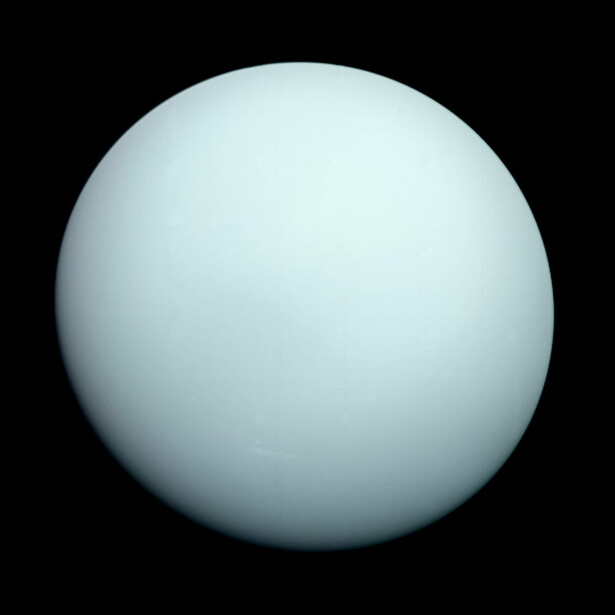
It did not come easily. Just three days before closest approach, the team discovered that a batch of images was coming down badly streaked and had to diagnose and correct the imaging sequence on the fly, with the encounter bearing down and every command still carrying that two and a half hour delay. They fixed it in time, and Voyager 2 delivered the first close views of Uranus and its moons, including the shattered, patchwork surface of Miranda.
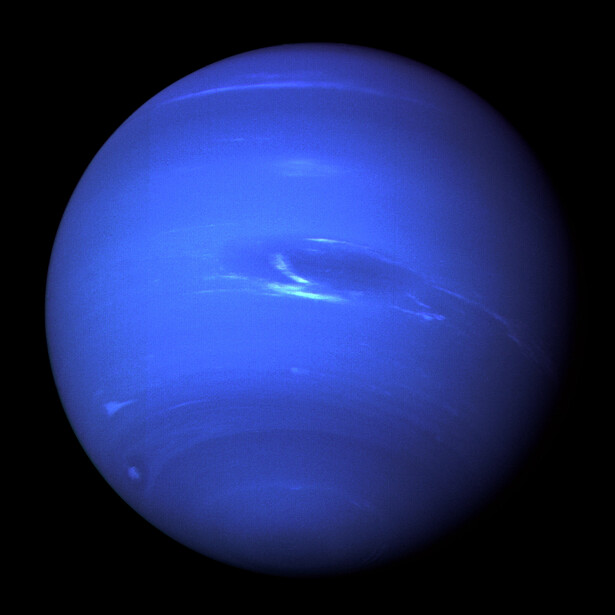
Neptune, on August 25, 1989, was darker still, and the light there was only a fraction of what Uranus had offered. Much of the machinery for coping with that darkness had been built for Uranus: alongside image motion compensation, engineers had qualified the attitude control thrusters to fire in pulses as short as about four milliseconds, the practical minimum, so that the little jets used to steady the spacecraft would not jolt it and blur long exposures. For Neptune, the team refined those pointing and tracking techniques further, including a scheme sometimes called nodding image motion compensation to keep targets locked. The techniques enabled both extremely long observations of faint targets, including Neptune's tenuous rings, where the shutter stayed open for several minutes, and sharp close-range imagery of features such as the Great Dark Spot and the geysers of the moon Triton.
One Last Look Back
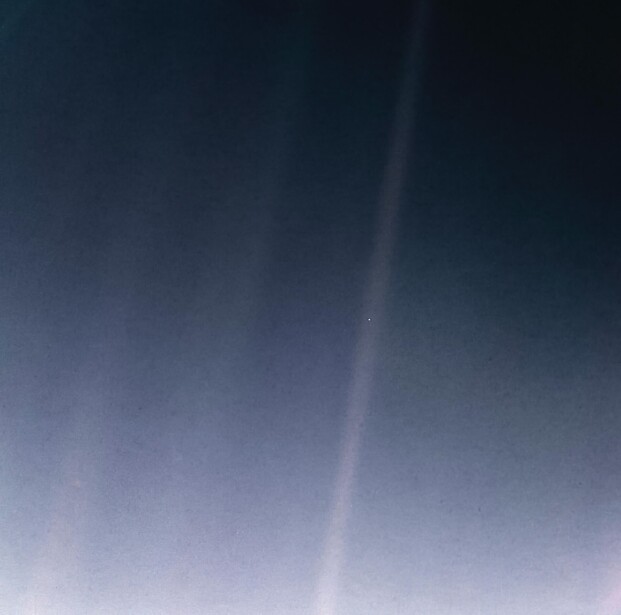
The final act of Voyager's cameras used every capability the system had. On February 14, 1990, with its planetary work finished and Voyager 1 about 3.7 billion miles from home, the spacecraft flipped its cameras around for a final glimpse and shot a mosaic of the planets it had left behind. The full sequence ran about 60 frames, 39 through the wide angle camera and 21 through the narrow angle camera, stitched into the first portrait of our planetary system seen from the outside. Several of those narrow angle frames caught Earth as a single bright speck, and three of them, shot through blue, green, and violet filters, were combined into the image later named the Pale Blue Dot.
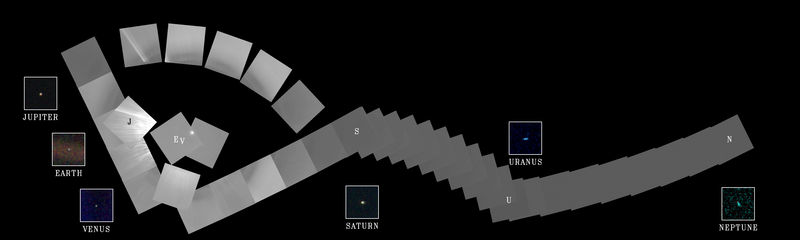
Even that farewell was pure pointing and timing. The scan platform had to find each planet as a faint point against the glare of a distant Sun, hold steady long enough to register it, cycle through filters, and do it all on a script written and uploaded from a world that would not see the results for more than five hours. The cameras that took it were switched off shortly afterward to save power for the long ride into interstellar space.
What those two spacecraft proved is that a camera does not need to be held, aimed, or even watched to make a great photograph. It needs a plan good enough to survive the hours between the shutter and the eye. Voyager's operators wrote that plan four times, for four alien worlds, and got it right.
Lead image - Artist's rendering of a Voyager spacecraft in deep space, the imaging cameras and other instruments visible on the scan platform at upper left. NASA/JPL, Public Domain. Source.



_-_JPEG_converted.jpg)

.png)


Join the Fstoppers community for free
-
Post comments and join in the discussions
-
Browse the site ad-free
-
Share your work and get featured in the community
-
Compete in the photo contests for fun and prizes
2 Comments
Phenomenal writeup. Half a century ago with a vidicon tube for a "sensor"!
Sure they did...