
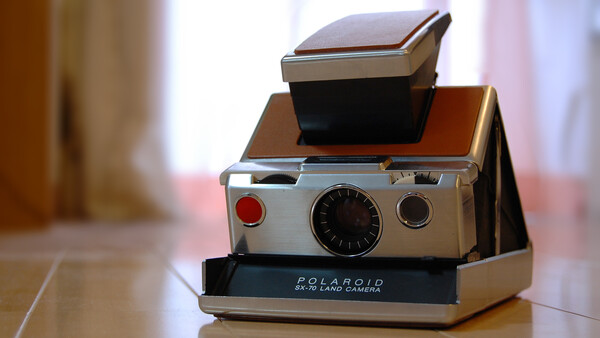
In April 1972, at Polaroid's annual meeting, Edwin H. Land reached into his jacket, pulled out a camera folded flat enough to hide in a suit pocket, and in about ten seconds fired off five color photographs. There was no timer to watch, no negative to peel away, no wet chemistry to wipe off your fingers. That was the SX-70, and more than fifty years later, it still looks like it wandered in from a future that never quite arrived.
Land had spent his career chasing a single idea he called one-step photography: point, press, and hold a real photograph in your hand a moment later. His earlier Land Cameras got close, but they were bulky, and they made you peel a print apart from a chemical-soaked negative and throw the mess away. The SX-70 erased all of that. It folded, it focused through the lens like a proper single lens reflex, and it spat out a self-contained print that developed in daylight while you watched. It was arguably the most ambitious consumer product any American company shipped in the 1970s, and it is still one of the best-looking objects ever to carry a shutter.
A Camera That Fit in a Suit Pocket
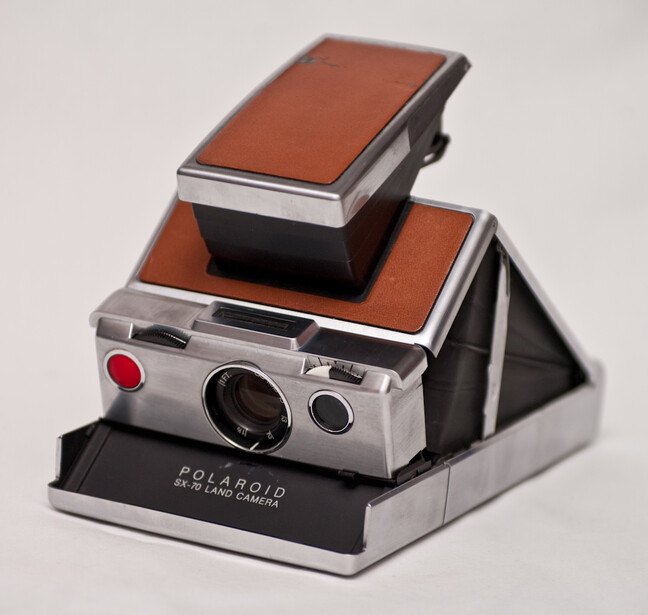
The first thing that hits you about an SX-70 is that it should not be possible. Closed, it collapses into a slab about an inch thick, a wedge of chrome-plated plastic wrapped in tan leather that looks more like a cigarette case or a slim flask than a reflex camera. You pull the viewfinder housing up and the whole body unfolds and locks into a rigid, angular shape with the lens out front and the film chamber below. Fold it back down and it disappears again.
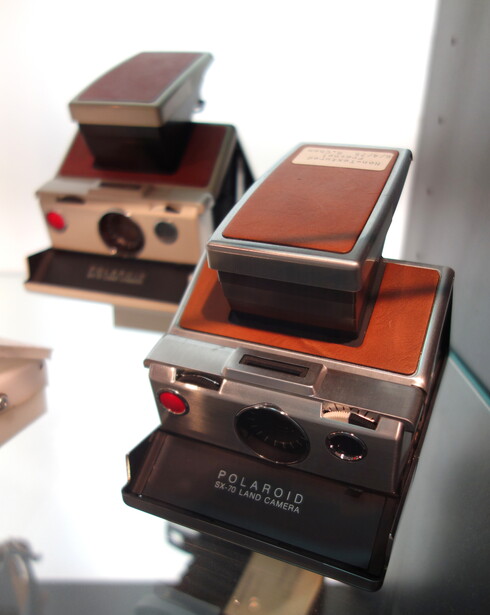
That trick was not styling for its own sake. Land wanted a serious camera that lived in a jacket pocket, and getting there meant solving a genuinely hard geometry problem, because a single lens reflex needs room for a mirror, a viewing path, and a flat film plane, none of which want to collapse. The final look came from industrial designers Henry Dreyfuss and James M. Conner of Henry Dreyfuss Associates, whose restraint is a big part of why the thing has aged so well. There is no wasted line on it. The leather-and-chrome Model 1 in particular reads less like 1970s consumer electronics and more like a piece of jewelry that happens to take pictures.
Bending Light Around Corners
The engineering underneath the leather is where the SX-70 stops being pretty and becomes genuinely strange. A reflex camera lets you look through the taking lens so you frame exactly what the lens sees. In a normal SLR that is a single mirror flipping up out of the way. In a camera that has to fold nearly flat and eject a print from the front, a single mirror does not fit, and the image would land on the film upside down and backward.
Polaroid's answer was a folded optical path built from mirrors and a Fresnel element, set at odd angles so the light bounces its way through the compressed body. While you compose, the taking mirror projects the image onto a Fresnel screen and a separate aspheric mirror relays an upright aerial image to your eye at the viewfinder; press the shutter and the reflex member pivots, so a mirror on its reverse side redirects the light onto the film for the print. Designing an optical system to pull off that reflex trick, inside a body barely thick enough to hold it, was a real optical achievement, not marketing.
Then there is the sound, which anyone who has held one remembers. Press the button and a motor drives the mirror system through its cycle, the shutter fires, and the motor runs again to push the developing print out through a slot at the front and reset the camera. The film pack carries its own battery, so each new pack normally supplies a fresh power source for the motor and electronics. That whir-and-thunk is the mechanical signature of the SX-70, and it is doing a lot of work in a very small space.
The Electronics Nobody Was Allowed to Understand
The part of the SX-70 story that gets skipped is that it was one of the earliest consumer products built around custom integrated circuits, and getting those chips to work nearly sank the whole project. The camera's automatic exposure, motor, and flash were managed by roughly 400 transistors spread across a set of control modules that had to fit into a sliver of space beside the lens. This was 1969 through 1972, when putting that much electronic control into a handheld camera was close to the edge of what was manufacturable.
Land handed the chip work to outside firms, including Fairchild and Texas Instruments, but he was so afraid of tipping off Kodak that he refused to tell them what they were actually building. The engineers were handed electrical specifications with the camera stripped out of the picture. As Polaroid engineer Peter Carcia put it, "they had very little to work with." The problems that followed were brutal in a way only hardware can be. The exposure photocell operated at around 15 picoamperes while the motor pulled several amps, and the electrical noise from the motor swamped the delicate sensing circuit. Texas Instruments designer Clark Williams described a motor that "put out a rich spectrum of noise that played havoc with our circuits." An early ceramic prototype cost roughly $100 a unit against a target near a few dollars, with a yield around one percent. IEEE Spectrum's account of that design battle between chip engineers reads like a thriller, complete with a TI chairman who declared the company did not fail and then spent from his own budget to prove it. They eventually got it to work, and cheaply, which is the only reason the camera you can hold today exists.
The Film That Developed in Your Hand
None of the folding or the optics would have mattered without the film, and the film is the real invention. The SX-70 was the first camera to use Polaroid's integral instant film, a single sealed unit holding the negative layers, the positive image, and the developing chemistry, all behind a white border. You did not peel anything, you did not time anything, and you did not have to keep it in the dark. The print ejected still blank, the image climbing up out of a pale green haze over several minutes, and the whole reaction happened out in the open air. Development finished within about ten minutes and left no chemical residue to wipe away.
Tucking a fresh 6-volt battery into every film pack was a quietly brilliant call. It meant the camera's most power-hungry moment, driving the motor, received a fresh cell with each pack, and it meant a new pack refreshed the electronics along with the pictures. The original SX-70 film rated at ASA 150, slow by any standard, which often forced long exposures and contributed to motion blur in ordinary indoor light.
It was not cheap. After a limited market introduction in Miami in late 1972, the SX-70 did not reach national US distribution until fall 1973, at $180 for the camera and $6.90 for a pack of ten exposures, which in today's money lands the camera well over a thousand dollars and each shot at more than five. Polaroid still sold about 700,000 of them by the middle of 1974 and kept the line in production until 1981. Instant film for the SX-70 disappeared after Polaroid ended production in 2008, then returned when the Impossible Project took over the last integral-film factory and acquired much of its machinery. Because key materials were no longer available, the group developed a new compatible film, releasing black-and-white stock in March 2010 and color film later that year. You can buy SX-70 film new today, which is not something you can say about most fifty-year-old cameras.
The Camera of Artists
The SX-70 sold to families, but it stuck with photographers who could have used anything. Ansel Adams, who had a long consulting relationship with Polaroid, worked with it. Andy Warhol carried Polaroids the way other people carry phones, and Walker Evans, near the end of his life, took to the SX-70 with something like relief at how immediate it was. That mix of amateur reach and serious credibility is rare. Very few cameras end up on a family shelf and in a fine-art print at the same time.
Its cultural stamp was set early and on purpose. In 1972 Polaroid commissioned the designers Charles and Ray Eames to make an eleven-minute film introducing the camera, scored by the film composer Elmer Bernstein, that treated a piece of consumer electronics like a subject worthy of real cinema. Polaroid screened it for shareholders before pressing it into duty as a sales piece, and in 1975 it carried off a bronze plaque at the Columbus International Film Festival. Getting the Eames Office to explain your product is roughly the design-world equivalent of having your portrait painted by a master.
What keeps the SX-70 alive is that the fundamentals were right. The proportions are honest, the mechanism is legible, and the object does exactly what it looks like it does. It folds, it opens, it thinks for a second, it hands you a photograph. Modern instant cameras are lighter and cheaper and easier, and none of them feel like this, because none of them tried to solve as many impossible problems at once and then hide the effort inside something you would be glad to leave sitting on a table. Pick up a working SX-70 now and the surprising thing is not that it is old. It is that so little since has looked as far ahead.
Lead image — Fabian Reus, CC BY-SA 2.0. Source.





.jpg)

.jpg)
.jpg)
Join the Fstoppers community for free
-
Post comments and join in the discussions
-
Browse the site ad-free
-
Share your work and get featured in the community
-
Compete in the photo contests for fun and prizes
No comments yet