
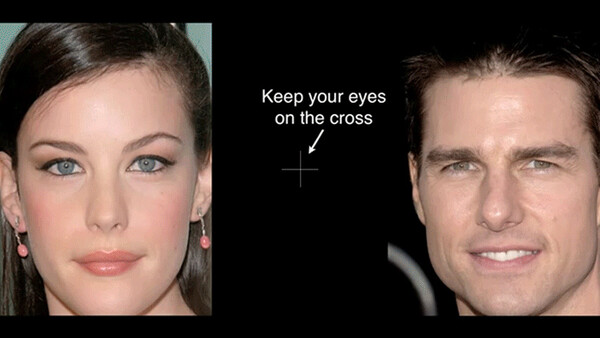
Yesterday a colleague Pratik Naik posted a gif of an interesting phenomenon, which coincidently illustrates an issue I have been having (at least it appears to be). When you shoot a job with thousands of images it’s sometimes paramount to quickly view and flag or pick the good ones. Some people even start with quickly rejecting the bad ones. This .gif is a good reason why you shouldn’t start with deleting the bad ones.

In the above .gif focus your eyes on the crosshairs in the center and don't move them. What do you see happen and what do you see in your peripheral vision? Please note that this works best if you are viewing from a computer monitor and not a phone.
So here is why I think this .gif explains my problem. I often will go through a job very quickly with my finger on the X button (reject in Lightroom) and another on a rating number (1-5). Often times I will see something I love while quickly scrolling through and then go back to the image for a closer look several seconds later. Upon backing up to the photo, I don’t see what I originally saw, or it looks different if I stare at every part of the photo, or I simply can't find the photo at all. I’ve always thought I was somewhat crazy or this issue was perhaps unique to me. I guess I am not special.
I have also seen this in other situations while working on set as a digital tech with Rob Grimm. As a digital tech I sit at a Mac Pro with a 30 inch Monitor and manage the software and scroll trough the catalogue for art directors, clients, and of course the photographer. Often times this is of 30-40 images that are just barely different from one another with minor changes in light, prop, or product position. I’ve always noticed if I scroll through the images too quickly someone will shout “Go Back to the one with the ____________” and I won’t be able to find what they saw and neither can they.
Very strange indeed. Another colleague here at Fstoppers Rich Meade then explained that this could be the result of a phenomenon described as Persistence of Vision, which is described as "The phenomenon of the eye by which an afterimage is thought to persist for approximately one twenty-fifth of a second on the retina."
Could it be that our brain blends together images if we scroll through them too quickly? Have I been picking, or even deleting, images I shouldn't have because I scroll through them too quickly?
I'm corn fuzzed here people, what do you think?





Join the Fstoppers community for free
-
Post comments and join in the discussions
-
Browse the site ad-free
-
Share your work and get featured in the community
-
Compete in the photo contests for fun and prizes
30 Comments
haha that's really cool!
I agree on it being P of V...The show 'your bleeped up brain' has talked about this.
Omigawd.
This has been around youtube for ages...
Good to know!!
Wow. That explains it. I'd always found something weird happening with my selections.
I've found that using smaller thumbs, and checking the navigator's preview helps with selections based on composition. Check detail and focus on the main preview (loupe) view.
I love the gifs, I dropped a black frame into my lightroom filmstrip, and got the same effect!
wow... very good, makes perfect sense... i've come back a few days later and viewed images i rejected and thought wtf did i not like this?
It is actually the phi effect... and it is what allows us to "see" movies. They're only a sequence of still images but it is our brain, and the phi effect, that make us blend one image after another and generate the illusion of movement. Regards from Mexico.
If it were persistence of vision, why does the image stay distorted after 1/25 of a second after the image has changed. I think it's more to do the image burning into the retina. Similar to when you look at a bright light and then when you look away the white spot follows your eye. Which isn't POV, is it?
CORN FUZZED
they turn into aliens
This happens to me all the time. I am a realistic illustrator and I have always noticed images burned into my vision for a fraction of a second, especially if I look at an image and then look to a solid colored object after, like white paper. I have always wondered if this is how I can draw extremely realistic portraits with ease, subconsciously my eye just transplants the image directly to the paper for my hand to follow.
i forgot about that trick :)
I saw this on Brian games..... the point of the gif, is this. If you look at the picture square in the face, you see a beautiful celebrity. But If you look at the cross hair, they aren't as beautiful. You notice an uglier person. Their point was that we're trained to see the people above as beautiful, but they aren't always.
Its lucky Lightroom is so phenomenally slow that it is rarely a problem. Photo Mechanic ftw
Photo Mechanic definitely rocks in this way - fast and especially easy to compare photos using the "G Key" as in the Greg Gorman Key.
So trippy!!!
that's just creepy
holly molly Wow!
We forget 14 minutes a day. Start with that. And you will solve your problem.
My brain does not have this problem while editing in Lightroom 5. The rendering is too slow
Also some colour-sensing in your eyes takes more time to clear certain colours from your nerve-memory compared to others. If people have different colour eyes then the browns may persist more than the blues, for example. Vision is chemical, not electronic.
Makes me think of the "gestalt principle", the idea, roughly, that our minds apprehend the whole before comprehending the parts, and will continue to try and do so, even after the whole stay the same for a while. It's an organizing principle, and, in this case, it tries to organize 'faces", when registering them equally, as "face", because the brain is really, really good at recognizing the whole of things (food! or a threat!), and less so at immediately knowing there are 147, 832 grains of rice in a fishbowl (though there are, of course, exceptions). You see "field" before seeing all of the leaves of grass in it.
Given two faces (that have roughly equal value), and staring at them fixedly for some duration . . . the mind tries to make a whole of them. But the components of "face" aren't seamless with each other, so . . . blurry.
The problem is this blurs different images. I do my selects in full screen slideshow mode so I only see one image. And don't see differing images at the same time.
the images look strange to begin with ...24mm lens?
When I originally wanted to be a photographer in the mid-80's the first thing my dad taught me about video filming was it takes the brain an average of 3 seconds to register what the eye see's. Now that I'm 35 and have an 8 year old daughter with Ocular Albinism (legally blind). I can truly vouch for that statement. In other words, I have to remind myself to slow down and look!
Great post. Never thought of this.
I guess I don't review an assignment the way this man does. I look at each shot individually on screen, using forward and backward arrows to navigate. When I see one I think is good I flag it as a 'pick'. I usually do this process twice before sorting to view only the picked shots. This works fine for me, but I would never completely dismiss a shot unless I was completely sure it had no value.
I'm a little creeped out!
crazy!!