
I have now tried both the Canon 28-70mm f/2 lens and the Canon 24-105mm f/2.8 to see which is better and where I would recommend each of these lenses. I'm just trying to answer the question of which one is right for me, and hopefully in doing so I'm able to also help you identify which one might be right for you.
First, we look at the Canon 28-70mm f/2. This lens is an absolute beast. It is heavy, it is big, and you can barely find filters for it, but the image out of it is fantastic. If you need the f/2, the lens wide open is still quite sharp and produces a fantastic image with good highlight and depth of field roll-off.
It is actually quite a joy to shoot with, although it is worth noting that it does not have IS built into the lens. That may or may not be a consideration if it is something that you value, or maybe if you have IBIS in your camera then you don't care. I use this both for photo and for video, and I can tell you that it works great for both. If you are in low light but still want to remain on a zoom, then I don't think there is really a better one in the Canon lineup that you can find.
I can say your wrist will probably hurt at the end of the day from using this because it is quite a large lens. And if you are somebody who puts a lot of filters on their lens, the 95mm filter thread might give you some difficulty in finding the right filter for this. Also, if you do shoot a lot of video, the aperture is not de-clicked, so just something for you to note there. Also, the barrel does protrude. There is a lock on the lens to keep it from falling out when you are walking around, so that's just worth noting.

Compare that to the Canon 24-105mm f/2.8. It does have a wider and longer range, more on the longer side than the wide, obviously. And it is a stop darker in the aperture, so your bokeh won't be quite as bokeh-y.
You are losing about a stop of light, but compared to its older brother, the f/4 variant, you are gaining a stop of light. And compared to a traditional 24-70mm, you are gaining that extra 35mm. This lens is also not light by any imagination. It is, however, lighter than the 28-70mm and has a much smaller barrel size in terms of its diameter. At only an 82mm thread, you can still find most screw-on filters from the majority of filter companies. And then if you have any smaller lenses beyond that, you can just use a step-down ring to adapt them to the rest. This is pretty much what I do with the majority of my lenses.
It does have a tripod collar, as this lens does stick out quite a ways from the camera, so you don't destroy your mount based on the weight. But that said, it is worth noting that one thing this has that the 28-70mm does not is that all the zoom, that whole 24-105mm range, is completely internal.
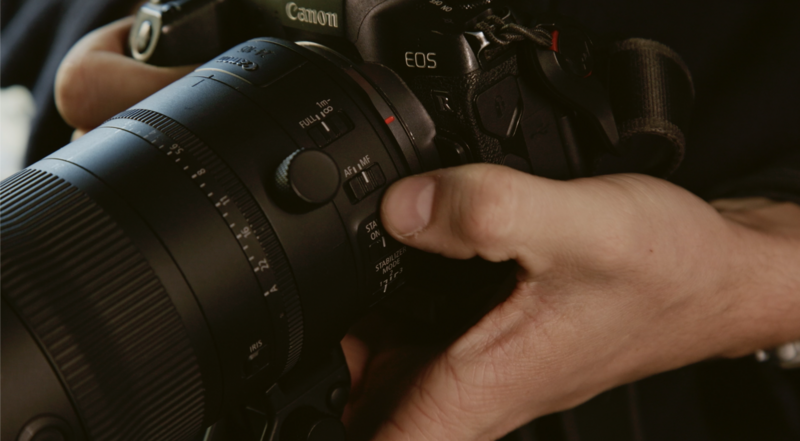
So you don't have the front element poking out from the lens, and you don't have that barrel moving in and out, potentially bringing in dust or dirt or anything undesirable. I personally prefer when the moving mechanics of a zoom are inside, so that's definitely a plus.
Additionally, if you shoot video, you might like this one more, as the aperture is de-clicked, meaning that you're able to do smooth iris pulls, whether opening up or stopping down, without it being jarring to the viewer. Beyond that, the lens also has built-in IS, and in fact has three modes of it, while the Canon 28-70mm does not have any. The three modes of the 24-105mm are mode one, an all-purpose optical stabilization that you'd be used to from most lenses with IS.
Then, mode two is going to be ideal for panning. If you're panning with your subject, then this is going to be what you want to focus on, as it's going to optimize for horizontal movement. And, lastly, mode three is more for sporadic movement, something like if you're shooting a lot of sports and, say, chasing a ball or a puck around. This is going to be something that will help you do that in a more stable fashion.
So, at nearly the same price, for me, a Canadian, you're looking at about $4,300 for either of these lenses, and I do think you only need one. But which one is for who? Which one would I personally pick?
If you're somebody who's more video-focused or shoots an equal amount of both stills and motion, and if you're somebody who wants a longer reach, doesn't mind stopping down just slightly while also valuing stabilization, and likes to put a variety of filters on their camera, then probably the 24-105 is going to be the best lens for you. If you want to sharpen your motion skills alongside this glass, Introduction to Video: A Photographer's Guide to Filmmaking is a solid companion.
That said, if you're more purely a photographer and you love a blurry background, or you enjoy shooting in low light and don't want to carry around a bunch of primes with you, then at that point I would think that the Canon 28-70 f/2 is going to be your best friend, although your quite large, heavy best friend.
For me, as I shoot a good amount of video and still content, mostly in the fashion and advertising space, both of these intrigued me, which is why I wanted to test them both out before pulling the trigger on either one, especially when that trigger costs $4,300, or after taxes closer to $4,800, almost $5,000 in total. And as much as I loved my time with the 28-70 and it produces some fantastic images, I think I would have to go with the 24-105 at f/2.8, as I like having the longer zoom range. I often found that 70 just wasn't quite far enough for what I wanted to do. And, weirdly, 28 sometimes almost wasn't wide enough. That 4mm, believe it or not, can make more of a difference than you think.
So that's the ins and outs of these two lenses and whether either of them could be right for you. Let me know if you've tried either of these and what your thoughts are.




Join the Fstoppers community for free
-
Post comments and join in the discussions
-
Browse the site ad-free
-
Share your work and get featured in the community
-
Compete in the photo contests for fun and prizes
1 Comment
24-105 is a useful range, but a bit short for my corporate event work. Eager for Samyang's forthcoming AF 28-135/2.8 to come to market.